• Home
  • Completed Costumes/Impressions
  • Emma and Her Dresses
  • Free Patterns and Instructions

Kitty Calash

~ Confessions of a Known Bonnet-Wearer

Kitty Calash

Category Archives: Research

Good Enough Coat

05 Monday Jan 2015

Posted by kittycalash in Clothing, Events, Living History, Making Things, Research

≈ 3 Comments

Tags

1820s, 19th century clothing, fashion, fashion plates, Federal style, greatcoat, sewing, sewing project, style, tailoring, winter, winter coat

The great coat is nice, but how ’bout them gaiters?

Winter is firmly here, with the snow, fog and ice that marks the season in the Ocean State. It’s not fun weather for living in the past, though there’s not a lot of that happening right now. Even so, there’s a February program on the horizon and what better excuse for fastening on a garment and making it?

Even if I’ll likely spend the day in a kitchen interpreting life below stairs in 1820 (while the light infantry occupies my living room and denudes my kitchen), an early 19th century event on a winter weekend seemed a worthwhile excuse for making a greatcoat, and, eventually, gaiters.

IMG_2733

With no pattern, and only 2 and 3/4 yards of thick, soft, grey double faced wool*,  I’m adapting my standard Spencer pattern. I didn’t upsize this too much, because women didn’t have frock coats and waistcoats to wear under their greatcoats or Carrick [carriage?] coats or Reding cotes. (I’m too engrossed with sewing to parse garment names.) The skirts will be attached at the waist, with a belt to hide the seam. At my height, cutting a back in one piece takes yardage I do not possess. Happily, the Taylor’s Instructor describes Redingcoats or Habits for women with attached skirts.

It's a new collar shape.
It’s a new collar shape.
IMG_2732

The collar shape diverges from my usual 1790s collar, and is based on another fashion plate, this time from 1815. The program I’ll be doing with Sew 18th Century is set in 1820. As a maid, I think an 1815 coat is pushing it a bit, since red wool cloaks hold up well, but I’ll take any excuse for some tailoring, I suppose.

1815, with a round collar that can stand up.

I plan to use this button arrangement, too, stylish as it is in not-quite-double breasted. Bring on the button-making– we all have to go death’s head sometime, and this wool is too thick for covered buttons without much heartbreak.

IMG_2735
IMG_2736

The lower front pins are there from the moment when I realized the front was hanging strangely — because I had neither marked nor sewn the bust darts. That oversight, and the pain in my ear, do suggest that the delightful cold I’ve had for weeks may be affecting me more than I think– but that’s just another argument in favor of a cozy wool coat.

IMG_2737

The sleeve pattern (again, not upsized) is once again the old standby two-piece sleeve from Henry Cooke’s 1770s unlined man’s frock coat, so of course it fits well.

I’m hoping to stitch up the sleeves this evening, and set them later this week. I’m still pondering lining materials– there’s just enough silk “persian” to do the body and sleeves–but I have some twilled wool that would increase the warmth and still provide some ‘slip’ in the sleeves.

And those blue gaiters? They’ll come in time, from the scraps of blue wool a friend is making his first ditto suit from. I’ll spot him some remnant table chintz for a summer waistcoat, and expect greater sartorial splendor will grace the spitting stamp inspector in Newport this August in exchange for my blue wool ankles.

*Holy burned hair smell, Batman! Mr Cooke’s right when he says this almost feels like foam, but put a flame to it, and you might as well be smoking sheep.

Share this:

  • Share on Facebook (Opens in new window) Facebook
  • Share on Pinterest (Opens in new window) Pinterest
  • Email a link to a friend (Opens in new window) Email
  • Share on X (Opens in new window) X
Like Loading...

The Unbearable Sameness of Dressing

04 Sunday Jan 2015

Posted by kittycalash in Clothing, Living History, Making Things, Reenacting, Research

≈ 9 Comments

Tags

18th century clothing, authenticity, common dress, common people, dress, John Copley, living history, sewing

One of the arguments I hear against changing the way people dress as civilians at reenactments, particularly the women but sometimes the men, is that “if we all use the same pattern, we’ll all look alike, and that’s not how people dress now or then.”

I have news for you: that is how we dress[ed].

I know, we can’t apply modern thinking to the past– that’s crap historiography. But why do we resist using the same correct patterns for historic garments when we are clearly dressing alike today?

Mrs Samuel Browne by Smibert, RIHS 1891.2.2
Mrs Joseph Mann by Copley, MFA Boston, 43.1353

I’ve not yet read a paper on the similarity of women’s dress in Robert Feke or John Copley’s portraits that really convinced me, but if you look at enough of them, you might think there’s only one woman and one dress in all of British North America, because Badger and Greenwood are painting her, too.

Even if those clothes are studio props, what does it say that the sitters wanted to be portrayed in the same clothes? Look, if that’s the only means of getting myself into a Charles James, you bet I’d take it. Or, for a more contemporary analogue, Alexander McQueen.

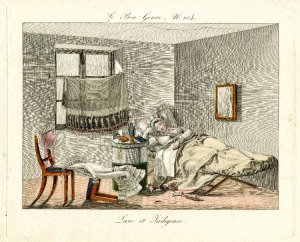
Luxe et Indigence. Le Bon Genre, 1817

Luxe et Indigence. Le Bon Genre, 1817

Dressing is about status as much as it is about self-expression, and in the 18th century, dressing signaled refinement, sensibility, and status through the quality of fabric as much as through the cut of clothes. Air Jordans do the same thing today, or North Face jackets, or Kate Spade purses. They show what you can afford, even if you’re eating oatmeal for dinner behind closed doors.

We dress the same now, and we dressed the same then, with variations according to pocketbook. We can’t all afford K&P superfine wool today any more than we could have bought the best wools or prints in the 18th century. But using accurate patterns and fabrics appropriate to our station will create the best impressions possible– even if my gown is cut to the same pattern as my wealthier acquaintance’s.

Share this:

  • Share on Facebook (Opens in new window) Facebook
  • Share on Pinterest (Opens in new window) Pinterest
  • Email a link to a friend (Opens in new window) Email
  • Share on X (Opens in new window) X
Like Loading...

Whimsical Whiskered Wednesday

26 Wednesday Nov 2014

Posted by kittycalash in History, Museums, Research

≈ 1 Comment

Tags

19th century clothing, British Museum, cats, etchings, George Moutard Woodward, Hand colored etching, Nicholas Rowe, Piercy Roberts, satire, satirical prints, silly cat engravings

A quintetto. Musical Amateurs. Hand colored etching by Piercy Roberts, after George Moutard Woodward, 1803. British Museum1981,U.199

A quintetto. Musical Amateurs. Hand colored etching by Piercy Roberts, after George Moutard Woodward, 1803. British Museum1981,U.199

E’en Age itself is cheard with Music. It wakes a glad Remembrance of our Youth, Calls back past Joy’s and warms us into Transport. Vide Rowe read the lines at the top of this engraving, and while I’m fairly confident the Rowe referred to is Nicholas Rowe, I have not connected the quote to him.

Instead, you’re treated to the image that struck me as I searched for 1820s maids at the British Museum. Happily, my household is one cat and one cockatoo short of this reality, but it pretty much sums up breakfast time Chez Calash, when I am too slow with the breakfast portions, and the beasts begin to sing.

Happy Thanksgiving, American readers. I’m taking a short break from museum thinking to wrangle our dinner to the table, attempt to finish a gown, and catch up on some sleep.

Share this:

  • Share on Facebook (Opens in new window) Facebook
  • Share on Pinterest (Opens in new window) Pinterest
  • Email a link to a friend (Opens in new window) Email
  • Share on X (Opens in new window) X
Like Loading...

The Museum of Crap

24 Monday Nov 2014

Posted by kittycalash in Collecting, Museums, personal, Research, Uncategorized

≈ 1 Comment

Tags

anarchist guide to historic house museums, antiques, collecting, exhibits, historic house museums, historic houses, interpretation, museum collections, Museums

After an intense three days spent thinking about museums, we went to the antique mall on Sunday. It did not disappoint, being stuffed with a variety of material goods.

image

We had not gone past the first round of booths when it occurred to me that what I was walking past a series of touchable period rooms or installations, a kind of non-judged science fair of historical displays, each one trying to convince me to literally buy its message.

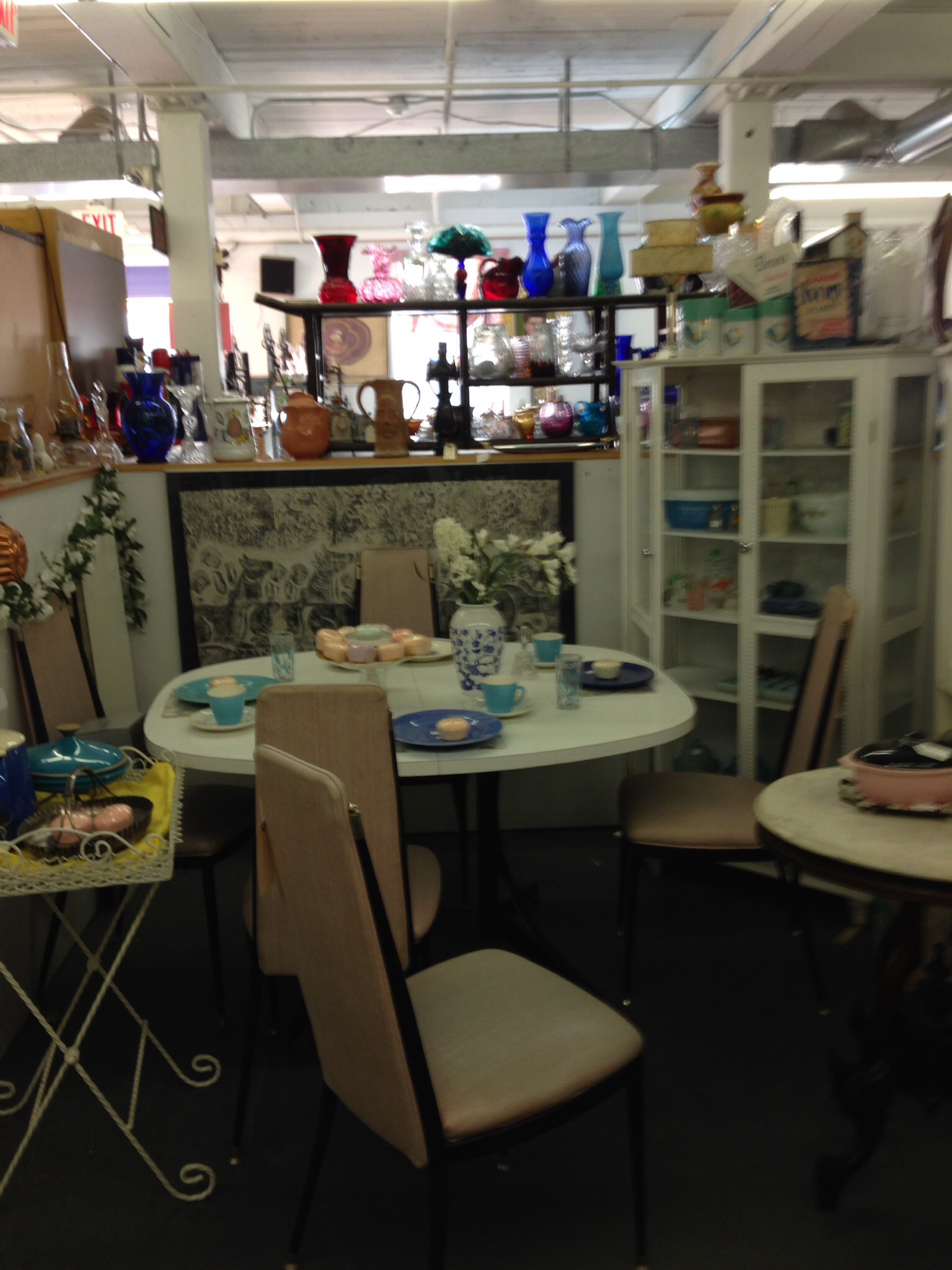
This came home when I saw the booth on the left, arranged much the way a period room in a museum is arranged, with the desk suggesting that someone has just walked away from it.

I’d seen this at a house in Boston, and I’ve seen it at home: it’s not enough. At least at antique mall, you can touch everything. At the museum, unless that desk and room are jam-packed*, we are not going far enough.

image

In this vignette, you can step into a dinette and sit at the table. Feel the linens, touch the dishes (I’d avoid the glittery cupcakes, myself) and pretend you are home.

This kind of interactivity is reserved for children’s museums, with varying degrees of success, often oversimplified based on an assumption that children need streamlined displays to “get” the exhibit message. Sometimes I feel a similar lack of sophistication in the presentations at the Museum of Crap, a lack of deep consideration– it is, after all, just a booth at a mall.

image

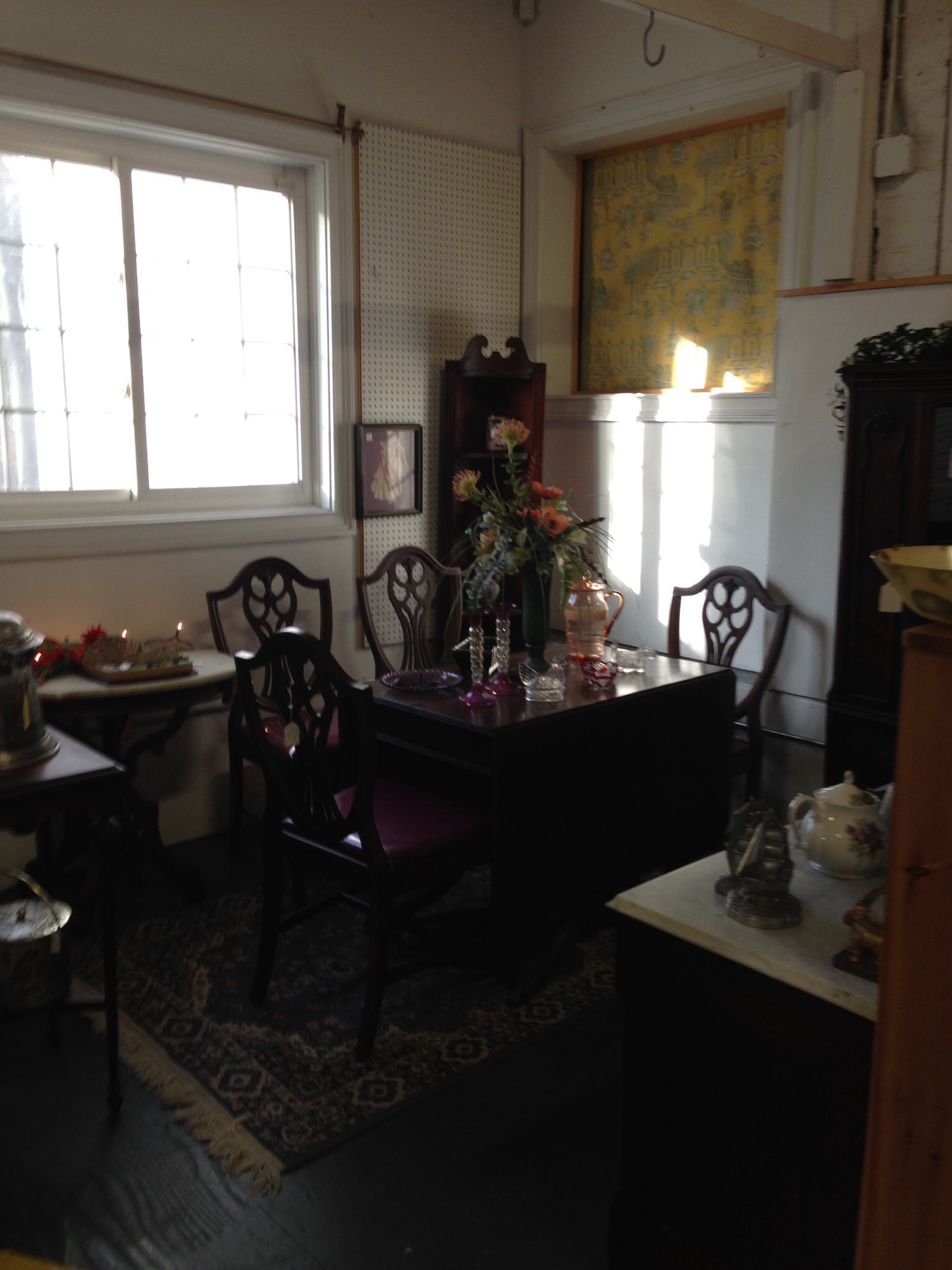
There are also the booths that really capture the deathly “Sunday dinner with the stiff relatives” feeling of some historic house museums and bad summer vacation memories, or perhaps for you it’s “tense Thanksgiving dinner with the in-laws,” or even “happy birthday tea with auntie,” and it’s a pleasant memory.

Antique malls clearly offer an array of display techniques, just as an major (large) museum with a variety of galleries.

Martha Stewart Living taught us about sorting things by color back in the 1990s, and it also taught us about the power of similarity: grouping like with like can create powerful visual displays and be quite attractive. Here’s the Gallery of Green. There was even an faux spongeware cat figurine, with a green sponge glaze. Details matter: difference stands out: that’s why the teddy bears pop in this booth.

image

image

Perhaps you prefer the natural history museum, or a medical museum? There are doll morgues for you folks. This proved quite popular with women of a certain age, thankfully still a little older than I.

image

There are displays for (almost) every taste. Couples go through these emporia, often at a similar pace (Mr S and I usually split up, and come together only occasionally to compare and share reactions) but not necessarily in unison.


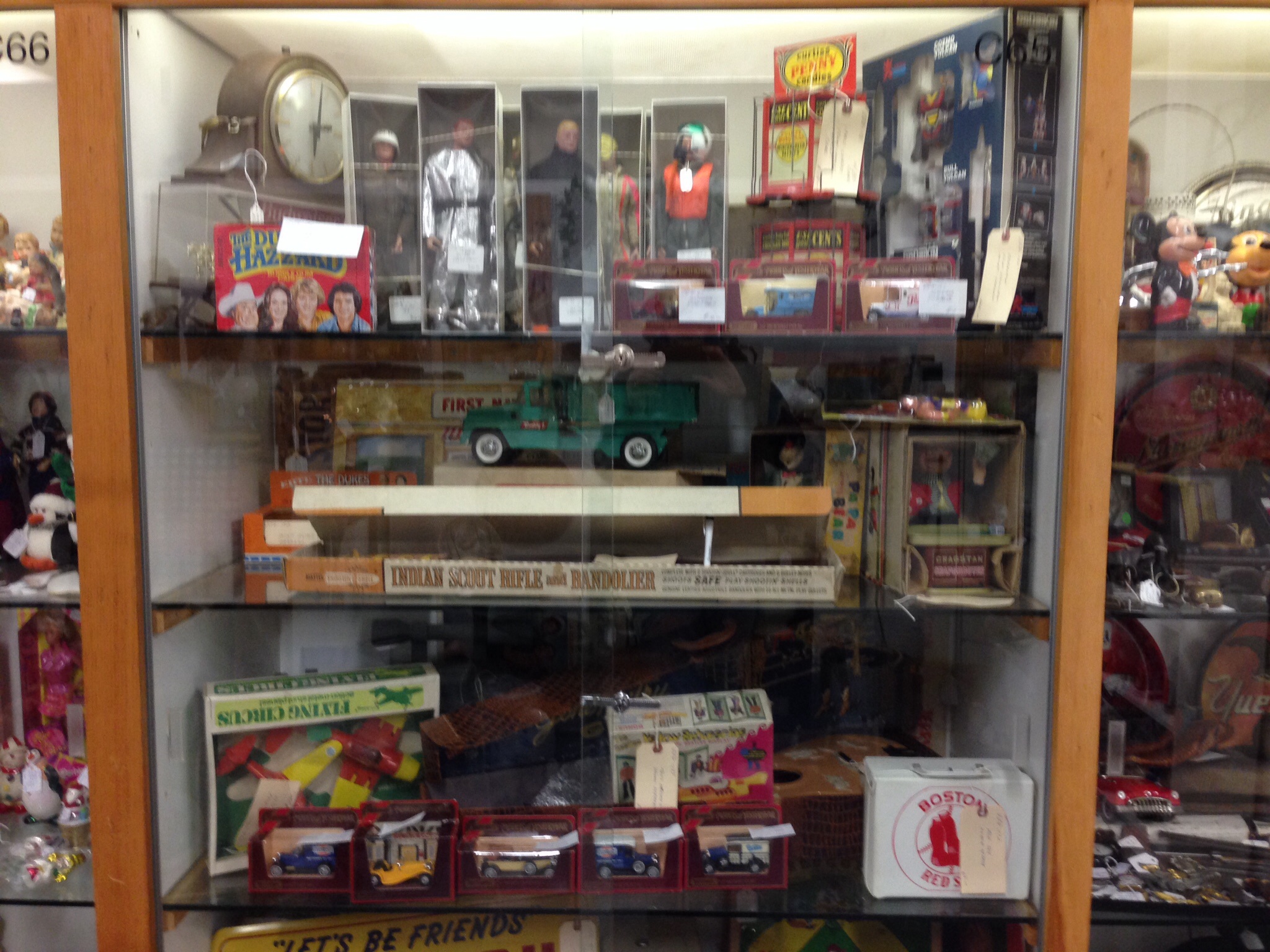
Here’s an entire case that might come to life in an episode of Futurama, but it’s full of stuff for nostalgic guys: G.I. Joe in Crash Team suit, Planet of the Apes figures, Captain Kirk, and the Indian Scout Rifle and Bandolier. Cars, trucks, a flying circus: here’s a man’s past for him to admire without the responsibility of keeping it up. These are social experiences, where people wander through and talk about their objects, the things they owned, or coveted, the memories they have, the future they imagine.

image

We’re consumers: our lives are all about stuff these days (having it, getting it, curating it, getting rid of it– even minimalists are about stuff) and whether you think that’s sad or not, it’s true. We express ourselves through things. Antique malls give us access to the things of the past in immediate, tangible ways. We can talk, remember, and play in these compendia in ways that we cannot in museums.

There are some unlikely display techniques. This is not an arrangement I would have come up with, but I enjoy it. It caught my attention. I can imagine that I know some folks who would have come up with this display, and had they done so in a museum under my purview, I would have undone it. Maybe that wouldn’t be right. It certainly stopped me and Mr S, and we both made certain the other saw it.

image

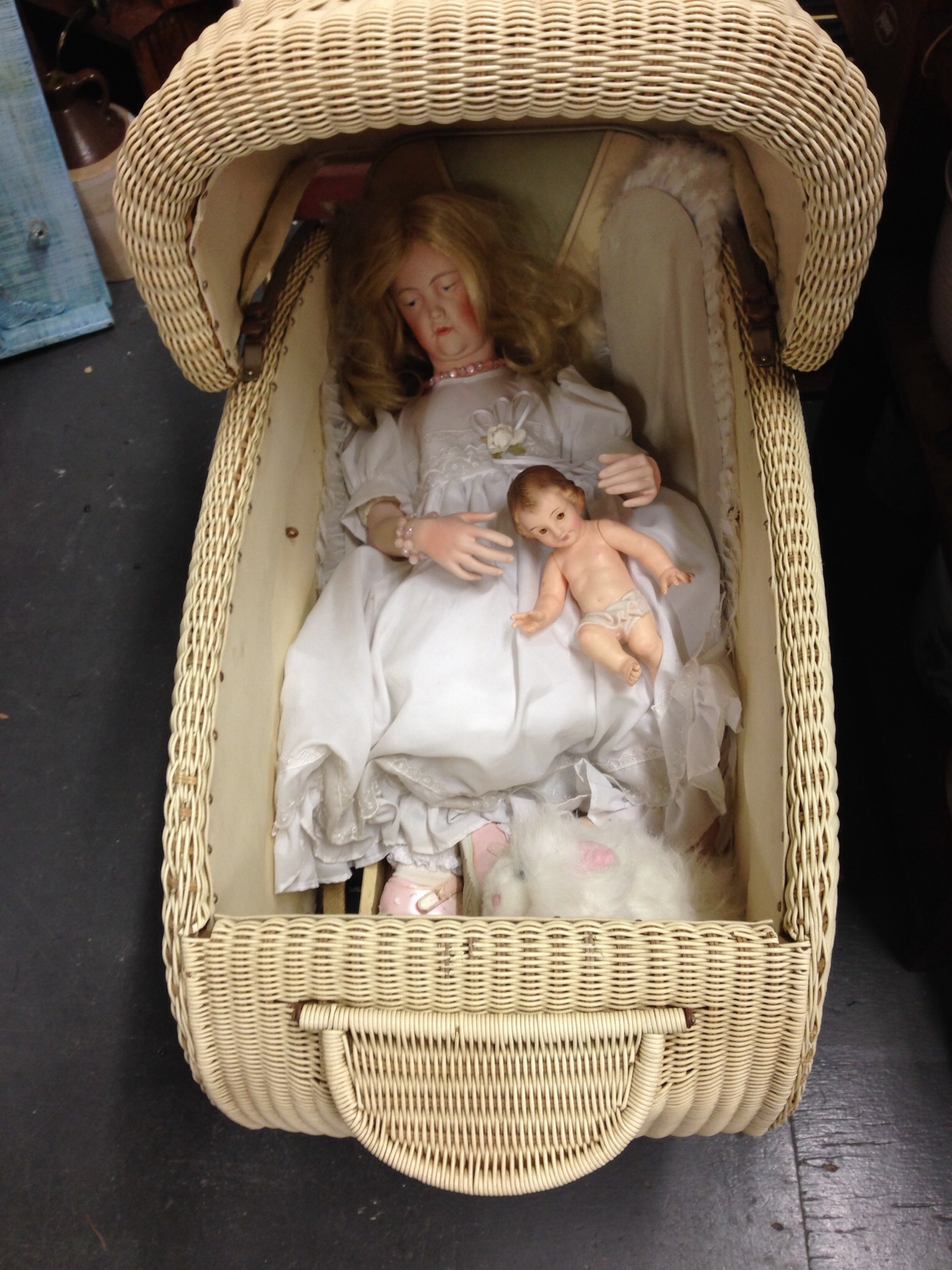
The carriage, while heavy, had an amazingly smooth suspension system unlike any pram I’ve ever pushed at home or elsewhere. I couldn’t tell you what Mary and Jesus and a plush Persian cat were doing in a pram, but I do recognize the care with which they have been arranged, and the whiteness of the display, which speaks perhaps to the universal innocence of this trio. Someone chose this, deliberately. This isn’t art, or hipsterism, this is as genuine as the doo-wop songs on the 1950s radio station chosen by the antique mall.

It’s all so sincere: the nostalgia, the Everly Brothers crooning through the ceiling speakers in the converted mill, the soft, smoothing touches of consumers handling the goods. As sincere as we are in museums, we’re missing something by keeping all of our collections out of reach, and by cloistering all of our galleries in silence.

I’m a huge fan of silence, but what would happen if we did play music in galleries? Would removing the silence allow people to talk more, between their companions and even strangers? I get the marketing spin of doo-wop soundtrack, and I get how wrong it would sound in Nathan Hale’s homestead…but wouldn’t it be interesting to try it now and then? Exile on Main Street resounding in the halls of the period mansion is how the staff sometimes experience it, and we love the places where we work. Why not show the public how we see the houses sometimes, instead of insisting on a false, and silent, objectivity?

*Exceptions made for displays of minimalist architects’s homes, with documentation. What would Corbu’s house musuem look like?

Share this:

  • Share on Facebook (Opens in new window) Facebook
  • Share on Pinterest (Opens in new window) Pinterest
  • Email a link to a friend (Opens in new window) Email
  • Share on X (Opens in new window) X
Like Loading...

Miss Juniper Fox

23 Thursday Oct 2014

Posted by kittycalash in Research

≈ 5 Comments

Tags

18th century, engravings, fashion, hairstyles, lewis walpole library, satire, squirrels, style

Miss Juniper Fox. [London] : Pub. by MDarly 39 Strand, Mar. 2, 1777. Lewis Walpole Library , 777.03.02.01.

Miss Juniper Fox. [London] : Pub. by MDarly 39 Strand, Mar. 2, 1777.
Lewis Walpole Library , 777.03.02.01.

If you’re not wearing an inverted rooster held down by two foxes on your head, you’re not living 1777.

I have no idea what, beyond extreme hairstyles, this print is satirizing. It’s not the Wedding of Mrs Fox (as interesting a read as that is), and it’s really 100 years too late to be about Quakers.

The thing about those foxes is that at first glance on my phone, I thought they were the muscular lycanthropic squirrels of historic house wallpaper, but what two squirrels would be doing with a rooster– supporting him in illness? holding him hostage for an acorn ransom?– was beyond me.

At least as roosters, this headdress makes a bit more (morbid) sense, but it’s still a satirical engraving that makes less sense to us in 2014 than it did in 1777.

Share this:

  • Share on Facebook (Opens in new window) Facebook
  • Share on Pinterest (Opens in new window) Pinterest
  • Email a link to a friend (Opens in new window) Email
  • Share on X (Opens in new window) X
Like Loading...
← Older posts
Newer posts →

Archives

wordpress statistics

Creative Commons License
Kitty Calash blog by Kirsten Hammerstrom is licensed under a Creative Commons Attribution-NonCommercial-ShareAlike 4.0 International License.

Website Built with WordPress.com.

  • Subscribe Subscribed
    • Kitty Calash
    • Join 621 other subscribers
    • Already have a WordPress.com account? Log in now.
    • Kitty Calash
    • Subscribe Subscribed
    • Sign up
    • Log in
    • Report this content
    • View site in Reader
    • Manage subscriptions
    • Collapse this bar
 

Loading Comments...
 

    %d