• Home
  • Completed Costumes/Impressions
  • Emma and Her Dresses
  • Free Patterns and Instructions

Kitty Calash

~ Confessions of a Known Bonnet-Wearer

Kitty Calash

Category Archives: Research

Ironing on Grass

06 Friday Dec 2013

Posted by kittycalash in Laundry, Living History, Reenacting, Research

≈ 4 Comments

Tags

18th century, 18th century clothes, common dress, common people, Costume, drawings, laundry, Paul Sandby, Research

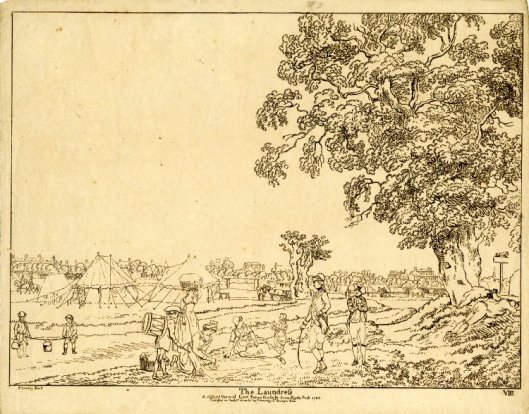
Paul Sandy, The Laundress, 1780. British Museum, 1904,0819.624

Paul Sandy, The Laundress, 1780. British Museum, 1904,0819.624

This print makes me think of Gertrude Stein, “Irons on the grass alas” because I think I would be pretty alas if I were ironing on grass. Still, I’m glad to know that ironing in camp is plausible, because it’s one more thing I can do, though also one more heavy item to pack.

I continue to chase laundry in my spare time, with a Pinterest board of collected images, which will give you a sense of the timeless drudgery of washing clothes. There will be stooping.

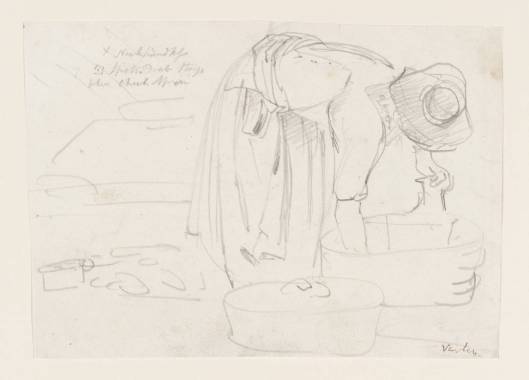
A Washerwoman, by John Varley (1778-1842). Tate Britain, T08695

A Washerwoman, by John Varley (1778-1842). Tate Britain, T08695

In this sketch by John Varley, he has helpfully given notes to supplement the lines.

“neckhandkf
spots Drab stays
blue check apron”

The symbol in front of ‘spots’ suggests the neckhandkerchief’s pattern, a dot in a square, much like the ones you can today from Burnley & Trowbridge.  “Drab stays” suggests a very utilitarian pair of wool stays, and that the washerwoman has stripped off her gown or bodice, and is working in shift, stays, and petticoat(s). This seems to be the same woman is in the “Woman with Wash-Tubs” drawing, and I’d guess her hat is straw.

A Scotch Washerwoman. Crayon drawing by Pauil Sandby after 1745. British Museum, Nn,6.61

A Scotch Washerwoman. Crayon drawing by Pauil Sandby after 1745. British Museum, Nn,6.61

There’s a remarkable consistency in the English drawings, though Varney and Sandby are about two decades apart. The tubs, the tools, the stooping: laundry is hard and unglamorous work, Sandby’s Scottish laundress aside. I can guarantee you that the 10th Massachusetts would have to outsource laundry in that style. (In any case, Scotland typified poverty and backwardness for late-eighteenth century Englishmen, so Sandby’s drawing, in addition to being titillating, is perpetuating English stereotypes of Scottish dress and practices and is, thankfully, not a reliable source.)

Share this:

  • Share on Facebook (Opens in new window) Facebook
  • Share on Pinterest (Opens in new window) Pinterest
  • Email a link to a friend (Opens in new window) Email
  • Share on X (Opens in new window) X
Like Loading...

“Unsuspected Cat”

04 Wednesday Dec 2013

Posted by kittycalash in Clothing, History, Museums, Research

≈ 4 Comments

Tags

18th century clothes, 18th century clothing, cats, Clothing, Costume, dogs, domestic pets, Emma, fashion, lewis walpole library, material culture, Mr Knightley, Research, satire

Squatting plump on an unsuspected cat in your chair!! George Cruikshank [1800]. Lewis Walpole Library, Image ID lwlpr09721 Call Number 800.00.00.176+

The Lewis Walpole Library provides endless amusement, and searching by subject yields some fun. People have had curious relationships with domestic pets for a centuries, and thank goodness cats invented the interwebs so we could get real perspective on this.

Quite aside from the minor domestic comedy of this engraving (I dislike the dark of winter and take my fun where I can), we can learn a lot. The domestic comedy itself helps remind us that while the people of the past saw the world differently, they were as foolish, bawdy and rude (or more so) than we are.

From a material culture perspective, we have (among many things):

  • a geometrically-patterned floor covering, probably a carpet but possibly painted.
  • floor-length curtains
  • looking glasses, paired
  • a slip-covered easy chair, matching the curtains and the cat’s cushion
  • two candles (only two!)
  • glasses with the characteristic straight temple pieces that end in loops
  • a colored open robe over a white muslin petticoat
  • a young gentleman in trousers, an old gentleman in breeches

I can imagine this depicting Emma and Mr Knightley (after their marriage) at home after dinner with her father and their young son: Mr Woodhouse in his nightcap and banyan, reading; Mr Knightley upset by the cat, while the Spaniel barks at the excitement.  All in all, highly satisfying.

Share this:

  • Share on Facebook (Opens in new window) Facebook
  • Share on Pinterest (Opens in new window) Pinterest
  • Email a link to a friend (Opens in new window) Email
  • Share on X (Opens in new window) X
Like Loading...

Dogs in Coats

03 Tuesday Dec 2013

Posted by kittycalash in Clothing, Making Things, Research

≈ 6 Comments

Tags

18th century clothes, Clothing, Costume, dog coats, dogs, dress, fashion, fashion plates, Spencer

[An amazonian dress]. London : Pubd. May 26, 1797, by G.M. Woodward, Berners Street. Lewis Walpole Library Image Number lwlpr08972, Call Number 797.05.26.02

[An amazonian dress]. London : Pubd. May 26, 1797, by G.M. Woodward, Berners Street. Lewis Walpole Library Image Number lwlpr08972, Call Number 797.05.26.02

I was wondering about contrast revers on women’s clothes, and if I could really get away with such a detail on a Spencer, when I happened upon this image on Pinterest. Well found indeed from 1797, and very nice hat as well. Bonus: Giant Muff.

The dog has a coat, too, and now that it’s cold in New England, the local whippets are turning out in their winter coats. Mr S and  I had a slightly crazy notion to dress a dog we know in a canine-scaled replica of a certain very special coat, but would need access to the hound (for measurements) and a particular scrap pile. With those circumstances not in the offing, let’s just be delighted that dogs in 1797 wore coats, and had bows in their topknots, which means that the end of civilization has been coming for a lot longer than previously thought.

Of course it may be that the dog has to dress as a human to keep from being eaten by the ENORMOUS and possibly carnivorous MUFF of DOOM. I think you could make one from the sheepskins at Ikea, if you could settle for white.

Share this:

  • Share on Facebook (Opens in new window) Facebook
  • Share on Pinterest (Opens in new window) Pinterest
  • Email a link to a friend (Opens in new window) Email
  • Share on X (Opens in new window) X
Like Loading...

The Checkered Past

26 Tuesday Nov 2013

Posted by kittycalash in Clothing, History, Research

≈ 3 Comments

Tags

18th century clothes, authenticity, Clothing, common dress, common people, common soldier, Costume, dress, exhibits, fashion, living history, Research, resources, Rhode Island

Coat, 1790s American CB: 38 in. Gift of The New York Historical Society, 1979.346.42. MMA
Textile Sample Book, 1771. British Rogers Fund, 156.4 T31, MMA

Some gentlemen I know should consider what they might want to do to avoid (or alternately, encourage) having this coat made for them. It’s really a lovely thing, found as the best things are, while looking for something else.

It reminded me, too, of the textile sample book at the Met, currently on display in the Interwoven Globe exhibition. (No, I haven’t seen it; I’m going to try, but…).

Wm Booth has a new linen coming in the winter, and as the men in my house have outgrown or outworn their shirts, I am thinking of making new check shirts. I did finish a white shirt at Fort Lee, which will go to the Young Mr (his small clothes being now his too-small clothes). I will have to make Mr S a white shirt for best wear, but they could each use a second working shirt. At least with checks you get “cut here” and “sew here” lines.

Last week, I found a weavers’ book in the Arkwright Company Records (Box 1, Folder 1, 1815). It’s a slim, blue paper-covered volume with small samplers glued in to the pages, and full of checks and stripes. Blue and white, red and blue, checks and stripes were prevalent in the late 18th and early 19th centuries. The more I look at extant garments, sample books, and ads, the more I think the streets must have been a vibrant, if grimy, visual riot.

Share this:

  • Share on Facebook (Opens in new window) Facebook
  • Share on Pinterest (Opens in new window) Pinterest
  • Email a link to a friend (Opens in new window) Email
  • Share on X (Opens in new window) X
Like Loading...

‘A perfidious wretch’: A Sermon on Benedict Arnold

24 Sunday Nov 2013

Posted by kittycalash in History, Research

≈ Comments Off on ‘A perfidious wretch’: A Sermon on Benedict Arnold

Tags

Benedict Arnold, Enos Hitchcock, Research, Revolutionary War

Reverend Enos Hitchcock, pastel on paper. RIHS 1970.23.1

By now you probably know how much I like the Reverend Enos Hitchcock in all his forms and centuries. I am lucky enough to have near-constant access to a collection of his papers, and in going through them folder by folder looking for clues to the Reverend’s waistcoat habits, I came upon a seemingly innocuous folder: Notes, untitled and undated sermons, commonplace book. You won’t find receipts for pink satin in there, but every folder is worth a look.

This folder was worth every minute I have spent on it, and every other folder in that box.

I found an undated sermon, but was able to date it by the content: October 1, 1780.

In his diary, Hitchcock notes the days of divine service, and the verses he used.

Diary of Enos Hitchcock, published by the RIHS, 1899.

Diary of Enos Hitchcock, published by the RIHS, 1899.

PS 122, 6,7,8 refers to the text he used, Psalms 122, A Prayer for the Peace of Jerusalem. He quotes it at the very end of the sermon.

As I read this manuscript, I was struck by the anger in it, and wondered if the “perfidious wretch” could really be who I thought it was, and yes, it was true: I had found Hitchcock’s sermon on Arnold’s treason.

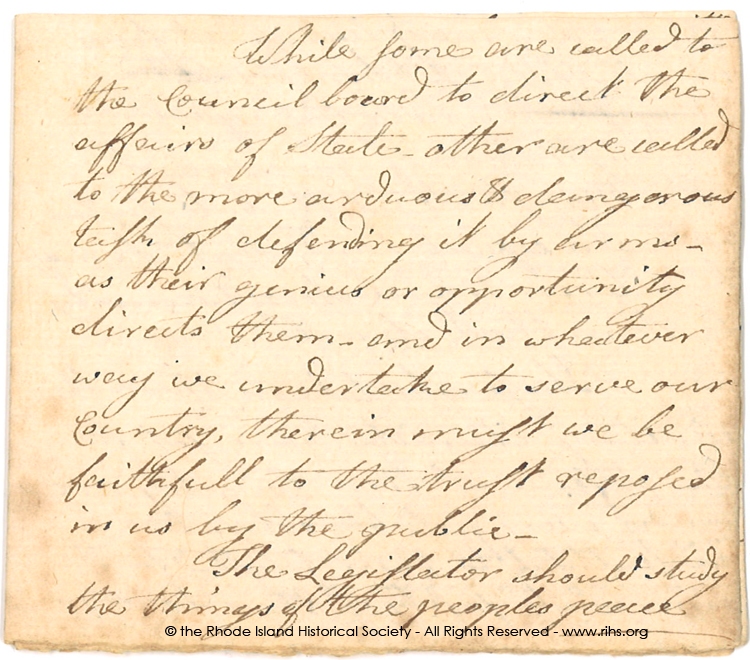
...faithfull to the trust reposed in us...

…faithfull to the trust reposed in us…

Here is the full transcript of the text:

MSS 78 Enos Hitchcock Papers
Box 1 Folder 57 Sermons: Notes, not titled and undated sermons

While some are called to the Council board to direct the affairs of State other[s] are called to the more arduous & dangerous task of defending it by arms- as their genius or opportunity directs them- and in whatever way we undertake to serve our Country, therein might we be faithfull to the trust reposed in us by the public.

The Legislator should study the things of the peoples [sic] peace that they may lead quiet lives in all Godliness & honesty The Magistrate under the equal administration of Government. The Magistrate distribute [sic] Justice with an equal hand, that he may be a terror to Evil doers & security to them that do well.

Those who take on them the Military Character & are set for the defence of their Country, are under every possible obligation to be faithful to their trust—for the immediate safety of their country depends on it. They have committed to you their liberties & their all & they look up to their Army for protection & security- and your own is connected with theirs in common—that in betraying your trust, you might would involve your country in all the miseries consequent upon the invasion of an unbridled Enemy- reduce Millions to absolute subjection to British Tyranny- ages & generations yet unborn to all the wretchedness of Slavery. What then can tempt the Soldier to desert his colours & treaterously [sic] betray the trust reposed in him – besides being guilty of perfidy, he must share in the consequences with them, must be afraid of the face of his Countrymen- or if he take refuge with the Enemy, must live an Exile in a State of Banishment & despised by every noble Spirited Friend to their interest. A Deserter- A Runaway- a perfidious wretch who has once betrayed his trust & therefore no confidence can ever be placed in him again! detestible [sic] Character! May every American Soldier have a Spirit above it.

If this be the danger & disgrace of Soldiers [sic] deserting his Country’s Cause & perfidiously betraying his trust- What Language will convey a Just Idea of the magnitude & blackness of that horrid plot, laid, by the Commander of a Department, for the tame Surrendery of the most important fortress in America? here language fails us! A design, black as Hell! a plot laid at the root of American Liberty! Millions of Subjects bartered away for a little shining dust!

“What chosen curse, what hidden vengeance in the Store of heaven Thunderbolt red with uncommon wrath, shall blast the man who owes his greatness to his greatness [sic] to his Country’s ruin?”

O Lucifer how art those fallen! Arnold, lately proclaimed, by our Orators, the thunderbolt of war, now a vile perfidious refugee with the Enemy, must live despised & die accurst by every generous Lover of his Country! May that day ever be remembered by America in which the discovery was made of the plot which must have nearly determined its fate!

While we regret the Treason, let us with gratitude acknowledge the goodness of providence in effecting the discovery. The train of minute circumstances which led to it, at once shews a superintending providence guideing [sic] the affairs of mankind, and that the justice of our cause challenges the divine patronage.

The Annals of history don’t afford a more striking instance of baseness & ingratitude, nor a more special interposition of divine providence. Tis the language even of the infidel, that the hand of providence is visible in this event, and indeed how can he do otherwise when he considers all the steps that lead to the discovery. A combination of circumstances, small in themselves, wholly independent of each other and yet necessarily connected in producing this Event & could all these take place in their proper order by merely chance or accident? Most certainly they shew an observant Eye penetrating thro’ all the secret machinations of vile, designing men- & a wise hand skillfully conduct the little adventitious events which opened the way to this important discovery.

Let us, my candid and generous fellow Soldiers, acknowledge with gratitude & the goodness of divine providence in this event- and express the sense we have of it by resigning ourself [sic] & all our concerns to the service of that God who governs all things in wisdom. & by a steady & uniform adherence to the cause & interests of our Country-

It often happens that the worst & most wicked designs of men are overruled in such a manner as to be productive of the greatest good. What advantages we shall derive from this cruel & vilainous [sic] act may be more clearly seen a twelvemonth than at present.

We have so often experienced the secret but powerful operations of divine providence concerning itself for our good, producing event very different from the designs of our enemys, leaving us no room to dispond but to hope its continuance to work out out [sic] real good & happiness & doubtless it will if we are not wanting in duty to God, our Country, & ourselves.

Pray, then with humble confidence in divine providence, for the peace of America: they shall prosper that love thee.

Peace be within thy walls and prosperity within thy palaces.

For my Brethren & Companion’s sake, I will now say peace be within thee.

Because of the house of the Lord, I will seek thy good.

Amen

Share this:

  • Share on Facebook (Opens in new window) Facebook
  • Share on Pinterest (Opens in new window) Pinterest
  • Email a link to a friend (Opens in new window) Email
  • Share on X (Opens in new window) X
Like Loading...
← Older posts
Newer posts →

Archives

wordpress statistics

Creative Commons License
Kitty Calash blog by Kirsten Hammerstrom is licensed under a Creative Commons Attribution-NonCommercial-ShareAlike 4.0 International License.

Website Built with WordPress.com.

  • Subscribe Subscribed
    • Kitty Calash
    • Join 621 other subscribers
    • Already have a WordPress.com account? Log in now.
    • Kitty Calash
    • Subscribe Subscribed
    • Sign up
    • Log in
    • Report this content
    • View site in Reader
    • Manage subscriptions
    • Collapse this bar
 

Loading Comments...
 

    %d