• Home
  • Completed Costumes/Impressions
  • Emma and Her Dresses
  • Free Patterns and Instructions

Kitty Calash

~ Confessions of a Known Bonnet-Wearer

Kitty Calash

Category Archives: Research

The Material World of Widow Weed: an interpretation

25 Thursday Oct 2018

Posted by kittycalash in Living History, material culture, Research

≈ 4 Comments

Tags

18th century clothing, britishareback, fashion, historical clothing, material culture, mourning, Occupied Philadelphia, Philadelphia

Pomade, powder, a pad, and a liberal dose of hairspray got me closer to Big Hair than I’ve ever been.

Part four of a series

Widow Elizabeth Weed: what would she wear? What would she own? My first inclination had been to wear the grey tabby wool gown I already had, until I realized how much of George Weed’s estate Elizabeth had received. As detailed in the first post, the strategic fabric reserve (SFR) provided a “just enough” remnant of shiny silk to make a gown. Second mourning seemed right, for six months past the death of her second husband; with Mrs. Mifflin’s 1773 gown style in mind, I decided to make an English gown with robings and stomacher. (To be honest, I’m pretty pleased with how close my cuff came to Mrs. Mifflin’s, considering how badly I can mess up a cuff, and that this was my first finished silk gown in an 18th century style.)

6AED8FF9-AA72-492C-AF69-BC52A6948122-6511-0000074A74443A19
9CBCCED9-0B10-4F75-97B6-1E64B779A3C1-6511-0000074A680FAF83
67984192-B06D-4844-8C60-DB5B715FFC5F-6511-0000074A9217E259

A gown is one thing, but what about the rest of the ensemble? The Widow Costard print provided some guidance, despite being some years later than 1777. The black hood and cloak or mantelet over a white cap appears in other widows’ portraits, although the black silk cloak is not an uncommon accessory. I had been toying with making one already, and had patterned one from the original in Costume Close Up; extant examples aren’t thick on the ground, but there are enough to demonstrate some consistencies.

Cloak, figured cerise silk satin with a lace trim, 1760-1770. Victoria and Albert Museum, T.61-1934

1760s example at the Victoria and Albert has a shape similar to that in the Williamsburg Collection, while another at the Met (dated, without a reason cited, to 1820-1829; perhaps the reason is in the selvage or the lace), provides some clues to construction and materials. So, with another remnant from the SFR in hand, I worked from my muslin to a paper pattern, using the neck cutout from my red wool short cloak as an additional guide. It went together in fairly short order, since it is mostly hemming, with just two seams and some pleating. While I wore it untrimmed due to time constraints, self trim or lace or would be ideal additions.

Portrait of a Woman called Lady Fawkener ca. 1760. Jean-Etienne Liotard.

Additional clues to Elizabeth Weed’s status as a six-months widow are found in the black silk ribbon of her cap; black and white hats are common enough that the hat alone does not signal “widow.” I chose to make mine from a black figured silk taffeta lined with white, based on an ad in a Philadelphia paper. On October 15, 1776, John Brown advertised in the Pennsylvania Evening Post for a runaway Irish servant girl, Judith Kennedy, wearing, among other items, a “black spotted silk bonnet lined with white.” Obviously, this might well mean “bonnet” in the form we are most familiar with, and I have taken liberties by extrapolating the spotted silk to my hat cover. Nonetheless, black and white hats are a thing, and I was looking to upgrade from my tatty and faded black chip hat.

Gathering white linen evenly is a challenge: literal thread counting.

Gown, hat, cloak, updated caps: so far, so good. I had a black wool petticoat already, suitable for mid-Atlantic autumn (there was no way a black silk quilted petticoat was happening in the time allotted), and black worsted (woven) mitts. What else would Mrs. Weed need? Upgraded shoes are tempting but beyond my budget, so the last article of clothing was an apron.

The majority of my aprons are check linen, with one clean unbleached linen apron and one stained white linen apron (coffee is my weakness). Fortunately, I found 30 yards of vintage white linen on a trip to New England, and thus had apron fabric handy. After making five aprons, this one went together in less than a day.

The final piece was jewelry. A few years ago I found a “Georgian” cut steel and glass locket suitable for hair that I wore as a widowed housekeeper; on a fresh black silk ribbon, that would be a cornerstone. I added a three-strand necklace of black glass beads to contrast with the locket (thanks to the local hobby store and a stash of findings). Earrings also came from the stash, made up quickly from modified buttons and black faceted drops.

Accessories. I finally have them.

I added a white silk neck-handkerchief for warmth, and bought a black one just in case. Based on images, I thought white most appropriate, but somehow, with the grey gown, the image of “Pilgrim” was hard for some visitors to overcome, so on Sunday, I switched to black. Sometimes you have to choose accessories to lower the hurdles for your audience. Explaining that I was not a Pilgrim, but in mourning–while providing an opportunity for interpretation–was not my primary objective, so the easy color switch seemed well worth making.

The remedies (as promised) were another, slightly strickier matter. While making them according to the receipts I found was relatively simple– this is long before big pharma– carrying them was another challenge. I opted to make a box, and fill some bottles, as will become plain in the next installment.

Share this:

  • Share on Facebook (Opens in new window) Facebook
  • Share on Pinterest (Opens in new window) Pinterest
  • Email a link to a friend (Opens in new window) Email
  • Share on X (Opens in new window) X
Like Loading...

Entr’acte

24 Wednesday Oct 2018

Posted by kittycalash in History, Living History, Research

≈ Comments Off on Entr’acte

Tags

explanations, intentions, table of contents

I: Mr B. Finds Pamela Writing. Joseph Highmore, oil on canvas (Part of four scenes of Richardson’s Pamela). Tate Britain, N03573

Entr’acte: an intermission.

Note: In this series, I describe the process I used to arrive at my conclusions and assemble the materials for my impression of pharmacist Elizabeth Weed. I strive to explicate a process of research, questioning, and reasoning that may be applied to any impression. Here’s a guide to what I’ve written thus far, and what I plan to write.

Part One: Been employed these several years past provides an introduction to the project

Part Two: may depend on being supplied explores some of the primary and secondary sources I used and questions I asked of those sources

Part Three: shop medicines, ointments, and salves examines some of the sources for 18th century remedies, and the material culture of pharmacies and healing practioners

Part Four: The Material World of Widow Weed looks at the pieces I assembled: the clothing and the choices I made for gown, hat, mantelet, apron and accessories, as well choices I made for the remedies and their presentation.

Part Five: The Widow will See You Now looks at the implementation, that is, how I chose to interact with the public, what I learned as I talked to 1200-1500 people over the course of two days, and how Drunk Tailor and I used the Anarchist’s Guide principles to inform our interactions.

Part Six will look at how these same principles and processes can be used to inform any impression you take up, with the hope that it will inspire the reader to look for new ways to add depth to living history. The fun isn’t only in the making or the performance, it’s also in the rehearsal of the research, and in assembling these scraps from the past into a living, breathing whole.

Share this:

  • Share on Facebook (Opens in new window) Facebook
  • Share on Pinterest (Opens in new window) Pinterest
  • Email a link to a friend (Opens in new window) Email
  • Share on X (Opens in new window) X
Like Loading...

“may depend on being supplied”

23 Tuesday Oct 2018

Posted by kittycalash in Events, History, Living History, Research

≈ 1 Comment

Tags

18th century, britishareback, Occupied Philadelphia, Philadelphia, women's history, women's work

Lady Anne Stewart. oil on canvas by Ann Forbes, 1774. National Gallery of Scotland, NG 2036

Part two of a series

A newspaper ad can be a rickety thing on which to build a persona when it’s not a runaway ad. Those will give you what the person is wearing, who is advertising for them, and sometimes the skills they have. To better understand Elizabeth Weed, I turned to genealogical and contextual research.

George Weed’s estate was settled by Elijah Weed, his son by his first wife, Esther. Altogether, it was worth £1268.19.7, a considerable sum in 1777. Granted, £775 was book debt, but that cash could be called in. The remainder consisted of £132.15.2 in Medicines etc.,£100 cash, and £261.3.9 in Goods and Chattels. Of this estate, widow Elizabeth kept £55.8.3 in Goods and Chattels, all of the Medicines etc. and £50 in cash. That’s all of the medicines, 20% of the value of the “Goods and Chattels,” and half the liquid cash of the estate. This would certainly provide the supplies and capital necessary to continue the pharmacy business.


Morris, Margaret Hill, 1737?-1816., Margaret Morris / Morris Smith, pinx’t ; eng. by J.M. Butler. Library Company of Philadelphia.

But what was life like as a woman in business? How many women were in business in Philadelphia in the last quarter of the 18th century? More than you would think– mostly as shopkeepers selling dry goods, some as tavern keepers, and others as nurses, midwives, and healers, including women acting as pharmacists and “doctresses.” Patricia Cleary’s article “‘She Will Be in the Shop’: Women’s Sphere of Trade in Eighteenth-Century Philadelphia and New York” published in the Pennsylvania Magazine of History & Biography Vol.CXIX,No. 3 (July 1995) was particularly helpful in understanding women in trade.

Another useful resource was Susan Brandt’s “‘Getting into a Little Business’: Margaret Hill Morris and Women’s Medical Entrepreneurship during the American Revolution,” published in Early American Studies, Vol. 13, Number 4 (Fall 2015). Margaret Hill Morris practiced as a pharmacist and healer in Burlington, New Jersey, worried lest she “spunge” off her relatives, and anxious to support herself as a widow with a son. (Morris was the sixth daughter of Dr. Richard Hill of Philadelphia, and presumably learned some of her trade from him. Quaker women were well-educated, and participated in the scientific and philosophical life of the city. )

Brandt’s article raised helpful questions to ponder: would Elizabeth Weed have taken food and firewood in barter for medicines? During the Occupation of Philadelphia, food was scarce and exorbitantly priced, and she was feeding not just herself but also her son George, born in 1774. How difficult was it to obtain medicinal supplies when the harbor remained closed (in part because of chevaux des frises built by Thomas Nevell)? When patriots fled the city ahead of the British, did Weed’s trade suffer? Did she conduct business with the British, and how did her friends and neighbors react if she did? Only some of those questions can ever be answered. For the rest– about Weed’s particular business– we can only make inferences based on other accounts.

Share this:

  • Share on Facebook (Opens in new window) Facebook
  • Share on Pinterest (Opens in new window) Pinterest
  • Email a link to a friend (Opens in new window) Email
  • Share on X (Opens in new window) X
Like Loading...

At Your Service

11 Thursday Oct 2018

Posted by kittycalash in Living History, material culture, Reenacting, Research

≈ 3 Comments

At Your Service

Trying something new in Adobe Spark. 

Share this:

  • Share on Facebook (Opens in new window) Facebook
  • Share on Pinterest (Opens in new window) Pinterest
  • Email a link to a friend (Opens in new window) Email
  • Share on X (Opens in new window) X
Like Loading...

Hair a la Titus and the Resting Bingley Face

15 Wednesday Aug 2018

Posted by kittycalash in Clothing, Making Things, Research

≈ 1 Comment

Tags

Federal style, Gadsby's Tavern, handsewn, sewing, sewing project

Reader, it is hot where I live. June, July, and August are tiresome months here, humid and warmer than what I became accustomed to in New England. After a year, I realized I’d had enough of trimming my hair myself. I texted a friend with good hair, and found someone to liberate my neck. Excellent, right? Well…it’s all good until you want to dress up.

Resting Bingley Face
Lady Russell's headdress, Persuasion, 1995.
Lady Russell’s headdress, Persuasion, 1995.

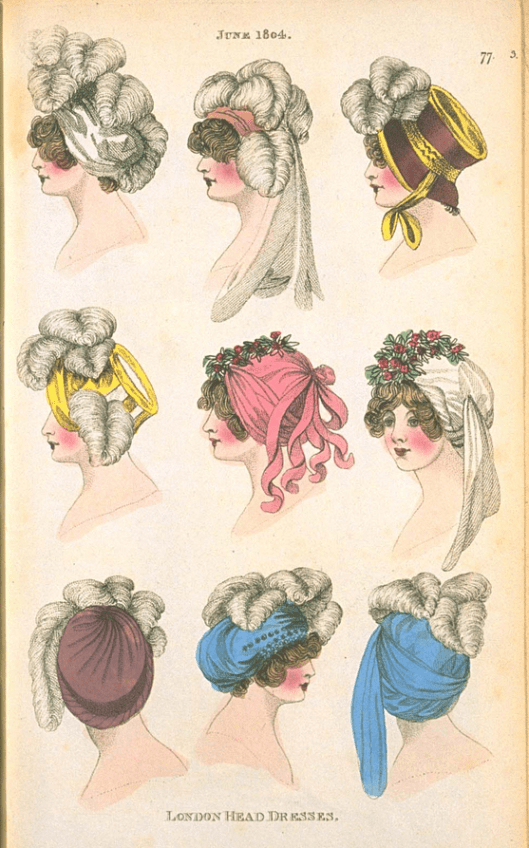
19th century history hair being somewhat mullet-like, my short in the back bob was not going to get the job done for last weekend’s Jane Austen Ball at Gadsby’s Tavern. What to do? Cap it, of course– there’s no way I could figure out how to tie a turban elegantly and reliably without giving up the hope of finishing some other projects I really want to finish this month. So, a cap/hat/sewn headdress. Aside from the examples seen in film adaptations of Jane Austen’s novels, what evidence is there for these concoctions?

ladies heads with various wraps and feathers

London Head Dresses, June 1804

woman in a gray tam o-shanter cap

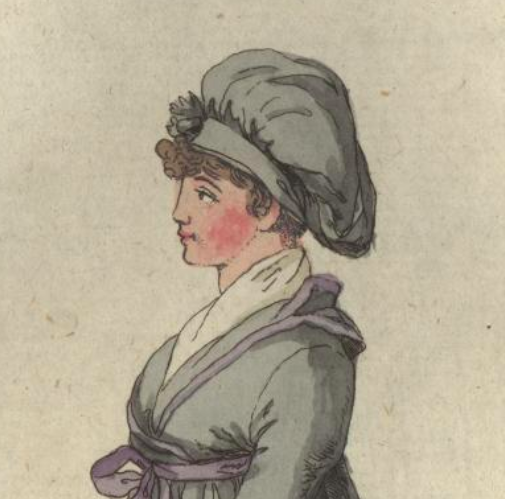
Detail, Plate 11, April 1799 Journal des Luxus und der Moden.

Enough, it would seem, to be getting on with. In addition to the 1804 Ladies’ Head Dresses plate, there are plates in the Journal des Luxus und der Moden showing headdresses and wraps, as well as an image of a pelisse and matching tam-o-shanter-like hat. These are simple enough to make, and I managed one in less than 24 hours.

IMG_4725
IMG_4726

two couples in historical dress

I had no idea Drunk Tailor and I would color coordinate so well. Also, Dat Hat.

The fabric is left over from a gown I made to wear to a dance in Salem one spring, , but which happily coordinated well enough with the sari gown made for a photoshoot, and also worn to Salem for a dance. Briefly, the cap is made from scraps, ornamented with a two-layered rosette centered with a paste button, with the bulk of the caul gathered up and stitched down to hold the shape and embellished with three coordinating tassels looped onto a gold silk-wrapped cord. In the end, not too resting Bingley face, and a satisfactory cover for what I’ll call my hair a la Titus when I’m not in the current century. Drunk Tailor’s hat covered, somewhat, here.

Share this:

  • Share on Facebook (Opens in new window) Facebook
  • Share on Pinterest (Opens in new window) Pinterest
  • Email a link to a friend (Opens in new window) Email
  • Share on X (Opens in new window) X
Like Loading...
← Older posts
Newer posts →

Archives

wordpress statistics

Creative Commons License
Kitty Calash blog by Kirsten Hammerstrom is licensed under a Creative Commons Attribution-NonCommercial-ShareAlike 4.0 International License.

Website Built with WordPress.com.

  • Subscribe Subscribed
    • Kitty Calash
    • Join 621 other subscribers
    • Already have a WordPress.com account? Log in now.
    • Kitty Calash
    • Subscribe Subscribed
    • Sign up
    • Log in
    • Report this content
    • View site in Reader
    • Manage subscriptions
    • Collapse this bar
 

Loading Comments...
 

    %d