• Home
  • Completed Costumes/Impressions
  • Emma and Her Dresses
  • Free Patterns and Instructions

Kitty Calash

~ Confessions of a Known Bonnet-Wearer

Kitty Calash

Category Archives: Research

Kits, Boxes, Sticks, and All

22 Thursday Feb 2018

Posted by kittycalash in History, Living History, material culture, Research

≈ 2 Comments

Tags

art, art history, art supplies, material culture, painting, sketching, watercolor

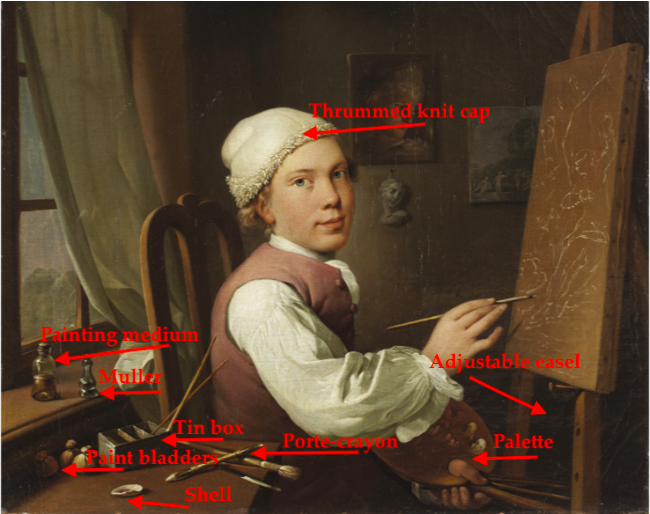
Jens Juel, Self portrait at an easel. Oil on canvas, 1766. Royal Academy of Fine Arts, Denmark.

Once again, I’m looking into artists’ materials and techniques, though instead of trying to kit myself out for the early Federal era, I’m digging into the last half (quarter) of the 18th century. It seems to be a time of rapid transitions in art materials as new pigments and media are developed. While Mr. Juel is beginning a work in oils, we still see some of the same tools that a watercolorist would use. Brushes, though his are shaped for working in oil; a shell, perhaps to combine pigment with medium, and bags of paint.

Before collapsible tubes were invented in 1841, artists scooped or scraped pigments mulled with medium into skin bags, secured them with twine or string, and then poked a hole in the bag to extrude pigment. Some more clever sorts would plug the hole with a cork– untying the bag would make more of a mess than a distribution system– but otherwise, you risked having your paint dry before you could use it up. Clearly there were some inefficiencies built into the system. (I think it also helps explain why “thick” paintings, that is, paintings using exuberant and textured layers of paint, do not appear until after collapsible tubes are invented and in wide use.)
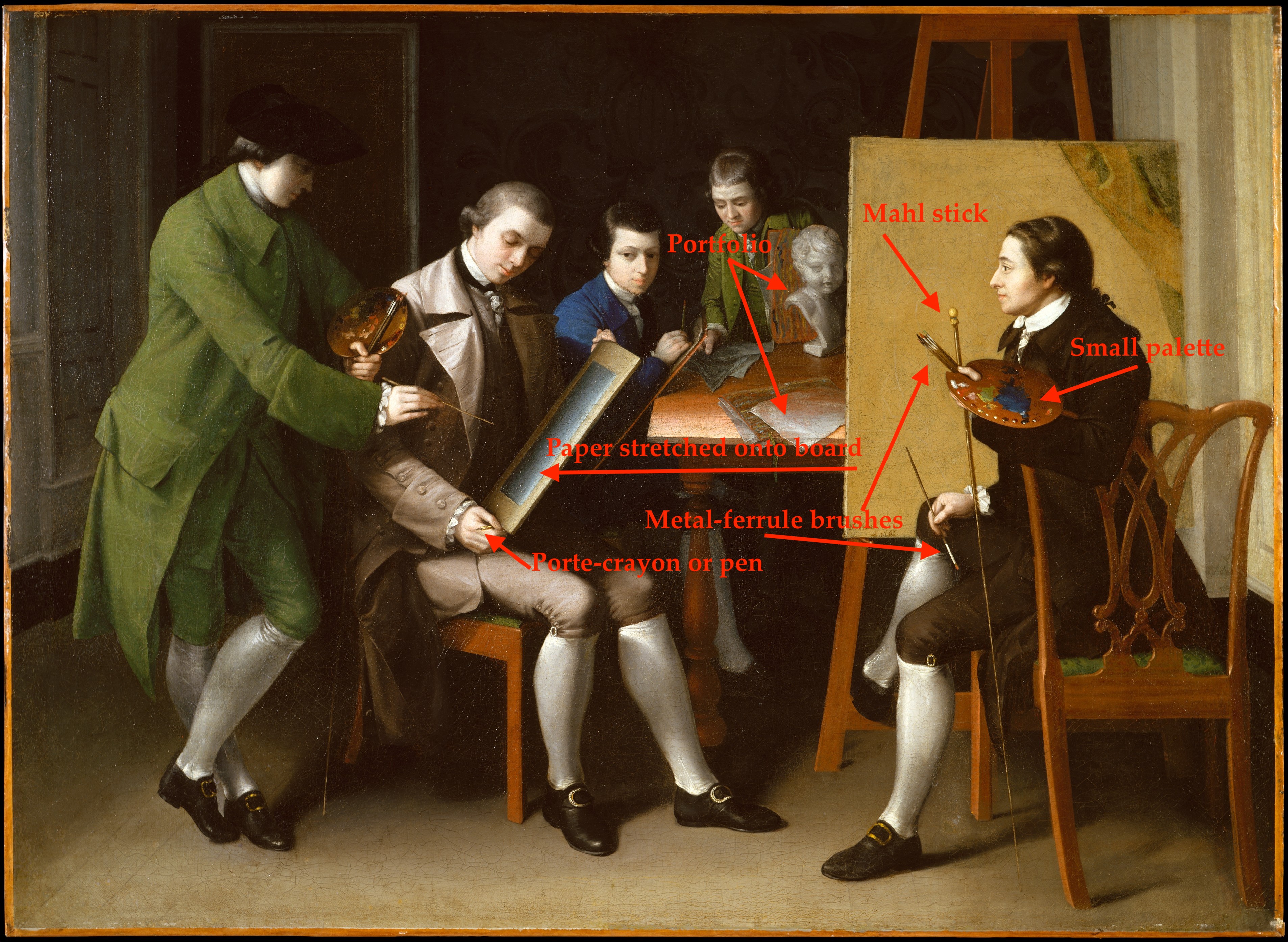
Matthew Pratt, The American School. oil on canvas, 1765. Metropolitan Museum of Art, Gift of Samuel P. Avery, 1897, 97.29.3

In Pratt’s American School, we can see how small the palettes are, and how small the dots of paint are compared to the pools where colors have been mixed. The easel, presented from another angle, offers clues to the adjustable pegs and triangular/tripod shape of the main support. But what of watercolors?
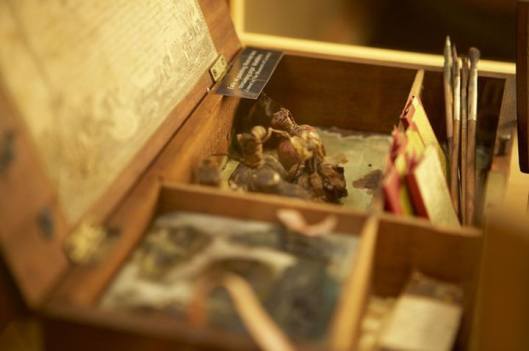
Winsor & Newton Old Paints: note the tiny bags of paint.

To date, I’ve found conservation reports more helpful than anything else, especially those analyzing paint content for sugars and gums. (One of the keys to watercolors was the re-wettable aspect of the colors; gum arabic, gum tragacanth and honey or sugar were ingredients used in varying proportions to achieve what we now take for granted.) The first watercolor cakes or blocks are introduced in 1780 by William Reeves; often, these were very hard, and had to be agitated in water (ground on a surface) to be used, much like sumi-e ink. Once paint was ground with water, it could be dried in a dish or container for re-wetting and later use. The question of course is, what do dry it in? How do you mix and use the paint?
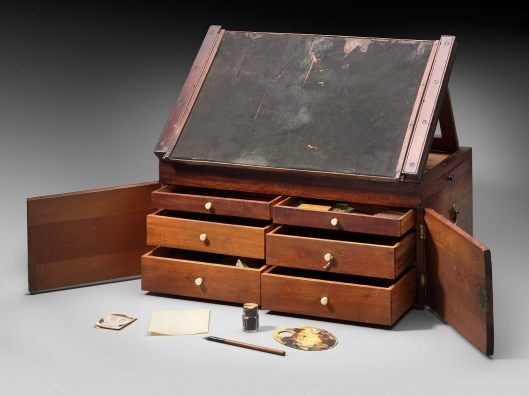
Caroline Schetky Richardson’s Paint Box
about 1820–30. MFA Boston. 1995.156.1

Mixing is simpler to solve: a palette, of course. The small, dirty-looking oval in the image above is the ivory palette used by Caroline Schetky Richardson; while her box is 1820-1830, it’s still very similar to box in Charles Willson Peale’s portrait of his brother James (below). The box is 21 inches wide, 10 inches high, and 13 inches deep. That makes the palette something like 3 inches wide, if we take a drawer as five inches wide.
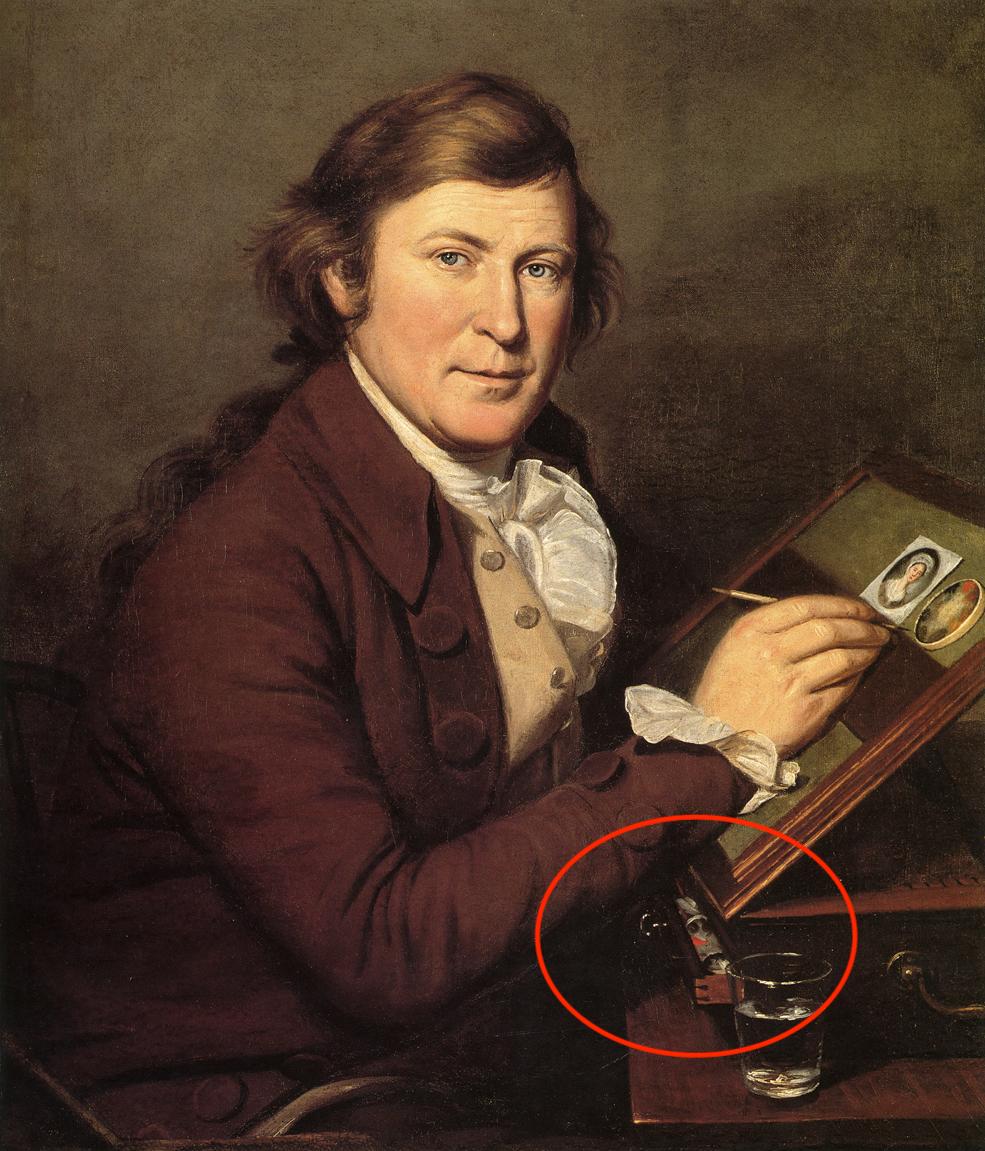
James Peale painting a miniature. Oil on canvas by Charles Willson Peale, 1795. Meade Art Museum, Amherst, MA

In the CWP portrait of JP, the slightly open drawer of the painting stand may be giving us a peek at his palette; the simple tumbler of water helps confirm that he is working in watercolor on ivory, and give us a sense of what kind of water container artists used– which, happily, can be more easily sourced than Mr Peale’s box.

Share this:

  • Share on Facebook (Opens in new window) Facebook
  • Share on Pinterest (Opens in new window) Pinterest
  • Email a link to a friend (Opens in new window) Email
  • Share on X (Opens in new window) X
Like Loading...

Wrap it up, I’ll take it

20 Tuesday Feb 2018

Posted by kittycalash in Clothing, Living History, Making Things, Museums, Research

≈ 7 Comments

Tags

Anna Maria Garthwaite, banyan, handsewn, I sew for money, museum replica, Robert Feke, sewing, silk, wrapping gown

To be honest, I would love to wrap my self up and take this silk, but it is for a museum to display, so instead the box is wrapped and ready to ship.

I was lucky to be included in a message group started by a friend asking if any of us had a banyan or wrapping gown to loan. Well, no… but I can make one!

So I did.

Banyan or wrapping gown
in silk designed by Anna Maria Garthwaite

My version is based on this 1750-1760 example at the Victoria and Albert Museum, of silk designed by Anna Maria Garthwaite ca. 1740-1750. To be honest, this is one of my favorite gowns, despite the fact that it bears no practical relationship to any part of my daily or living history life. A girl can dream, though…

Just a little bit scary, despite being able to get more silk if I really messed up.

In particular, I like the way the style combines the t-shape of a basic banyan with the pleats used to shape European women’s gowns. Tricky, right?

Ann Shippen Willing, oil on canvas by Robert Feke, 1746. Winterthur Museum Museum purchase with funds provided by Alfred E. Bissell in memory of Henry Francis du Pont. 1969.0134 A

I made a pattern in muslin (it took two) primarily by draping, reading the V&A description, and looking at the original images as large as I could get them. By the time I had a pattern, I was mostly convinced, but still intimidated by the silk. I’ve had my eye on this ever since I saw at the local store, for it reminded me strongly of the Anna Maria Garthwaite silk worn by Ann Shippen Willing (Mrs. Charles Willing) of Philadelphia in this portrait by Robert Feke.

In the interest of economy, I machine sewed the long seams and the interior (lining) pleats, though I would not if I wear to make this for myself. Once the main seams were done, I pleated and pinned again.

IMG_3400
IMG_3409

Then it was time for my one of my favorite activities, hand-stitching pleats. It’s impressive how the look of a garment changes (and improves) as you continue to work on it. The fullness of the gown with the inserted pleats is pretty impressive and very satisfying to wear. It sounds fabulous as it moves with your body.

Front...
Front…
back, and side...
back, and side…
just before packing.

Once the gown is fully dressed on a mannequin (that is, over a shift and petticoat), I know it will assume the more correct shape of the green gown at the V&A– it looks better even on me, although it is too small, being made for a mannequin representing an 18th century woman.

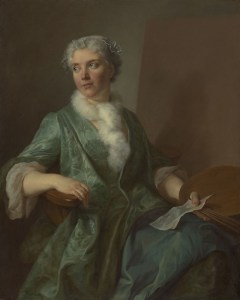
Portrait of a Woman Artist, c. 1735
Oil on canvas
40 x 32 5/16 in. (101.7 x 82 cm)
Restricted gift of Mrs. Harold T. Martin in honor of Patrice Marandel, 1981.66
Art Institute of Chicago

Along the way, I found another green silk wrapping gown or banyan, this time worn by a French artist.I can guarantee you I would never wear silk to paint in, but your mileage may vary, and if I had a maidservant and unlimited cash in 1760, perhaps I would emulate the Mademoiselle at left.

Share this:

  • Share on Facebook (Opens in new window) Facebook
  • Share on Pinterest (Opens in new window) Pinterest
  • Email a link to a friend (Opens in new window) Email
  • Share on X (Opens in new window) X
Like Loading...

Reading the Night

18 Monday Dec 2017

Posted by kittycalash in material culture, Research

≈ 3 Comments

Tags

art history, context, engravings, lithographs, prints, semiotics

Francois-Robert Ingouf after Sigmund Freudenberger (French, 1747 – 1812 ), La soiree d’hyver, 1774, etching and engraving, Rosenwald Collection 1943.3.4377

Details. It’s all in the details, right? I see this print multiple times every day, and contemplate the little stories in the details of the room.

Francois-Robert Ingouf after Sigmund Freudenberger (French, 1747 – 1812 ), La soiree d’hyver, 1774, etching and engraving, Rosenwald Collection 1943.3.4377

Perhaps the first thing I noticed that jarred my eye (and my thinking) was the row of glass vases for forcing bulbs. They look so modern, don’t they? But the shape is classic– form following function– and findable today. How pleasing that my mother’s winter ritual of filling windowsills and mantles with forcing bulbs can be visually documented to one of my favorite eras–and was, indeed, common in the past. This is one of those “everybody did it” ideas I can endorse.

French François Linke Louis XVI Style Gilt Bronze and White Marble Clock
Francois-Robert Ingouf after Sigmund Freudenberger (French, 1747 - 1812 ), La soiree d'hyver, 1774, etching and engraving, Rosenwald Collection 1943.3.4377
Francois-Robert Ingouf after Sigmund Freudenberger (French, 1747 – 1812 ), La soiree d’hyver, 1774, etching and engraving, Rosenwald Collection 1943.3.4377

What else is on the mantle? A clock, undoubtedly ormolu– though it could be much worse. And yes, the cupid on the clock has meaning in this print.

And then there’s this: the hot water urn– or is it?

Tucked into the fire place, I was initially pretty sure that’s a hot water/tea/coffee urn, meant to go with the tea or coffee cup on the mantle (see above; it’s in front of the bulb vases). Hot tea or coffee would be welcome on a cold winter’s evening, and the water would stay warmer tucked close to the fire.

Francois-Robert Ingouf after Sigmund Freudenberger (French, 1747 - 1812 ), La soiree d'hyver, 1774, etching and engraving, Rosenwald Collection 1943.3.4377
Francois-Robert Ingouf after Sigmund Freudenberger (French, 1747 – 1812 ), La soiree d’hyver, 1774, etching and engraving, Rosenwald Collection 1943.3.4377
Tea urn. Silver, by John Carter II. 1773-1774. Metropolitan Museum of Art, 11.28a–f

18th Century Cast and Wrought Iron Fireplace Fire Grate

But it could also be a decorative fender, ornamented with urns at the ends. The fireplace grate shown here is English, made ca. 1780 according to the seller) but should you have space cash burning a hole in your pocket, there’s a similar 19th century reproduction of the one in the print for sale on the interwebs, should you care to recreate this image (I know some of you have the clothes). In fact, there are quite few fenders-with-urns, once you start looking, some in bronze and some in steel.

And what of this? Is that an 18th century dog house or covered dog bed? Yes, it is.

Dog kennel, by Claude I Sené, 1775-1780. Metropolitan Museum of Art, 1971.206.18
R-20100527-0015.jpg

The bouillotte candlestand on the table is another nice household detail, illuminating a book lying open on the table set against the wall.

R-20100527-0015.jpg
Screenshot 2017-12-17 10.48.42

It has taken me some time of looking at period images to accept these candle stands as correct, since my experience with them was grounded in electrified reproductions in suburban Colonial Revival dens and family rooms– a location I will admit I was prejudiced against to begin with, having grown up in a city surrounded by architects devoted to (and buildings by) Mies van der Rohe.

But therein lies the point of looking: what initially seems absurd (Versailles-quality dog beds) or simply anachronistic (candlestands with shades) slides into place when seen and understood, within its proper context.

Share this:

  • Share on Facebook (Opens in new window) Facebook
  • Share on Pinterest (Opens in new window) Pinterest
  • Email a link to a friend (Opens in new window) Email
  • Share on X (Opens in new window) X
Like Loading...

Gathering Thoughts

25 Saturday Nov 2017

Posted by kittycalash in Clothing, Living History, Making Things, Research

≈ 1 Comment

Tags

apron, classes, Paul Sandby, Research, sewing, sewing project

Someone must watch the baggage.

You only live once, as they say, so you might as well enjoy yourself, and have a nice apron while you’re at it.

At last I have finished the one I made to serve as a demonstration model for the apron class I taught for Crossroads of the American Revolution. Plain, unbleached linen (osnaburg), it will be a good, serviceable garment well suited to getting dirty through use. There’s a lot to be said for filth, and my first-ever apron has acquired a fine patina of stains and wear.

Paul Sandby RA, 1731–1809, British, London Cries: A Girl with a Basket on Her Head ("Lights for the Cats, Liver for the Dogs"), ca. 1759, Watercolor, pen and brown ink, and graphite on medium, cream, slightly textured laid paper, Yale Center for British Art, Paul Mellon Collection
Paul Sandby RA, 1731–1809, British, London Cries: A Girl with a Basket on Her Head (“Lights for the Cats, Liver for the Dogs”), ca. 1759, Watercolor, pen and brown ink, and graphite on medium, cream, slightly textured laid paper, Yale Center for British Art, Paul Mellon Collection
Paul Sandby RA, 1731–1809, British, London Cries: "Do You Want any Spoons...", ca. 1759, Watercolor, pen and brown ink and graphite on medium, cream, slightly textured laid paper, Yale Center for British Art, Paul Mellon Collection
Paul Sandby RA, 1731–1809, British, London Cries: “Do You Want any Spoons…”, ca. 1759, Watercolor, pen and brown ink and graphite on medium, cream, slightly textured laid paper, Yale Center for British Art, Paul Mellon Collection

So why make a new one, aside from needing a teaching aid? Especially when you already HAVE a checked apron that’s looking used, and you have others in your wardrobe: why? One reason was the sheer cussedness of making the plainest, dullest, least-pretty item as finely and carefully as I could. Another was that the more I looked for apron data and examples, the more I noticed plain linen aprons. Yes: the preponderance of aprons are check, but looking at Sandby again made me realize that plain was documented, and under-represented in living history.

Sandby shows working women in checked and in blue aprons, but he also seems to depict women in plain, unbleached linen aprons, particularly the women in the street scenes. All the more reason to make up a plain apron, when your preference is portraying the urban underclass.

DSC_0811
DSC_0824

It’s also a good chance to hone one’s skills and keep in practice when you’re avoiding sewing the things that need sewing, like new shifts. And a basic project is meditative in a way that a new pattern is not: making stitches small and even is to sewing what scales are to piano playing or singing.

The first supervised apron I ever made is described here, and I’m pleased that my skills have improved since.

DSC_0825
DSC_0826

Stroke gathers are worth practicing, since they’re used on shifts and shirts as well as aprons; I’ve even used them on early 19th century garments to evenly distribute fine cotton lawn across the back of a gown. Sharon Burnston explains them here. I don’t know that there’s any one “trick” to them aside from patience and even stitches, but that “trick” will take you far in assembling pretty much every hand-made garment.

Share this:

  • Share on Facebook (Opens in new window) Facebook
  • Share on Pinterest (Opens in new window) Pinterest
  • Email a link to a friend (Opens in new window) Email
  • Share on X (Opens in new window) X
Like Loading...

We Have Data

26 Thursday Oct 2017

Posted by kittycalash in Living History, Making Things, Philosophy, Reenacting, Research

≈ 1 Comment

Tags

authenticity, interpretation, Reenacting, Research, survey

My assistant misunderstood the exercise, and is disappointed that we will not be turning the government over to him.

Data Cat says it’s clear: Cats Rule.

What is clear is that 501 people from around the world (really: people responded from the US, Canada, Australia, Europe, Great Britain) were interested enough to see what we could find out by asking questions about what, how, and why we make and wear these funny clothes. I’m immensely grateful that Google tools are easy to use, as I can present Graphs Without Tears:

Here’s how that breaks down:
Strongly disagree: 1.8%
Disagree: 0.6 %
Neutral: 3%
Agree: 30.9%
Strongly agree: 63.7%

That is, 94.6% of respondents agree that they try to make the most period-correct clothing they can. The “strongly disagree” folks (9 of them) are interesting to me, because it’s a position that’s foreign to me. (This is why recording your email was an option, so I could clarify the data.)

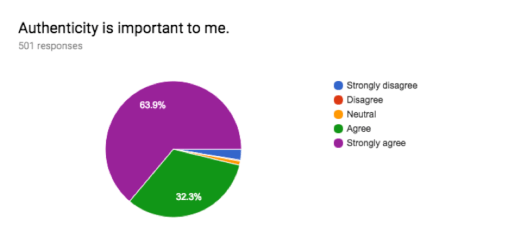
Next, let’s look at Authenticity:

Here’s how that breaks down:
Strongly disagree: 2.6%
Disagree:.2 %
Neutral:1%
Agree:32.3%
Strongly agree:63.9%

And on the use of Primary Sources:

Yes: 94.4%
No: 5.6 %

When I dug into what sources people use, and consider “primary sources,” I realized I have more questions to ask, and there are some folks who could use some research help. Not handed to them on a plate or in a slideshow, but in terms of process, and in recognizing primary versus secondary sources, and how they can be used together for maximum understanding.

Then I asked, Why is documentation important to you? 

Those responses will also inform another round of questions. Many were very revealing of thought processes and approaches; some made me a little sad. A couple of people said, essentially, I don’t want other reenactors to laugh at me.  I think we can do better than that, right? Let’s try empathy on for size, and be as helpful as we can in guiding people to an understanding of what they want to do, and how best to go about it.

Because the answers varied in length, I started reading them to discern the essence of the response, and I came up with five categories; the sixth slice represents the answers left blank.

Accuracy: 73.4%
Immersion: 11.6%
Learning: 6.1%
Respect (of ancestors, history): 4.0%
Personal (fun; satisfaction): 0.5%
No answer: 4.5%

Accuracy is the main reason documentation matters to people, and they gave good answers for why accuracy mattered.

I want to have the resource itself, rather than someone else’s interpretation of it. If everyone bases their impression off of somebody else, rather than going to the source first, it becomes a game of telephone.

It’s like medical documentation. If it’s not written down, it didn’t happen. There’s enough open source imagery and documents on the internet, let alone physical ones or surviving garments, that there really is no excuse for wild supposition.

Because everything else is unsubstantiated conjecture or hearsay and feels inauthentic to me and to those around me.

Because I use my impression to communicate about history, and history is grounded in factual, accurate information.

Documentation is the truth behind the fiction of a living history impression.

Immersion had interesting answers, too:

I want to accurately portray my impression for the public. As an added bonus, wearing the correct clothing and using period correct items, helps me connect with the people I portray on a personal level.

Because the point of living history (to me) is to recreate the past enough to learn from the visceral experience of *living* it, so it needs to be pretty accurate! Documentation is how I can know if what I’m doing is accurate (or close to accurate).

It tells us a lot about the larger picture of what was going on: trade, manufacturing, diplomacy, economics

Learning:
Because if we’re teaching people history, teaching them something that’s wrong is a disservice and an embarrassment on our part. We have the ability to learn what’s correct.

Researching and documenting my impression is why I am proud to put on my clothes. I enjoy the challenge and detective work that comes before I ever cut into any fabric.

Respect:
We owe it to our ancestors to tell their stories as accurately as possible.

For the class of person I represent, documentation can be very difficult to get at. Some documentation indicates that the garment(s) in question possibly existed, 3 pieces of documentation is ideal, but 2 will sometimes do, depending on my instincts about something. I have regretted only going for two in the past because my intention is generally to represent something very common. Documentation is important because it shows respect for the historical people I am trying to represent, it shows respect for my own work and time and it shows respect to the hobby (which, in historical circles, is often far more important than people give it credit for).

There’s a lot to think about in considering what you all think about, and I am really grateful for your help! As I look at the answers over the next days/weeks, I’ll let you know what else I see, and once I figure out how to ask the next round, there will be more questions! Thanks again! (And if you didn’t get to participate this time, no worries: you can join in next time; the easiest way is to follow the Kitty Calash FB page, but I’ll also post a link here.)

Taking the Census. oil on canvas, 1854. Francis William Edmonds. Gift of Diane, Daniel, and Mathew Wolf, in honor of John K. Howat and Lewis I. Sharp, 2006 2006.457 Metropolitan Museum of Art.

Share this:

  • Share on Facebook (Opens in new window) Facebook
  • Share on Pinterest (Opens in new window) Pinterest
  • Email a link to a friend (Opens in new window) Email
  • Share on X (Opens in new window) X
Like Loading...
← Older posts
Newer posts →

Archives

wordpress statistics

Creative Commons License
Kitty Calash blog by Kirsten Hammerstrom is licensed under a Creative Commons Attribution-NonCommercial-ShareAlike 4.0 International License.

Website Built with WordPress.com.

  • Subscribe Subscribed
    • Kitty Calash
    • Join 621 other subscribers
    • Already have a WordPress.com account? Log in now.
    • Kitty Calash
    • Subscribe Subscribed
    • Sign up
    • Log in
    • Report this content
    • View site in Reader
    • Manage subscriptions
    • Collapse this bar
 

Loading Comments...
 

    %d