• Home
  • Completed Costumes/Impressions
  • Emma and Her Dresses
  • Free Patterns and Instructions

Kitty Calash

~ Confessions of a Known Bonnet-Wearer

Kitty Calash

Category Archives: Snark

Frivolous Friday: A-Spalling Behaviour

08 Friday May 2015

Posted by kittycalash in Fail, Frivolous Friday, personal, Snark

≈ 6 Comments

Tags

19th century clothing, art, Clothing, common dress, Costume, fashion, movies, Mr. Turner, Museums, snark, some snark, style

Mr. Turner, out now on iTunes and elsewhere, won’t be for everyone: M’damsel isn’t treated very well– artists are, you know, often narcissistic, driven users– but the landscapes thrill.

We talk sometimes about going to the antique store in historical clothing and asking why our chattel is for sale. I toy with similar naughty thoughts about visiting historic house and other museums, but Mr Turner inspires a dream of a simpler pleasure: dressing in period clothes to visit a period gallery.

Classic Mr Turner in the salon

Possibly my companion would grunt as Turner does, but we might also unnerve guards by pointing walking sticks at salon-hung still lifes or reacting with disgust at the sight of an Impressionist work. (Might as well take it all the way.)

Everybody’s a critic

No takers yet for this diversion, which is just as well. I expect it would be a quick way to meet security and police staff if you didn’t coordinate with the museum/gallery in advance. Still: what a stunt. Someday I’ll pull it off.

Share this:

  • Click to share on Facebook (Opens in new window) Facebook
  • Click to share on Pinterest (Opens in new window) Pinterest
  • Click to email a link to a friend (Opens in new window) Email
  • Click to share on X (Opens in new window) X
Like Loading...

Smells Like Money: Must be Auction Season

30 Monday Mar 2015

Posted by kittycalash in Art Rant, Collecting, Snark

≈ 3 Comments

Tags

art, auctions, birds, dogs, ducks, material culture, porcelain, snark, Snarky Duck, some snark, Sotheby's, tureen

There’s nothing like a little frivolity to lighten your day when you’ve been pondering some really serious and stomach-churning topics. Hail, then, the arrival of the Sotheby’s catalog and the momentary dropping of all material culture pretenses.

This time, it’s Private Collections.  You say Private Collections, I say Disturbing and Hyper-Overpriced Gift Shop. But what does Snarky Duck say?

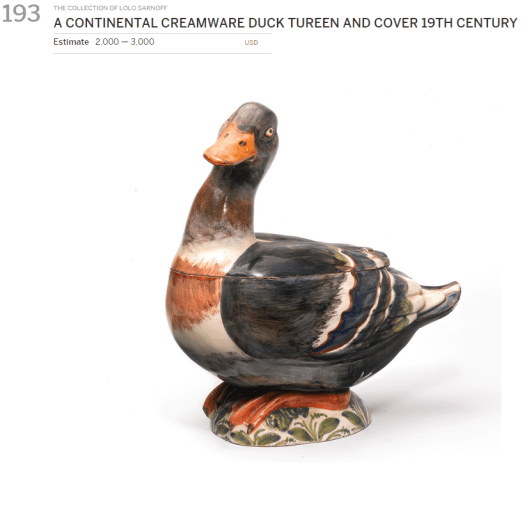
A Continental creamware duck tureen and cover.  Duck ways, no more hot soup, please.

A Continental creamware duck tureen and cover. Duck says, No soup for you.

Poor Strangled Parrot: I don’t think he can say much.

A Holitsch parrot-form jug and cover ca. 1760.

A Holitsch parrot-form jug and cover ca. 1760.

And these guys, described as playful dogs, look more like dyspeptic pugs to me.

A pair of Hochst fayence figures of seated pugs ca 1770.

A pair of Hochst fayence figures of seated pugs ca 1770.

It is amazing what people will make and buy (which delights me), and I’m certain that things I own would astonish and appall someone with different taste. But animal effigies always intrigue me, and (aside from Snarky Duck, our 19th century friend) figures like these could have graced the mantels and tables of the finest homes of the 19th century. It would have been a crowded and raucous world.

Here’s the whole catalog, should you care for some ormolu chairs or Aubusson drapes (which I did not know existed until today).

Share this:

  • Click to share on Facebook (Opens in new window) Facebook
  • Click to share on Pinterest (Opens in new window) Pinterest
  • Click to email a link to a friend (Opens in new window) Email
  • Click to share on X (Opens in new window) X
Like Loading...

New England Spencers

07 Saturday Feb 2015

Posted by kittycalash in Book Review, Clothing, History, Making Things, Museums, Research, Snark

≈ 7 Comments

Tags

19th century clothing, cataloging, common dress, common people, Dublin Seminar, Federal New England Fashion, Federal style, New England, Regency, Research, Spencer, Spencers, Sylvia Lewis

You may recall how tortured I was (sort of) about making a Spencer for What Cheer Day, concerned that Spencers could not be documented to Rhode Island, let alone New England. I had the same worry about the Not-Quite-Good-Enough Coat.

JDK_8210_1

Things will come to those who wait, and what came this week was the long-awaited Proceedings of the Dublin Seminar for 2010, Dressing New England. In it I found an article by Alden O’Brien, Federal New England Fashion in the Diary of Sylvia Lewis.

Sylvia Lewis [Tyler], Diary (1801-1831), MSS 2899 in the Americana Collection of the NSDAR provides the basis for O’Brien’s article and my joy. It begins routinely enough with my favorite stuff– spinning!– and carries on to knitting: stockings, mittens, gloves, a hat or two, and even “comforters,” or scarves. Shag, or thrummed, knitting is mentioned, so at least those of us interpreting the world of 1801 and later can be war.

The real excitement comes on the third page: in the winter of 1803-1804, Sylvia Lewis cuts and sews a greatcoat. Then, in 1806, she makes a green Spencer, and in 1808, a black one.

Spencer ca. 1800 French. silk. Purchase, Irene Lewisohn Trust Gift, 1991 1991.239.2

Spencer ca. 1800
French. silk. Purchase, Irene Lewisohn Trust Gift, 1991
1991.239.2

1806 is still later than I wore my Spencer. They’re shown in fashion plates of the 1790s, and here’s a pattern, too: so they’re clearly worn in Europe earlier than 1806. The similarity between the French silk spencer at the Met and fashion plates gives me confidence that they are being made and worn in the 1790s and early years of the 19th century; Spencers are also mentioned in tailoring manuals of this period.

1797, with a similar shape to the Met's French silk spencer.

1797, with a similar shape to the Met’s French silk spencer.

They’re placed in New England with written documentation, but how early are they here? And what did they look like? I know of one in a private collection which I am slavering to see, based on the description of the wool. The MFA has a few that seem to be local to Lexington, and there is one in Maine with a catalog record that shines with passive aggressive crankiness, and delights when compared to another in the same catalog. And no, I’m pretty confident that gentlemen did not wear spencers, or tailed spencers, at any time.

"wearing a spencer"
“wearing a spencer”
"she *says* its a spencer"
“she *says* its a spencer”

But there’s really good stuff in Sylvia Lewis’s diary for anyone who wants to know more about clothing production, use, and costs in early Federal New England. Even if your Library doesn’t have it, your Librarian can get a copy of the article for you through ILL or you can buy the entire proceedings here.

Share this:

  • Click to share on Facebook (Opens in new window) Facebook
  • Click to share on Pinterest (Opens in new window) Pinterest
  • Click to email a link to a friend (Opens in new window) Email
  • Click to share on X (Opens in new window) X
Like Loading...

Send in the History Clowns

14 Wednesday Jan 2015

Posted by kittycalash in Living History, personal, Philosophy, Reenacting, Snark

≈ 3 Comments

Tags

authenticity, interpretation, living history, living history museums

Once upon a time, I called reenactors and costumed interpreters History Clowns. The pilgrims at Plimoth Plantation 25 years ago scared me, and I did not like to visit living history museums.

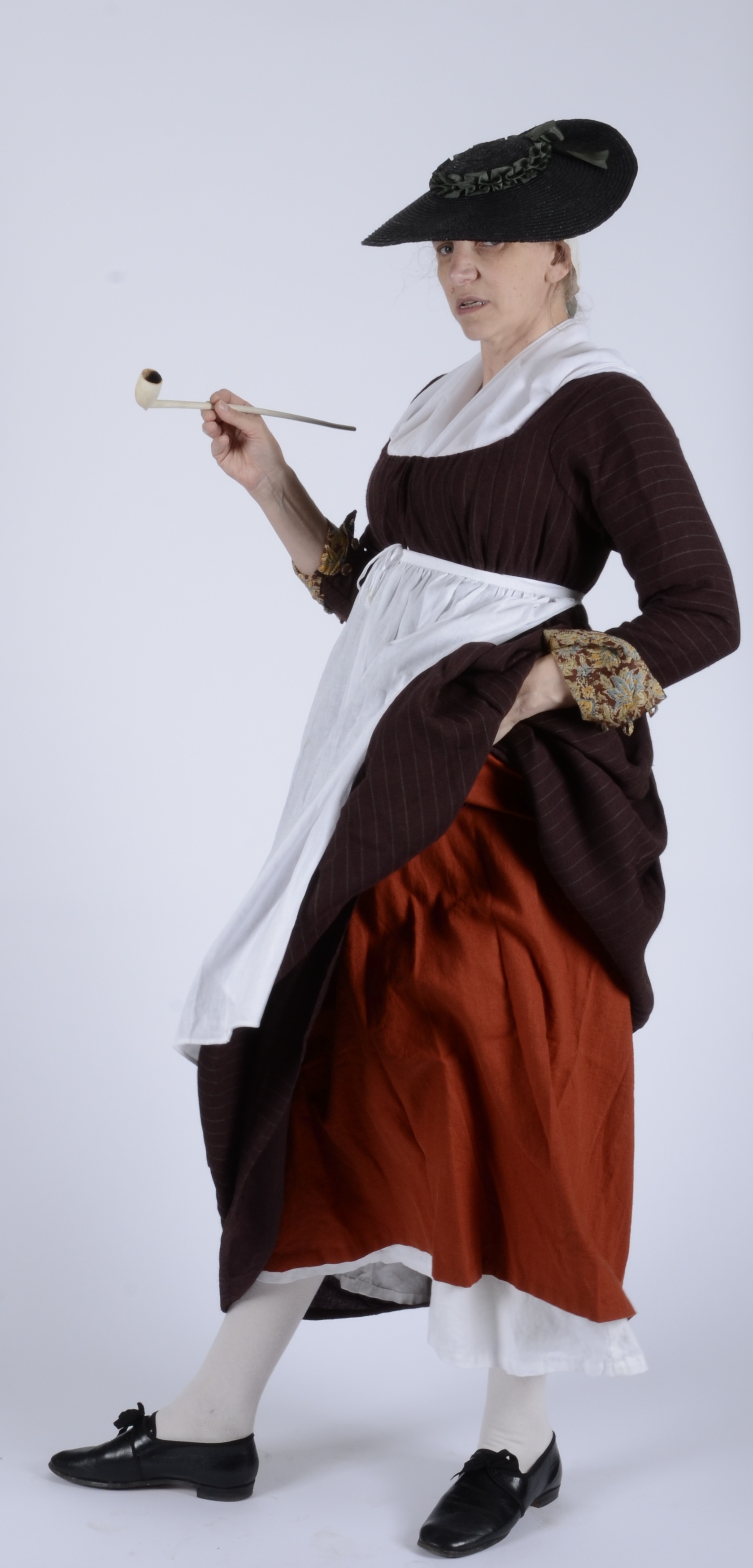
petticoat

History Clown

Now, I’m one those costumed clowns.

What changed? For one thing, I did. But more importantly, living history and reenacting changed. It got better. It became more accurate, more inclusive, more specific. (Even Plimoth admitted at a Dublin Seminar that their costuming had evolved.)

When I see the fights that erupt online (there was a skirmish on Facebook last night—Peale’s march will not die), I think about the History Clowns. I think about the evolution that has taken place, and I think about the skirmishes I get into in trying to plan living history events at my own institution.

Most of these fights are not about accuracy—that FB fracas wasn’t—but do we know what they are about? We try to push back with our insistence that accuracy matters, but that’s not the argument our opponents are trying to have with us. They don’t give two rats about the cut of your breeches or the cord on your canteen or what you think of their rubber-soled shoes.

They want to be recognized. They want to be appreciated. They want to matter.

It reminds me a lot of when I first came to the place I work; I was one of three new, younger people hired within a short span of time to work on exhibits and an expansion project that never happened. As we looked at the organization, we saw things that didn’t seem right to us. But often, we met a lot of resistance to new ideas: “We’ve done that already.” “We tried that and it didn’t work.” “This is fine the way it is.” “We’ve always done it that way.”

I think those translate thusly: If you do it, you might make my attempt look bad.

If you succeed where I failed, I will look bad.

I don’t want to change.

I’m afraid to try something new.

What about my efforts? Won’t they be rewarded anymore?

I think that’s what people are saying to us sometimes, even when the words they say are, “These haversacks are fine, they’re really durable. It doesn’t matter if the fabric isn’t really right,” or “Market wallets? No, that was just a Henry Cooke fad.”*

43919175The fight is probably not as much about accuracy and authenticity as it is about feelings. That said, I think it behooves people on both sides of this line (and it is often generational) to be equally mindful of each other’s feelings. While we can respect the work that people before us have done, they should respect the work we are doing now, as new resources come to light, and new thinking is applied to history and interpretation.

Just as we cannot live in the past of historic house museums, we cannot live in the past in reenacting/living history. And while I respect the tenure of some unchanging regiments and the work they’ve done before, it comes down to this:

Accuracy matters. Adapt or die.


*I think my eyeballs fell out when I heard that one, from a guy who prides himself on his extremely accurate topographic battlefield models.


Share this:

  • Click to share on Facebook (Opens in new window) Facebook
  • Click to share on Pinterest (Opens in new window) Pinterest
  • Click to email a link to a friend (Opens in new window) Email
  • Click to share on X (Opens in new window) X
Like Loading...

Mansplained in the Museum+

21 Friday Nov 2014

Posted by kittycalash in Museums, personal, Snark

≈ 7 Comments

Tags

Boston, Bostonian Society, Council Chamber

+ Edited to correct typos and to add this link to Sheldon Cohen on Divorce in Providence County, 1749-1809.

I’ve been at a conference the latter half of this week, peering inside the workings of Cambridge and Boston cultural institutions, and most enjoyably, hearing about authenticity and disruption at the Bostonian Society: let’s get this party started!

Except: there I was in the elegantly and intelligently* done “Seat of Power” exhibition in the Council Chamber, pulling the label out from the chair seat to read about a Boston woman shopkeeper in the 18th century when a man had to explain it to me, with a special “feminist” bent that was supposed to, somehow, make this disruption of my visit okay.

I had been telling a young woman next to me, also part of the conference, that I wasn’t sure if this woman was the Boston woman who had been widowed three times and accumulated a great deal of wealth despite the interference of her husbands, and despite the property laws of the time.

The man, not part of the conference, needed to tell me that of course the woman had owned nothing herself, that being the regrettable law of the time, but in balance it was okay, because men were required to care for, and pay for the keep of, their wives and children.

Reader, this is where I made my mistake: I engaged.

“Not always,” I said. “There are certainly examples of divorce and bigamy, and women unable to get their bigamist husbands to pay heir children’s keep.”

“Oh, those were the exceptions. Men were even imprisoned and beaten for not neglecting their families.”

“Except when they advertised that they would not be a responsible for their wife’s debts, and forswore them; we see that in newspapers of the time. So it’s not universal.”

Do you hear the warning klaxon here? Because I surely missed it.

“I’m a history teacher, and I know. You cannot use the extreme exceptions of 1% of the population to justify your absolutist argument. You can’t make statements like that.”

Well, obviously I can: any of us can be as wrong as we care to be, whenever and wherever we like, if our skins are thick enough.

I replied that I thought I was trying to qualify his statement, and nothing more: that he had taken the absolutist position and I was interested in sticking up for the “predominately” and “mostly by not always” corners of history.

It devolved from there until I finally thanked him, told him he’d surely shown me the error of my ways, and I appreciated his comments.

He reemphasized his point that our forefathers had been wrong; I said they’d been right by their lights and in their time, and that it was important to remember that.

His rejoinder was that it was wrong, of course, and women should have rights, etc. etc.

Gentlemen: let me tell you now that this approach will not endear you to the ladies. These are bad pick up lines.

So there it was, mansplained in the museum, by a feminist history teacher.

It’s enough to make me stop talking to people. And best of all: I think he was a reenactor I’ve met before, unable to recognize me because I am a woman, and not a soldier. Also, no bonnet.

May your day be amused by this anecdote, even as I puzzle over it. References to divorce articles later– I am in a cafe before another session.

*thanks to T. S. Eliot for binding these words together in my mind for ever
Share this:

  • Click to share on Facebook (Opens in new window) Facebook
  • Click to share on Pinterest (Opens in new window) Pinterest
  • Click to email a link to a friend (Opens in new window) Email
  • Click to share on X (Opens in new window) X
Like Loading...
← Older posts
Newer posts →

Archives

wordpress statistics

Creative Commons License
Kitty Calash blog by Kirsten Hammerstrom is licensed under a Creative Commons Attribution-NonCommercial-ShareAlike 4.0 International License.

Website Built with WordPress.com.

  • Subscribe Subscribed
    • Kitty Calash
    • Join 621 other subscribers
    • Already have a WordPress.com account? Log in now.
    • Kitty Calash
    • Subscribe Subscribed
    • Sign up
    • Log in
    • Report this content
    • View site in Reader
    • Manage subscriptions
    • Collapse this bar
 

Loading Comments...
 

    %d