Good Enough Coat

Tags

, , , , , , , , , , ,

The great coat is nice, but how ’bout them gaiters?

Winter is firmly here, with the snow, fog and ice that marks the season in the Ocean State. It’s not fun weather for living in the past, though there’s not a lot of that happening right now. Even so, there’s a February program on the horizon and what better excuse for fastening on a garment and making it?

Even if I’ll likely spend the day in a kitchen interpreting life below stairs in 1820 (while the light infantry occupies my living room and denudes my kitchen), an early 19th century event on a winter weekend seemed a worthwhile excuse for making a greatcoat, and, eventually, gaiters.

IMG_2733

With no pattern, and only 2 and 3/4 yards of thick, soft, grey double faced wool*,  I’m adapting my standard Spencer pattern. I didn’t upsize this too much, because women didn’t have frock coats and waistcoats to wear under their greatcoats or Carrick [carriage?] coats or Reding cotes. (I’m too engrossed with sewing to parse garment names.) The skirts will be attached at the waist, with a belt to hide the seam. At my height, cutting a back in one piece takes yardage I do not possess. Happily, the Taylor’s Instructor describes Redingcoats or Habits for women with attached skirts.

The collar shape diverges from my usual 1790s collar, and is based on another fashion plate, this time from 1815. The program I’ll be doing with Sew 18th Century is set in 1820. As a maid, I think an 1815 coat is pushing it a bit, since red wool cloaks hold up well, but I’ll take any excuse for some tailoring, I suppose.

1815, with a round collar that can stand up.

I plan to use this button arrangement, too, stylish as it is in not-quite-double breasted. Bring on the button-making– we all have to go death’s head sometime, and this wool is too thick for covered buttons without much heartbreak.

The lower front pins are there from the moment when I realized the front was hanging strangely — because I had neither marked nor sewn the bust darts. That oversight, and the pain in my ear, do suggest that the delightful cold I’ve had for weeks may be affecting me more than I think– but that’s just another argument in favor of a cozy wool coat.

IMG_2737

The sleeve pattern (again, not upsized) is once again the old standby two-piece sleeve from Henry Cooke’s 1770s unlined man’s frock coat, so of course it fits well.

I’m hoping to stitch up the sleeves this evening, and set them later this week. I’m still pondering lining materials– there’s just enough silk “persian” to do the body and sleeves–but I have some twilled wool that would increase the warmth and still provide some ‘slip’ in the sleeves.

And those blue gaiters? They’ll come in time, from the scraps of blue wool a friend is making his first ditto suit from. I’ll spot him some remnant table chintz for a summer waistcoat, and expect greater sartorial splendor will grace the spitting stamp inspector in Newport this August in exchange for my blue wool ankles.

*Holy burned hair smell, Batman! Mr Cooke’s right when he says this almost feels like foam, but put a flame to it, and you might as well be smoking sheep.

The Unbearable Sameness of Dressing

Tags

, , , , , , ,

One of the arguments I hear against changing the way people dress as civilians at reenactments, particularly the women but sometimes the men, is that “if we all use the same pattern, we’ll all look alike, and that’s not how people dress now or then.”

I have news for you: that is how we dress[ed].

I know, we can’t apply modern thinking to the past– that’s crap historiography. But why do we resist using the same correct patterns for historic garments when we are clearly dressing alike today?

I’ve not yet read a paper on the similarity of women’s dress in Robert Feke or John Copley’s portraits that really convinced me, but if you look at enough of them, you might think there’s only one woman and one dress in all of British North America, because Badger and Greenwood are painting her, too.

Even if those clothes are studio props, what does it say that the sitters wanted to be portrayed in the same clothes? Look, if that’s the only means of getting myself into a Charles James, you bet I’d take it. Or, for a more contemporary analogue, Alexander McQueen.

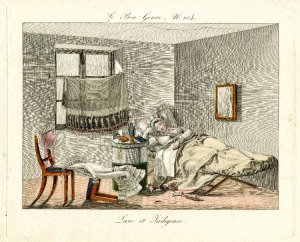
Luxe et Indigence. Le Bon Genre, 1817

Luxe et Indigence. Le Bon Genre, 1817

Dressing is about status as much as it is about self-expression, and in the 18th century, dressing signaled refinement, sensibility, and status through the quality of fabric as much as through the cut of clothes. Air Jordans do the same thing today, or North Face jackets, or Kate Spade purses. They show what you can afford, even if you’re eating oatmeal for dinner behind closed doors.

We dress the same now, and we dressed the same then, with variations according to pocketbook. We can’t all afford K&P superfine wool today any more than we could have bought the best wools or prints in the 18th century. But using accurate patterns and fabrics appropriate to our station will create the best impressions possible– even if my gown is cut to the same pattern as my wealthier acquaintance’s.

Gingerbread (in the) House

Tags

, , , , , , , , , ,

Illustration by Tasha Tudor

Illustration by Tasha Tudor

Here we are again, at the time of year known as Impending Parental Visit, which causes a variety of reactions ranging from full-on repaint the kitchen and both baths freak out (whilst nursing an 8-week-old Young Mr) to Eh, she’s got a dog acceptance.

This year, Mr S had the freak out, and has undertaken a living room painting project which he has carried out on weekends since Thanksgiving. It does look good, and I am grateful for his persistence, because this year’s late fall and early winter brought me a serious case of the blues.

That's a happy cat!

happy cat!

I’m in the midst of trying to finish a dress before my mother arrives (my sewing area is really our dining table, with the Strategic Fabric Reserve stowed in sideboards and cupboards). Yesterday, I tried it on: it fits, and looks rather nice (grey wool, and when it’s done, you’ll see it). But it fails in intention: clearly, it is no maid’s dress.

But I felt so much happier in my stays and petticoat that I dug up the wool dress made for farm adventures, put on my apron, and made ginger bread.

The cat approves of my reading material.

The cat approves of my reading material.

The recipe, which I shared recently with a friend, is an old Rhode Island family receipt, and very similar to the Tasha Tudor cookbook receipt. (The Howling Assistant approved of Tasha’s Roast Chicken receipt. She is a poultry fan.)

When copying over the receipt for my friend, I forgot the hot water, and failed to warn him that this gingerbread cake is best eaten with a fork. Delicious, but sticky, here it is:

1/4 cup butter, room temperature or a little softer
1 cup sugar
1 teaspoon baking soda
1 cup boiling water
Combine the last two ingredients and pour over the butter & sugar.
Add 3/4 cup molasses
Combine well.

Sift into the liquid mixture:
1.5 cups flour
1/2 teaspoon ginger (I use a heaping 1/2 tsp)
1 teaspoon cinnamon
pinch salt

Combine gently. Into the mixture drop one unbeaten egg.
Beat the whole with a hand-cranked eggbeater or whisk.

Pour into greased 9×13 pan, and bake at 350F for 35 to 40 minutes, or until a toothpick comes out clean.

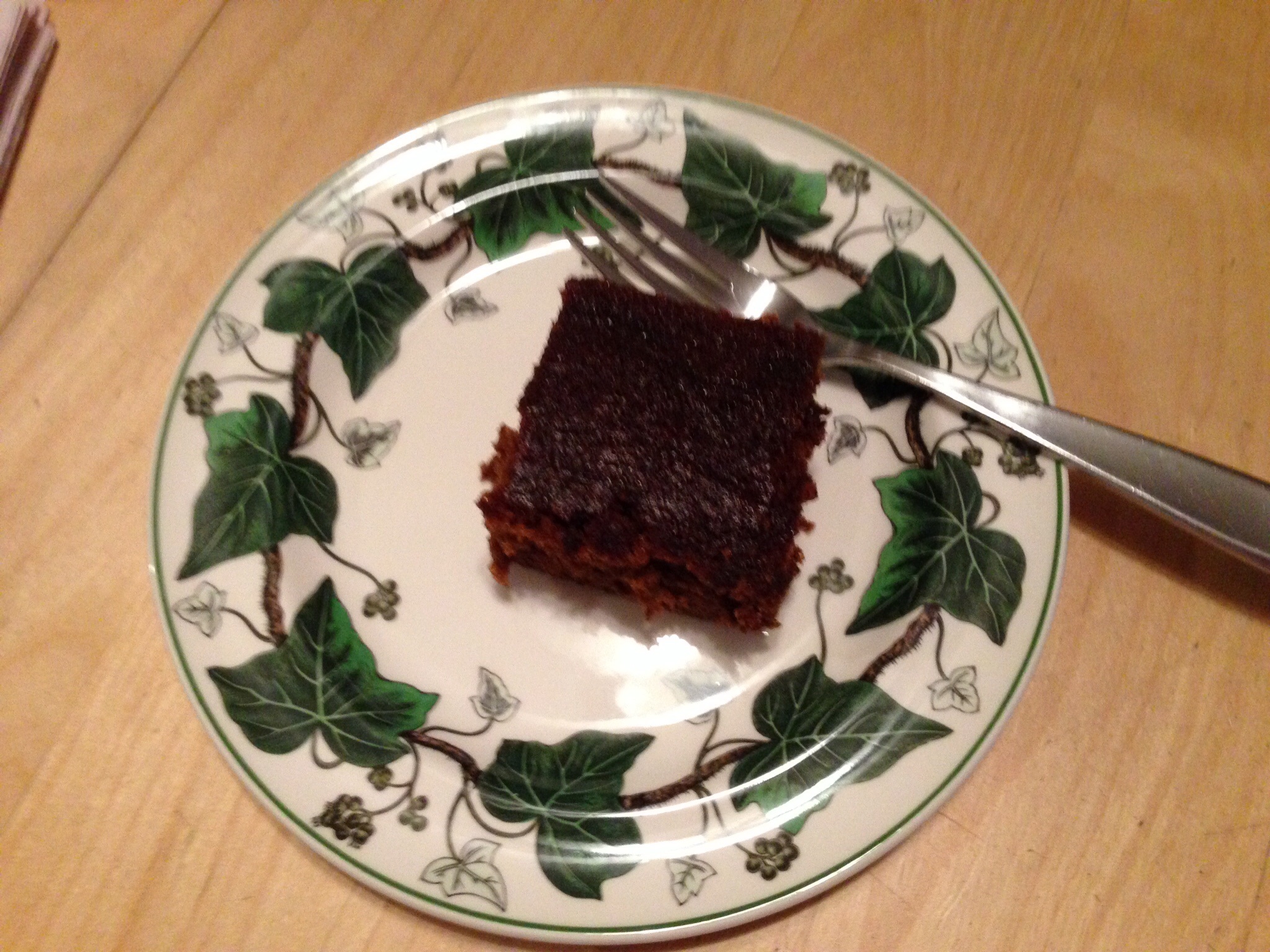
Gingerbread cake

Gingerbread cake

Good with tea, coffee and clementines. I’ve made this perhaps a dozen times, once without the egg, and it’s always edible. (The egg provides some leavening, so made without it, the cake is dense and extra sticky.) Baking it makes the whole house smell good and it’s a simple, one-bowl receipt. For an easy holiday treat to share, I recommend this Rhode Island Gingerbread Cake.

Scabbers Paints

Tags

, , , , , , ,

Perhaps you know him as Timothy Spall, but the actor playing Mr Turner is best known in my house for his role as Scabbers, AKA Peter Pettigrew, in the Harry Potter films.

I am anxiously awaiting the release of Mr Turner, and have watched the trailer multiple times in anticipation of material for the authenticity and accuracy fires.I’ve also watched The Power of Art again, because I love Simon Schama as the David Attenborough of fine art, and I’ve enjoyed the way that Mr Turner’s titles appear to use a similar color-into-liquid trope as TPOA’s bleeding titles. Just go watch it.

Why am I so excited to see Scabbers paint? Because the trailer looks so damn good.

The color, the set dressing, the intensity of the colors, all suggest that the film team paid close attention to the material culture of the past, and to those tiny details that create a satisfactory, accurate closed world that helps us achieve experiential and even transcendent authenticity.

Of course I enjoy costume drama: you’d expect that, right? And messed up costume and material culture details can wreck a film or TV program for me, but what you might not expect is that there are some films I enjoy despite their apparent inaccuracy.

Take the Muppet Christmas Carol. That’s one of my favorite adaptations of the Dickens’ work, because it creates a world true to itself filled with believable objects and characters (even the ones I can’t stand), and returns authentic emotions. Scrooge’s headmaster was never an enormous eagle muppet: but the shabby school room works, much the way Beatrix Potter’s anthropomorphic tales work.

In The Pie and the Patty Pan, Duchess can’t bake– what dog can bake? But we can believe that Duchess is a greedy eater, and might well think she swallowed the patty pan. The touch of hypochondria in a greedy dog is intensely satisfying, I think.

Cat and dog at a tea table

Where is the Patty Pan?

What does this mean for historic house and living history interpretation? It means furnishing a believable world with accurate clothing, goods, and accouterments, based on primary sources with characters who convey authentic emotions and ideas to create a transcendent learning experience.

I even have a diagram:

The experience equation

The experience equation

And that’s why I want to see Scabbers Paint. Because anything that creates a believable historical experience is worth learning from.

Winter Workshops

Tags

, , , , , , , , , , , , ,

Interior of a Tailor's Shop, Museum of London

Interior of a Tailor’s Shop, Museum of London

Come sew with me! Well, you’ll be sewing with Henry Cooke, but I’ll be there, too.

Check the Newport Historical Society’s website for more information about workshops and conversations this winter designed to for anyone with an interest in early American history who wants to expand their understanding of material culture interpretation.