Hair-raising

Tags

, , , , , , , , ,

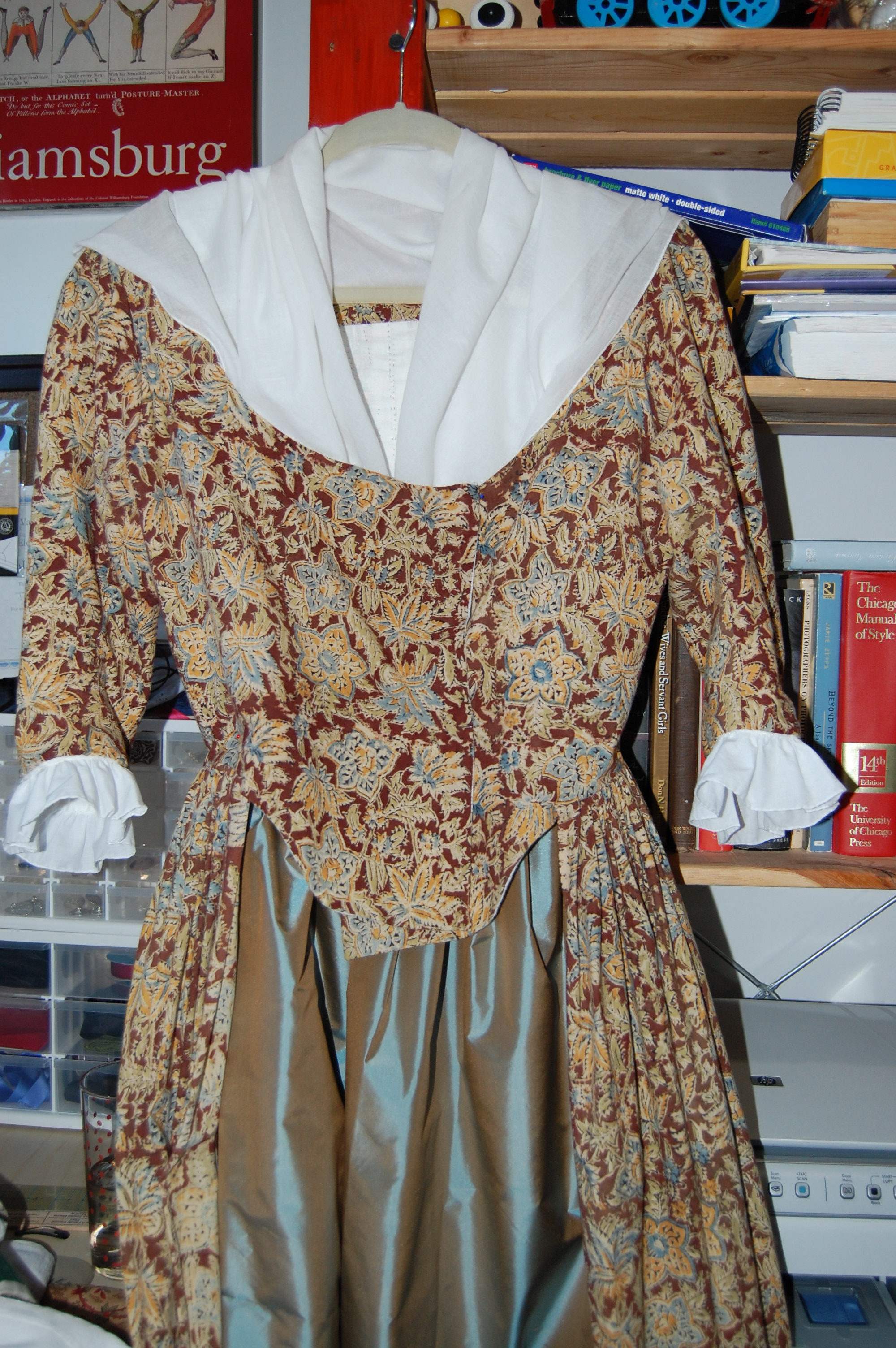
An old gown, with new sleeve ruffles and petticoat.

An old gown, with new sleeve ruffles and petticoat.

We are going to a ball tonight, and while I am looking forward to seeing Sew 18th Century and the lovely Mr and Mrs B among other friends, this is a different kind of experience for Mr S and me. We are, after all, more accustomed to crashing parties than attending them. (There are photos of the Riot Act Night here.)

The biggest difference is in presentation. I ended up making a changeable blue silk petticoat to dress up a cotton print gown, to which I’ve added sleeve ruffles made by the incomparable Cassidy. While I once had plans–dreams–of finishing and wearing the silk sacque in time for this, I was overtaken by events  and have settled for an ensemble more suited to my persona, and Mr S’s planned outfit, the Saratoga coat and breeches. I feel just OK with center front closing cotton print for late 1777, and have seen enough cotton print gown and silk petticoats at Williamsburg to brazen it out.

This is a marked upgrade from linen petticoats that smell like woodsmoke (sigh!) and print neckerchiefs that you shouldn’t smell.

Perhaps the biggest change, though, is to my hair. (Yes, the pun is finally paying off, like a loaded gun in the first act.)

All cleaned up with someplace to go.

All cleaned up with someplace to go.

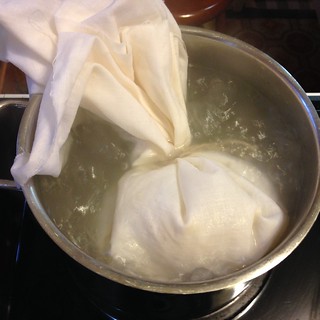
I started this day with wet hair, curlers, setting lotion and bobby pins, swearing like a sailor and convinced/hoping the world might end right in our bathroom. Last night I watched Jenny La Fleur‘s 18th century pouf tutorial, and thought I had the basics down.

Wrong. Or half-wrong. I should have gone looking for a don’t-lose-your-mind video, plus one on how to make pin curls in exacting detail. True to my ability to over-think anything, I began to wonder which way I should spin the pin curls– clock wise? Counter-clock wise? Is it opposite if you’re in Australia and New Zealand? My brain is a cluttered place.

In under an hour I had achieved a lop-sided mound of curlers and curls, which I thoughtfully covered with a kerchief to spare my family from death by Medusa. They refused to take me to Walmart, though I finally had the hair for it. Eventually, I pulled out half the bobby pins in the known universe, and had a head full of snakes. Silver snakes. Apparently there’s more grey in my hair than I realized.

Another half-hour of pins and hairspray later, I had a slightly more upscale version of my usual hair style, accented with a shiny green ribbon. Underneath that demure cap, my hair is doing terrible, feral things. Of all the things I learned today, I know with certainty that despite my small head, the next time I’m gonna need bigger rollers, and when I get home from the ball, I must wash my hair.
Discipline’s the Thing

Tags

, ,

Warning: Gratuitous Cat Photos

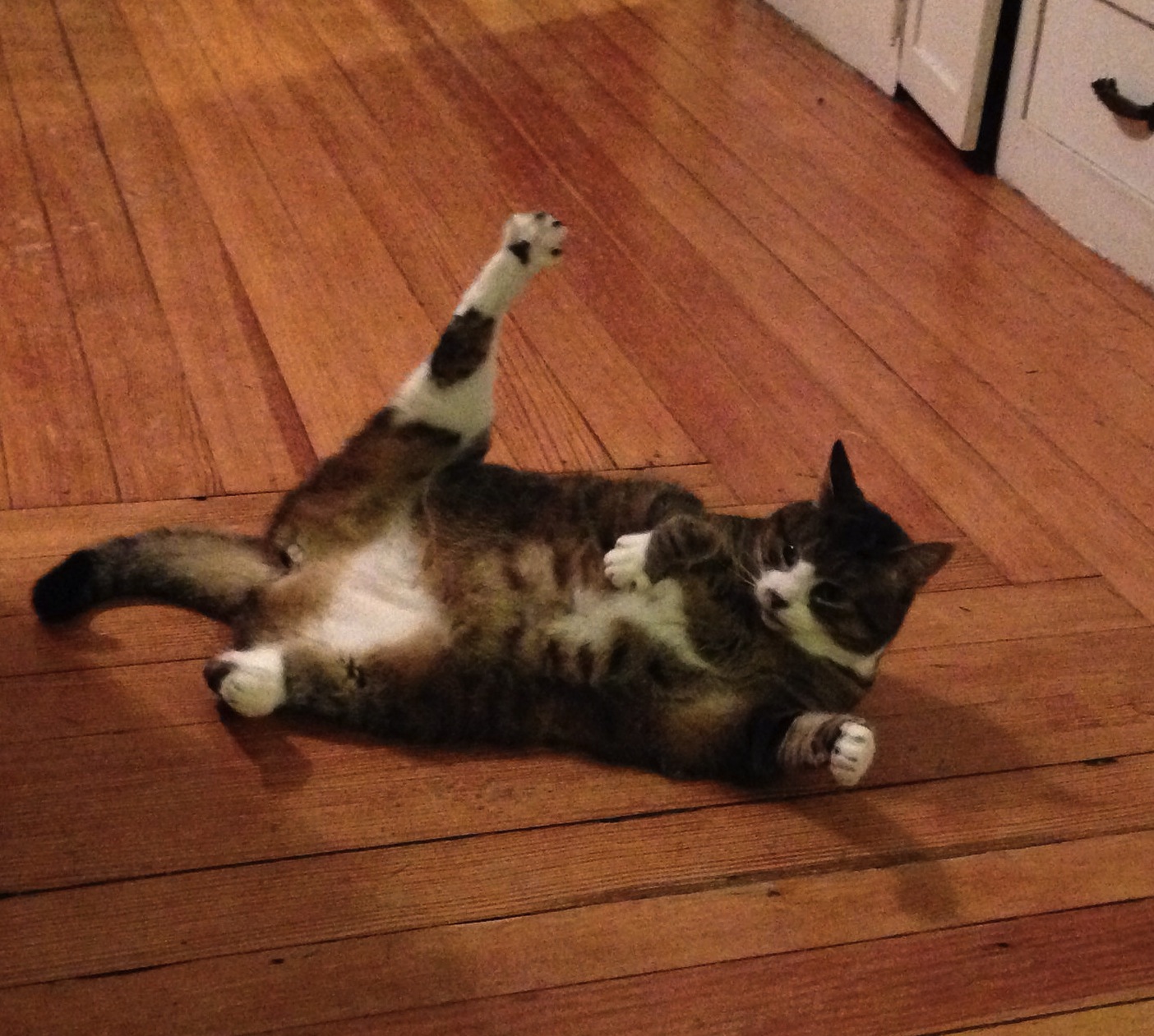
The Howling Assistant attempts to build her core

The Howling Assistant attempts to build her core

As the Howling Assistant will attest, Pilates can be brutal. Here she is, stuck over her blubberous expanse of belly. To be fair, she was very sick as a kitten and as a result seems to gain weight no matter what she eats.

She watches from the sofa every morning while I collapse in a heap of quivering, cat-fur-accented jelly. At least she’s entertained.

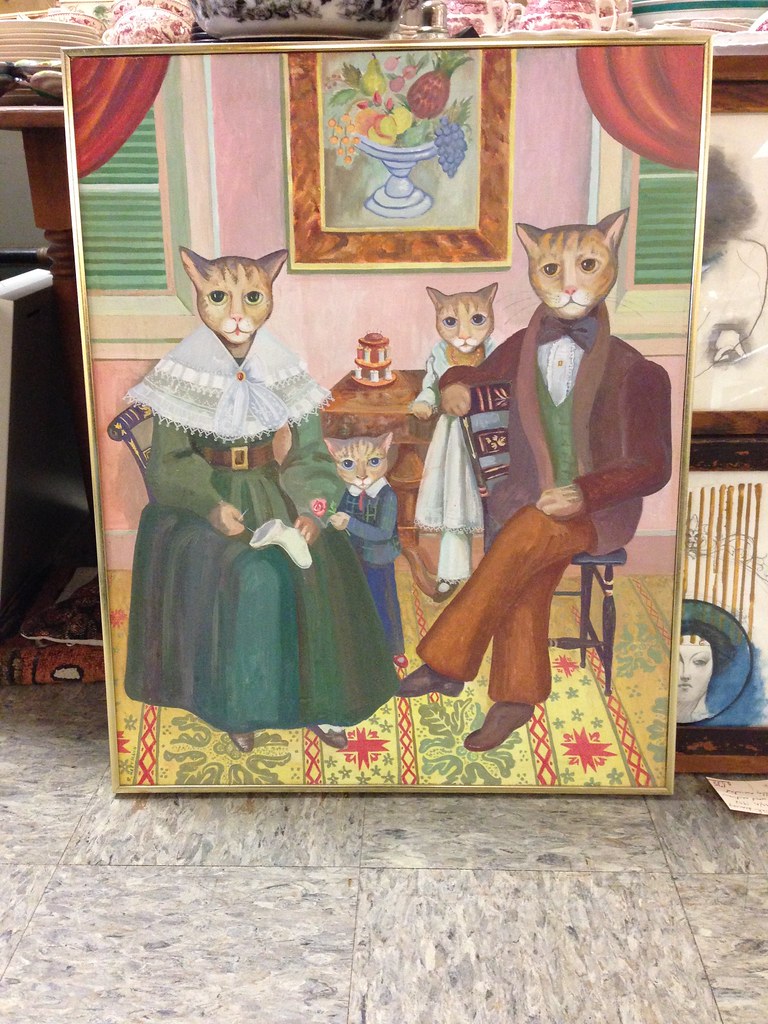
The Cat Family Folk Portrait

There was entertainment in abundance in Pawtucket yesterday, where I spotted a new genre of folk art I had not seen before. By the time you strip off the layers of weirdness, you’ve moved through appropriation, jokiness and Post Modernism to sincerity and then I’m not sure quite where you end up. I’ve seen the “historic portraits with cats and dogs” genre before, done well and done poorly, but never anything quite so home-grown as this. I have to agree with my friend that the carpet’s pretty wonderful, and the details captured in he Hitchcock chairs are well-observed. Art’s a curious thing, and observation. It pleased me to find this, and I hope in some way it will please you to see it. We’re strange creatures; enjoy the ride.

Quaker Dress

Tags

, , , , , , , , ,

Costume in Detail by Nancy Bradford, page 372.

Costume in Detail by Nancy Bradford, page 372.

I’m still struggling with the Quaker Dress conundrum, both because I want a challenge and I want to be as accurate as I can be.

So, not unlike my stubborn cat, I got an idea, and I just can’t shake it. The kind-of-cross-over, apron-front, v-neck day dress.

I’ve tried and failed before, but I got a little farther Saturday. When I went looking for the original, I was pleased to find that it had ended up at Killerton House, as part of the National Trust Collection.

You can find it here, but you can’t see it yet. 

WOMAN IN GRAY DRESS John Brewster Jr. (1766–1854) New England 1814 Oil on canvas 29 1/2 x 24 5/8 in. (sight) American Folk Art Museum, promised gift of Eric D.W. Cohler, P3.1998.1

WOMAN IN GRAY DRESS
John Brewster Jr. (1766–1854)
New England
1814
Oil on canvas
29 1/2 x 24 5/8 in. (sight)
American Folk Art Museum, promised gift of Eric D.W. Cohler, P3.1998.1

I think it may look something like the dress in this portrait, but without the collar.

Bradfield’s notes indicate that the front, sloping edge is a “fine, 1/10″ selvedge very narrow of rich dull orange saffron.” Based on this note, I have tried using the selvedge for that edge in the lining. (Better to fail on the lining than on the silk, right?)

We’ll see… the next trial will be a drawstring, just to see if I can get this business to fit.

Shopping at Dobyns and Martin

Tags

, , ,

A Range of Goods, lately Arrived from Maryland.

In the not-too-distant past of up till last week, I was still under the impression that I would be doing two living history presentations on tea at the end of March, but through a series of maddening-for-a-colleague circumstances, that is not the case. To begin preparing for these programs, I had started secondary and primary source research on tea and tea parties, as you may recall. I also ordered some things from Dobyns and Martin, thinking how nice it would be for people to see and smell and sample historically correct teas.

Friday was a happy day chez Calash, coming home at the end of a long week to three days off and packages! Though I won’t need the teas for work, it does seem to me that they will be quite suitable for other living history presentations, and I can always ‘steal’ some from an officer if I get tired of the black market in shirts.

In addition to tea and lump sugar (which will fit nicely in Bridget’s pocket), I ordered soap. The lavender wash ball seems suitable for officers and the better sorts, while a cake of lye soap will vastly upgrade our dish-, self- and clothes washing in camp. While I’m game to make my own soap, a lack of ingredients and facilities hinders production.

Carrot pudding Trial One. Verdict: Too much nutmeg.

And, finally, the rose water. I’m looking forward to enhanced baking, a good activity in the weather we’ve had lately. While I don’t think the rose water would have saved the way-too-much-nutmeg carrot pudding, it will certainly be welcome in dishes future. I’m motivated to get a boiled pudding right, and in the field, because I know the Enos Hitchcock ate pudding and venison as a chaplain in the war.

Anachronisms, ahoy!

Tags

, , , , , , , , ,

Deborah Sam[p]son (Gannett), oil on paper by Joseph Stone, 1797. RIHS Museum Collection, Gift of Jesse Metcalf, 1900.6.1

Deborah Sam[p]son (Gannett), oil on paper by Joseph Stone, 1797. RIHS Museum Collection, Gift of Jesse Metcalf, 1900.6.1

There’s a petition circulating in certain government circles in support of a campaign to give Deborah Sam[p]son her very own stamp. This is, in part, fueled by the upcoming 250th anniversary of the founding of Sharon, MA.

I’ve got no problem with that—commemoration is something we humans do and need. And Deborah Samson’s is an interesting story, but possibly not for the reasons cited in the letters from officials who shall remain nameless. They describe her as “a pioneer of promoting women’s rights and eliminating gender barriers” and “a trailblazer for gender equality,” phrases that would have been just about nonsense in the Revolutionary war period.

And that’s my problem with it: the anachronistic representation of a woman’s story, bent to the purposes of the present. Don’t get me wrong—I’m a feminist, I’ve enjoyed Deborah Samson’s story since I read about her as a kid in one book or another, so I sympathize with the Stamp Movement.

What makes me crazy is bad history.

Hannah Snell, as depicted in an excerpt from "The Life and Adventures of a Female Soldier," the narrative of the most famous cross-dressing British soldier of the century. It appeared in Isaiah Thomas's New England Almanack (Boston, 1774). Printers recycled the image on other imprints. American Antiquarian Society.

Hannah Snell, as depicted in an excerpt from “The Life and Adventures of a Female Soldier,” the narrative of the most famous cross-dressing British soldier of the century. It appeared in Isaiah Thomas’s New England Almanack (Boston, 1774). Printers recycled the image on other imprints. American Antiquarian Society.

In Masquerade, Alfred Young tells Sampson’s story well, busting myths that both we—and she—created. (This short bio is a good overall sketch of Deborah’s life. ) What struck me the most about Deborah Samson’s life was the lack of certainty, stability, and material comfort. We’ll never know the specific circumstances that led her to enlist, though Young does yeoman’s work to unearth everything he can about her life and circumstances, and the context in which she lived.

I’m not an unbiased reader—I did get a little shouty on the third floor when I read “trailblazer for gender equality,” and that phrase has lingered and grown tattered as my colleagues and I have chewed it over—but Young’s point about women of the lower sorts is well taken.

Here’s an excerpt from an interview with Young about the book:
“In cross-dressing, Deborah was like a good many other plebeian women we are discovering who were in flight: to escape indentured servitude, to avoid the shame of a pregnancy, to get out of the reaches of the law, and so on. But to explain why she carried it off so long, you have to fall back on her skills and resourcefulness.”

So much for that pioneer of promoting women’s rights—Samson was a pioneer in skillful deceit (no mean feat) and in using that deceit to further the main chance, that is, Deborah Samson’s chance. What’s wrong with that? I like that better, and that’s my bias and my interests.

Reading about Deborah Samson helped me think about Bridget Connor and the women like her, probably less skilled and less educated than Samson, probably even more impoverished. It’s a mysterious mix of personality and circumstances that drives us all, but considering what we can know about Deborah Samson helps us understand her not so much as a pioneer for gender equality but as a self-interested human being acting for herself despite the barriers of class, education, and gender. And that can help us understand the people we can know even less about, like Bridget Connor.

For a taste of historical prose, you can find an annotated version of Samson’s story written by Herman Mann here, at Harvard University Library’s digital page delivery system.