• Home
  • Completed Costumes/Impressions
  • Emma and Her Dresses
  • Free Patterns and Instructions

Kitty Calash

~ Confessions of a Known Bonnet-Wearer

Kitty Calash

Tag Archives: 18th century clothes

The Checkered Past

26 Tuesday Nov 2013

Posted by kittycalash in Clothing, History, Research

≈ 3 Comments

Tags

18th century clothes, authenticity, Clothing, common dress, common people, common soldier, Costume, dress, exhibits, fashion, living history, Research, resources, Rhode Island

Coat, 1790s American CB: 38 in. Gift of The New York Historical Society, 1979.346.42. MMA
Textile Sample Book, 1771. British Rogers Fund, 156.4 T31, MMA

Some gentlemen I know should consider what they might want to do to avoid (or alternately, encourage) having this coat made for them. It’s really a lovely thing, found as the best things are, while looking for something else.

It reminded me, too, of the textile sample book at the Met, currently on display in the Interwoven Globe exhibition. (No, I haven’t seen it; I’m going to try, but…).

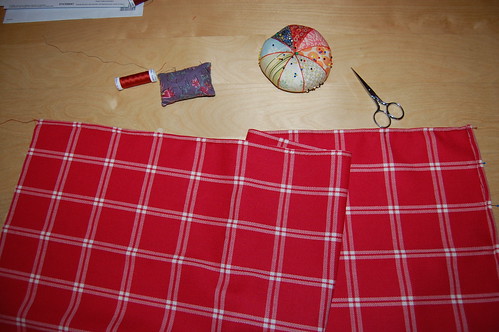
Wm Booth has a new linen coming in the winter, and as the men in my house have outgrown or outworn their shirts, I am thinking of making new check shirts. I did finish a white shirt at Fort Lee, which will go to the Young Mr (his small clothes being now his too-small clothes). I will have to make Mr S a white shirt for best wear, but they could each use a second working shirt. At least with checks you get “cut here” and “sew here” lines.

Last week, I found a weavers’ book in the Arkwright Company Records (Box 1, Folder 1, 1815). It’s a slim, blue paper-covered volume with small samplers glued in to the pages, and full of checks and stripes. Blue and white, red and blue, checks and stripes were prevalent in the late 18th and early 19th centuries. The more I look at extant garments, sample books, and ads, the more I think the streets must have been a vibrant, if grimy, visual riot.

Share this:

  • Share on Facebook (Opens in new window) Facebook
  • Share on Pinterest (Opens in new window) Pinterest
  • Email a link to a friend (Opens in new window) Email
  • Share on X (Opens in new window) X
Like Loading...

To (Ft) Lee or Not to (Ft) Lee?

19 Tuesday Nov 2013

Posted by kittycalash in Events, Living History

≈ Comments Off on To (Ft) Lee or Not to (Ft) Lee?

Tags

10th Massachusetts, 18th century clothes, Brigade of the American Revolution, Events, Fort Lee, living history, Revolutionary War, weather, wool

A Market Girl with a Mallard Duck, pastel by John Russell, 1787. (Sold by Christie's)

A Market Girl with a Mallard Duck, pastel by John Russell, 1787. (Sold by Christie’s)

I like Fort Lee: after all, I like big guns, and Fort Lee has a 32 pound gun.

It’s always cold, though, and I could use a day sewing various projects or vacuuming. But it’s also the last event of the season. Of course, in the slack time, I always stand on the NJ shore wondering how feasible it would be to run over to Manhattan for trim, fabric, or a trip to a museum. In kit. Because…. why not?

But Mr S wants me to come, so I’ve stirred myself to cutting and pressing and starting to hem a wool kerchief. This is made from some crossed-barred wool found in Somerville on the shopping expedition with Sew 18th Century.

She kindly sent me the image above, which is a good thing because I get distracted and think, “you know, that image with the duck and the girl and the bonnet,” which will give you 71,000,000 results in Google, but fortunately includes this one.

Three hems: I should be done by now.

It’s an easy project, but sometimes those are the hardest because you’re not learning anything. That, of course, is what Netflix is for: ghastly murders or sophisticated dramas keep you going on repetitive hems.  (I do my best backstitching to BBC crime dramas– go figure.)

So, a November Saturday up on the Palisades means wool, in fact, requires wool, and for the first time I think I have enough wool to stay reasonably comfortable. That’s a cloak, kerchief, gown and two wool petticoats, plus wool stockings and, if they fit, sheepskin insoles for my shoes. We have a wool shift at work, but at about 50 years later than the Fall of Fort Lee, it provides no justification for a wool flannel shift. Still, a wool shift is a tempting thought, and suddenly that kerchief hem gets more interesting, as I start to think about where to look for documentation of wool or flannel shifts.

Share this:

  • Share on Facebook (Opens in new window) Facebook
  • Share on Pinterest (Opens in new window) Pinterest
  • Email a link to a friend (Opens in new window) Email
  • Share on X (Opens in new window) X
Like Loading...

How many men and a tub?

16 Saturday Nov 2013

Posted by kittycalash in Laundry, Living History, Research

≈ Comments Off on How many men and a tub?

Tags

10th Massachusetts, 18th century, 18th century clothes, authenticity, common people, common soldier, laundry, living history, washing

The Laundry
Louis-Adolphe Humbert de Molard (French, Paris 1800–1874)
1840s, Salted paper print Credit Line: Gilman Collection, Purchase, Ann Tenenbaum and Thomas H. Lee Gift, 2005
2005.100.1241

How many men does it take to know what kind of wood a laundry tub should be made of?
For now, one woman. Yes, I’ve got a new obsession.

It started innocently enough with an exchange about future laundry tubs and an existing tub described as large, made of pine, and badly shrunken. Somehow I found myself burning to know, What is the appropriate wood for a laundry tub made in southeastern New England between 1775 and 1785?

Luckily I work in the kind of place where you might find an answer to that kind of question. In the Miscellaneous Manuscripts Collection, I found George Dods Cooper Accounts (MSS 9001-D Box 4). Mr Dod worked as a cooper in Providence between about 1790 and 1820, so he’s later than I need for this specific application, but I’m not sure the form changes radically before 1850, so Mr Dods seemed like a good place to begin.

While I did not find the hoped-for a receipt for purchases of specific kinds of wood, I did find that Dods was coopering with both iron and wooden hoops, and that he was making barrels, tubs and buckets of unspecified kinds of wood as well as cedar tubs.

1813 Mr Holroid
Nov 19
Sating 4 iron hoops on a Poudering Tub 0=6 0
Sating 6 Wooden Do- on another – Do- 0=3 0

1810
Oct 3 Satting 3 hoops on a large cedar tub 1 firking hoop 0=1-6

1813
July 6 Sating 2 hoops on a Cedar tub 0=1-0

–George Dods Papers, MSS 9001-D Box 4, Folder 2, RIHS Library.

Poudering or powdering tubs were used for salting meat; satting is how Mr Dods spelled setting, and the firking is a firkin. His spelling was idiosyncratic but consistent.
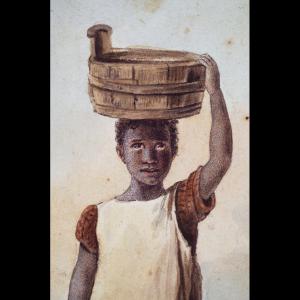
Enslaved Girl 1830 Origin: America, Virginia, Arlington County Primary Support: 6 x 4 1/8in. (15.2 x 10.5cm) Watercolor, pencil, and ink on wove paper Museum Purchase Acc. No. 2007-34,1

Enslaved Girl, 1830
America, Virginia, Arlington County
Watercolor, pencil, and ink on wove paper
Museum Purchase Acc. No. 2007-34,1

So, 1813: a cedar tub. But was it for laundry? I found well buckets and house buckets, ‘poudering’ tubs and pounding barrels, barrels for meat and rum and ‘flower,’ cedar tubs and a ‘tub for Cora,’ but no tub specifically described as a laundry, washing or dish tub.

Searching local library and special collections databases using the appropriate Library of Congress subject terms proved fruitless as well, though eventually I ended up at Williamsburg, where I found an 1830 watercolor drawing of an enslaved girl with a tub on her head. (They call it a tub; you and I might call it a piggin.) This at least confirmed the persistence of the tub style seen in the 1785 British Encampment drawing. I suppose that’s something.

Domestic Engineering and the Journal of Mechanical Contracting, Vol. LX No. 6, page 160. 1912

But still, questions persisted: first, what wood would be right, and secondly, what size should the tub be? There was the thought that pine might not be right, since reputable coopers are making tubs from oak and cedar. Finally did what most of us do when frustrated now: I did a very simple Google search and ended up at Google Books with Domestic Engineering and the Journal of Mechanical Contracting, Volume 60. 

This journal helpfully informed me that Wooden tubs are made out of 1- 1/4 inch white pine grained or dovetailed together at the ends and held together by means of iron rods and went on to explain that Great latitude was generally allowed in the making of wooden tubs as they were usually made on the premises by the carpenter who had no standards to follow. No standards! Doesn’t that explain a lot.

Fully loaded for Saratoga

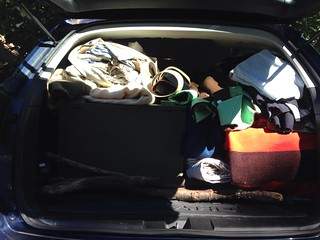
Do I have any clearer direction? Well, clear as mud, maybe. It appears that one could have a tub of unspecified wood, hooped with wood or metal, in which one could do laundry. Or one could follow Domestic Engineering, and consider the current pine tub acceptable, if perhaps in need of mending. (I have not seen it, so I do not know.) I suppose the question is really whether or not all of this business will fit into the supply wagon known as our Subaru.

Share this:

  • Share on Facebook (Opens in new window) Facebook
  • Share on Pinterest (Opens in new window) Pinterest
  • Email a link to a friend (Opens in new window) Email
  • Share on X (Opens in new window) X
Like Loading...

(Not) Spencer Closure

14 Thursday Nov 2013

Posted by kittycalash in Clothing, Making Things, Research

≈ 2 Comments

Tags

18th century clothes, authenticity, Costume, fashion, LACMA, menswear, Metropolitan Museum of Art, museum collections, Research, sewing

Jacob Issacs by Ralph Earl, 1788. Dayton Art Institute

No, I still haven’t written to the museum in Sweden– I had fabric shopping to do. Well, not had to, but when someone offers to take you to a new den of iniquity crack house fabric store you haven’t seen before, you go.

Reader, I scored. Mr S will have a new fabulous and toasty waistcoat thanks to a 5/8 of a yard remnant of the coziest Italian double faced wool I have ever petted. It should be a kitten! Mr Isaacs here has a lovely black waistcoat and while I cannot achieve that fabulousness without a new pattern (sigh) and I think that waistcoat is silk, you get the general green-and-black idea. Mr S totally has that hat.

Coat, French, 1790s. MMA 1999.105.2

But in thinking about the Spencer issue (and yes, I scored some on-sale broadcloth so I can make another one on the way to cutting into that K&P wool), I asked Mr Cooke about clasps, since the Spencers I’m interested in are so very clearly grounded in menswear generally, and uniforms particularly. The answer was what I’d expected: buttons and buttonholes or braid loops on dragoons’ and hussars’ coats, hooks and eyes sandwiched between shell and lining on center-front closing uniform coats.

So I went back to look at menswear, because somewhere the phrase “miniature frock coat” rattled in my head, and I knew I wanted to re-draft the pattern for the front anyway, to get closer to the high stand and fall collar of the Swedish original.

The other collection that’s extremely useful is the LACMA collection, because they have patterns up on their website.

Man's Banyan Textile: China; robe: the Netherlands, Textile: 1700–50; robe: 1750–60 (M.2007.211.797)

Man’s Banyan
Textile: 1700–50; robe: 1750–60 (M.2007.211.797)

I’ve already started to crib a new two-part sleeve pattern from a frock coat pattern, so now I think the next step to getting the look I want is to crib from the LACMA banyan pattern. It’s earlier than the Spencer by some 30 years or more, but the neckline looks like a better place to start.

And, bonus, along the way I’ll learn more about menswear to the ultimate benefit of those guys I sew for.

Share this:

  • Share on Facebook (Opens in new window) Facebook
  • Share on Pinterest (Opens in new window) Pinterest
  • Email a link to a friend (Opens in new window) Email
  • Share on X (Opens in new window) X
Like Loading...

Laundry!

12 Tuesday Nov 2013

Posted by kittycalash in Events, Living History, Reenacting, Research

≈ 2 Comments

Tags

10th Massachusetts, 18th century, 18th century clothes, authenticity, Clothing, common soldier, laundry, Research, washing

James Malton, 1761-1803, A Military Encampment in Hyde Park, 1785, Watercolor with pen in black ink, with traces of graphite on moderately thick, moderately textured, beige, laid paper, Yale Center for British Art, Paul Mellon Collection

James Malton, 1761-1803, A Military Encampment in Hyde Park, 1785, Watercolor with pen in black ink, with traces of graphite on moderately thick, moderately textured, beige, laid paper, Yale Center for British Art, Paul Mellon Collection

I’ve been thinking about laundry, and not just because I did wash yesterday, but also because I’m committed now to learning more about the women of the 10th Massachusetts (dude, it’s on paper). Since I won’t be able to get up to the Mass Archives or MHS until the holiday break, one place I can start is with the material culture of army women’s lives. This is also helpful as I am thinking about asking for a laundry tub for Christmas. (I had an aunt who got a toilet seat for Mother’s Day, and my husband once gave his siblings fire extinguishers for Christmas, so you cannot deny that we have a proud history of gift-giving.)

There’s a lot to love in the detail above, and while there are some things I don’t think you’d find in the 10th Mass camp — from red coats to chairs, even broken–we can still find useful information. After all, if your chair is broken, you have more of a leg to stand on for having a chair.

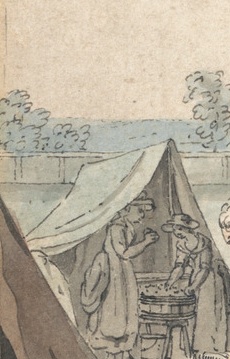
The buckets and washtubs have wooden hoops: that’s a fine detail, and one I appreciate, with my very particular bucket. That means, though, that the washtubs I have in mind might not work, as they have metal bands. My bucket man took a long time to get my bucket right, and he doesn’t make washtubs…but maybe the local man would consider trying a smaller tub. Hard to know, but size will be an issue. It appears there may be two sizes of tub in the image above: a larger tub on the makeshift table at left, and a smaller one on the broken chair.

Detail, James Malton, 1761-1803, A Military Encampment in Hyde Park, 1785, Watercolor with pen in black ink, with traces of graphite on moderately thick, moderately textured, beige, laid paper, Yale Center for British Art, Paul Mellon Collection

Detail, James Malton, 1761-1803, A Military Encampment in Hyde Park, 1785, Watercolor with pen in black ink, with traces of graphite on moderately thick, moderately textured, beige, laid paper, Yale Center for British Art, Paul Mellon Collection

The improvised clothesline is a reassuring detail, being pretty much what I have in mind for our camps, pending some riverbank logging. These taller sticks would then join our kettle or musket-rack sticks as part of the permanent equipage carried by the Subaru baggage train.

We’d been talking about doing a cold wash at work, where a friend was advocating NOT digging a pit and boiling laundry on the lawn, so these washing women intrigued me: none of them are boiling clothes. In fact, there’s no fire to be seen! But look again at where those kettles are. In the detail above and again at left, note a large kettle adjacent to every washtub. Could it be that water was boiled in a larger (enormous) kettle, and dipped into these smaller kettles? The other thing to note is that this seems to be family-based washing  and not regimental-scale washing. Given that I’d probably only have two shifts and four shirts to wash on a good day (they’re wearing their shirts, you see), could this model work?

None of the reenactments we see achieve anything like the scale of the events or activities we’re trying to recreate. Very few of us can cook with five pounds of flour, and there are never enough guys to make up a full brigade in the field. Those truths don’t mean we should skimp or cut corners, but they do mean that we should cut our coat to our cloth. Smaller scale washing could still convey the hassle, necessity, and gender division of the work.

Share this:

  • Share on Facebook (Opens in new window) Facebook
  • Share on Pinterest (Opens in new window) Pinterest
  • Email a link to a friend (Opens in new window) Email
  • Share on X (Opens in new window) X
Like Loading...
← Older posts
Newer posts →

Archives

wordpress statistics

Creative Commons License
Kitty Calash blog by Kirsten Hammerstrom is licensed under a Creative Commons Attribution-NonCommercial-ShareAlike 4.0 International License.

Website Built with WordPress.com.

  • Subscribe Subscribed
    • Kitty Calash
    • Join 621 other subscribers
    • Already have a WordPress.com account? Log in now.
    • Kitty Calash
    • Subscribe Subscribed
    • Sign up
    • Log in
    • Report this content
    • View site in Reader
    • Manage subscriptions
    • Collapse this bar
 

Loading Comments...
 

    %d