• Home
  • Completed Costumes/Impressions
  • Emma and Her Dresses
  • Free Patterns and Instructions

Kitty Calash

~ Confessions of a Known Bonnet-Wearer

Kitty Calash

Tag Archives: authenticity

“All sorts and conditions of women”

13 Monday Jan 2014

Posted by kittycalash in Clothing, History, Laundry, Living History, Reenacting, Research

≈ Comments Off on “All sorts and conditions of women”

Tags

10th Massachusetts, 18th century clothes, authenticity, camp life, common dress, common people, common soldier, cooking, dress, fashion, interpretation, James Peachey, living history, Revolutionary War, tents
img094

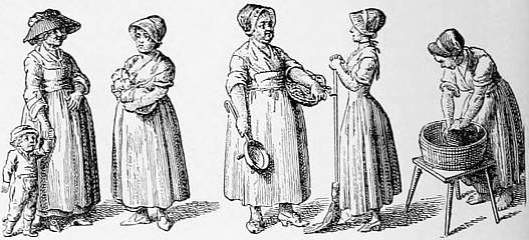
Ever on the track of laundresses and working women, I came upon The Project Gutenberg EBook of The History of Modern Painting, Volume 1 (of 4), by Richard Muther. I was rewarded with  a laundress and a cook holding a spider. Daniel Chodowiecki, a German artist, seems to have been as drawn to the common people as Paul Sandby. The caveat of course is that is he German, so details may not always be correct for American interpretations (pinner aprons, for example).

Still, we have the classic washtub-on-a-table set up, and the laundress is barefoot, which makes very good sense, though my feet hurt just from thinking about standing barefoot on the stubble of the field at Saratoga.

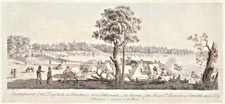
Encampment of the Loyalists at Johnstown, a New Settlement, on the Banks of the River St. Lawrence in Canada, taken June 6th 1784, James Peachey.

Encampment of the Loyalists at Johnstown, a New Settlement, on the Banks of the River St. Lawrence in Canada, taken June 6th 1784, James Peachey.

Laundresses come with style, too, though I am asking myself, “Is that a fabulous hat, or is your head just in front of some balled-up, sleeping livestock?” Was is discernible is that her hair is down, and she is leaning on the washtub. The tent seams are also clearly visible, and she does have the iconic washtub on a table set up.

Encampment of the Loyalists at Johnstown, a New Settlement, on the Banks of the River St. Lawrence in Canada, taken June 6th 1784. James Peachey

Encampment of the Loyalists at Johnstown, a New Settlement, on the Banks of the River St. Lawrence in Canada, taken June 6th 1784. James Peachey

In another detail of the same image, we have a woman who is clearly wearing a black bonnet, tending a kettle on a fire. Here’s yet another piece of evidence for the three sticks-two kettles-no matches set up, and for the tinned kettles being left to get black on the outside.

What is she wearing on her body? There’s a white (or a least white-grounded) kerchief, and what looks like a grey or drab petticoat. But is that a short gown, jacket or bed gown? I’d say jacket, mostly because of the fit, but it’s hard to say at this distance. Whatever word you care to use, she’s wearing a reddish-brown garment fitted to her torso that appears to have a side-back seam.

Once again, tent seams are visible. This tent, just like the one in the other detail, also has some large off-white item thrown over the end. Could it be a blanket, out to air in the sun?

I do also appreciate the short blue jacket/white trousers of the man or boy to the left of the woman, since I know a guy who possesses those clothes and prefers trousers to breeches. He appears to be drinking from a cup as he carries a kettle, presumably of fresh water.
Encampment of the Loyalists at Johnstown, a New Settlement, on the Banks of the River St. Lawrence in Canada, taken June 6th 1784, James Peachey.

Encampment of the Loyalists at Johnstown, a New Settlement, on the Banks of the River St. Lawrence in Canada, taken June 6th 1784, James Peachey.

The entire view of the Loyalists’ camp is here, with a zoomable image. The drawing is full of details applicable to camp life interpretations, from women’s bonnets to fishing rods.

As I contemplate the troublesome Bridget Mahoney, I find the detail below of a solder and a woman rather pleasing.
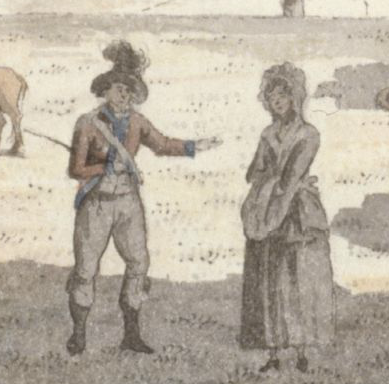
Does she solemnly swear she is up to no good?

Does she solemnly swear she is up to no good?

Share this:

  • Share on Facebook (Opens in new window) Facebook
  • Share on Pinterest (Opens in new window) Pinterest
  • Email a link to a friend (Opens in new window) Email
  • Share on X (Opens in new window) X
Like Loading...

Mummers Crash

05 Sunday Jan 2014

Posted by kittycalash in Events, History, Living History, Reenacting

≈ 3 Comments

Tags

10th Massachusetts, 18th century clothes, authenticity, common people, Events, living history, Major John Butttrick House, masks, Minute Man National Historic Park, Mummers, Twelfth Night

Visards. chipboard, paint and ribbon

On Thursday, Mr S and I got an intriguing invitation from Mr Cooke: would we like to be part of a secret plan to create a disturbance? We are the sort of people who got thrown out of a mattress store just for asking questions, so we said yes. You’re invited to the best riot you know about, you say yes.

This plan involved crashing the Colonial Twelfth Night Party at the Major John Buttrick House in Concord. As mummers. In masks.

‘Mascara’, Givannbi Grevembroch. Venetian, 18th century

This morning, after some very cursory research and reading of the documents we were sent, I made our ‘visards.’ The form is based on the Elizabethan ‘visard’ shown here, and while that object is too early, it seems to be typical of the masks that persist, even into the 18th century.

In the Venetian carnival traditions, this round, black form is known as a moretta, held in place by a button the woman held in her teeth.

We were having none of that– I was supposed to make a ruckus, after all–so I opted for ties, which I sewed on despite the presence of a stapler. The basic form is an oval, 7 inches by 7 inches, but I would recommend cutting the forehead down if you will be wearing this with a hat or bonnet. (I had to trim Mr S’s, and should trim my own.)

Mr S borrowed my blue cloak, we both borrowed sticks for Mr Cooke, who had a very fine, knobby and thorny-looking shillelagh. In the kitchen of the Butterick House, we joined Mr C, Mr JH, and Mr GH to go over the plan one more time, and to try out our lines. Once we were gathered, we put on our masks, hoods, and visards/visages, and felt pretty creepy. Wearing a mask is very disorienting– you don’t look like yourself, but more importantly your vision is altered (especially those who couldn’t wear their glasses under their guides) and significantly limited. I wish I’d practiced a bit more, especially with the mask and bonnet combo’s bucket-on-my head sensation.

Mummer in the house.

We managed not to terrify ourselves but rather to compliment one another on our very fearsome and convincing appearances as rabble-rousing mummers. Mr JH gathered us up, and off  we went slinking out the door and to the street, where Mr Cooke and Mr FC began to sing. The two of them together made a fine and convincing racket, which I was only sorry that Mr S and I could not join (much to learn). We barged into the house and into the room where the very proper guests were gathered, and launched in.

Did I mention this was a secret? There were some confederates in the room, but the sedate civilians were caught unawares and were, according to reports, frightened. (Also very entertained, but also shocked.) A scene played out with the mummers begging for money, teasing guests, and generally causing commotion until the constable arrived and  read us the act prohibiting such behaviour. We protested each clause, but it was clear we had broken the law. Fortunately, the spirit of Christmas prevailed, and on this night before Twelfth Night, we were allowed food and drink if we would let the company alone. It was a happy conclusion for everyone.

Share this:

  • Share on Facebook (Opens in new window) Facebook
  • Share on Pinterest (Opens in new window) Pinterest
  • Email a link to a friend (Opens in new window) Email
  • Share on X (Opens in new window) X
Like Loading...

The Historical Sew Fortnightly: 2013 review, 2014 plans

12 Thursday Dec 2013

Posted by kittycalash in Clothing, Historical Sew Fortnightly, Living History, Making Things, Thanks

≈ 2 Comments

Tags

18th century clothes, authenticity, Costume, dress, fashion, Historical Sew Fortnightly, sewing

The Andes Candies coat at Saratoga

I didn’t get nearly as many things made for the 2013 Historical Sew Fortnightly as I wanted to. Some of the challenges didn’t appeal to me,  but mostly I just couldn’t keep up! Reenacting ate a lot of my life, especially in the late summer and fall. The Andes Candies coat and the What Cheer Day sewing, while totally gratifying, happened when I was thinking about the “Green” color challenge. But, on the positive side, because I’ve waited and played with Spencers, I have a much better pattern plus what I hope will be an entry for HSF #25, the One-Metre Challenge.

Looking ahead to 2014, I can see that July and August are going to be tough. We expect to have a lot going on at work, and the reenacting season will be in full, heavy swing. (Starting July 19th, there are five weeks in a row of events and work. We won’t be able to do everything, so there will be some figuring out to do. Also, our house will be a mess.)

The 2014 Challenges Announced Thus Far:

Last year’s mending. This year: more lost buttons.

Challenge #1, Make Do and Mend, will be a chance to fix things I know are awry. There’s a petticoat hem come undone, some binding that needs reattaching, buttons popped off waistcoats, and haversack straps to be shortened. That’s all without even looking: Imagine what I’ll find if I look (or maybe not, it could get ugly). I think this challenge will help me tidy up after last season, and prepare for the next. There was mending last year, too.

Challenge #2, Innovation, is a little more worrying. I’ve got a major dress project underway, and will have to adapt that to this challenge. Fortunately, I think compere fronts on sacques might count as an innovation, so that will help keep me on track.

Mrs. Elijah Boardman and her Son, William Whiting Boardman. The Huntington Library, 83.8.15

Mrs. Elijah Boardman and her Son, William Whiting Boardman. The Huntington Library, 83.8.15

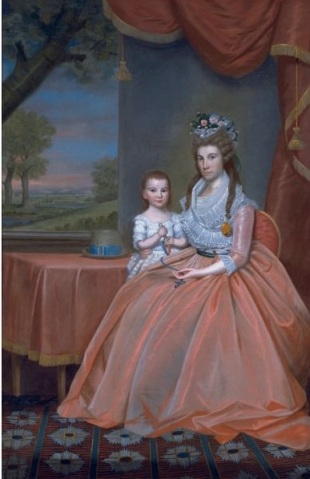
Challenge #3, Pink! Will probably not be mine. None of the things I plan to make are even remotely pink. I thought I had some pink silk and was about to ditch the sacque for a pink Ralph Earl, but it turns out that silk is more lavender than pink. I looked at some pink silk, but then Sew 18th Century helped convince me to buy the cross-barred silk instead. And, like yellow, pink can be unfortunate on me, unless it is coral. Of course, pink can mean red if you’re making traditional hunting clothes…so this could still get interesting. And I know of a receipt for 5/8 of a yard of pink satin…which sounds to me like a waistcoat.

Challenge #4, Under it All, will probably have to be pocket hoops or other skirt supports for the sacque. I have been working on a faux quilted petticoat, with limited success (it may qualify for make do and mend…), but would need hip pads to round out the silhouette properly. Have you noticed this is a bit out of order? Yes, I need the skirt supports first, but six weeks in advance is plenty of time! Well, from this vantage point, anyway. It’ll look like madness on the other side of New Year’s.

I know I’ll miss deadlines and fall behind, I know I’ll get distracted in the summer and stop reading about all the great things people have made, but thanks to the HSF, I’ve kept more on track and become a better seamstress, than I was a year ago. Many thanks and kudos to the Dreamstress and everyone else around the world who joined in, and will join in, on this international sew-along.

Share this:

  • Share on Facebook (Opens in new window) Facebook
  • Share on Pinterest (Opens in new window) Pinterest
  • Email a link to a friend (Opens in new window) Email
  • Share on X (Opens in new window) X
Like Loading...

Muff-ed Up

11 Wednesday Dec 2013

Posted by kittycalash in Clothing, Making Things, Museums, Research

≈ 2 Comments

Tags

18th century, 18th century clothes, 18th century clothing, authenticity, Costume, dress, fashion, fashion plates, museum collections, Research, satire, sewing

Remember the Amazon? She has the dressed-up dog and the Muff of Doom. I’ve gotten a little obsessed with her, and that obsession has led to some interesting places.

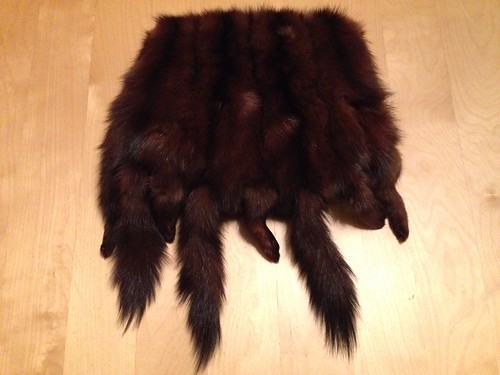
The Muff of Dooms Past. Poor minks.

For one thing, it’s winter, and everybody has cold hands, so everybody is making muffs.

Here at Crazy Scheme Central, I had thought about making the great Ikea sheepskin Muff of Doom, but that’s a place I generally don’t go until after the Christmas madness, when the store in Stoughton does look as if it had been plundered by orcs.

Instead, I bought a Muff of Dooms Past at an antique store. I wouldn’t buy a new real fur anything, and I do feel bad about the poor minks, but at least no new minks were harmed. Or sheep. But golly, it’s soft and delicious and it’s easy to see why people wanted fur, given that we’re essentially hairless mammals. It measures 11 inches high (not including decoration) by 11 inches wide at the narrowest point, and 14 inches wide at the base.

Pupils of nature Maria Caroline Temple delt. ; TS. sculp. London] : Pubd. April 30, 1798, by S.W. Fores, No. 50 Piccadilly, corner of Sachville [sic] St., [1798]. Lewis Walpole Library Call Number 798.04.30.01+

Pupils of nature Maria Caroline Temple delt. ; TS. sculp. London] : Pubd. April 30, 1798, by S.W. Fores, No. 50 Piccadilly, corner of Sachville [sic] St., [1798]. Lewis Walpole Library Call Number 798.04.30.01+

The Muff of Dooms Past is not nearly as large as the Amazon’s muff, or as large as the ones seen in fashion plates and satires.  The sad little tail-and-paw fringe has precedent (see left), though I believe at least one tail has been lost. As far as I can tell, with no label, this is probably a 1950s muff of local manufacture (there is a fur company, now in Warwick, that started in Providence, and is now going out of business). It could be earlier, but the flexibility of the pelts suggests a more recent vintage.

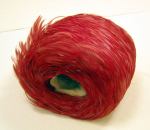
The Met has some fantastic late 18th/early 19th century muffs of a color that screams warmth. The size of the brighter one is just 8 by 7 inches. In case you think that’s anomalous, here’s another muff of similar type and size.

Muff, early 19th century. French, of feathers, wool MMA 2009.300.1397
Muff, third quarter 18th century. British of feathers, fur MMA 1984.101

They seem small compared to the Amazon’s muff, and even the Student of Nature’s. And yet, there they are. It’s hard to know exactly where the measurements were taken, and if they include the extreme fluff of the feathers; I tend to think not, but that the measurements are for the firmest part of the muff. (That’s how we would measure, and then include the largest “fluff” measurements in a ‘special measurements’ field with a note.) There is a 1780-1820 swan’s down muff at the V&A with a record but no photo or measurements.

Satires are hard to use: we know they’re depicting some grain of truth, usually in the background details, but also in what they’re portraying. How do we interpret those enormous muffs? They appear over and over, in consecutive years of satirical engravings and fashion plates. Maybe the way to interpret them is to see those muffs as the extreme end of fashion– Alexander McQueen muffs, if you will– and the extant muffs represent the more reasonable dimensions of fashion. I wouldn’t call red feather muffs typical, and I wouldn’t suggest we all carry them. But based on what exists in museum collections, maybe a smaller-than-satire muff is within the bounds of reason for actual use.

Share this:

  • Share on Facebook (Opens in new window) Facebook
  • Share on Pinterest (Opens in new window) Pinterest
  • Email a link to a friend (Opens in new window) Email
  • Share on X (Opens in new window) X
Like Loading...

HSF # 24: Re-Do (Thank goodness it’s done!)

02 Monday Dec 2013

Posted by kittycalash in Clothing, Historical Sew Fortnightly, Living History, Making Things

≈ Comments Off on HSF # 24: Re-Do (Thank goodness it’s done!)

Tags

18th century clothes, authenticity, common dress, common soldier, Costume, dress, fashion, Historical Sew Fortnightly, menswear, shirts

Shirt, view number one

Shirt, view number one

Like a zombie, I’ve returned to the Historical Sew Fortnightly with an undead shirt. I was working on it in August 2012, and at long last, it is really complete. So I offer it up as the Re-Do for HSF #11: Squares, Rectangles and Triangles, as it has no curves at all. (Well, aside from any wonky cutting I may have done.) It would also work for HSF #15, White, as it is actually white. Things happened in the basket along the way to getting done, and the half-made body had to washed.

The thing about shirts is that they don’t look like much unless they’re well photographed, preferably on a human or a mannequin with arms. I lack the latter, and the former specimens were not worth asking, since they’d been made to work all weekend.

So, some facts are in order. right?

The Challenge: #22, Re-Do. (# 11 and/or #15)

Fabric: White Linen, 5.3 ounce, I think. It was a while ago.

Pattern: This would have been cut from the Kannik’s Korner shirt pattern, though more by using the pieces to mark and measure and make sure I had all the small squares and bits the pattern takes.

Year: 1770-1790, depending. At their class level, the guys can keep wearing this kind of shirt for a long time. (It will be the Young Mr’s.)

Notions: Two thread buttons, one bone button; all three from my strategic reserve as the new selection of thread buttons has vanished (I blame the cat).

How historically accurate is it? Well, let’s give it 75%. It’s all linen, but the selvedges aren’t right, the stitching is variable and the insides are not all finished correctly. Patience, Iago, patience…there will be time for the last felling over whipstitching. I suppose for the common shirt it is, the coarser linen and variable stitching might boost the accuracy a bit. 82% for intentions, points still taken off for knowing what’s wrong with it.

Hours to complete: Freaking endless. I lost count, but in the end, probably five hours to finish button holes, felling, hems, and side gussets. The problem is that it’s repetitive and boring: back stitch, prick stitch, slip stitch, hem, all in straight lines. And this was shirt number three (four is right behind for Mr S) so the thrill’s gone out a bit.

First worn: Rejected in nearly-finished but unhemmed state by the Young Mr at Fort Lee, thoughit would have stayed in his trousers better than his too-small-clothes, he’ll wear this shirt in February at a celebration of Washington’s birthday.

Total cost: $17.74 for the fabric, I forget for the buttons and there’s always thread in the house. Call it $20 all told.

Share this:

  • Share on Facebook (Opens in new window) Facebook
  • Share on Pinterest (Opens in new window) Pinterest
  • Email a link to a friend (Opens in new window) Email
  • Share on X (Opens in new window) X
Like Loading...
← Older posts
Newer posts →

Archives

wordpress statistics

Creative Commons License
Kitty Calash blog by Kirsten Hammerstrom is licensed under a Creative Commons Attribution-NonCommercial-ShareAlike 4.0 International License.

Website Built with WordPress.com.

  • Subscribe Subscribed
    • Kitty Calash
    • Join 621 other subscribers
    • Already have a WordPress.com account? Log in now.
    • Kitty Calash
    • Subscribe Subscribed
    • Sign up
    • Log in
    • Report this content
    • View site in Reader
    • Manage subscriptions
    • Collapse this bar
 

Loading Comments...
 

    %d