• Home
  • Completed Costumes/Impressions
  • Emma and Her Dresses
  • Free Patterns and Instructions

Kitty Calash

~ Confessions of a Known Bonnet-Wearer

Kitty Calash

Tag Archives: authenticity

Occupy Princeton

10 Tuesday Jan 2017

Posted by kittycalash in Events, History, Living History, Reenacting, Thanks

≈ 11 Comments

Tags

authenticity, interpretation, living history, New Jersey, Princeton, Ravages of Princeton, Revolutionary War, winter

Morven Museum (Richard Stockton's house) under occupation. Photo by Al Pochek

Morven Museum (Richard Stockton’s house) under occupation. Photo by Al Pochek

What if they had a reenactment and there was no battle? Can you really interpret military history without a battle?

Why yes; yes, you can. And you can do it well, engaging and exciting visitors and interpreters alike.

Last Saturday, Princeton was under British occupation once again, as we recreated the winter of 1777 this past weekend. I joined the planning for this  back in October– I double checked– and it really started months before that. Many hands (and imaginations) make events like this work, but for me, the most exciting part was helping to produce an essentially civilian day of programming that interpreted the Revolutionary War in New Jersey. Yes, there was “a musket thing” mid-day, but that wasn’t the focus of the action.

The ink froze, but oaths were to be signed anyway. Photo by Al Pochek.

The ink froze, but oaths were to be signed anyway.

HM 17th Regiment made their base of operations/occupation the porch of Morven House (formerly Richard Stockton’s residence) while the populace of Princeton attempted to go about their daily lives in Palmer Square. Quakers found themselves pressed to sign the Oath of Allegiance to King George III, despite their protestations that they could not take sides in a war.
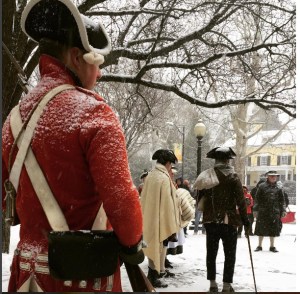
Quakers and citizens, surrounded by occupying troops, listen to the officer's exhortations. From instagram @thebentspoon

Quakers and citizens, surrounded by occupying troops, listen to the officer’s exhortations. From instagram @thebentspoon

Some citizens seemed all too eager to sign the Oath, though rumor had it that one had previously pledged his loyalty to the rebel cause. (Sources have it that by the summer of 1778, this miscreant will be exacting revenge upon his neighbors as a Retaliator.)

Vignettes were drawn from documentation like the Brief Narrative of the Ravages of the British and Hessians at Princeton, 1776-1777:

“Triumph on that Days Victory the noted third day of January 1777 when they took two men and a Woman that could not stand Prisoners one of the men being much younger then the other & haveing shoes on made his Escape The Woman being unable to march they left her so they had in truth none from Princetown to Crown their Conquest with but the poor Old Captive without shoes. This is the Renowned Victory Obtained that day near Prince- town Which (it is said) is amply set forth in one of the New York newspapers 1 to be a Compleat victory obtained by the Regulars over the Continental Army so far as I have Related is true according to best Information that I can get, And so far I agree with that news Paper that the Regulars gained a Victory over two men and one woman. …. In takeing these three Prisoners they violated three of their Officers Protections for the two men had Each of them one, and the Womans Husband had another Besides they are all Reputed Quakers…” (Brief Narrative pp 18-20)
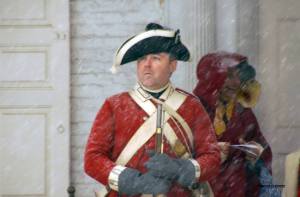
Lance Corporal Becnel proved himself in the afternoon.

Lance Corporal Becnel proved himself in the afternoon. Photo by Al Pochek

The constant snow kept our shoes on, but goods were stolen, occupants assaulted, soldiers beaten, prisoners taken, and justice served.

Hardy visitors followed us from Morven to Palmer Square and back, and one of the most exciting moments of the day for me was when a visitor said, “Wow, so the [British] soldiers didn’t really protect you, did they? You couldn’t count on them to keep you safe!” This seemed a pretty good summation of our interpretive goals:

  • The British failed to win the “hearts and minds” of New Jersey residents because they turned liberation into occupation.
  • The British lost the war in New Jersey because they treated everyone as a traitor.
  • The revolutionary war in New Jersey was as much a civil war as a rebellion against the crown.

I count that a major win for living history.

Share this:

  • Share on Facebook (Opens in new window) Facebook
  • Share on Pinterest (Opens in new window) Pinterest
  • Email a link to a friend (Opens in new window) Email
  • Share on X (Opens in new window) X
Like Loading...

Trigger Warnings

05 Thursday Jan 2017

Posted by kittycalash in Events, History, Living History, Reenacting

≈ Comments Off on Trigger Warnings

Tags

authenticity, common soldier, difficult interpretations, first person interpretation, interpretation, living history, New Jersey, Princeton, Revolutionary War

Reenactors portraying Philadelphia Associators take part in the real time tour of the Battle of Princeton, Princeton, NJ, January 3, 2015. Beverly Schaefer, Times of Trenton

Philadelphia Associators January 3, 2015. Beverly Schaefer, Times of Trenton

It’s upon us, this Princeton event, and Peale’s, too. And the overnight march I missed two years ago. I’m so glad to be part of this, and I’m interested in seeing where it goes from here– partly for me, and partly for the way we do living history. Now, I’ll miss some of what I’d like to see (like Mr. White’s tour of the second battle of Trenton, but when you’re plundering in Princeton, you’re committed.) A formal media release may be downloaded here.

A little more than two years ago I was asked if I wanted to join the Peale’s March to Princeton. I said no, because women couldn’t march and that was the experience I wanted. Someday, I will have the hallucination that allows me to square experiential learning with authenticity, and, at the same time, the world will care about having a women’s Tour de France.

Anyway: there’s a point. This event became a pivot point for me in thinking about accuracy and authenticity of all kinds.

Accurate impressions rendered in a place of shared value will transport you to the past, and give you insights you did not expect. That is the point of these exercises: insight and understanding. It’s how to get high on history.

Test run: bedspread petticoat. Girl's gotta keep warm.

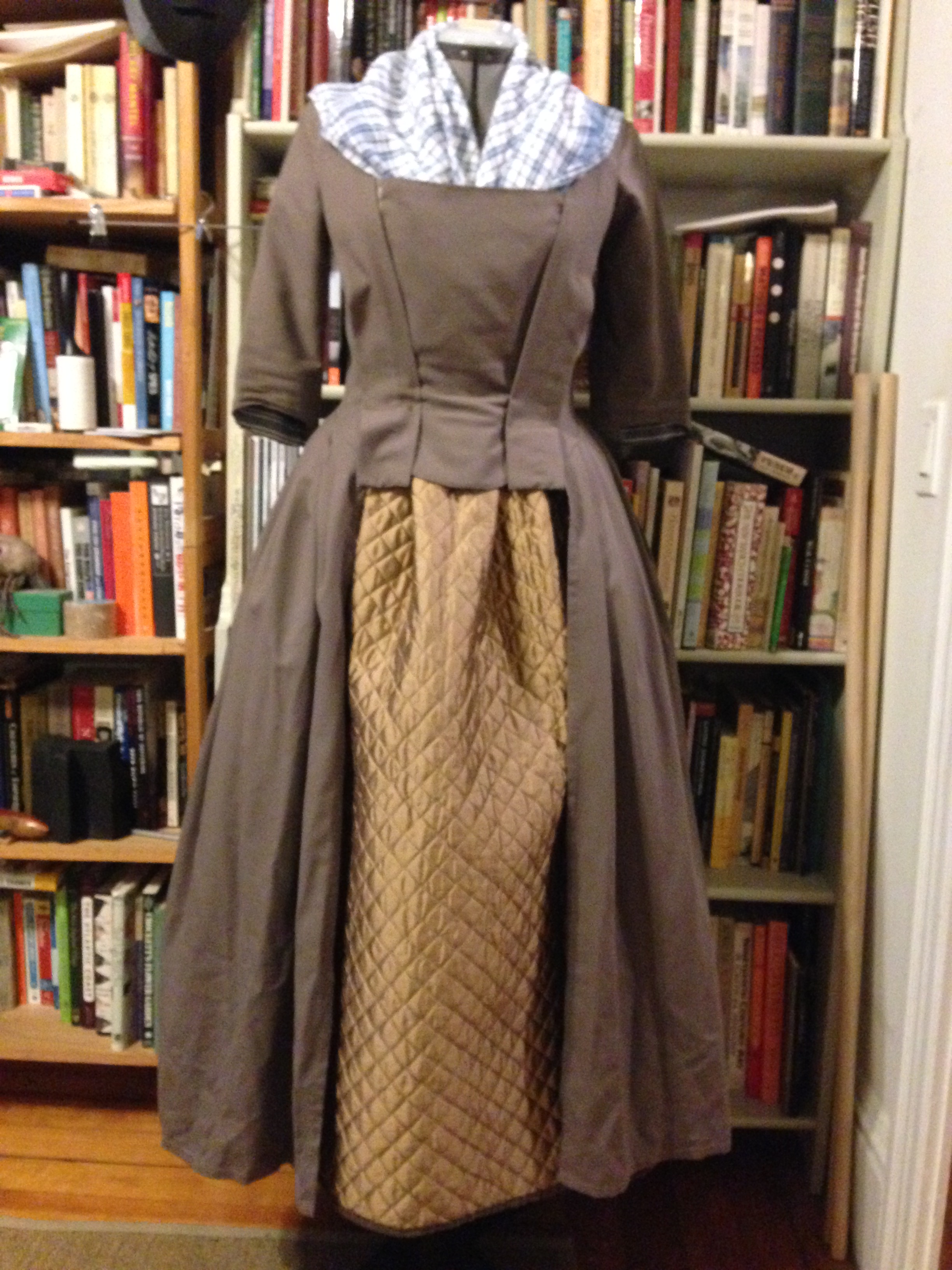
Test run: bedspread petticoat. Girl’s gotta keep warm.

In Palmer Square and at Morven, that means stealing (from each other), soldiers arresting Quakers, Loyalists and Whigs insulting each other, arguments about loyalty oaths, and women being attacked. (When you see the grey gown grabbed off the square by the red coat, please know that this is acting.) It means rough justice in a drum head court martial.

Will it work? I think so. Will it change my life, the way not attending two years ago did? That will depend on what I regret.

Share this:

  • Share on Facebook (Opens in new window) Facebook
  • Share on Pinterest (Opens in new window) Pinterest
  • Email a link to a friend (Opens in new window) Email
  • Share on X (Opens in new window) X
Like Loading...

Museum Fail: Icon, not Replica

21 Wednesday Dec 2016

Posted by kittycalash in Art Rant, Fail, History, material culture, Museums

≈ Comments Off on Museum Fail: Icon, not Replica

Tags

authenticity, collections, difficult interpretations, exhibits, interpretation, material culture, Museums, National Marine Corps Museum, objects

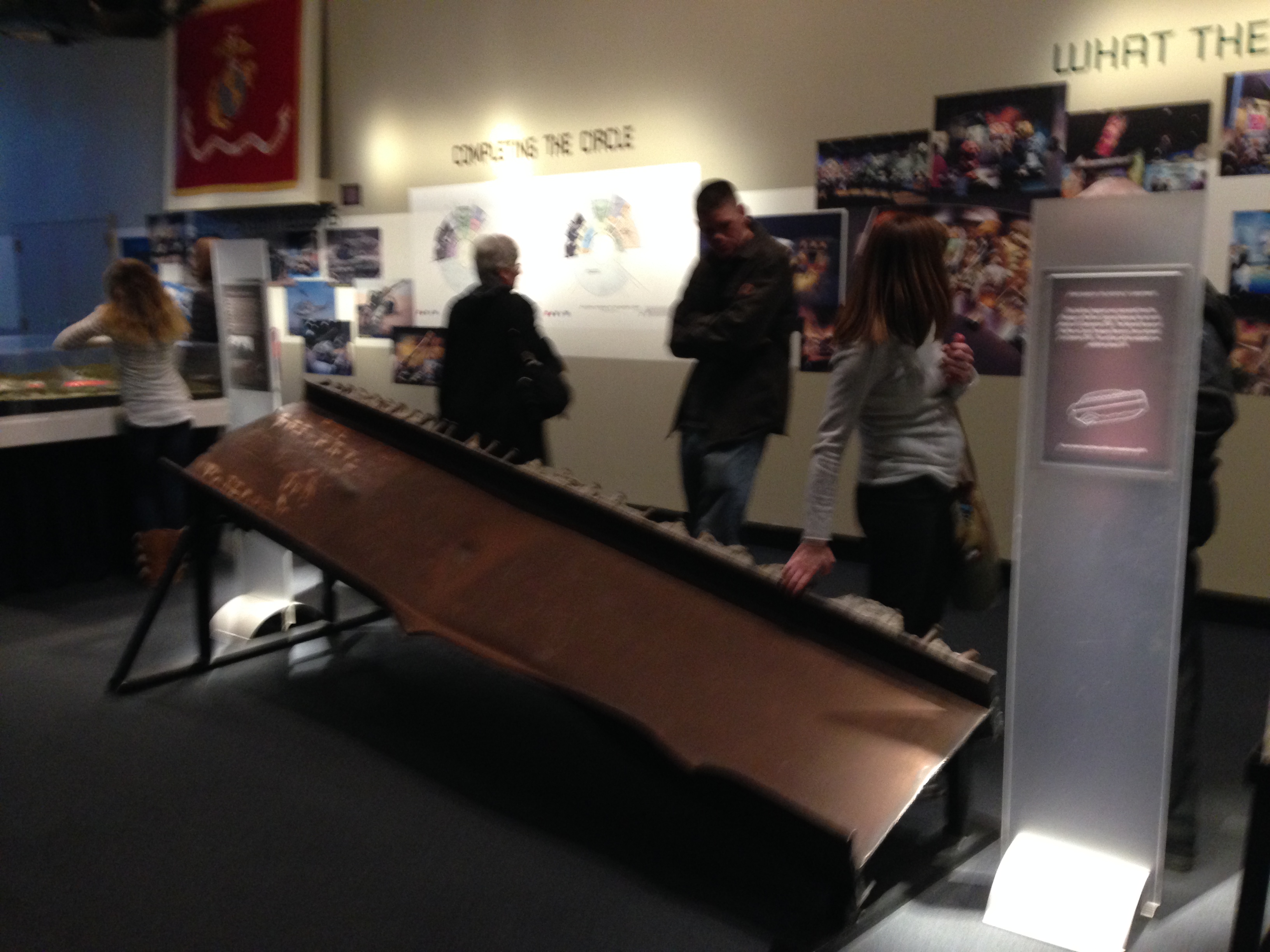
img_8606

What am I?

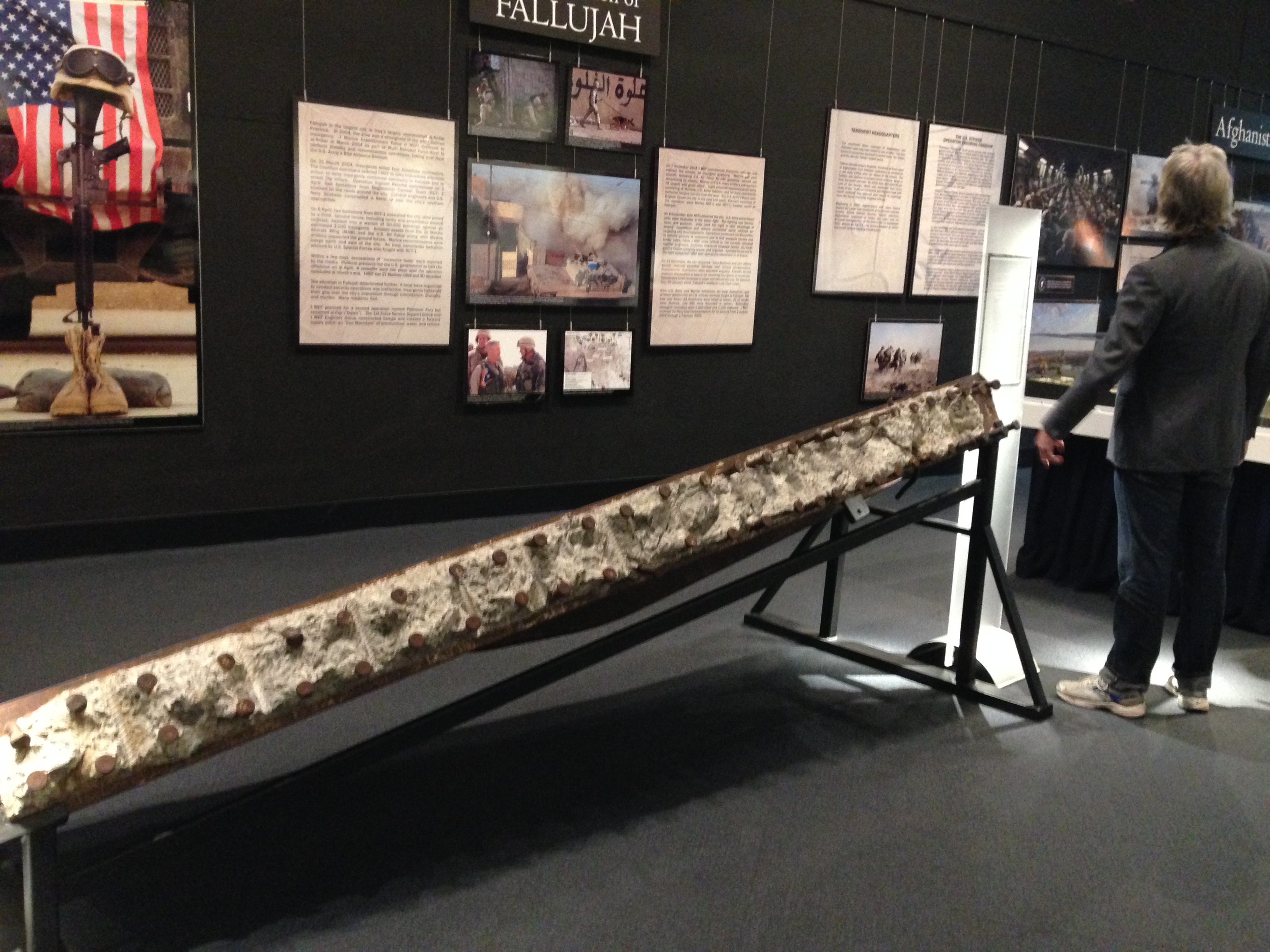
Do you know what this is? Do you think it’s real? Here’s a clue: it’s a relic of an iconic event in early 21st-century North America.

On the last visit to the National Marine Corps Museum, I watched the tourists circle objects at the end of the traditional galleries and displays, and overheard a woman ask her companions:

What’s this a replica of?

Reader, I cringed– and not for the sentence construction.

What's this a replica of?

What’s this a replica of?

And then I stepped back. I thought that for someone my age it would be obvious. Here, have some additional museum context.
img_8604

In a museum where everything is real, how does a visitor come to ask not only if that World Trade Center steel beam is a replica, but what is it replicating? I’m not sure semiotics can save us here. My first, New York Times-reading, media-soaked, Northeast Corridor response was, How can you miss that? How can you not recognize that, let alone mistake the steel and concrete relic for a replica?

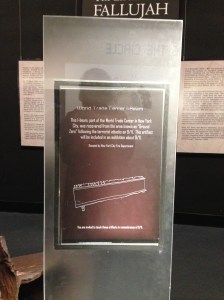
img_8603

Ah, hubris. There is a label, though I have seen better. Would it be more helpful in a larger font, turned perpendicularly to the I-beam? Possibly. But the lesson that’s deeper than label formatting and placement is recognizing how much we take for granted. Our visitors, even those we assume to be educated consumers of media and information, may not share our knowledge base. They may not read objects or images as readily as we think they do; we certainly cannot assume they’re all taking away the same information– and that has nothing to do with education or background.

Everyone truly sees the world differently. How, and what, we choose to put on a label should always be grounded in remembering that we do not all share the same information. Context is critical, and probably would have made these relics more real, and less replica.

Share this:

  • Share on Facebook (Opens in new window) Facebook
  • Share on Pinterest (Opens in new window) Pinterest
  • Email a link to a friend (Opens in new window) Email
  • Share on X (Opens in new window) X
Like Loading...

Change

20 Tuesday Dec 2016

Posted by kittycalash in personal, Philosophy

≈ Comments Off on Change

Tags

authenticity, Hamilton, interpretation, personal, philosophy

my-obama-me_20-12-16-1

Changing seasons, change we can believe in, be the change you want to see in the world.

This dumpster fire of a year is nearly over, and the commonplace is to note how much has changed: that’s our human instinct. But much does not change, most often within ourselves.

It’s our perception or understanding that changes, and, if we are lucky, causes us to act. That’s the mechanism behind the progressive movement in enacting/reenacting/living history. It’s the mechanism behind organizational change, and personal change. Sometimes it’s the sole inspiration to get me to clean my house. Holy cats, that’s a lot of kitty fur! As the sun finally shines in on the rug.

Sometimes we push as hard as we can to make change happen, but lack access to all the levers: then we have to wait. I am waiting now: I have pushed every lever and turned every knob within my reach, and the waiting is agony.

High school seniors applying to college know this feeling: when will I know? People starting new habits wonder, when will I see a difference? As a species, we have trouble with time. But tiny changes and tweaks aggregate, accrue over time like compound interest. We’ll get there.

Think about what you used to know, and what you know now, how you’ve learned more about what (or who) you love, how the way you approach a problem from collar stands to coat names. All those little changes make a difference– all the difference, the only difference.


Share this:

  • Share on Facebook (Opens in new window) Facebook
  • Share on Pinterest (Opens in new window) Pinterest
  • Email a link to a friend (Opens in new window) Email
  • Share on X (Opens in new window) X
Like Loading...

Sideways Into Immersion

04 Sunday Dec 2016

Posted by kittycalash in History, Museums

≈ 1 Comment

Tags

authenticity, history, interpretation, Museums


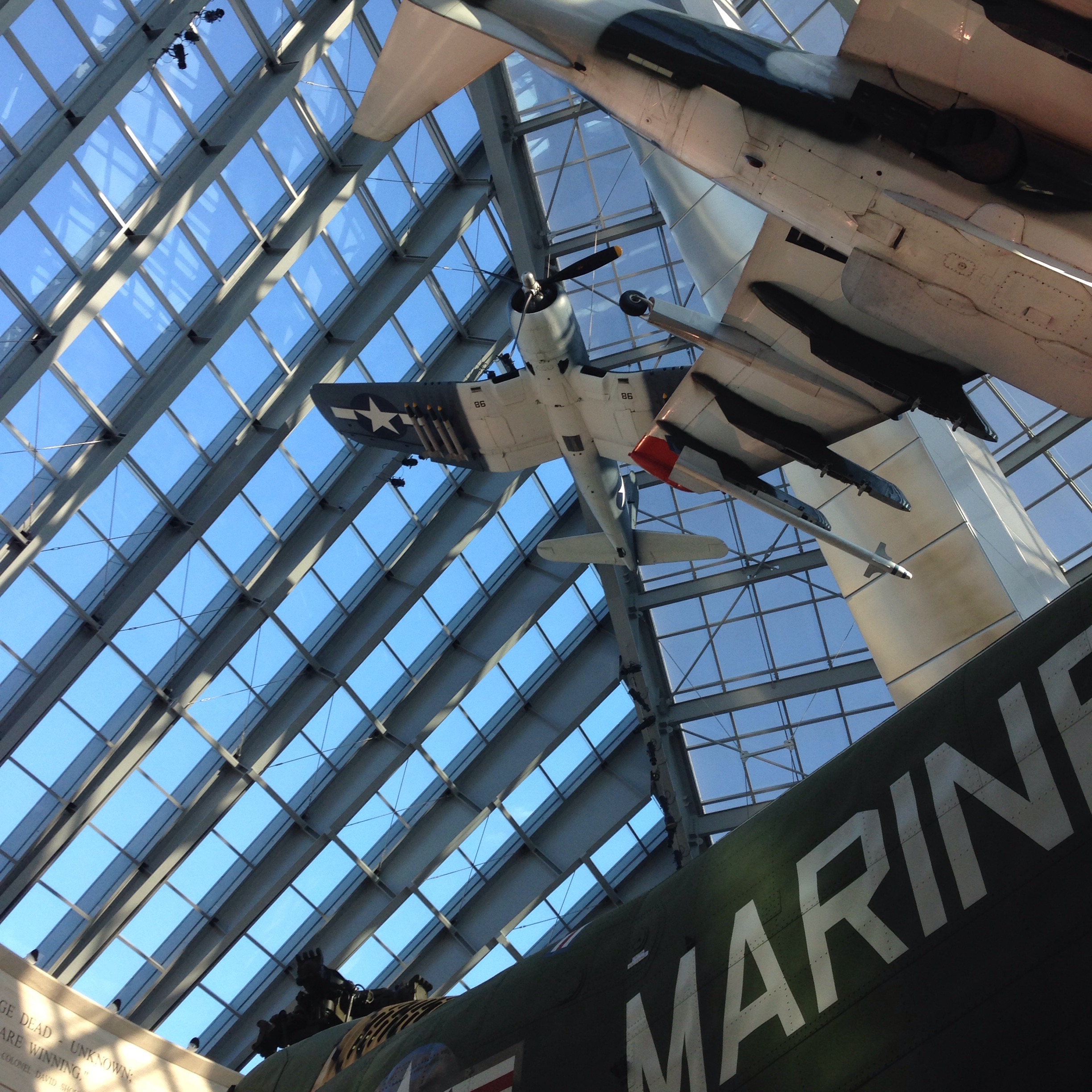
I was recently asked where I found inspiration for my work, and the obvious answer was in my travels, from the arrangement of bannister-back chairs on the wall at the Yale University Art Gallery to men shaving with straight razors on the parade ground at Fort Ticonderoga. There’s a kind of middle-ground answer as well: the National Museum of the Marine Corps.


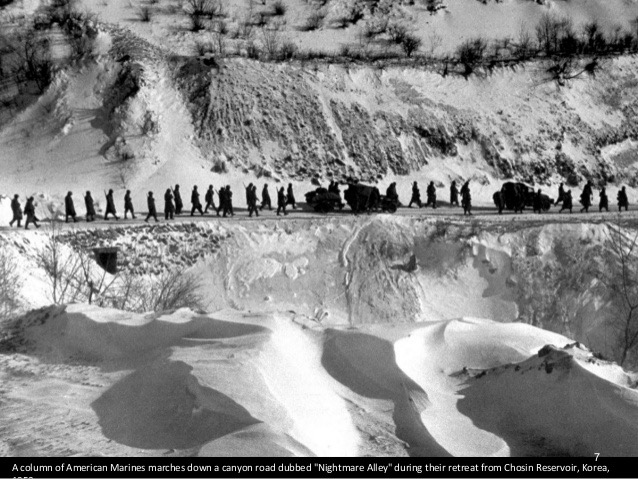
Drunk Tailor took me there almost a year ago, and since What Cheer Day prompted me to think about emotional goals, I’ve wanted to go back. Anna asked about uncomfortable emotions, and while Sharon is absolutely right about the United State Holocaust Memorial Museum being necessary, it was the NMMC’s 20th century displays that came to mind, particularly Chosin and Khe Sanh– Chosin all the more so after watching the American Experience program on the battle of Chosin.


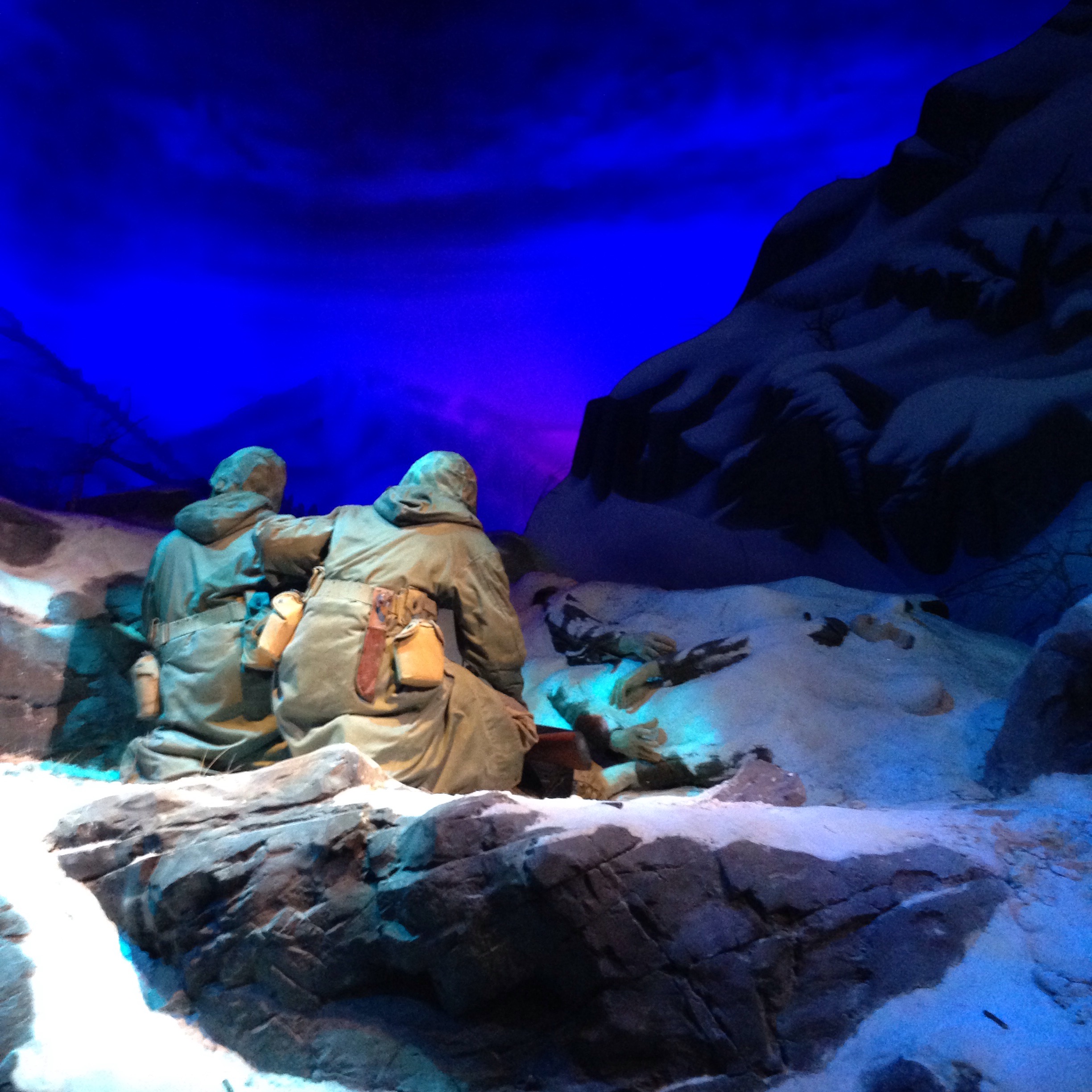
A year ago, the Chosin Reservoir gallery experience resonated with me because it was so well done. Reproductions of David Douglas Duncan photos (he sticks with me because, like Omar Bradley, he came from Missouri) hang on the wall beside two glass doors. To the right, a film runs on a loop, framed by cast resin icicles. Open the doors, and even Drunk Tailor and I are dwarfed by the landscape looming out of the dark. Figures of Marines crouch above us, sheltering behind a snowbank…of dead, frozen Marines. Artillery rounds burst against the dark sky, and I wrap my coat around me because, more than fearful or shocked by the noise and lights, I’m cold. Really cold.

There’s no possible way a gallery –even a Marine Corps Museum gallery– can replicate a fraction of the Chosin experience, but the gallery succeeds in shocking our senses through the simple use of temperature shift, and that is enough to take us out of the everyday. Physical discomfort prompts an emotional shift that allows us to better empathize with, and understand, the experience of the Marine at Chosin. Now, the NMMC and I may have very different takeaways from this gallery: while I absolutely respect and admire the Marine corps (c’mon, I sew OD gowns while binge-watching The Pacific), my instinctive response is No More Wars. That’s a complicated response to have in a military museum, and one I feel more strongly at the NMMC than I have at the West Point Museum.

I attribute these different responses to the greater sophistication of the NMMC compared to the WPM, which presents very standard uniform/flag/weapon/label displays. The NMMC begins that way (the sole “motion” in the earliest galleries is stylized seagulls against a blue sky), and while I love roundabouts and shakos nearly as much as Drunk Tailor, these galleries do not connect us to the history as immediately — as emotionally– as Chosin and Khe Sahn.

img_0821

img_0821


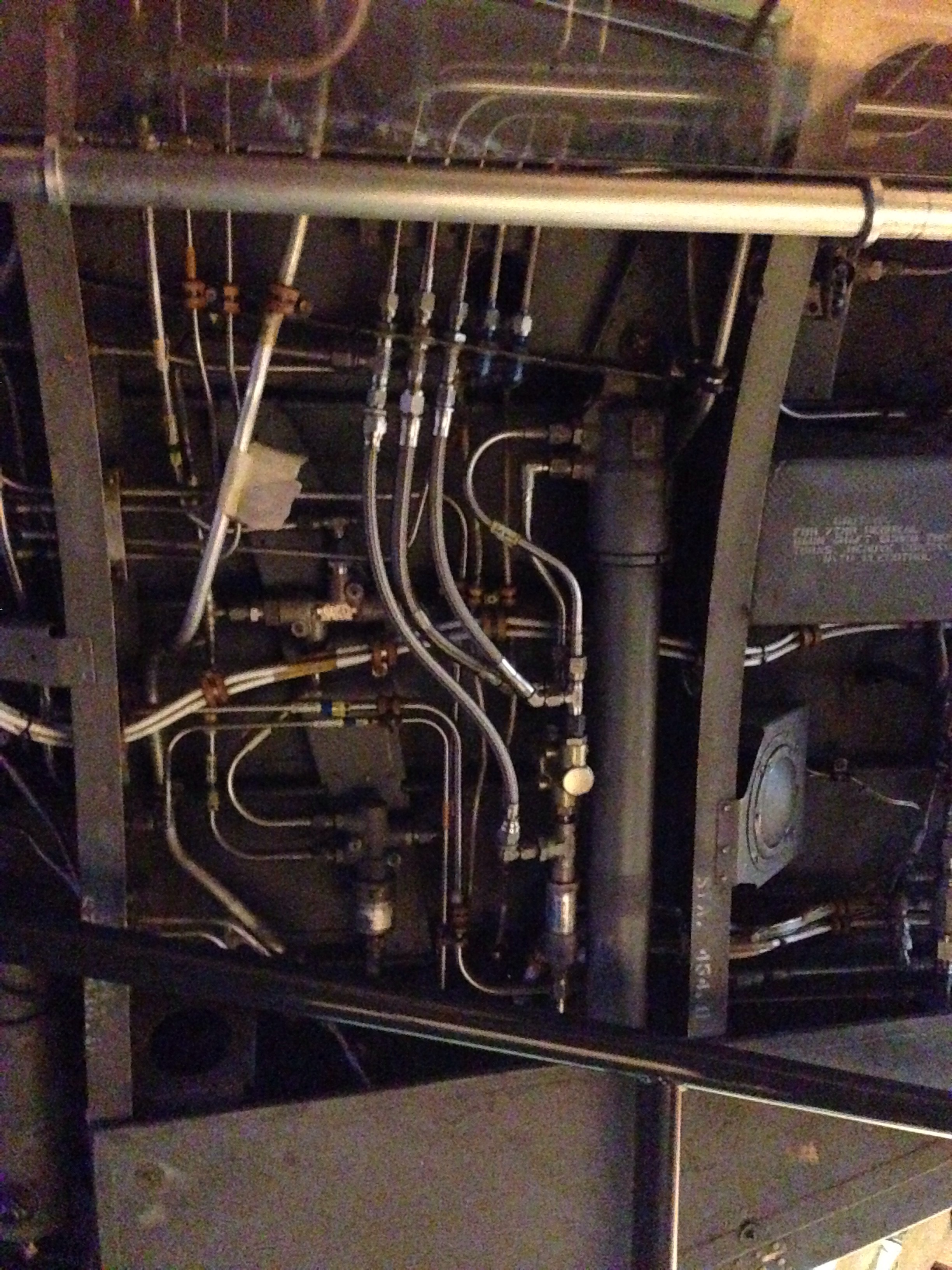
Khe Sahn was slightly disappointing this visit compared to last year. To be sure, the helicopter entrance continues to impress me, but I recall the gallery having higher heat and more rats, as well as louder volume. The temperature contrast was particularly notable against Chosin, and I remember taking my coat off in the Khe Sahn gallery last year. Despite those differences, a toddler entering Khe Sahn promptly turned around to leave. The radio noise was clearer this year, and I suspect that the gallery continues to be fine-tuned, as staff attempt to balance the noise of the siege against the noise of the entrance. This is a place where a faint odor of hydraulic fluid lingers in the helicopter, and probably prompted the emotional response Drunk Tailor observed visiting with veterans.


The bottom line, though, is that mindful use of sensory input in any museum can increase visitors’ emotional connection to, and engagement in, the material presented. Visitors are smart: it won’t take much for them to notice a smell, temperature or sound, so even the most cautious museums can sidle into more sensory engagement.

Share this:

  • Share on Facebook (Opens in new window) Facebook
  • Share on Pinterest (Opens in new window) Pinterest
  • Email a link to a friend (Opens in new window) Email
  • Share on X (Opens in new window) X
Like Loading...
← Older posts
Newer posts →

Archives

wordpress statistics

Creative Commons License
Kitty Calash blog by Kirsten Hammerstrom is licensed under a Creative Commons Attribution-NonCommercial-ShareAlike 4.0 International License.

Website Built with WordPress.com.

  • Subscribe Subscribed
    • Kitty Calash
    • Join 621 other subscribers
    • Already have a WordPress.com account? Log in now.
    • Kitty Calash
    • Subscribe Subscribed
    • Sign up
    • Log in
    • Report this content
    • View site in Reader
    • Manage subscriptions
    • Collapse this bar
 

Loading Comments...
 

    %d