• Home
  • Completed Costumes/Impressions
  • Emma and Her Dresses
  • Free Patterns and Instructions

Kitty Calash

~ Confessions of a Known Bonnet-Wearer

Kitty Calash

Tag Archives: Clothing

Dogs in Coats

03 Tuesday Dec 2013

Posted by kittycalash in Clothing, Making Things, Research

≈ 6 Comments

Tags

18th century clothes, Clothing, Costume, dog coats, dogs, dress, fashion, fashion plates, Spencer

[An amazonian dress]. London : Pubd. May 26, 1797, by G.M. Woodward, Berners Street. Lewis Walpole Library Image Number lwlpr08972, Call Number 797.05.26.02

[An amazonian dress]. London : Pubd. May 26, 1797, by G.M. Woodward, Berners Street. Lewis Walpole Library Image Number lwlpr08972, Call Number 797.05.26.02

I was wondering about contrast revers on women’s clothes, and if I could really get away with such a detail on a Spencer, when I happened upon this image on Pinterest. Well found indeed from 1797, and very nice hat as well. Bonus: Giant Muff.

The dog has a coat, too, and now that it’s cold in New England, the local whippets are turning out in their winter coats. Mr S and  I had a slightly crazy notion to dress a dog we know in a canine-scaled replica of a certain very special coat, but would need access to the hound (for measurements) and a particular scrap pile. With those circumstances not in the offing, let’s just be delighted that dogs in 1797 wore coats, and had bows in their topknots, which means that the end of civilization has been coming for a lot longer than previously thought.

Of course it may be that the dog has to dress as a human to keep from being eaten by the ENORMOUS and possibly carnivorous MUFF of DOOM. I think you could make one from the sheepskins at Ikea, if you could settle for white.

Share this:

  • Share on Facebook (Opens in new window) Facebook
  • Share on Pinterest (Opens in new window) Pinterest
  • Email a link to a friend (Opens in new window) Email
  • Share on X (Opens in new window) X
Like Loading...

A Good Day for a Greatcoat

27 Wednesday Nov 2013

Posted by kittycalash in Clothing, History

≈ 7 Comments

Tags

18th century clothing, Clothing, common dress, menswear, weather

A greatcoat or driving coat from 1812

A greatcoat or driving coat from 1812

It is lashing rain on the windows chez Calash, and soon enough the present-day chariot known as the Subaru will commence hauling Mr S to the train station and the Young Mr to school. Bikes and buses are unpleasant in the rain, though the Young Mr is always (and only) driven to school on Wednesdays due to a peculiar busing and schedule arrangement.

But what if they lacked this luxury, and had to venture out? The way it sounds out there, the smartest choice would be to stay at home by the fire, but someone  has to fetch the wood and the water, and someone has to milk the cow and fetch the fool cat in.

b201bb1306af9b5d4dfbbe8fdb321ea8

Greatcoat, Chester County Historical Society. from Fitting and Proper, by Sharon Burnston. Scurlock Publishing, 1999.

If you could afford one, you’d wear your greatcoat (new or second-hand).

Made of broadcloth, this would be your non-flammable water-resistant choice for inclement weather. Woven and then milled, the fabric would be dense enough to resist water and hold a cut edge, which makes those capes a more winning proposition.

Over a slim-cut body, layered capes can emphasize and exaggerate shoulder width, making these utilitarian garments sexier than you’d expect. (Of course, I have a thing for guys dressed like this, so your mileage may vary. But by the Civil War, the lines are boxy and, well, yawn.)

Greatcoats aren’t even remotely on my list for this year, but someday I’d like to make one, if only to borrow it. Baby, it’s cold outside.

Share this:

  • Share on Facebook (Opens in new window) Facebook
  • Share on Pinterest (Opens in new window) Pinterest
  • Email a link to a friend (Opens in new window) Email
  • Share on X (Opens in new window) X
Like Loading...

The Checkered Past

26 Tuesday Nov 2013

Posted by kittycalash in Clothing, History, Research

≈ 3 Comments

Tags

18th century clothes, authenticity, Clothing, common dress, common people, common soldier, Costume, dress, exhibits, fashion, living history, Research, resources, Rhode Island

Coat, 1790s American CB: 38 in. Gift of The New York Historical Society, 1979.346.42. MMA
Textile Sample Book, 1771. British Rogers Fund, 156.4 T31, MMA

Some gentlemen I know should consider what they might want to do to avoid (or alternately, encourage) having this coat made for them. It’s really a lovely thing, found as the best things are, while looking for something else.

It reminded me, too, of the textile sample book at the Met, currently on display in the Interwoven Globe exhibition. (No, I haven’t seen it; I’m going to try, but…).

Wm Booth has a new linen coming in the winter, and as the men in my house have outgrown or outworn their shirts, I am thinking of making new check shirts. I did finish a white shirt at Fort Lee, which will go to the Young Mr (his small clothes being now his too-small clothes). I will have to make Mr S a white shirt for best wear, but they could each use a second working shirt. At least with checks you get “cut here” and “sew here” lines.

Last week, I found a weavers’ book in the Arkwright Company Records (Box 1, Folder 1, 1815). It’s a slim, blue paper-covered volume with small samplers glued in to the pages, and full of checks and stripes. Blue and white, red and blue, checks and stripes were prevalent in the late 18th and early 19th centuries. The more I look at extant garments, sample books, and ads, the more I think the streets must have been a vibrant, if grimy, visual riot.

Share this:

  • Share on Facebook (Opens in new window) Facebook
  • Share on Pinterest (Opens in new window) Pinterest
  • Email a link to a friend (Opens in new window) Email
  • Share on X (Opens in new window) X
Like Loading...

About that Spencer…

13 Wednesday Nov 2013

Posted by kittycalash in Clothing

≈ 2 Comments

Tags

buttons, Clothing, fashion, mistakes, Regency, sewing, silk, Spencer, worsted

It's better on a human than on a hanger.

It’s better on a human than on a hanger.

Take my Spencer, please.

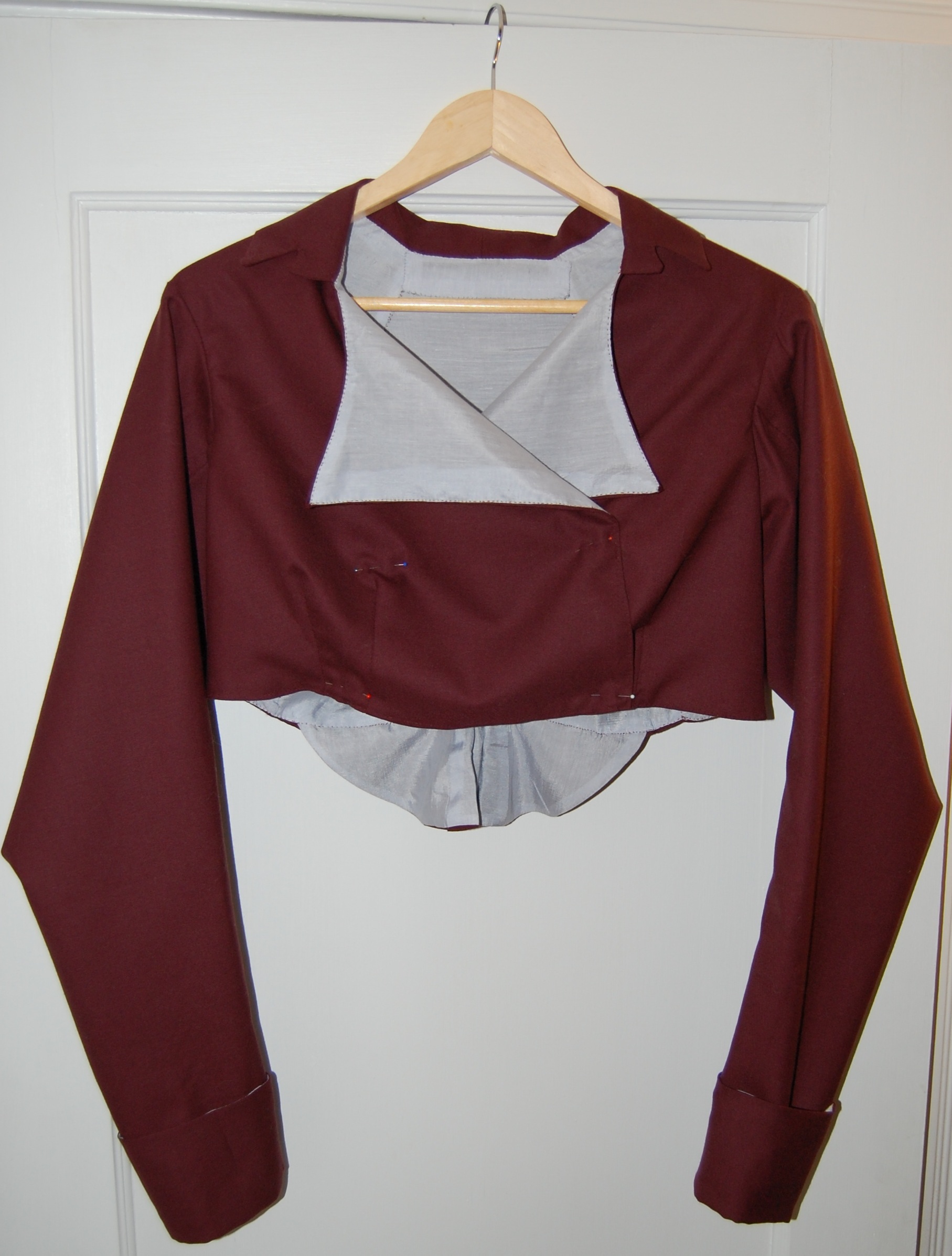
I’m close to being finished– all that remains are closures, but the sewing is done. It fits, though I haven’t yet tried it on over stays.  It looks less wretched in the mirror than it does on a hanger, I will give it that.

The wool is a yard and a quarter worsted remnant, and while it has a nice hand, it was sometimes annoying to press. It may have been the fault of the silk, though; I used a very light weight silk–even lighter than Booth’s “persians”– and that was probably a mistake.

DSC_0405

Last-minute peplum and button additions.

The Swedish Spencer closes with clasps, and while hooks and eyes are pretty common for center-closing garments (men’s and women’s) “clasps” was new to me. The double-breasted riding habit coat in Janet Arnold (from the Salisbury Museum, no photos online) closes with covered buttons. That seems reasonable for this worsted trial garment. I’m beginning to wonder if the Swedish Spencer is really finished, or if the clasps might be a later addition. Time to write a letter, I think…

Share this:

  • Share on Facebook (Opens in new window) Facebook
  • Share on Pinterest (Opens in new window) Pinterest
  • Email a link to a friend (Opens in new window) Email
  • Share on X (Opens in new window) X
Like Loading...

Laundry!

12 Tuesday Nov 2013

Posted by kittycalash in Events, Living History, Reenacting, Research

≈ 2 Comments

Tags

10th Massachusetts, 18th century, 18th century clothes, authenticity, Clothing, common soldier, laundry, Research, washing

James Malton, 1761-1803, A Military Encampment in Hyde Park, 1785, Watercolor with pen in black ink, with traces of graphite on moderately thick, moderately textured, beige, laid paper, Yale Center for British Art, Paul Mellon Collection

James Malton, 1761-1803, A Military Encampment in Hyde Park, 1785, Watercolor with pen in black ink, with traces of graphite on moderately thick, moderately textured, beige, laid paper, Yale Center for British Art, Paul Mellon Collection

I’ve been thinking about laundry, and not just because I did wash yesterday, but also because I’m committed now to learning more about the women of the 10th Massachusetts (dude, it’s on paper). Since I won’t be able to get up to the Mass Archives or MHS until the holiday break, one place I can start is with the material culture of army women’s lives. This is also helpful as I am thinking about asking for a laundry tub for Christmas. (I had an aunt who got a toilet seat for Mother’s Day, and my husband once gave his siblings fire extinguishers for Christmas, so you cannot deny that we have a proud history of gift-giving.)

There’s a lot to love in the detail above, and while there are some things I don’t think you’d find in the 10th Mass camp — from red coats to chairs, even broken–we can still find useful information. After all, if your chair is broken, you have more of a leg to stand on for having a chair.

The buckets and washtubs have wooden hoops: that’s a fine detail, and one I appreciate, with my very particular bucket. That means, though, that the washtubs I have in mind might not work, as they have metal bands. My bucket man took a long time to get my bucket right, and he doesn’t make washtubs…but maybe the local man would consider trying a smaller tub. Hard to know, but size will be an issue. It appears there may be two sizes of tub in the image above: a larger tub on the makeshift table at left, and a smaller one on the broken chair.
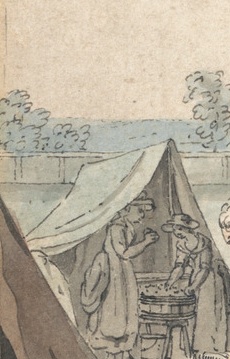
Detail, James Malton, 1761-1803, A Military Encampment in Hyde Park, 1785, Watercolor with pen in black ink, with traces of graphite on moderately thick, moderately textured, beige, laid paper, Yale Center for British Art, Paul Mellon Collection

Detail, James Malton, 1761-1803, A Military Encampment in Hyde Park, 1785, Watercolor with pen in black ink, with traces of graphite on moderately thick, moderately textured, beige, laid paper, Yale Center for British Art, Paul Mellon Collection

The improvised clothesline is a reassuring detail, being pretty much what I have in mind for our camps, pending some riverbank logging. These taller sticks would then join our kettle or musket-rack sticks as part of the permanent equipage carried by the Subaru baggage train.

We’d been talking about doing a cold wash at work, where a friend was advocating NOT digging a pit and boiling laundry on the lawn, so these washing women intrigued me: none of them are boiling clothes. In fact, there’s no fire to be seen! But look again at where those kettles are. In the detail above and again at left, note a large kettle adjacent to every washtub. Could it be that water was boiled in a larger (enormous) kettle, and dipped into these smaller kettles? The other thing to note is that this seems to be family-based washing  and not regimental-scale washing. Given that I’d probably only have two shifts and four shirts to wash on a good day (they’re wearing their shirts, you see), could this model work?

None of the reenactments we see achieve anything like the scale of the events or activities we’re trying to recreate. Very few of us can cook with five pounds of flour, and there are never enough guys to make up a full brigade in the field. Those truths don’t mean we should skimp or cut corners, but they do mean that we should cut our coat to our cloth. Smaller scale washing could still convey the hassle, necessity, and gender division of the work.

Share this:

  • Share on Facebook (Opens in new window) Facebook
  • Share on Pinterest (Opens in new window) Pinterest
  • Email a link to a friend (Opens in new window) Email
  • Share on X (Opens in new window) X
Like Loading...
← Older posts
Newer posts →

Archives

wordpress statistics

Creative Commons License
Kitty Calash blog by Kirsten Hammerstrom is licensed under a Creative Commons Attribution-NonCommercial-ShareAlike 4.0 International License.

Website Built with WordPress.com.

  • Subscribe Subscribed
    • Kitty Calash
    • Join 621 other subscribers
    • Already have a WordPress.com account? Log in now.
    • Kitty Calash
    • Subscribe Subscribed
    • Sign up
    • Log in
    • Report this content
    • View site in Reader
    • Manage subscriptions
    • Collapse this bar
 

Loading Comments...
 

    %d