• Home
  • Completed Costumes/Impressions
  • Emma and Her Dresses
  • Free Patterns and Instructions

Kitty Calash

~ Confessions of a Known Bonnet-Wearer

Kitty Calash

Tag Archives: common dress

Gentlemen Prefer Blue

19 Thursday Jun 2014

Posted by kittycalash in Clothing, History, Living History, Museums, Research

≈ Comments Off on Gentlemen Prefer Blue

Tags

1812, 18th century clothes, 18th century clothing, 19th century, 19th century clothing, Blue wool coat, common dress, common people, fashion, menswear, museum collections, Rhode Island, Rhode Island Historical Society, RIHS Museum Collection, style

Blue wool coat c. 1800. RIHS Museum Collection 1968.38.1

Blue wool coat c. 1800. RIHS Museum Collection 1968.38.1

Continuing the theme of wool coats that will make you itch in August, I present you with another Rhode Island coat. This coat has features I’m more familiar with: a smooth sleeve head, slightly fuller tail pleats, and tail pockets (I love secret pockets). The notched collar with its fine beak-like points makes me think this is later than 1790-1800, as the style heads in the direction of the white wool coat from yesterday’s post.
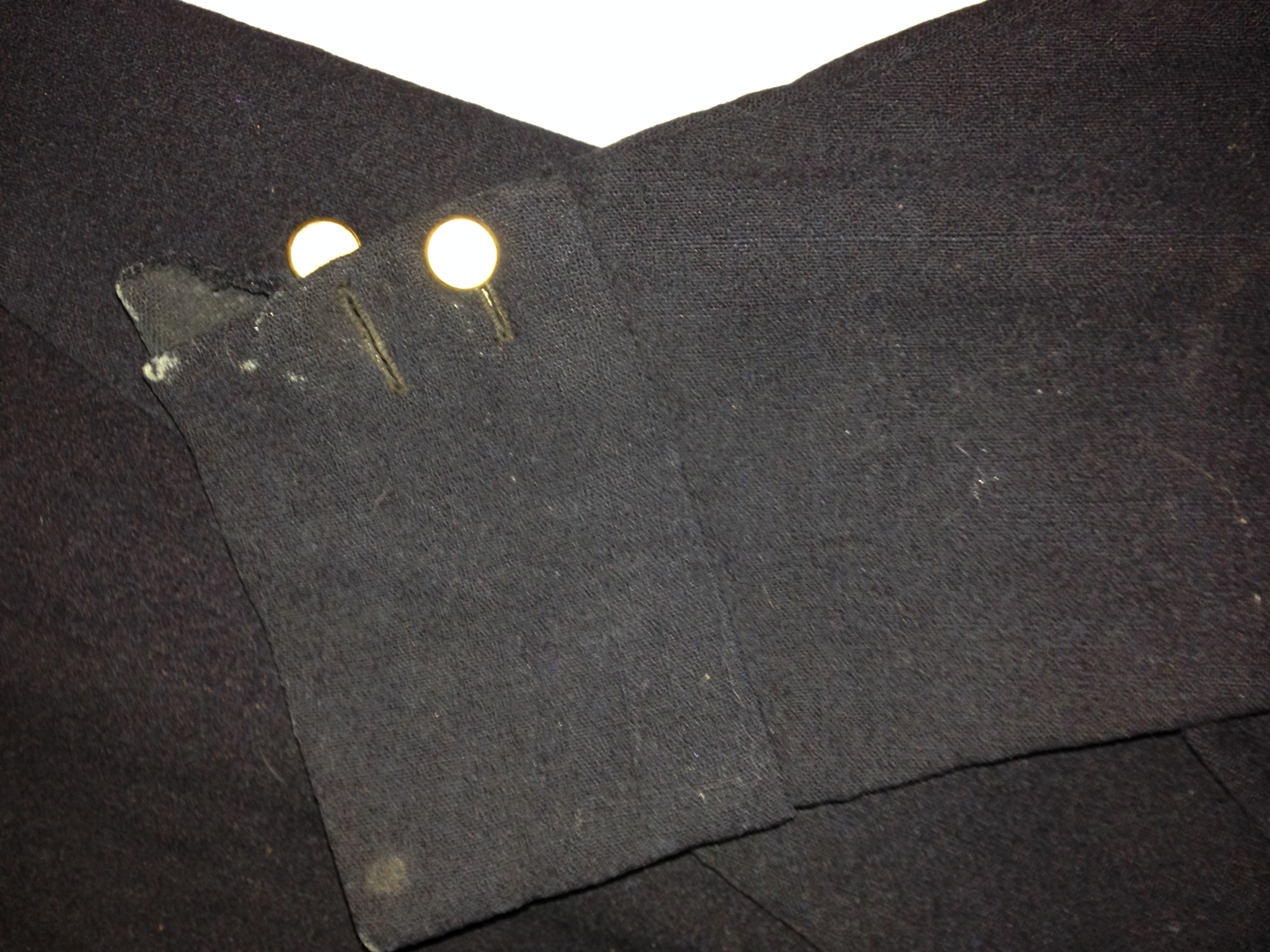
Slit cuff with two buttons, RIHS Museum Collections, 1968.38.1

Slit cuff with two buttons, RIHS Museum Collections, 1968.38.1

There’s no waist seam, so we can be pretty certain that this coat is earlier than 1818, if not 1810. Another telling measure of age is cuff treatment. This slit cuff seems to start in the 1780s or 1790s and persist into the early 19th century, (and beyond: gentlemen, check your coat sleeves and you’ll see what I mean).

That’s an awfully long range, 1780s to forever, but the smooth sleeve head and lack of waist seam help narrow the time frame. I’d hazard– and this is a hazardous business– ca. 1805 date for this coat, which would give me leeway for a common man to wear this into 1812, though make it more difficult for him to wear it in 1799/1800. (You can look back in fashion, but high style on the lower sorts is a tricky business and requires a lot of thought.)
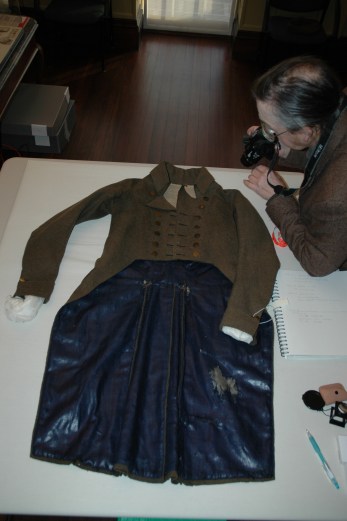
1925.11.1A, RIHS Museum Collection

1925.11.1A, RIHS Museum Collection

For travel to 1790-1800, I have another coat in mind, though it will probably be a long time before I get it made. This, too, has classic markers of its time, though the collar’s stand-and-fall style makes me think it is closer to 1790 than to 1800.

The lining of this coat is a particular treat: every time I’m able to pull this out for viewing (and since it’s boxed right now, that’s not happening), that blue glazed wool is a treat. The wear mark on the left proper tail lining is intriguing, too: sometimes those start as moth holes and progress, and sometimes they’re wear that’s later found to be delicious and expands by chomping. (Wool and silk and protein, and delicious treats for pests.)

I find these coats really exciting, and often feel a little “Make All the Coats,” but of course I can’t, not quickly, anyway. And these two don’t really solve my August in 1812 problem, as the clock ticks on…but I think there is a solution, thanks to Sharon Burnston and Fitting & Proper.
Share this:

  • Share on Facebook (Opens in new window) Facebook
  • Share on Pinterest (Opens in new window) Pinterest
  • Email a link to a friend (Opens in new window) Email
  • Share on X (Opens in new window) X
Like Loading...

A Whale-Safe Bonnet

23 Friday May 2014

Posted by kittycalash in Clothing, History, Living History, Making Things, Reenacting, Research

≈ 6 Comments

Tags

18th century, 18th century clothing, bonnets, common dress, common people, engravings, fashion, Marquis of Grandby, millinery, Research, Revolutionary War, sewing, style

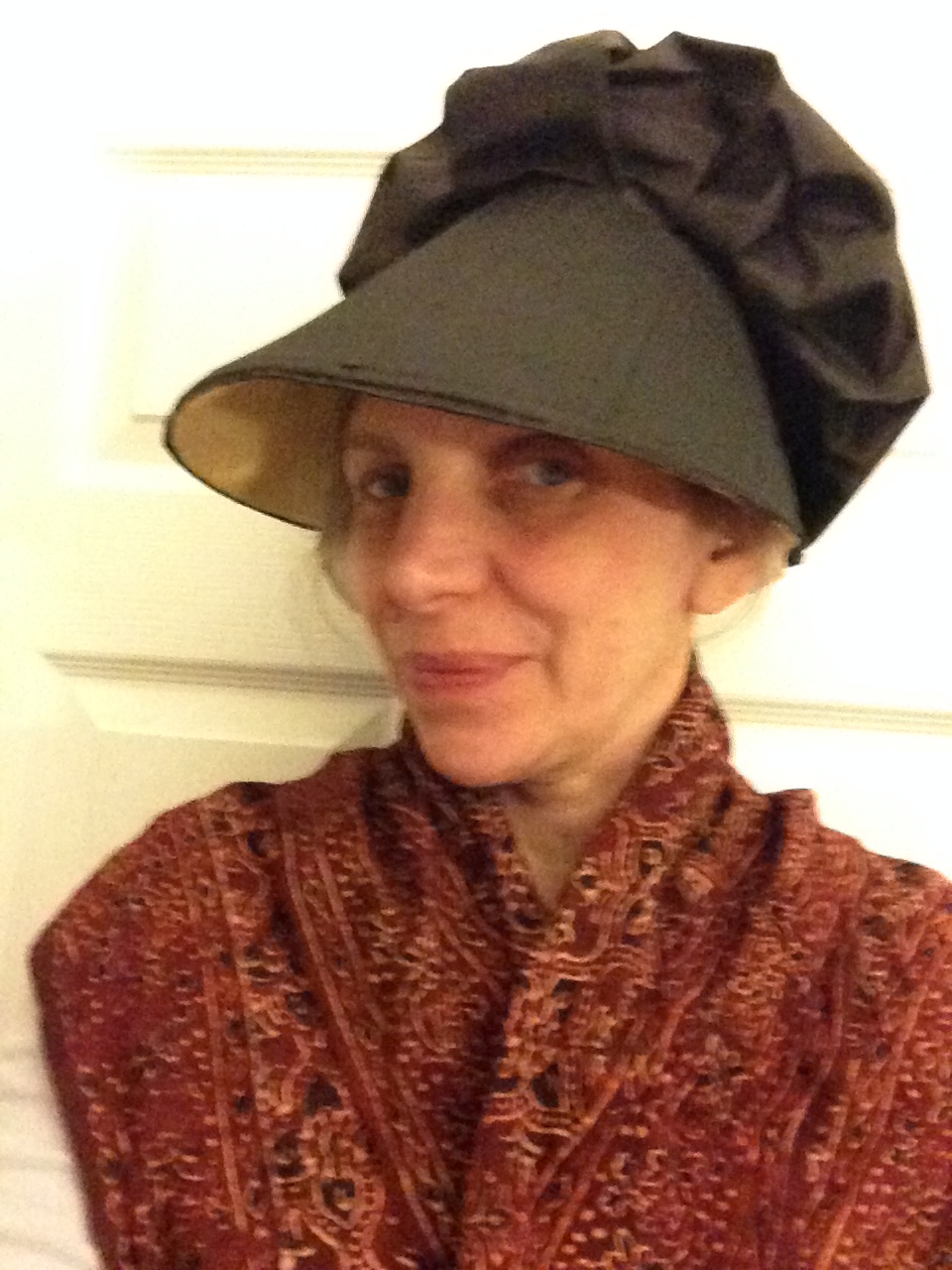
Complete with my interpretation of "Hat Face"

Complete with my interpretation of “Hat Face”

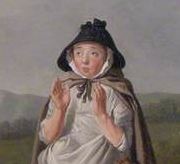
As promised, my interpretation of the ribbed bonnet in the 1789 engraving. There are a few problems with this beyond the model. (Which is not to say that I don’t like this bonnet– I do!)

I used the Kannik’s Korner bonnet pattern (view F, I think) as the basis for this because I already had a brim, lining, and caul cut and in a drawer. Given my current medicated state, using something pre-cut seemed advisable. That means I didn’t play with the brim to create the line of the Williamsburg bonnet, or the curve of the brim in the “Fortune Teller” engraving.

Detail, The Marquis of Grandby

Detail, The Marquis of Grandby

Is this style acceptable for the period I typically interpret (1775-1783)? Well… there are other examples of the lampshade-style bonnet, as in the Edward Penny painting of the Marquis of Granby. This painting is dated “after 1765” so there’s some room for interpretation there…too much room. But if that’s 1765-1770, and the “Fortune Teller” is 1789, I think we have comfortably covered the 1775-1783 time frame, even if it is a bit like a queen-sized blanket on a twin bed.

Front view: more lamp-shade like.

Front view: more lamp-shade like.

As you can see, the bonnet does have some lamp-shade-like tendencies on my head, which I consider a benefit. I like the way the ribs are visible, even if I remain unconvinced by the caning. I think it’s a little too wide, and lacks resiliency, though to be honest, I have only felt baleen at the New Bedford Whaling Museum, where there is a large sample on the second floor.

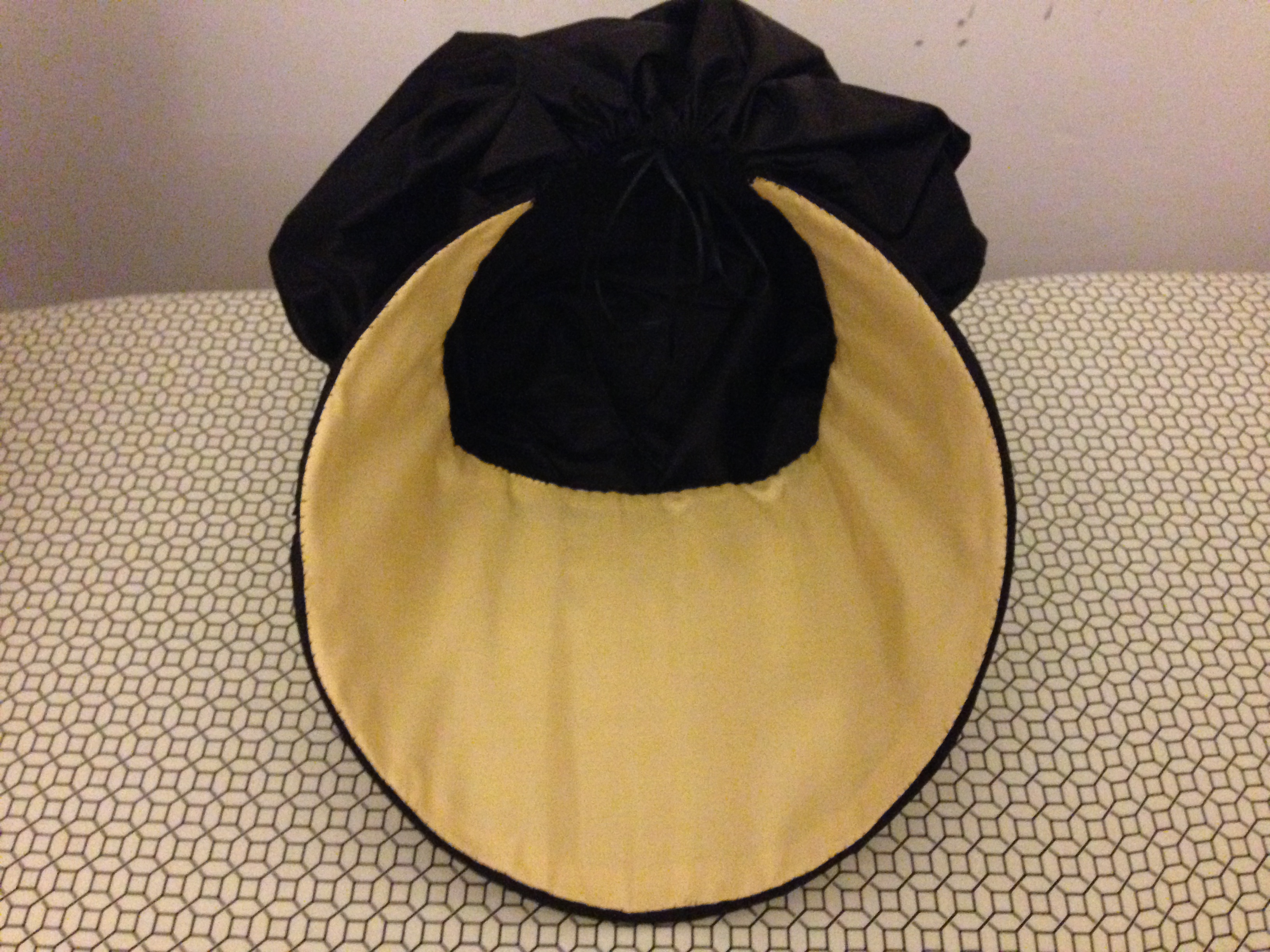
To compensate for the disappointing cane in the brim, I slipped a piece of millinery wire into the pocket underneath the cane. The layers in the brim are:

  • black taffeta
  • horsehair canvas
  • linen buckram
  • yellow taffeta

The channels are all hand-sewn, and then the cane was slipped in. I stitched the black taffeta caul to the first three layers, and then lapped the yellow taffeta over the raw edges and stitched it down to finish the brim/caul seam.

No, I didn’t take any in-process pictures…probably because this took considerable snake-eyed concentration last weekend. IMG_1477 IMG_1476

Usually, I line the cauls of my bonnets, but through shear laziness or distraction, I opted not to this time, and I think I’ll leave it this way for a while. You will also note that I have not trimmed this: I have some black silk ribbon coming, and I may try that. I don’t have enough black taffeta left to cut self-fabric ties, and there do seem to be some plain examples. A plainer, lamp-shade-like bonnet may be just the ticket for Bridget.

What would I do differently? Next time I would definitely play with the brim shape using a paper template. I’d like a lower, curvier, brim. Once I had the shape worked out in paper, I would use that as a template to cut the taffeta and horsehair or light buckram layers.

The Edenton Tea Party

The Edenton Tea Party

I’d also try zip ties. I know: not period correct! But short of risking federal prosecution resulting from a trip to New Bedford with some shears, I’m not sure that anything other than plastic will have the resiliency and spring that baleen has, and that made these bonnets so special. I thought of them while making this bonnet, but I think Mr S used them all at work in the past two months. A Facebook friend has been thinking of zip ties, though, and has a hankering for one of these bonnets. I can’t say that I blame her– and honestly, I think I might join her.

Share this:

  • Share on Facebook (Opens in new window) Facebook
  • Share on Pinterest (Opens in new window) Pinterest
  • Email a link to a friend (Opens in new window) Email
  • Share on X (Opens in new window) X
Like Loading...

Interpretation 101

28 Monday Apr 2014

Posted by kittycalash in Events, History, Living History, Reenacting, Research

≈ 4 Comments

Tags

10th Massachusetts, 18th century, Bridget Connor, Brigade of the American Revolution, common dress, common people, common soldier, first person interpretation, interpretation, living history, museum practice, Museums, Reenacting, Research, resources, Revolutionary War

This slideshow requires JavaScript.

On Saturday morning, I gave a presentation at the BAR School of Instruction on Interpretation. The slides are above, and the presentation (with my notes) is here.

The handouts and bibliography I used in thinking about Bridget Connor an be found on the Interpretation 101 page.

Share this:

  • Share on Facebook (Opens in new window) Facebook
  • Share on Pinterest (Opens in new window) Pinterest
  • Email a link to a friend (Opens in new window) Email
  • Share on X (Opens in new window) X
Like Loading...

Pockets 2.0

09 Wednesday Apr 2014

Posted by kittycalash in Clothing, History, Living History, Making Things, Reenacting

≈ 2 Comments

Tags

18th century clothes, 18th century clothing, common dress, common people, Events, pockets, sewing

Pockets the First

Pockets the First

At left, Pockets 1.0 or perhaps beta. The far left pocket, when worn alone, was definitely beta. Then came the striped pocket, and then sewing them both to the tape. That helped– and I use the small pocket for things like wallet, phone, car keys and Band-aids, and the larger pocket for interpretive things. I try to follow the Under the Redcoat kind of model: one pocket is modern, one is historical; that way I don’t pull the car keys out along with the knitting, or am at least less likely to.

Too much stuff.

Too much stuff.

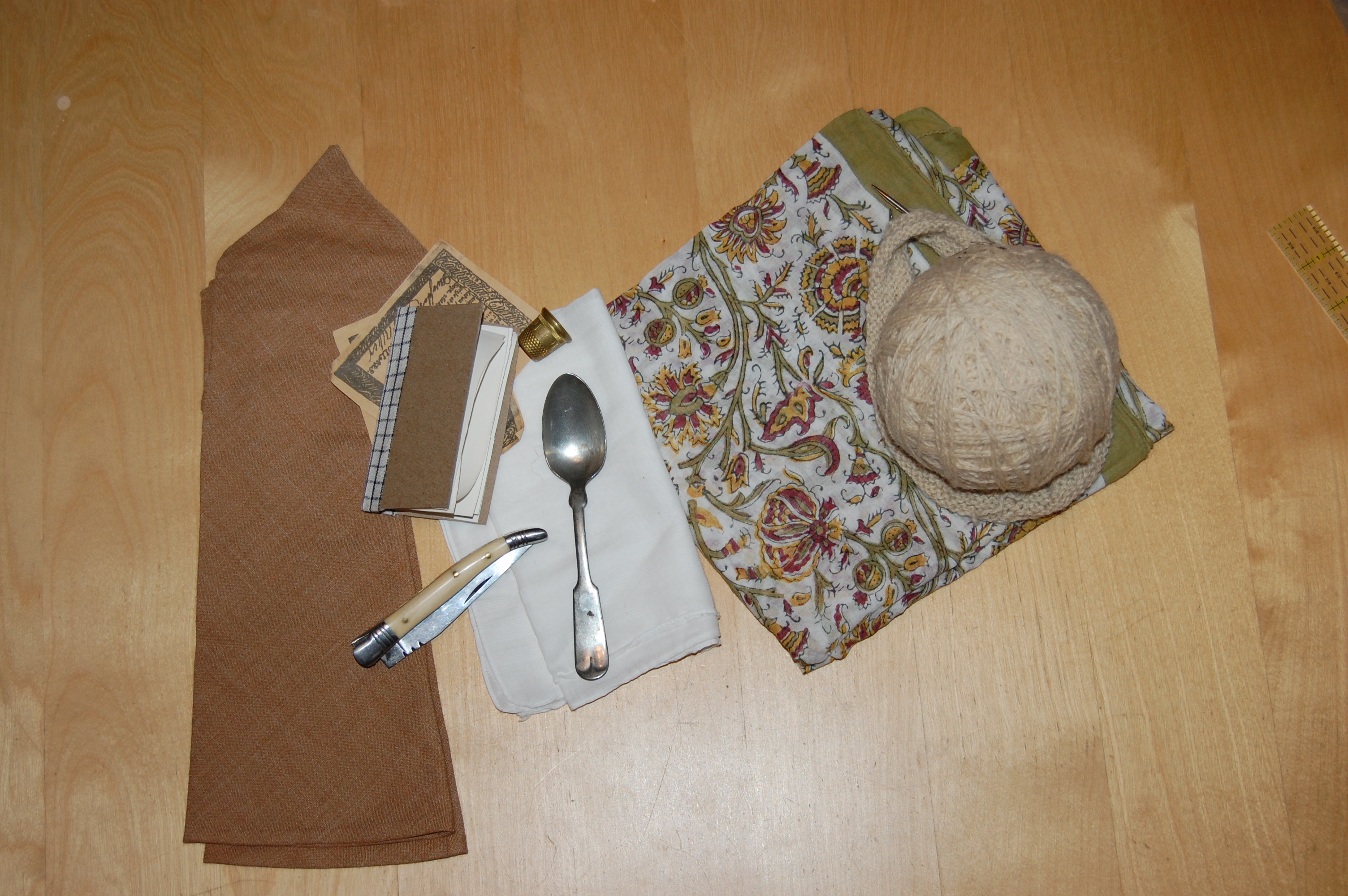
Here’s the stuff I carry in my purse today, actually a backpack-purse, downsized from a messenger bag. That’s a lot of stuff. But if you compare the list to the list of what might have been in an 18th century pocket, you’ll find a lot of similarities.

There’s a pen and a pencil, wallet and checkbook, granola bar, chewing gum, change purse, keys, more keys, and phone. All of those are just modern analogues for paper money, coins, orange or apple, candy, book and notebook, since the phone can fill in for so many things– notebook, money, keys, pen, book…

DSC_0174

The historical assortment is much more attractive, in part because I don’t use these things every day, and they don’t get tangled up and worn in a bag. Mitts, kerchief, hankie, my husband’s pay, knife, thimble, spoon, and knitting (I may never get a pair of stockings knit): these are all accurate to carry, though the knitting needles will have to change before that’s taken out in public.

DSC_0173

All that, or some combination of like things, will go into one pocket, and the modern mess into the other. I fear these new pockets are, for now, too nice for Bridget. I may just stick with my old, mis-matched ones for now.

Share this:

  • Share on Facebook (Opens in new window) Facebook
  • Share on Pinterest (Opens in new window) Pinterest
  • Email a link to a friend (Opens in new window) Email
  • Share on X (Opens in new window) X
Like Loading...

What would you carry?

04 Friday Apr 2014

Posted by kittycalash in Clothing, History, Living History, Research

≈ 3 Comments

Tags

18th century clothes, 18th century clothing, common dress, fashion, pockets, style, women's history

The V&A’s extensive article includes many hints about what might be in woman’s pockets.

Pocket ca. 1784, American cotton, wool Brooklyn Museum Costume Collection at The Metropolitan Museum of Art,  Gift of the Brooklyn Museum, 2009; Bequest of Marie Bernice Bitzer, by exchange, 1996  MMA 2009.300.2241

Pocket
ca. 1784, American
cotton, wool
Brooklyn Museum Costume Collection at The Metropolitan Museum of Art,
Gift of the Brooklyn Museum, 2009; Bequest of Marie Bernice Bitzer, by exchange, 1996
MMA 2009.300.2241

Sharon Burnston, on the Historic New England site, points out that “Pockets thus represent the kind of dilemma that objects of material culture can present to scholars. Much is known about how and when these items were made, but evidence of how they were used remains fragmentary and tantalizing.”

Fragmentary and tantalizing indeed!

Another scholar posits that “Pockets empowered women in many ways: they allowed them to carry possessions around with them for practical and personal uses, and gave them rights of ownership and privacy. I argue that decorative pockets also heightened women’s self-esteem by making them to feel more attractive – and that they esteemed their pockets in return.”

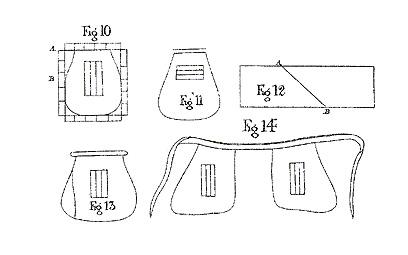
From the Workwoman’s Guide

As we can see from this diagram from the Workwoman’s Guide, pockets could take many shapes, and the extant evidence bears this out. There are oblong pockets, and more rectangular pockets, rounder pockets, longer and shorter and wider pockets. One suited one’s self, and cut one’s pattern to one’s cloth.

The identification of pockets with self, with intimacy and privacy, is explored in Women’s Pockets and the Construction of Privacy in the Long Eighteenth Century, by Ariane Fennetaux.
Fennetaux’ article and the V&A page on pockets were particularly useful in enumerating more specific kinds of items that might be carried in an 18th century woman’s pocket.

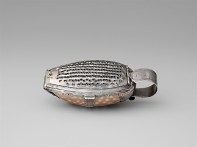
Nutmeg grater ca. 1690, British Cowrie shell, silver Gift of Irwin Untermyer, 1968 MMA 68.141.278

Nutmeg grater
ca. 1690, British
Cowrie shell, silver
Gift of Irwin Untermyer, 1968
MMA 68.141.278

Using cases from the Old Bailey, we can begin to draft possible contents lists.

A pair of silver buttons
A pair of buckles
A pen knife
Thimble
Coins
A silver spoon
A pair of scissors
Keys
Needlecase
Biscuit
Nutmeg and grater
Smelling bottle
An orange or an apple
A pocketbook
Comb
Snuff box
Jewellery
Needlebook
Pocketbook
Paper
Pen or pencil

When Pamela runs away, she takes with her, in her pocket, two handkerchiefs, two caps and five or six shillings.

Of all the listed things, what might Bridget have carried? Some of the things she carried would be needed, but others would be wanted.

Share this:

  • Share on Facebook (Opens in new window) Facebook
  • Share on Pinterest (Opens in new window) Pinterest
  • Email a link to a friend (Opens in new window) Email
  • Share on X (Opens in new window) X
Like Loading...
← Older posts
Newer posts →

Archives

wordpress statistics

Creative Commons License
Kitty Calash blog by Kirsten Hammerstrom is licensed under a Creative Commons Attribution-NonCommercial-ShareAlike 4.0 International License.

Website Built with WordPress.com.

  • Subscribe Subscribed
    • Kitty Calash
    • Join 621 other subscribers
    • Already have a WordPress.com account? Log in now.
    • Kitty Calash
    • Subscribe Subscribed
    • Sign up
    • Log in
    • Report this content
    • View site in Reader
    • Manage subscriptions
    • Collapse this bar
 

Loading Comments...
 

    %d