• Home
  • Completed Costumes/Impressions
  • Emma and Her Dresses
  • Free Patterns and Instructions

Kitty Calash

~ Confessions of a Known Bonnet-Wearer

Kitty Calash

Tag Archives: common dress

Illuminating Lampshades

08 Monday Feb 2016

Posted by kittycalash in Clothing, History, Living History, Reenacting, Research

≈ 8 Comments

Tags

18th century, 18th century clothing, authenticity, bonnets, common dress, common people, Costume, fashion, Paul Sandby, style

The more you look, the harder things get. That’s usually cause for celebration, but I’m starting to feel the pressure of more ideas and commitments than time. Here’s a question: in these undated Sandby watercolors, are the women wearing the bonnet colloquially called lampshade? What does lampshade look like from the side? My guess is that it looks a great deal like the headwear of the woman sitting on the wall. (Click the images to go to the Royal Collection site where you can enlarge them.)
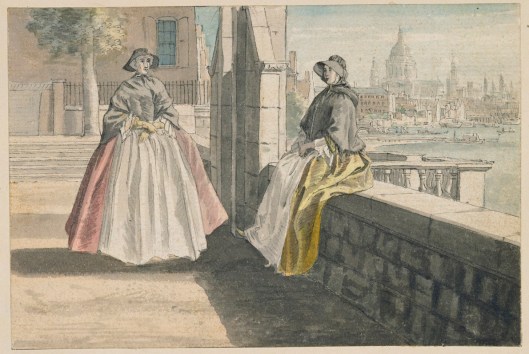
Somerset House Gardens. Watercolor by Paul Sandby, 1750-1760. Royal Collection Trust/© Her Majesty Queen Elizabeth II 2014

Somerset House Gardens. Watercolor by Paul Sandby, 1750-1760. Royal Collection Trust/© Her Majesty Queen Elizabeth II 2014

So much good stuff in this image: the woman sitting on the wall, swinging her foot (take that, decorum); the black silk mantles; sleeve ruffles; gloves; pointy shoes; big skirts.

About those pointy shoes and big skirts….much as I would love for this image to be really relevant to my quest, we are looking at the 1750s. At least lampshade comes in to greater focus, both in date and in construction. Ooh, look! More lampshade.

The Ladies Waldegrave, 1760-1770. Watercolor by Paul Sandby Royal Collection Trust/© Her Majesty Queen Elizabeth II 2014

The Ladies Waldegrave, 1760-1770. Watercolor by Paul Sandby Royal Collection Trust/© Her Majesty Queen Elizabeth II 2014

The eldest of these young ladies was born in 1760 and the youngest in 1762, so we’re really close to 1770 here. They’re not only incredibly adorable (I know a quite darling and very young lady for whom I want to make one of these pretty much immediately), but they’re in the right time period. Most of the bonnet images in the Royal Collection seemed to be of young women or girls, until I happened upon this image, from 1768.

A carriage, with man and lady 1768. Watercolor by Paul Sandby. Royal Collection Trust/© Her Majesty Queen Elizabeth II 2014

A carriage, with man and lady 1768. Watercolor by Paul Sandby. Royal Collection Trust/© Her Majesty Queen Elizabeth II 2014

Well, “lady” might be pushing it where I’m concerned, but that image feels like the best solid evidence of bonnetness close to 1770.

The ascent to the Round Tower c.1770. Paul Sandby. Royal Collection Trust/© Her Majesty Queen Elizabeth II 2014
Detail, The ascent to the Round Tower c.1770. Paul Sandby, Royal Collection Trust/© Her Majesty Queen Elizabeth II 2014

Here’s another ca. 1770 image. Way in the back, there’s a bonnet.

Can’t get enough of that black taffety? Have another.

A young girl, standing 1760-1780. Paul Sandby, Royal Collection Trust/© Her Majesty Queen Elizabeth II 2014

A young girl, standing 1760-1780. Paul Sandby, Royal Collection Trust/© Her Majesty Queen Elizabeth II 2014

Wonder what that might look like from the back? Voila.

A girl in a sunhat, seen from behind, 1760-1770. Paul Sandby, Royal Collection Trust/© Her Majesty Queen Elizabeth II 2014

A girl in a sunhat, seen from behind, 1760-1770. Paul Sandby, Royal Collection Trust/© Her Majesty Queen Elizabeth II 2014

This is by no means an exhaustive search, but thanks to a Facebook commenter, I’ve rediscovered the Royal Collection, and found later images of the peculiarly lamp-shade like headwear, and one image with a firm date of 1768.

In Book of Ages, Jill Lepore quotes a February 27, 1766 letter from Jane Franklin Mecom in Boston to Deborah Read Franklin in Philadelphia, regarding the clothing her brother Benjamin had shipped to her. “For ‘Each of us a Printed coten Gownd a quilted coat a bonnet.’ She continues about her bonnet, “is very suteable for me to were now being black and a Purple coten.” (Lepore, Book of Ages, p. 144)

What do you suppose that 1766 bonnet looks like? Do you think it looks more like lampshade, or these transitional forms? Probably lampshade, but the materials are intriguing: Purple cotton. Is that the brim lining? Jane Mecom is in mourning, so I’d expect the main body (brim and caul) of the bonnet to be black, and most likely taffeta, which turns up as a descriptor in the runaway ads.

Wide-brimmed, black taffeta bonnet, possibly lined in cotton, 1766-1768. But how long did bonnets last?*  What went into them– Buckram? Pasteboard? Coated pasteboard? Baleen? A combination of pasteboard and baleen?

I’ve got some ideas, and if the next winter storm doesn’t delay the mail too long, I might have experiments to conduct this weekend.

*Or any clothing? But that’s a post for another day.
Share this:

  • Click to share on Facebook (Opens in new window) Facebook
  • Click to share on Pinterest (Opens in new window) Pinterest
  • Click to email a link to a friend (Opens in new window) Email
  • Click to share on X (Opens in new window) X
Like Loading...

Sometimes a Great Notion

03 Thursday Dec 2015

Posted by kittycalash in Clothing, Living History, Making Things, Reenacting

≈ 3 Comments

Tags

18th century clothes, 18th century clothing, Clothing, common dress, dress, fashion, living history, sewing, style

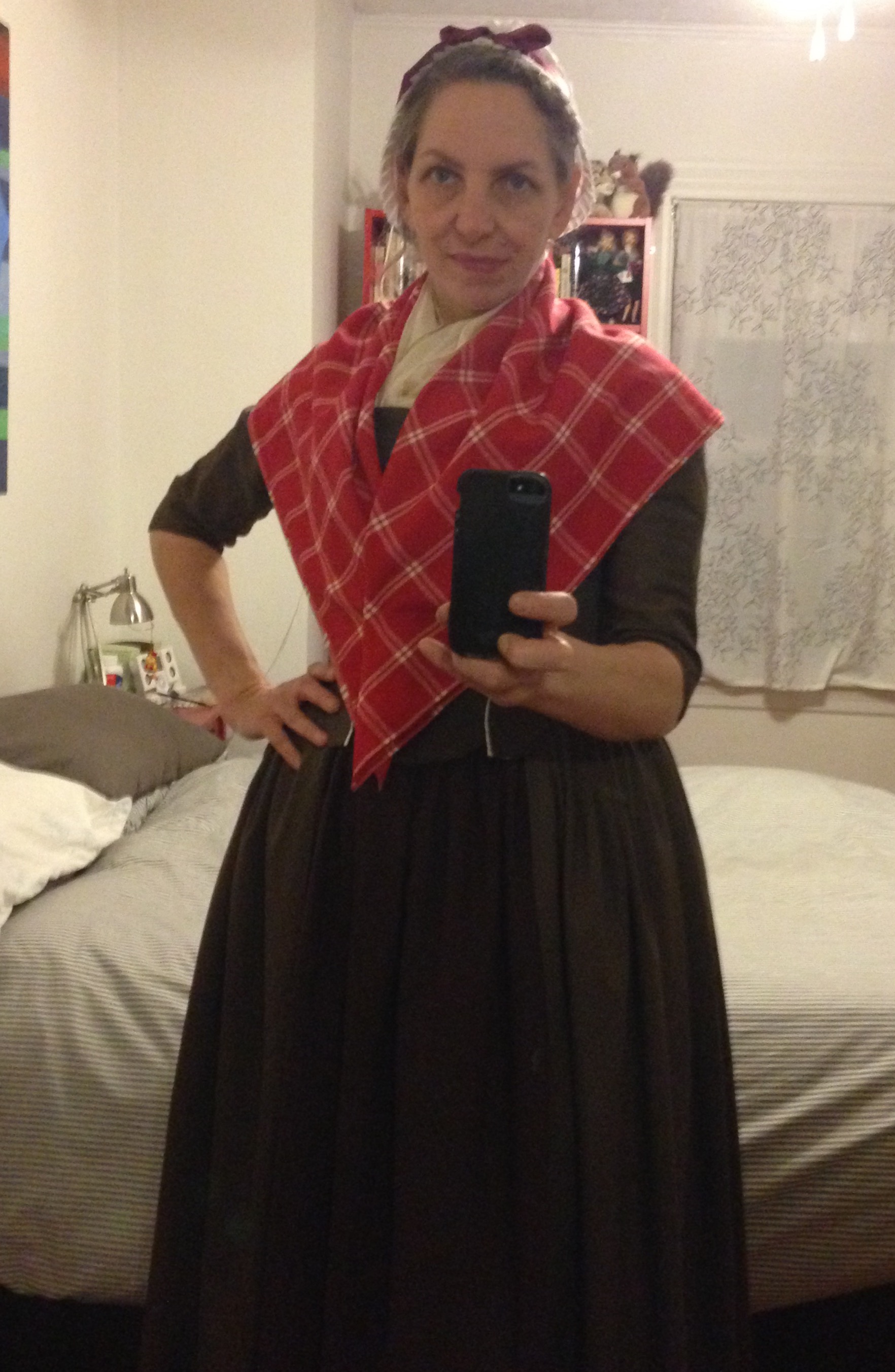
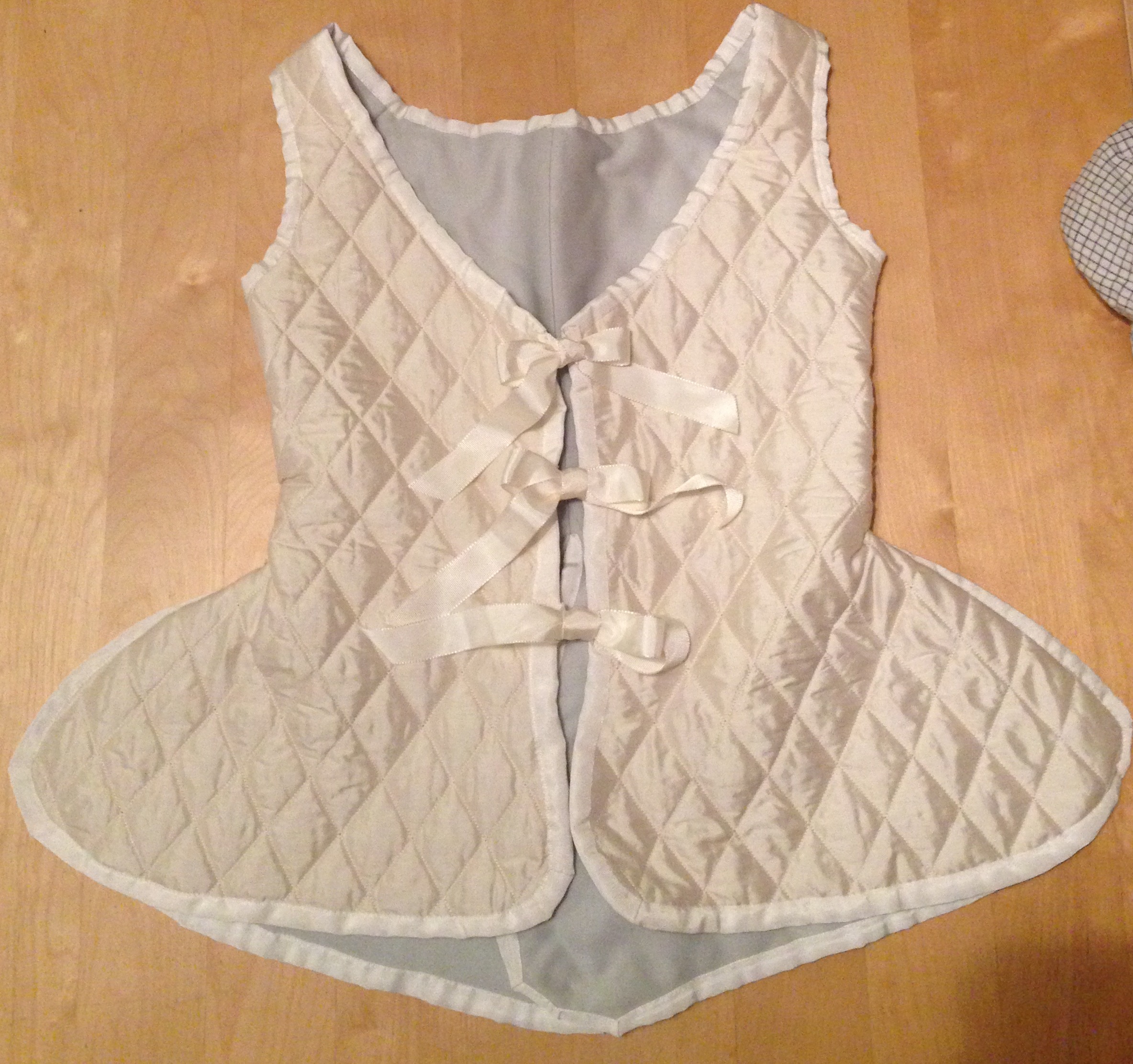
Finished! Cozy, too.

Finished! Cozy, too.

(Think Lead Belly, not Ken Kesey.)

No, I did not take a notion to jump in the river, but I did take a notion to sew slightly more than the quilted waistcoat.

I couldn't resist.

I couldn’t resist.

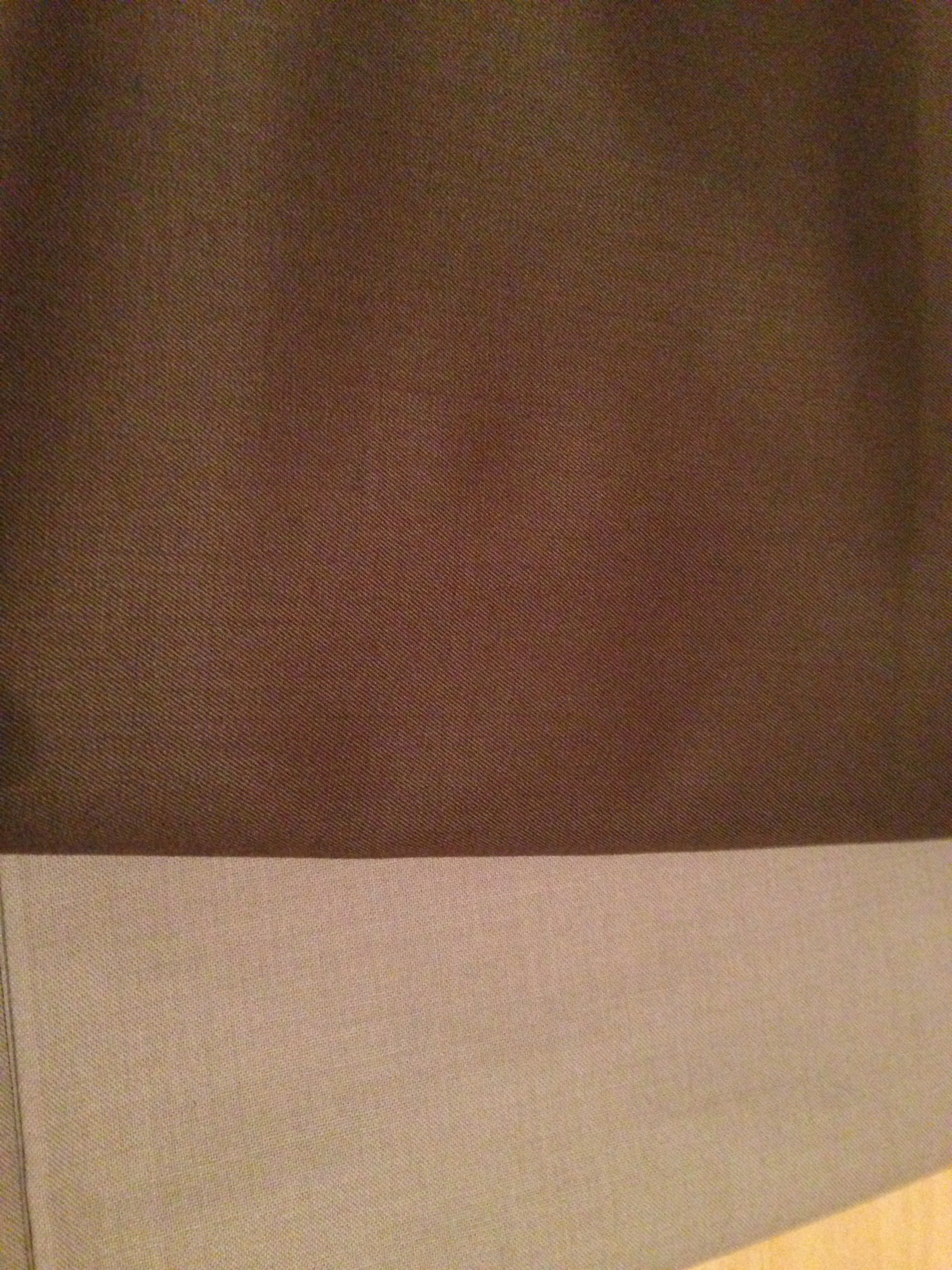
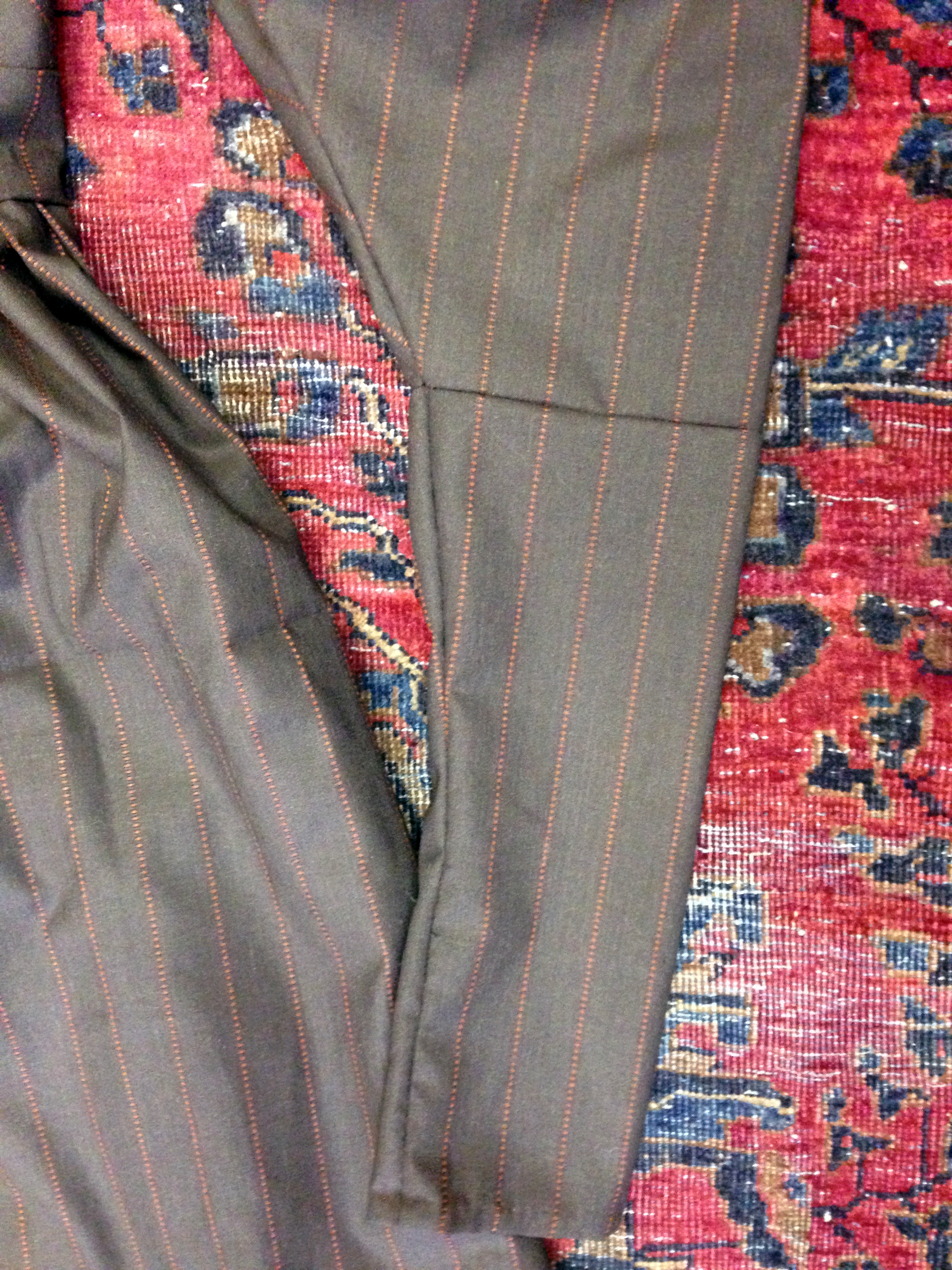
I got this unshakable great notion, you see, about some wool from the remnant table in Framingham. It was a lovely olive color, and paired up with some plain weave I already had, it reminded me strongly of World War II-era Army uniforms from the ETO, which I had been packing recently in Rhode Island’s alpine north. And yes, if I find a pinker tan for a petticoat, I will procure it.

Since I already have an olive wool petticoat that will also work for this notion, I started on the gown last week, cutting it out on Wednesday night so the table would be clear for Thanksgiving dinner.

The wool was a little slippery to pleat, and the twill slightly dazzling with its sheen. Let’s pretend it’s shalloon, shall we?

First the back
First the back
and then the sides.
and then the sides.

A week into the project (after a brief annoying detour attempting to correct my mitt pattern), I have only half the hem and the bottom of the robings to finish. Not too shabby, thanks to a holiday weekend and hours of The Pacific, Band of Brothers, and The Purple Plain. Homage to the color, I suppose.

I'm never not smirking, so thanks for not smacking me.

I’m never not smirking, so thanks for not smacking me.

It fits– which always seems like a miracle, even with a tested pattern– and better yet, it fits over that plush waistcoat.

The rustle of the silk and the swish of the wool are unlike anything I’ve ever worn. I think I shall feel quite fancy– let us hope I shall also feel quite warm.

Share this:

  • Click to share on Facebook (Opens in new window) Facebook
  • Click to share on Pinterest (Opens in new window) Pinterest
  • Click to email a link to a friend (Opens in new window) Email
  • Click to share on X (Opens in new window) X
Like Loading...

Packing Meat

19 Thursday Nov 2015

Posted by kittycalash in 1830s, Clothing, Events, Reenacting

≈ 1 Comment

Tags

1830s, 19th century clothing, common dress, common people, dress, fashion, living history, Massachusetts, Old Sturbridge Village, sewing

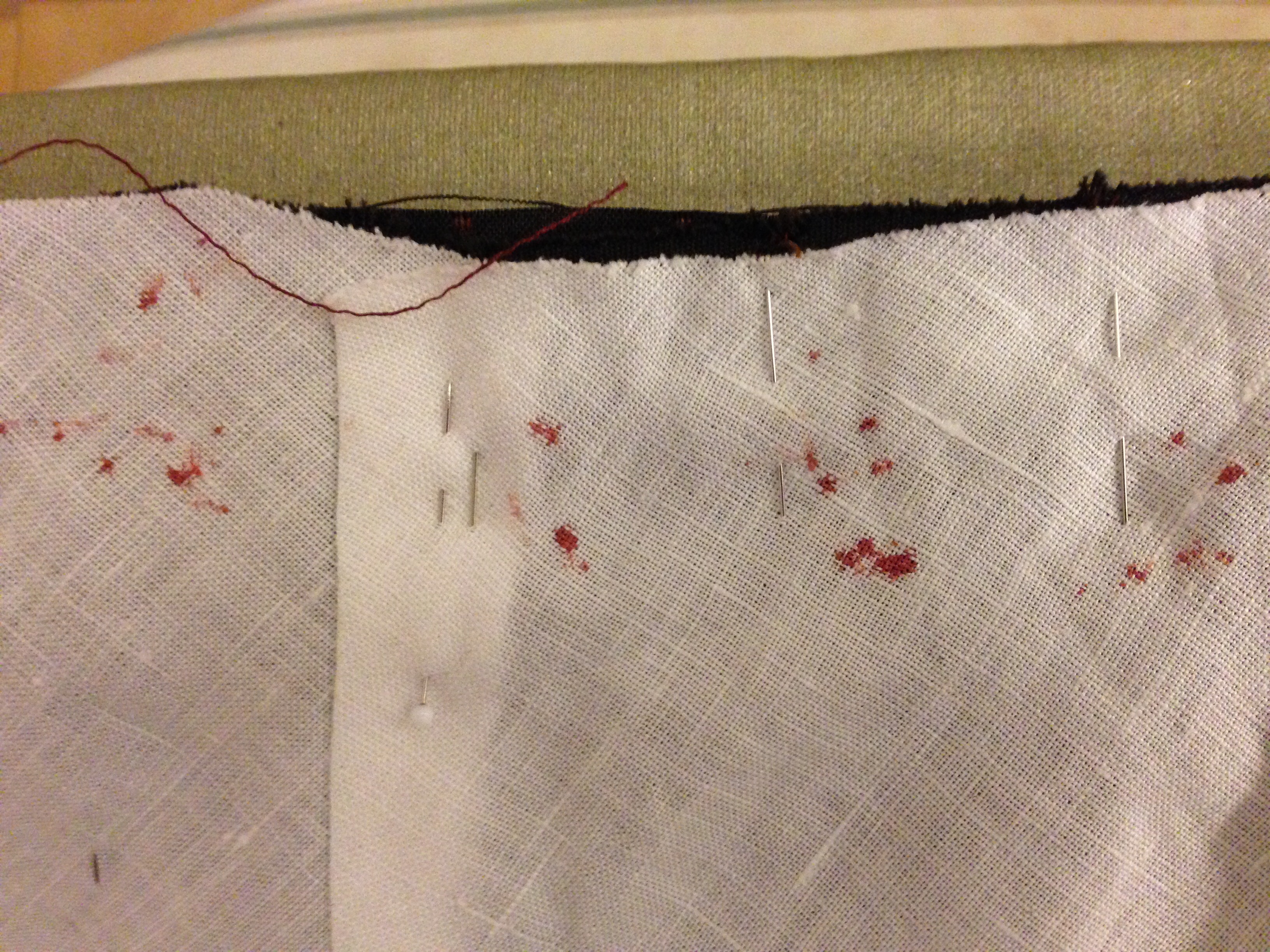
If it bleeds, it leads.

If it bleeds, it leads. Waistband pinning is surprisingly dangerous.

Sometimes you end up doing things for reasons you don’t entirely understand. Remember that brief flirtation with the 1830s? Well… we met again, and this time, I said yes to the dress.

Several friends are on the “shoot meat, win a target” program at OSV this weekend, and I agreed to go along. Yes, it’s a gun show. Yes, I’m compromising again.

Gentle reader, it gets worse. While I had not planned to dress, I rethought this choice last week. Awake in the early morning hours of November 11, I thought about dress patterns, wool petticoats, and the contents of the Strategic Fabric Reserve. One of my wool petticoats fit the waistline of my 1820s dress better than the 1800 dress I made it for, so I figured I was on my way towards being warm outdoors in November.

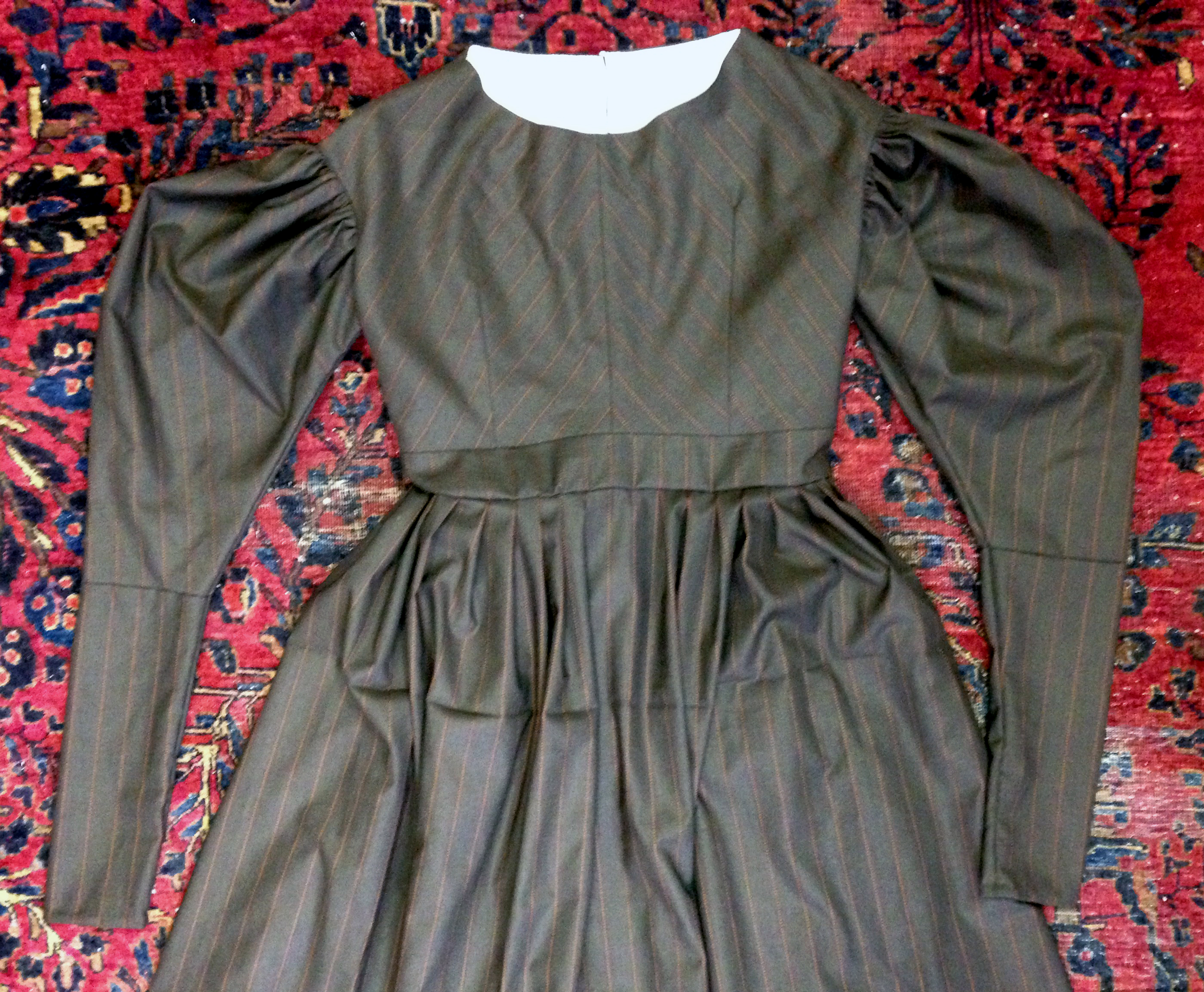
Spot the error. It's the dyslexic '30s.

Spot the error. It’s the dyslexic ’30s.

I have 1830s patterns, and a muslin was quick to make. Worse yet, once the muslin was made up and tried on over stays, it needed no alteration beyond a slight shoulder seam adjustment. Can you imagine? That hideous decade fits me? Doom or destiny, you be the judge: I had enough striped wool blend to cut a dress and a pelerine… so I did.

The other sleeve's stripes are just slightly off.

The other sleeve’s stripes are just slightly off.

The bodice went together quickly, and the sleeves were fairly easy at the shoulder and arm scye (I really enjoy setting sleeves). It was the length and width along the forearm that threw me, and I ended up having to piece on the lower sleeve. Twice.

The sleeves are where the meat comes in: you say pork chop, I say leg of lamb, the fashion plate says gigot. I did reduce the arc a bit, which makes this a more late-1820s style than firmly mid-1830s. Since some of the folks I’m going with will be wearing a mix of late 1820s and 1830s styles, slimmer sleeves seemed reasonable.

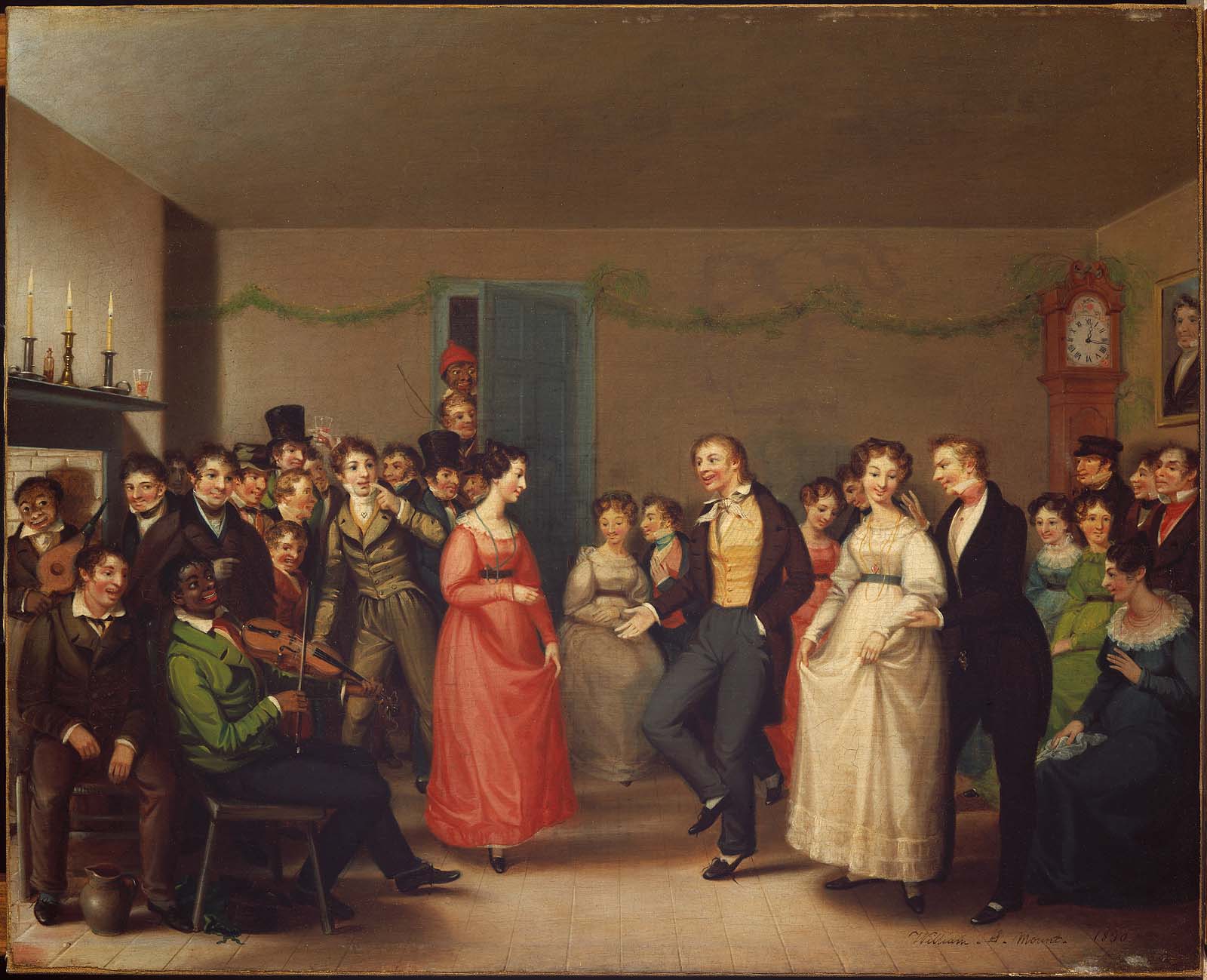
Rustic Dance After a Sleigh Ride, 1830. William Sidney Mount MFA Boston 48.458

Rustic Dance After a Sleigh Ride, 1830.
William Sidney Mount MFA Boston 48.458

More seriously, I’m taking cues from the William Sidney Mount painting I’m so fond of. The women in this 1830 painting have less flamboyant sleeves and possibly achievable hair. Honestly, the things I get into when I lie awake and think. I ought to know better by now…but every decade is a new adventure.

What remains to be done? Backstitching the waistband and waistband lining, hooks and bars at the back closing, the ever-popular hem of enormity, and a final pressing. Achievable, I think, with focus and some lunchtime sewing.

Share this:

  • Click to share on Facebook (Opens in new window) Facebook
  • Click to share on Pinterest (Opens in new window) Pinterest
  • Click to email a link to a friend (Opens in new window) Email
  • Click to share on X (Opens in new window) X
Like Loading...

On & Off the Grid

16 Wednesday Sep 2015

Posted by kittycalash in 1830s, Clothing, Living History, Making Things

≈ 2 Comments

Tags

10th Massachusetts, 19th century, 19th century clothing, checks, Clothing, common dress, common people, fashion, Federal style, linen, stripes

It’s been a very busy time chez Calash, with many changes underway and to come. It’s hard to keep up with all the writing I’m doing everywhere, but eventually I’ll be back on topics of authenticity, standards, and whimsical Wednesdays.

This week, though, is all about checks. (Most weeks are, in some way, aren’t they?) Not paychecks, silly: linen checks.

We are headed out to Eastfield Village Friday afternoon where Mr Hiwell and the Young Mr will join in the 1833 militia muster, and Mr JS and I will occupy a house as a shop/tailoring business/punch-making and cooking establishment of one kind or another.

Mr Hiwell has been warned to expect a diet unlike his norm, and since his roundabout is white, we will quickly know if he is smuggling Oreos and barbeque sauce.
 For the Young Mr, I have been making trousers. Yes, I do like things to line up. I wasn’t even paying that much attention when I cut these, but apparently that was  was enough.

Yes, even the buttons.

IMG_4452
IMG_4459

Sigh. It’s a thing.

He’s also got a roundabout in the works, which I must focus on more closely to finish. This is patterned from an original in Henry Cooke’s collection, but… Mr. Cooke and I, on a very sticky Tuesday afternoon, did not have the Young Mr at hand to measure again. The original was too small: that we knew. What we did not know was that the boy had taken on a man’s shape– or, as a friend says, “he’s dude-shaped now!”–and the additions we made were not enough, except (barely) to the sleeves.

IMG_4335
IMG_4336

Oh, well. There was just enough to make it all work, and after some trials I realized it needed a lining. What kind of lining? A checked lining, of course!

It seems okay, but these collars are strange to  me.

IMG_4450
IMG_4451

Well, at least he will be clad.

Let you think  I’m sewing only for the lad, I am in fact working on a gown for myself. There’s a hopeful yard or so of another check’d  linen from the stickiest fabric store on 39th Street lurking, but I do not think that apron will happen this week. Perhaps John Brown’s housekeeper will finish it someday.

IMG_4329
IMG_4479

At least there are already gowns and aprons ready-made that can travel with me. Someday soon I’d like to finish my new stays… winter will come soon enough, and more sewing then.

Share this:

  • Click to share on Facebook (Opens in new window) Facebook
  • Click to share on Pinterest (Opens in new window) Pinterest
  • Click to email a link to a friend (Opens in new window) Email
  • Click to share on X (Opens in new window) X
Like Loading...

Hobby Misogyny

04 Tuesday Aug 2015

Posted by kittycalash in Living History, Reenacting, Research

≈ 29 Comments

Tags

18th century clothes, authenticity, Clothing, common dress, Costume, interpretation, Reenacting

What do you see and remember at events? At every event I go to, I see a range of impressions, or historic expressions.

unknown artist, 18th century, The Encampment in the Museum Garden, 1783, Aquatint, hand-colored, Yale Center for British Art, Paul Mellon Collection

unknown artist, 18th century, The Encampment in the Museum Garden, 1783, Aquatint, hand-colored, Yale Center for British Art, Paul Mellon Collection

There are Good things: a chintz bedgown that’s actually becoming; a checked suit I wish the kid would wear; the Ugly Dog Coat Mr S wants, the umbrella I want to make just for its lines.

The Bad and the Ugly are present, too.

Drawstring shift necks, makeup, infernal bodices, Birkenstocks, sofa-size prints… “light” troops with dining flies, tables, and tin roasters. Stores tents packed with plastic packaging. White “trews” baggy as painters pants, breeches reaching below the knee, haversacks as man-purses, tube socks, sneakers, peacock feathers on women’s hats, girls with undressed hair and no caps.

What is the meaning of these bodices and tube socks: are they the disease, or a symptom? I think they’re a symptom, telling us about a deeper problem.

If “authenticity” is a journey and not a destination, everyone starts this journey at a different point, and some people are more sophisticated consumers of knowledge than others. Hard as it is to fathom, some people—even with decades of time in this— don’t know any better. I’ve encountered half-correctly dressed wives of men who’ve been to Battle Road who didn’t even know workshops are available to help them with stays and gowns. The ignorance is not always willful, even if it seems that way.

Why are some women such a mish-mash of reasonably accurate jacket with acceptable petticoat worn without stays, a drawstring shift, an OK cap, modern glasses, and a purse?

Paul Sandby RA, 1731–1809, British, Washerwomen, between 1790 and 1805, Graphite and brown wash on moderately thick, cream, rough laid paper, Yale Center for British Art, Paul Mellon Collection

Paul Sandby RA, 1731–1809, British, Washerwomen, between 1790 and 1805, Graphite and brown wash on moderately thick, cream, rough laid paper, Yale Center for British Art, Paul Mellon Collection

Do they not see the return on investment for stays and a gown and shoes and a cap and glasses and no makeup? Perhaps they don’t feel pretty when they venture out of their normal realm, and they’re only visiting, anyway. Is this the reason for the half-baked costume approach?

Or could it be that the unit commanders have set no standards for the women? That they don’t consider the women to really be unit members? Or that the women don’t consider themselves members? That they don’t matter the way the muskets do?

Could some women’s lack of authenticity—and by “authenticity” here I mean “period appropriate clothing”—be rooted in the phallocentric/musket-centric culture of the hobby? In some units, men and women seem to engage in parallel play, like toddlers, where the men field in the foreground, and the women cook in the background (women on the field is an issue I will not take up here). The men are in charge, making the decisions: the women, and what they wear, appear not to matter, and are nearly invisible. I think this is rooted in basic misogyny and the riptide of the hobby’s boys-club attitude.

If misogyny is part of why women perpetuate inauthentic impressions, then having women invested in their units and roles, with more research and more care, might be threatening to men who want weekends for themselves and their ‘war games.’ But I believe that without a significant investment by women, and by units in women’s roles, this hobby won’t survive, and it’ll be a lot less fun and educational for everyone.

That means, of course, that I think units will have to allow women a voice, and develop standards for women as well as men. Those units with the farthest to “travel,” authenticity-wise, will need to build up stores of wearable, authentic women’s clothing to loan, or include women’s workshops in their schedules. If they don’t want women and/or families participating, then that has to be clear, too, and women who do want to participate will have create their own civilian units. (I don’t have solutions for all of these issues.)

attributed to Hubert-François Gravelot, 1699–1773, French, active in Britain (1733–1745), Matrimonial Fisticuffs, with a Portrait of the Pugilist John Broughton, in the Background, undated, Watercolor, pen and black ink and graphite on medium, slightly textured, beige laid paper, Yale Center for British Art, Paul Mellon Collection

attributed to Hubert-François Gravelot, 1699–1773, French, active in Britain (1733–1745), Matrimonial Fisticuffs, with a Portrait of the Pugilist John Broughton, in the Background, undated, Watercolor, pen and black ink and graphite on medium, slightly textured, beige laid paper, Yale Center for British Art, Paul Mellon Collection

When the men around them don’t value or encourage their participation, and when units do not have men and women as equal members with clear standards for both, I think you end up with poor impressions—particularly women—and camps full of crap. These are symptoms of a larger problem of misogyny and silence.

Anthony Highmore, 1719–1799, British, Group of Three Ladies, undated, Watercolor, pen and brown ink, and graphite on medium, blued white, moderately textured laid paper, Yale Center for British Art, Paul Mellon Collection

Anthony Highmore, 1719–1799, British, Group of Three Ladies, undated, Watercolor, pen and brown ink, and graphite on medium, blued white, moderately textured laid paper, Yale Center for British Art, Paul Mellon Collection

In recent years there have been calls for greater attention to standards for women by unit commanders. But I think that we should go further, and call for greater participation of women in real leadership roles in the hobby. That’s when you will see real change, not just in clothing, but in presentations.

And that is where I think the future of this hobby lies: in recognizing that living history events are mobile museums, not just mobile monuments.

To get more complete, inclusive and, I think, authentic, experiences will take more inclusive leadership structures, from unit memberships to the boards of umbrella organizations. That would be one small step towards bringing leadership and management into line with the modern world and current best practices in management for cultural and historic organizations. Because that is what the umbrella organizations have become. The boys’ historic shooting clubs have grown up, and it’s time to let the girls play for real, and to value women’s roles past and present.

Share this:

  • Click to share on Facebook (Opens in new window) Facebook
  • Click to share on Pinterest (Opens in new window) Pinterest
  • Click to email a link to a friend (Opens in new window) Email
  • Click to share on X (Opens in new window) X
Like Loading...
← Older posts
Newer posts →

Archives

wordpress statistics

Creative Commons License
Kitty Calash blog by Kirsten Hammerstrom is licensed under a Creative Commons Attribution-NonCommercial-ShareAlike 4.0 International License.

Website Built with WordPress.com.

  • Subscribe Subscribed
    • Kitty Calash
    • Join 621 other subscribers
    • Already have a WordPress.com account? Log in now.
    • Kitty Calash
    • Subscribe Subscribed
    • Sign up
    • Log in
    • Report this content
    • View site in Reader
    • Manage subscriptions
    • Collapse this bar
 

Loading Comments...
 

    %d