• Home
  • Completed Costumes/Impressions
  • Emma and Her Dresses
  • Free Patterns and Instructions

Kitty Calash

~ Confessions of a Known Bonnet-Wearer

Kitty Calash

Tag Archives: fashion

My Life as a Chair, or, Warm in Winter

11 Wednesday Jan 2017

Posted by kittycalash in Clothing, History, Living History, Making Things

≈ 6 Comments

Tags

18th century clothing, common dress, fashion, interpretation, living history, quilted petticoat, Reenacting, sewing, winter

Can I get an “Aw, yiss” for being warm outdoors?

img_8826

After the aftermath. Photo by Drunk Tailor.

They may not be the most accurate <cough>machinestitchedoffabolt<cough> quilted petticoat and waistcoat, but they sure do make a difference.

These aren’t exactly base layers– a white wool flannel shift would not be amiss–but the quilted layers make a big difference to a day in the cold. When I added up the layers, I came to 8 without counting accessories like neck handkerchiefs and stockings:

  • Shift
  • Stays
  • Waistcoat
  • Lightweight Wool Petticoat
  • Heavy Wool Petticoat
  • Quilted Petticoat
  • Gown and Stomacher
  • Cloak
The underneaths. Photo thanks to Drunk Tailor.
The insides.
The insides.

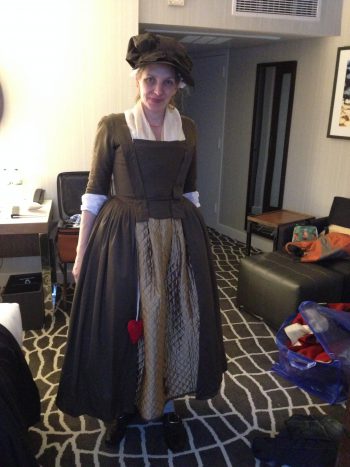
It isn’t always pretty, but in cold, wet weather, function trumps fashion (not that I’m not pretty pleased with this upholstery). The waistcoat ties on, so you have some adjustment should your weight or shape fluctuate. The petticoat, in this case, works like every other petticoat, with the sole exception of a short pocket slit on one side due to operator impatience (this was finished just a few days before it needed to be packed for Princeton).
img_8823

Thanks to Drunk Tailor for more patience.

The quilted fabric (originally intended, I am sure, for a bedspread) is lined with a plain weave wool for extra insulation and body; the waist band is bound with wool tape, as is the hem. Down in the basement, there’s a camblet- wool batting- linen lining sandwich on a frame, ready for quilting, if I only I would drag it up stairs and start, and I know it would be both more insulating and more accurate.

Does it all fit? Well…pretty much! An open robe with stomacher makes it easier to fit all these layer underneath, and, happily, I don’t have the best sense of my own size, so my clothes tend to be a little bigger than they must be. Fortunately, historical clothing generally involves adjustable closures that make fluctuations and layering easy to accommodate.

After Anna B’s and Anna K’s comments on the overview of the event, I was reminded that these are the confessions of a known bonnet-wearer, and I will humiliate self for history, so in case you are wondering: no, I didn’t wear drawers of any kind, or leggings, or long underwear. A pair of silk stockings under a pair of wool stockings kept my lower extremities warm, but my nethers were sometimes chilly, in a highly specific, localized, but small way. I think this may be where the wool shift comes in– or one that fits a bit better than my current garment, which is a tad too large.

On the porch at Morven, a range of head coverings. Photo by Matt White

On the porch at Morven, a range of head coverings. Photo courtesy Matt White

When it comes to ears, you can see that we adopted a range of solutions. Ear-covering caps under bonnets, under straw hats, and under kerchiefs, were worn by some. At far left, my cap perched on top of my head, so I tied my bonnet on with a kerchief and pulled my hood over all of that. Mistress V (at far right) wore a cap, a kerchief and a hat (which was summarily removed in the afternoon, by Mistress S at her left). Mistress F, holding the cream colored blanket with a wide black stripe, wore a wool hood over a cap and under her straw hat. Wear enough layers– and the right layers, meaning mostly wool and silk– and you will be warm, perhaps even sweaty if you’re active. Still, I might trade in my “Hobo Woman of Princeton” look for a quilted silk hood if the right one came along.
Share this:

  • Click to share on Facebook (Opens in new window) Facebook
  • Click to share on Pinterest (Opens in new window) Pinterest
  • Click to email a link to a friend (Opens in new window) Email
  • Click to share on X (Opens in new window) X
Like Loading...

Frivolous Friday: Fashion Flashback

18 Friday Nov 2016

Posted by kittycalash in Frivolous Friday, History, Making Things, personal, Research, Thanks

≈ 3 Comments

Tags

18th century clothing, authenticity, Costume, cotton print, East India trade, fashion, friends, party clothes, sewing, thanks

IMG_6945
I don’t know about you, but the past ten days or so have been surreal in a way that I haven’t experienced in a dozen years or so. Numerous creative folks I know are working hard to find new, engrossing projects and sharing what they find with others. As always, Satchel Paige has excellent advice: Don’t look back, something might be gaining on you.

What project shall I take up again, to distract myself from the shorter days and colder temperatures?

This is actually making reasonable progress, and might even be done by early December.
dscn4571

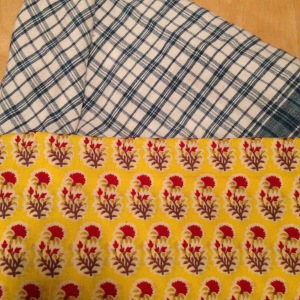
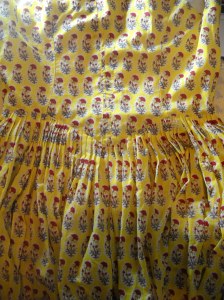
It’s satisfying work, pleating and stitching this lightweight cotton, tiny stitches in white linen thread. I’ve made some modifications to the pattern, but not many, aiming for a 1780-1782 style. Judicious cutting and generous friends will, fingers crossed, even yield a matching petticoat, which is very exciting indeed– and an unusual fashion statement chez Calash. Here, we focus on clash, but the fabric itself takes care of that for me.

dscn4572
dscn4573

Now, if only I had bright red morocco leather shoes to wear with this, that would be a sight indeed.

Share this:

  • Click to share on Facebook (Opens in new window) Facebook
  • Click to share on Pinterest (Opens in new window) Pinterest
  • Click to email a link to a friend (Opens in new window) Email
  • Click to share on X (Opens in new window) X
Like Loading...

Mrs Pabodie, I presume?

16 Wednesday Nov 2016

Posted by kittycalash in Clothing, History, Living History, Museums, Pabodie Project

≈ 1 Comment

Tags

18th century clothes, 18th century clothing, 19th century clothing, dress, fashion, Federal style, interpretation, Research, Rhode Island Historical Society

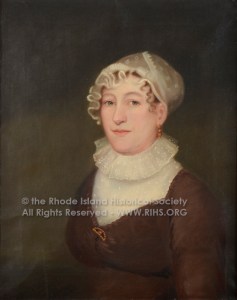
Mrs William (Jane) Pabodie. oil on canvas, 1813. RIHS 1970.60.2

Mrs William (Jane) Pabodie. oil on canvas, 1813. RIHS 1970.60.2

Remember Mrs Pabodie? She appeared a week ago today in Providence after an intense sewing effort left your author with numb fingers. The process was as straightforward as these things ever are, manipulating fabrics to do your bidding once you think you have the right materials.

It took more rounds of white muslins from Burnley and Trowbridge than I care to count, and a variety of book muslins from Wm Booth Draper, just for the chemisette and cap. The laces came from Farmhouse Fabrics in the most expensive small package I’ve yet ordered that did not contain antique jewelry.

Mrs Pabodie attempts to remember when she was born (1771). Photo by J. D. Kay

Mrs Pabodie attempts to remember when she was born (1771). Photo by J. D. Kay

The gown is a wool and silk blend remnant from Wm Booth Draper, just enough to make a gown (even at my height) though I admit the front hem will need some piecing or a ruffle to give it the proper length. Still, the thing more or less works, though as I compare the details to the original painting, I admit we’re still in beta.

Impressed from Newport-- or nearly so-- Low Spark makes his Providence debut. Photo by J.D. Kay
Impressed from Newport– or nearly so– Low Spark makes his Providence debut. Photo by J.D. Kay
Reverend Hitchcock, hoping against hope that the tailor will one day finish his fine silk waistcoat. Photo by J. D. Kay
Sissieretta Jones extols the beauties of Paris-- and pearls. Photo by J. D. Kay
Sissieretta Jones extols the beauties of Paris– and pearls. Photo by J. D. Kay

I was joined by three friends from different eras (because you know me: if it’s not didactic, we’re not doing it): a sailor who on the run from a Newport press gang in 1765; Reverend Enos Hitchcock of the Beneficient Congregational Church in 1785; and Sissieretta Jones, soprano of Providence, around 1880. Each of the characters described their lives and their clothing, and I will admit that the Annual Meeting audience may not have been fully prepared for some of what they heard– I’m not certain they had ever considered how apt “balancing a sheep on my head” might be in describing Reverend Hitchcock’s wig.

Mrs Pabodie points out East Side landmarks to a visitor examining the theatre curtain backdrop painted around 1810. Photo by J. D. Kay

Mrs Pabodie points out East Side landmarks to a visitor examining the theatre curtain backdrop painted around 1810. Photo by J. D. Kay

In the end, they were entertained, and may even have learned something, as we celebrated 2016’s interpretive theme, Fashioning Rhode Island.

Share this:

  • Click to share on Facebook (Opens in new window) Facebook
  • Click to share on Pinterest (Opens in new window) Pinterest
  • Click to email a link to a friend (Opens in new window) Email
  • Click to share on X (Opens in new window) X
Like Loading...

Frivolous Friday: The Pabodie Project

16 Friday Sep 2016

Posted by kittycalash in Clothing, Events, History, Living History, Making Things, material culture, Pabodie Project

≈ 12 Comments

Tags

19th century clothing, authenticity, fashion, Federal style, interpretation, Jane Pabodie, portraits, Rhode Island, Rhode Island Historical Society

Mrs William (Jane) Pabodie. oil on canvas, 1813. RIHS 1970.60.2

Mrs William (Jane) Pabodie. oil on canvas, 1813. RIHS 1970.60.2

Jane Jewett Pabodie, born around 1771, died 23 March 1846 is buried in Swan Point Cemetery on the Seekonk River in Providence. She was the wife of William Pabodie– which one? Well, it’s hard to tell until I really dig into the genealogy. At the moment I am so besotted with this image that all I can think about is what she’s wearing!

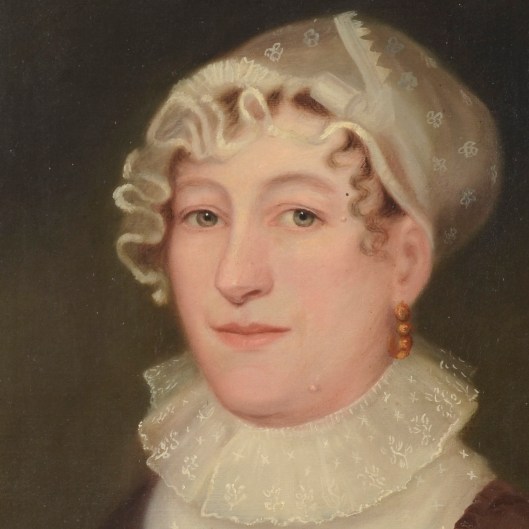
What she’s wearing….about that. I have some work– and some thinking– to do. The cap is slightly confounding. It’s a chance to learn a great deal more about early federal caps, which is good. I don’t understand it, which is unfortunate. The asymmetrical nature of the cap is new to me- or at least I cannot think of another example, so feel free to school me, people. But really: it is asymmetrical! With a ruffle on what is the right side of her head, and a… pinked? Van Dyked? Prairie pointed? band that runs from her left ear around to the back of her right ear? I’m confused. It would make more sense if the cap had slipped, but why would the Pabodies pay for a painting that recorded such a thing?

Honestly, I think the only way to really understand the cap is to make the cap. In muslin first, thankyouverymuch, I’m not that crazy.

Detail, Mrs William Pabodie. Oil on canvas, 1813. RIHS

Detail, Mrs William Pabodie. Oil on canvas, 1813. RIHS

The chemisette is more straightforward, being made of a sheer figured or embroidered cotton with a slightly gathered collar embellished with floral whitework embroidery. That I think can manage, at least in the basic construction (fabric, well, I’m looking).

Of course, why do I feel the need to manage all of this, with a deadline now less than eight weeks away? For a program, of course– I have only to write the copy for it. The idea (for me, anyway) is to replicate a portrait as closely as I can. Now, Mrs Pabodie and I are not exactly the same age, but I think I can pull this off…the cap, more troubling.

It’s an interesting project for me, not so much from the sewing point of view, but from a conceptual standpoint.

How close can I get? What does exactitude mean?

If I want to represent a character, what’s more important: understanding the clothing, or understanding Jane Pabodie? Constrained as I am by modern materials, unable to match these exactly, how do I navigate choices based on suppositions of what an artist meant to represent? Just my kind of conundrum.

Share this:

  • Click to share on Facebook (Opens in new window) Facebook
  • Click to share on Pinterest (Opens in new window) Pinterest
  • Click to email a link to a friend (Opens in new window) Email
  • Click to share on X (Opens in new window) X
Like Loading...

Hell is a Hand Basket

15 Thursday Sep 2016

Posted by kittycalash in Art Rant, Clothing, Fail, History, material culture, Research

≈ 5 Comments

Tags

18th century, 18th century clothes, art history, authenticity, baskets, Costume, dress, fashion, interpretation, John Copley, john smibert, Joseph Blackburn, portraits, Research

Gentle Reader: Remember the post on semiotics? We need to go back to that once more.

Just what are we looking at here?
copley_john-singleton-mrs-daniel-rogers-middleton-collection

John Singleton Copley.
Portrait of Mrs. Daniel Rogers (Elizabeth Gorham Rogers), 1762
50 X 40, oil on canvas.
Middleton Collection, Wake Forest University
HC1991.1.1

Hmm…. 1762. Does that dress look like 1762 to you? Or does it resemble a 17th century garment? Check out those sleeves: scallops. The shift sleeves: super full. The line of the gown at the neck: a shallow scoop. The front of the bodice: closed.

Are those the hallmarks of a typical 1762 gown in New England, England, or France? You are correct, sir: They are not.

What’s happening here? What is Copley doing, and why?

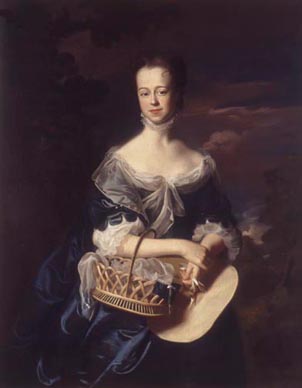
He’s making his subject look good, reflecting her wealth and status. He’s flattering her by painting her in a faux-17th century gown, a “Vandyke costume, a popular artistic convention in England related to the vogue for fancy dress and masquerade.”* 1762 seems a trifle late for this convention, but in 1757, James McArdell produces a mezzotint of Thomas Hudson’s portrait of the Duchess of Ancaster. Henry Pelham wrote to Copley in 1776 that he had purchased one of those mezzotints, suggesting their use as references for Colonial American painters. Reynolda House has a nice explication of this style of dress in the Thëus portrait they own of Mrs. Thomas Lynch, shown below.

Mrs. Thomas Lynch, oil on canvas by Jeremiah Thëus, 1755. Reynolda House, 1972.2.1

Mrs. Thomas Lynch, oil on canvas by Jeremiah Thëus, 1755. Reynolda House, 1972.2.1

There was also a convention of portraying women in “timeless draperies,” following the school of Peter Lely and Godfrey Kneller, both late 17th-century English painters who produced portraits with generalized costumes.

Lady Mary Berkely, wife of Thomas Chambers. oil on canvas by Sir Godfrey Kneller, ca. 1700. Metropolitan Museum of Art, 96.30.6

Lady Mary Berkely, wife of Thomas Chambers. oil on canvas by Sir Godfrey Kneller, ca. 1700. Metropolitan Museum of Art, 96.30.6

This portrait by Kneller (born in Germany, he worked in England) explains a lot, doesn’t it? And this timeless convention persists for some time, and the stylization of the facial features and hair is copied by English and colonial American painters. John Smibert, long familiar to many of you, was a leading practitioner of this style of portrait, and his work would have been well known to Copley and his sitters.

Mrs Samuel Browne by Smibert, RIHS 1891.2.2

Mrs Samuel Browne by Smibert, RIHS 1891.2.2

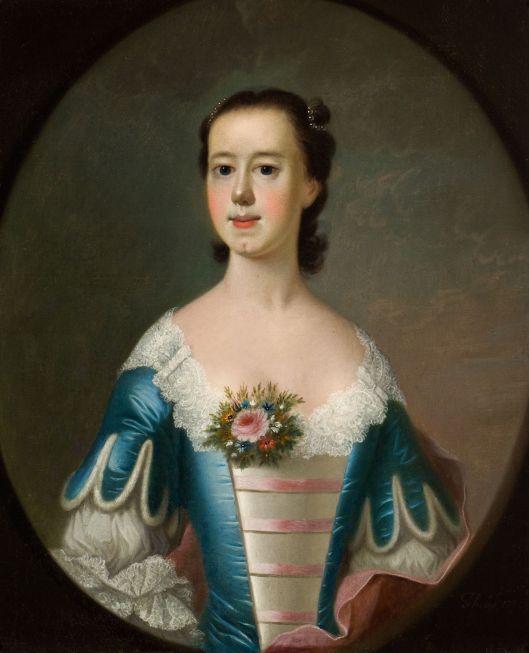
Blackburn’s portrait of Mary Sylvester adopts two conventions at once, in a way: she’s in timeless-style drapery and fancy dress as a shepherdess. Let’s remember, too, that there’s symbolism in the shepherdess imagery, referencing pastoral innocence and Mary Sylvester’s unmarried, presumably virginal, status. Don’t believe me? Read the catalog entry, written (at the very least) under the supervision of actual, degree-toting art historians.

Mary Sylvester, oil on canvas by Joseph Blackburn, 1754. Metropolitan Museum of Art, 16.68.2

Mary Sylvester, oil on canvas by Joseph Blackburn, 1754. Metropolitan Museum of Art, 16.68.2

Where does that leave us with Mrs. Rogers? She’s portrayed in what is essentially fancy dress, holding her straw hat in her left hand (much as Mary Sylvester is) with a basket over her right forearm. You will note the open work of the basket, the delicate arches and the fineness of the base. What’s in it? Something gauzy, as light as the drape around her shoulders, with a square of dark blue silk and a fine white silk ribbon. Honestly I am not entirely certain — the resolution of the image is dreadful.

But what’s NOT in the basket? A redware or pewter mug, sewing, keys, bottle, food, candy, toys, or, really, anything of a very concrete or practical nature.

Is this image a justification for carrying a [nearly empty ] basket on the streets of Boston? Of course it is–as long as you justify walking the streets of Boston in imaginary or fancy dress.

*p.106, Ribeiro, Aileen. “‘The Whole Art of Dress’: Costume in the Work of John Singleton Copley.” John Singleton Copley in America, Metropolitan Museum of Art, 1995.

Share this:

  • Click to share on Facebook (Opens in new window) Facebook
  • Click to share on Pinterest (Opens in new window) Pinterest
  • Click to email a link to a friend (Opens in new window) Email
  • Click to share on X (Opens in new window) X
Like Loading...
← Older posts
Newer posts →

Archives

wordpress statistics

Creative Commons License
Kitty Calash blog by Kirsten Hammerstrom is licensed under a Creative Commons Attribution-NonCommercial-ShareAlike 4.0 International License.

Website Built with WordPress.com.

  • Subscribe Subscribed
    • Kitty Calash
    • Join 621 other subscribers
    • Already have a WordPress.com account? Log in now.
    • Kitty Calash
    • Subscribe Subscribed
    • Sign up
    • Log in
    • Report this content
    • View site in Reader
    • Manage subscriptions
    • Collapse this bar
 

Loading Comments...
 

    %d