• Home
  • Completed Costumes/Impressions
  • Emma and Her Dresses
  • Free Patterns and Instructions

Kitty Calash

~ Confessions of a Known Bonnet-Wearer

Kitty Calash

Tag Archives: history

Bang Bang Pew

16 Monday Jan 2017

Posted by kittycalash in History, Museums, Philosophy

≈ 2 Comments

Tags

forts, history, interpretation, military history, war of 1812

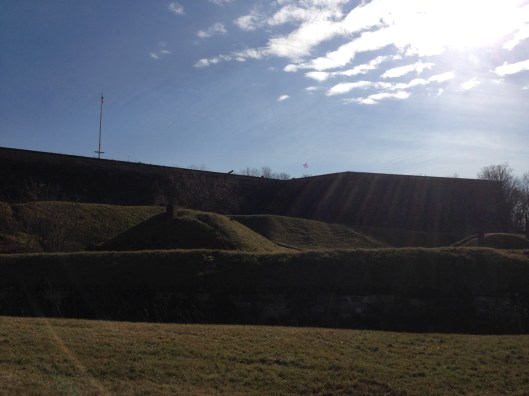
img_8896Like an energetic Golden Retriever, I need to be walked daily, almost without regard to weather, and I have a fondness for water that I fear makes me a questionable house guest-cum-nurse. Fortunately for me, Drunk Tailor has a granular knowledge of his surroundings that allows him to recalibrate his understanding of the places he likes to suit my needs: hence a Sunday trip to Fort Washington, Maryland. Plenty of room to wander, a wide* meandering river, defensive weapons installations.

It’s a large site and we only explored the main fort structure, the shore by the lighthouse, and the visitors’ center (I’ve seen plenty of Endicott batteries before, both on the Potomac and on Narragansett Bay). It started out well enough: the curious tripping stick figure sign warned us of the wooden bridge into the fort, and reminded me of a friend with a fondness for fonts and curious graphic design.

img_8890Guardhouse, batteries, masonry walls, stables, earthworks, former ditches, the remains of powder houses: all good stuff. The signs were what one comes to expect from the NPS: UV-damaged labels, slightly behind the times graphically, indicative of the slow pace and underfunding of the preservation of our national heritage.

img_8894

Drunk Tailor’s memories of Fort Washington include a first-person living history event set on the (literal) eve of the Civil War, with men portraying member of a Texas-based unit wondering how they would ever get home, and responding to a woman’s inquiries about General Lee and Grant with the suggestion that reading Harper’s would bring her up to date with current events. Now, we are in January and my expectations are low in the cultural heritage off-season: this is the time for maintenance, upgrades, rest and refurbishment.
img_8903

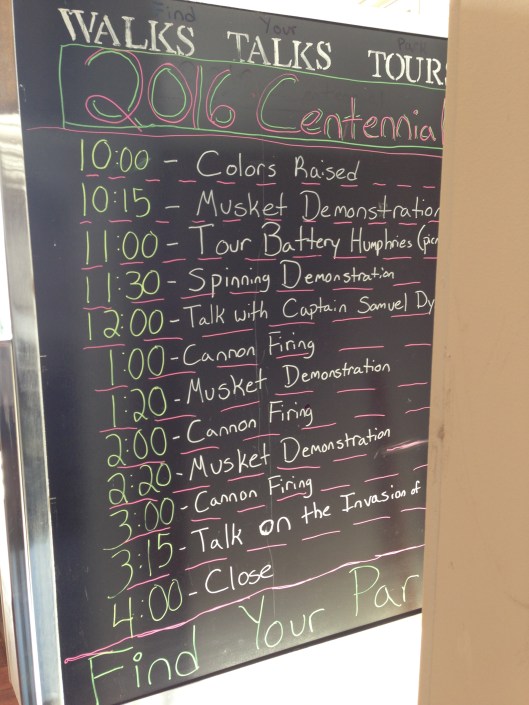
All the pew. Plus some spinning.

What I did not expect– though I should have– was the leftover daily event roster from some time in 2016.

Boom! Goes the cannon, et cetera. Because Boom! is easy. Add in a side of spinning and we are good to go, right? We got something for the ladies. (You know where this is going, right?)

The best thing I can say for Fort Washington is that I was spared endless racks of brown sticks displayed with only the barest of identifying labels and no interpretation**. But here we are at a site with over 200 years of history and just the vaguest hints in the visitor center of decades of use and change over time. And I like military history. I like weapons. But the more I visit the more I marvel at the way we underestimate our visitors’ capacity for understanding and interest in the past.

img_8889

Bigger Booms

As we drove away from Fort Washington, I began to think that once again, we are asking the wrong questions. Instead of questions that can be answered, “Guns Got Bigger,” why not ask some of the following:

  • What was daily life like for the men stationed here?
  • What material differences did officers and enlisted men experience?
  • Could enlisted men get married? Where were their wives?
  • How much did soldiers get paid?
  • What was the typical term of enlistment? Did that change over time?
  • Where were the stables? What were the horses used for?
  • How was the fort supplied? Where were the kitchens?
  • Where were the mess halls? What was a typical diet?
  • How did rations differ for men and officers?
  • Did any of the British officers or enlisted men remember the area around Washington, D.C. from their service in the Revolutionary War? To what degree might that have influenced the way the War of 1812 was fought?
  • What about that court martial, Captain Dyson? How was it run? What testimony did Dyson give?

Why did I have to go to the Fort Washington website to learn about the Adjutant General’s school, and the WAAC detachment? And why is it a PDF instead of a webpage?


img_8899
img_8900

Perhaps the most salient question to ask, on the Monday of inauguration week, is why do we care so little for our shared past that we accept the level of funding and staffing that gives us this level of interpretation? Don’t we, as a people, and our history, matter more than this?


*For the East Coast. The Potomac ain’t no Mississippi.

** I’m looking at you, West Point Museum.

Share this:

  • Share on Facebook (Opens in new window) Facebook
  • Share on Pinterest (Opens in new window) Pinterest
  • Email a link to a friend (Opens in new window) Email
  • Share on X (Opens in new window) X
Like Loading...

Sideways Into Immersion

04 Sunday Dec 2016

Posted by kittycalash in History, Museums

≈ 1 Comment

Tags

authenticity, history, interpretation, Museums


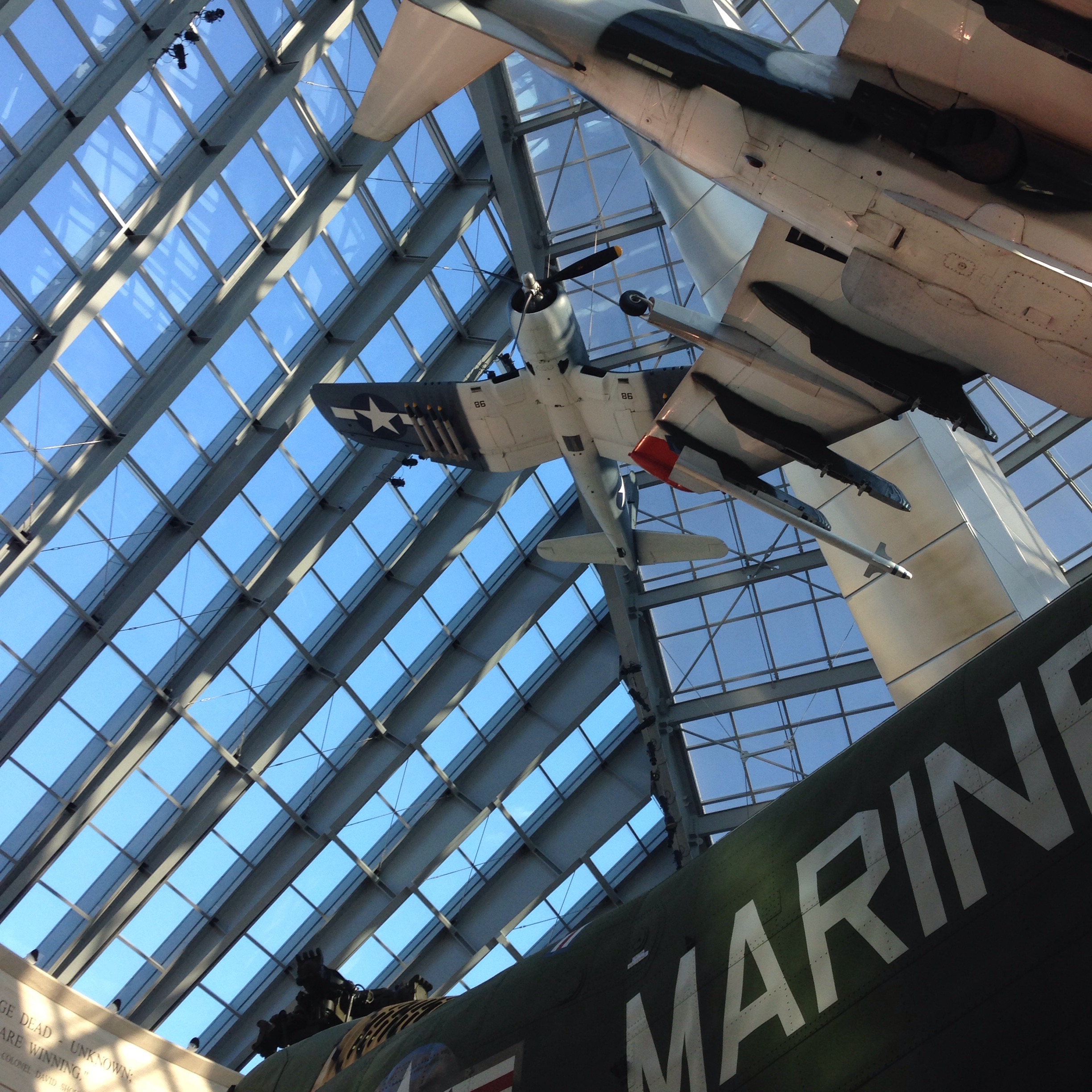
I was recently asked where I found inspiration for my work, and the obvious answer was in my travels, from the arrangement of bannister-back chairs on the wall at the Yale University Art Gallery to men shaving with straight razors on the parade ground at Fort Ticonderoga. There’s a kind of middle-ground answer as well: the National Museum of the Marine Corps.


Drunk Tailor took me there almost a year ago, and since What Cheer Day prompted me to think about emotional goals, I’ve wanted to go back. Anna asked about uncomfortable emotions, and while Sharon is absolutely right about the United State Holocaust Memorial Museum being necessary, it was the NMMC’s 20th century displays that came to mind, particularly Chosin and Khe Sanh– Chosin all the more so after watching the American Experience program on the battle of Chosin.


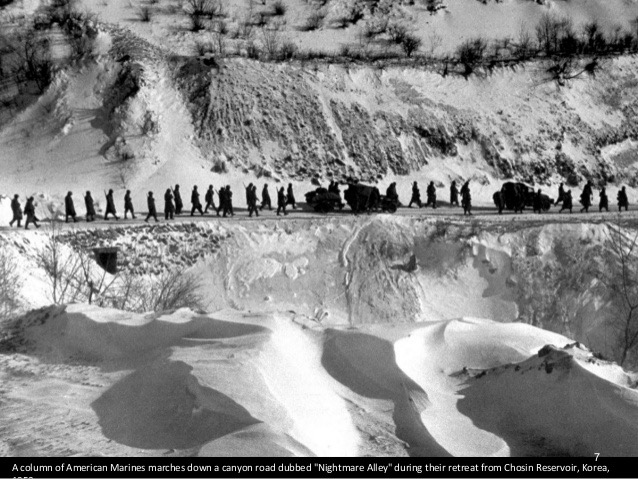
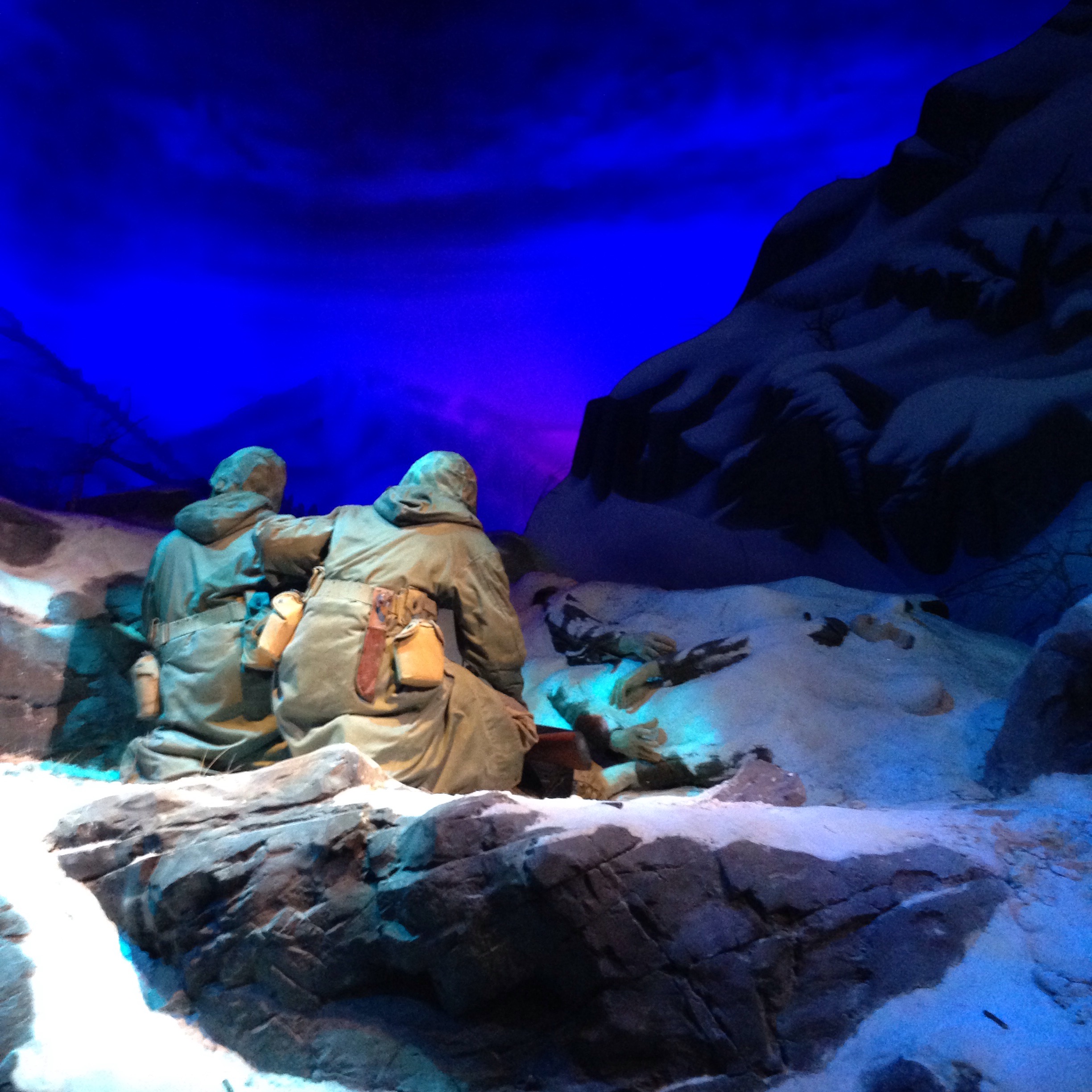
A year ago, the Chosin Reservoir gallery experience resonated with me because it was so well done. Reproductions of David Douglas Duncan photos (he sticks with me because, like Omar Bradley, he came from Missouri) hang on the wall beside two glass doors. To the right, a film runs on a loop, framed by cast resin icicles. Open the doors, and even Drunk Tailor and I are dwarfed by the landscape looming out of the dark. Figures of Marines crouch above us, sheltering behind a snowbank…of dead, frozen Marines. Artillery rounds burst against the dark sky, and I wrap my coat around me because, more than fearful or shocked by the noise and lights, I’m cold. Really cold.

There’s no possible way a gallery –even a Marine Corps Museum gallery– can replicate a fraction of the Chosin experience, but the gallery succeeds in shocking our senses through the simple use of temperature shift, and that is enough to take us out of the everyday. Physical discomfort prompts an emotional shift that allows us to better empathize with, and understand, the experience of the Marine at Chosin. Now, the NMMC and I may have very different takeaways from this gallery: while I absolutely respect and admire the Marine corps (c’mon, I sew OD gowns while binge-watching The Pacific), my instinctive response is No More Wars. That’s a complicated response to have in a military museum, and one I feel more strongly at the NMMC than I have at the West Point Museum.

I attribute these different responses to the greater sophistication of the NMMC compared to the WPM, which presents very standard uniform/flag/weapon/label displays. The NMMC begins that way (the sole “motion” in the earliest galleries is stylized seagulls against a blue sky), and while I love roundabouts and shakos nearly as much as Drunk Tailor, these galleries do not connect us to the history as immediately — as emotionally– as Chosin and Khe Sahn.

img_0821

img_0821


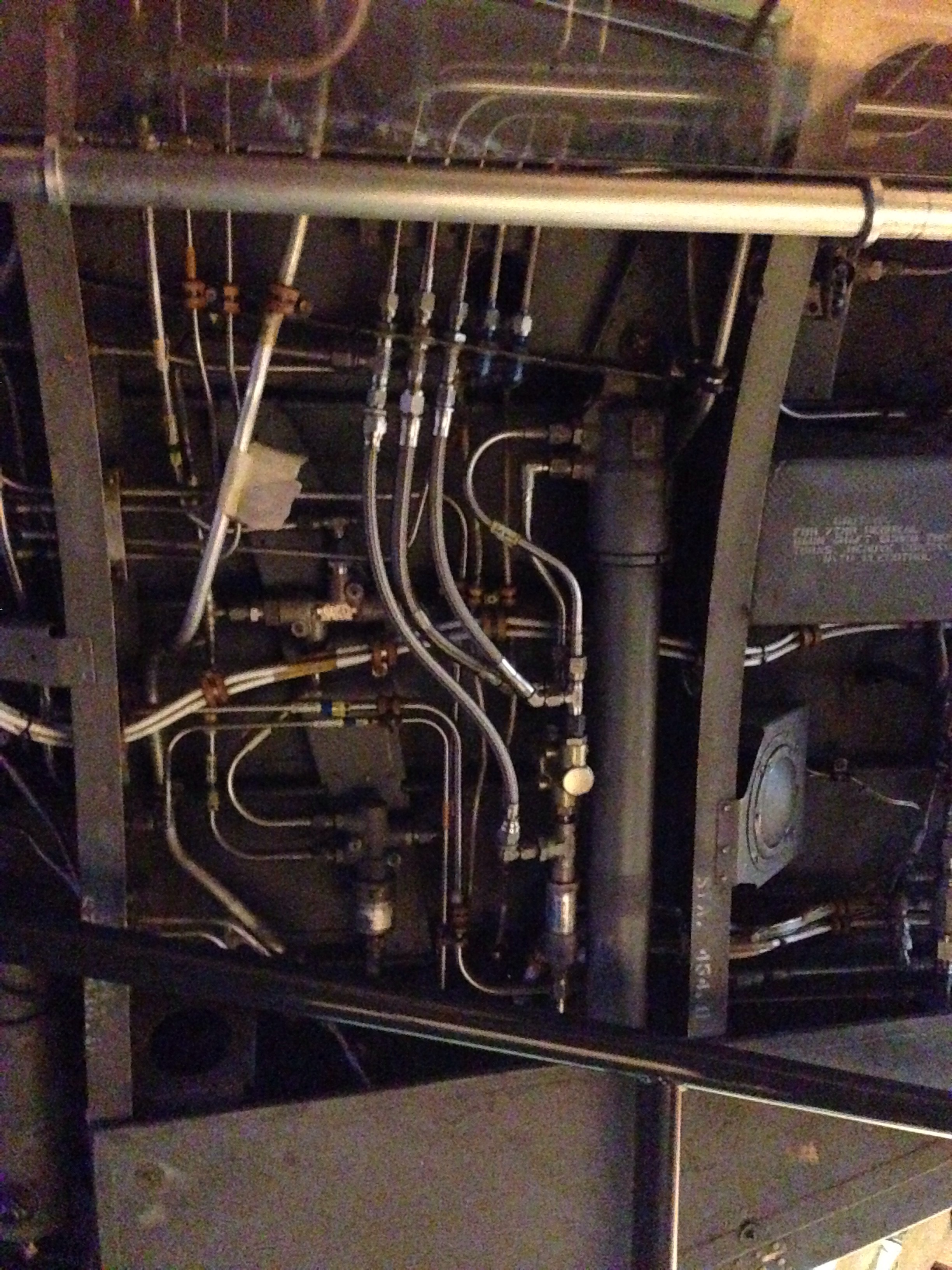
Khe Sahn was slightly disappointing this visit compared to last year. To be sure, the helicopter entrance continues to impress me, but I recall the gallery having higher heat and more rats, as well as louder volume. The temperature contrast was particularly notable against Chosin, and I remember taking my coat off in the Khe Sahn gallery last year. Despite those differences, a toddler entering Khe Sahn promptly turned around to leave. The radio noise was clearer this year, and I suspect that the gallery continues to be fine-tuned, as staff attempt to balance the noise of the siege against the noise of the entrance. This is a place where a faint odor of hydraulic fluid lingers in the helicopter, and probably prompted the emotional response Drunk Tailor observed visiting with veterans.


The bottom line, though, is that mindful use of sensory input in any museum can increase visitors’ emotional connection to, and engagement in, the material presented. Visitors are smart: it won’t take much for them to notice a smell, temperature or sound, so even the most cautious museums can sidle into more sensory engagement.

Share this:

  • Share on Facebook (Opens in new window) Facebook
  • Share on Pinterest (Opens in new window) Pinterest
  • Email a link to a friend (Opens in new window) Email
  • Share on X (Opens in new window) X
Like Loading...

The Landscapes of Things

20 Wednesday Jul 2016

Posted by kittycalash in Collecting, Living History, material culture, personal

≈ Comments Off on The Landscapes of Things

Tags

collecting, collections, history, interpretation, landscape, material culture

Or, you never know where things will end up.

New post, Old post, Cataloger

New post, Old post, Cataloger

You can learn a lot about a place by visiting its antique and junk shops. Here, where the China Trade was A THING, you can practically fall over Chinese export porcelain (and its imitators) of a variety of types every day. It can become a bad habit. You can become an enabler.

IMG_7449

Elsewhere, the objects for sale tell a different story. I’m fond of the haphazard antique malls museum of things world, and while on a tea pot delivery mission to Maryland, went to one in Mount Vernon. It was astonishing.

Mid-century modern furniture, the Arabia Anemone tableware of my childhood, and shelves of geisha dolls, Kabuto, ceramics, and the occasional sword confused me at first until I realized these were probably the jumbled contents of a prior generation of military and civil servants’  homes emptied by their children. The aesthetics were markedly different from what I typically encounter in southeastern New England, where I am accustomed to reading subtle variations between the states I frequent.

14

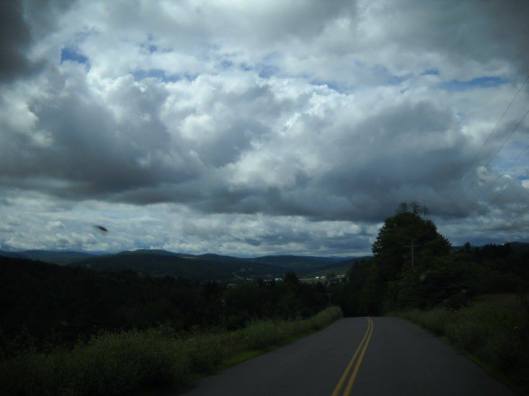
Local variations occurred in Vermont as well, though the general flavor was more familiar.

16
17

Some things are universal: chaotic piles of partially-identified snapshots can be found anywhere, stacks of pelts and dog-like foxes, not so much. Origins debatable, ethics questionable, the late mammals tempted the tourist trade in St. Johnsbury, where we stopped as we headed south for home.

12

We influence our landscape more than we credit: from changes in the land wrought by farming to climate change to the differences in what we cast off and what we collect, the visible human influence is undeniable. Material culture can be about place as much as it is about thing.

Share this:

  • Share on Facebook (Opens in new window) Facebook
  • Share on Pinterest (Opens in new window) Pinterest
  • Email a link to a friend (Opens in new window) Email
  • Share on X (Opens in new window) X
Like Loading...

Fine Art Friday

20 Friday May 2016

Posted by kittycalash in History, Living History, Research

≈ Comments Off on Fine Art Friday

Tags

19th century clothing, art, art history, fine art, history, interpretation, sewing, sketchbook, sketching, women's history

Sketching a Cottage, Sept 29, 1816. Watercolor by Diana Sperling

Sketching a Cottage, Sept 29, 1816. Watercolor by Diana Sperling

In a mere four weeks, I will pack the Subaru and head west into New York State as so many Rhode Islanders have before me. And while I will have clothes suitable for the time of the RI Quaker Migration, I will be leaving not to found a more utopian society nor to seek my fortune on a farm. Instead, I’ll be joining some dear friends for a weekend sketching party (minus the horse and carriage).

This new enterprise has required some additional research, and while I look forward to painting miniatures at some point this summer, I suspect this venture will be a simpler proposition. A new dress and apron are the least of my worries: brushes, watercolor boxes, sketchbooks, pencils and pens all require research just when I should be thinking more seriously about the way the Revolution played out as a civil war in New Jersey.

Anne Rushout, ca. 1768–1849, British, 3 sketchbooks of 82 drawings by Anne Rushout (B1977.14.9506-9587), 1824 to 1832, Watercolor on moderately thick, slightly textured, cream wove paper, Yale Center for British Art, Paul Mellon Collection

Anne Rushout, ca. 1768–1849, British, 3 sketchbooks of 82 drawings by Anne Rushout (B1977.14.9506-9587), 1824 to 1832, Yale Center for British Art, Paul Mellon Collection

Still, the Yale Center for British Art has rarely failed me: a simple search for sketchbook turned up a catalog record for three sketchbooks of 82 drawings by Anne Rushout. These are lovely, well-executed landscapes in a fine British tradition, far more sophisticated than Diana Sperling or Sophie DuPont– I fear I will closer to Sperling and DuPont when I take up sketching again, and can at least console myself that my wonky drawings will be part of a fine tradition of ladies’ accomplishments.

Man and cat, 2004

Man and cat, 2004

The Yale Center for British Art also has a nice Romney sketchbook for Paradise Lost, which demonstrates the cartoon-like nature of preliminary drawings (and I mean cartoon in the old sense, not the Animaniacs sense, though the uses are related). And as I sew my dress of unmatched checks, I have art programming to entertain me: Fake or Fortune, thanks to a tip from Ms B, has provided happy, envious hours of conservation labs, artists’ colourmen, and auction rooms. Vicarious delight, indeed.

Share this:

  • Share on Facebook (Opens in new window) Facebook
  • Share on Pinterest (Opens in new window) Pinterest
  • Email a link to a friend (Opens in new window) Email
  • Share on X (Opens in new window) X
Like Loading...

Wicked Inspiration

28 Thursday Apr 2016

Posted by kittycalash in Art Rant, History, Living History, personal, Philosophy, Reenacting

≈ 2 Comments

Tags

anarchist guide to historic house museums, Hamilton, historical reenactors, history, interpretation, literature, living history, passion, progressive reenacting, Reenacting

You know that musical? The one you can’t get tickets to unless they were willed to you by your grandmother because she was lucky enough to stumble out of the Tardis right at the box office on opening day, but had to buy them for, like, six years from now, and they’re actually for the Kansas City production? The one in which the founding fathers are, you know, brown? My friends and family assumed I’d hate the whole idea, but I don’t. Like so many people, I love it, and not just for the music, though my preferred method of psyching myself up for GeeDubs1790 or What Cheer Day is listening to the Stones or the Beastie Boys all the way up.

So, what then, interests me in “Hamilton,” and why do I think it relates to interpretation? This: the way that the show filters the concerns of the late eighteenth century through the lens of the twenty-first could make for enlightening listening.

My Shot gives me goosebumps: why? Is it because history and civics are finally sexy?

Maybe. But “Hamilton” as a whole, per Rebecca Mead in the New Yorker, “is a hymn to the allure that America promises the immigrant who aspires to reach its shores; it is also an argument for the invigorating power that this nation’s porous borders, and porous identity, have always offered.”

Porous identity. That’s part of why I’m fascinated. But just as “Sleep No More” and Occupy Providence (really really) were partial inspirations for What Cheer Day, “Hamilton” strikes me as the kind of production worth paying attention to. No, I am not suggesting that the paunchy reenactors start channeling their inner Biggie, though I might well pay to see that.

No, what I’m suggesting is that we reconsider what it is we’re doing out there on the field and in the historic houses, and not just what but how and why. Hamilton takes an unexpected approach to history and it’s going gangbusters, while Amazing Grace tanked. So it’s not about the costuming authenticity, though I implore you not to give that up. It’s about the passion. It’s about coming at things sideways.

What makes you love doing laundry, drilling with precision, telling local gossip, making soap, or whatever it is that you love best about your place in the past? Why does all this matter to you so much? What is it that we can learn about today as you teach us about the past? Let loose that love and passion, share those insights, and ten to one you’ll have more fun and excite more visitors.

Share this:

  • Share on Facebook (Opens in new window) Facebook
  • Share on Pinterest (Opens in new window) Pinterest
  • Email a link to a friend (Opens in new window) Email
  • Share on X (Opens in new window) X
Like Loading...
← Older posts
Newer posts →

Archives

wordpress statistics

Creative Commons License
Kitty Calash blog by Kirsten Hammerstrom is licensed under a Creative Commons Attribution-NonCommercial-ShareAlike 4.0 International License.

Website Built with WordPress.com.

  • Subscribe Subscribed
    • Kitty Calash
    • Join 621 other subscribers
    • Already have a WordPress.com account? Log in now.
    • Kitty Calash
    • Subscribe Subscribed
    • Sign up
    • Log in
    • Report this content
    • View site in Reader
    • Manage subscriptions
    • Collapse this bar
 

Loading Comments...
 

    %d