• Home
  • Completed Costumes/Impressions
  • Emma and Her Dresses
  • Free Patterns and Instructions

Kitty Calash

~ Confessions of a Known Bonnet-Wearer

Kitty Calash

Tag Archives: interpretation

Who do you play with?

08 Friday Aug 2014

Posted by kittycalash in Living History, Philosophy, Reenacting

≈ 4 Comments

Tags

authenticity, engagement, history, interpretation, living history, philosophy, Reenacting

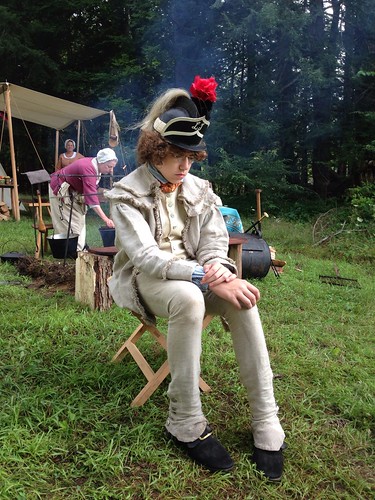
sad light infantry private

Don’t just sit there pouting…

Solving romantic troubles is not my forte, but just as your first crush may not be the person you spend your life with, the first living history/reenactment group may not be your last.

Some folks are serial joiners, just as there are people who engage in a series of medium-term relationships: as long as everybody knows what’s going on, things should be fine and no one will be set anyone else’s goldfish free and leave each other twisting in the wind. But some of us want a long-term home in history: what should we consider?

In no particular order, I offer the follow areas to examine:

Communication Style & Frequency
Surprised to discover members of your group at an event you thought they weren’t attending, so you went with someone else? Find yourself alone at an event that people said they were attending, but dropped at the last moment? Just because all life is like middle school, there’s no need to recreate scenes from Gidget in historic clothing: communicate.

Everyone requires different amounts of information, but after considerable time working, I think it’s hard to over-communicate. Folks, if it’s too many emails, hit the delete key. But if you do not get the basics– a list of events and potential attendees, reminders as the event approaches, coordination of food, canvas and powder supplies– and end up powderless and alone at an event, you may want to reconsider your allegiance.

Level of Activity & Engagement
“It’s just event after event after event,” whined the Young Mr last summer, and I hadn’t even made him march to Fort Ti and sleep under a brush arbor. Some people need to mix primitive camping in funny clothes with a few days at the beach, others spend their entire summers living life as old-school as they can. Some perform the classic turn-your-back maneuver described on Peabody’s Lament (pro tip: don’t do that!) while others actively seek opportunities to engage the public. Some like to be in first person, and others are always and only in third person.
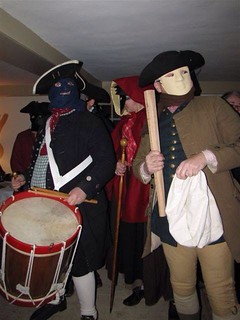
Mummers at Major John Buttrick House

How many activities can you fit into your year?

What’s your preference? If you want to try immersive, first-person interpretations, you need a unit that will support that, and opportunities to try it out. And if you want to go out often, you may need some flexibility in time period and activity.

But even beyond the times when you’re dressed in historic clothing and working with the public, you want to be with a group that includes people who are set a variety of RPMs. If you’re all super-intense original garment/gear/methods copying maniacs, you might not be balanced. As a newcomer, you need an environment that mixes challenges and support– like a good kindergarten.

Authenticity Standards
On that super-intense original garment/gear/methods copying theme, if the group doesn’t manage to meet a certain level of authenticity, or is not striving to improve, and to learn and try new things, is that the right group for you? I find that a curious mind is a necessity, one willing to accept that research advances and what we thought was right in the past may be proven wrong.

The other key here is, how does the group help you meet standards? Are there workshops to help you make up kit or improve what you already have? How deep do the standards go: clothing only, or to camp set up? What about how you cook, what you eat, and what you eat it with?
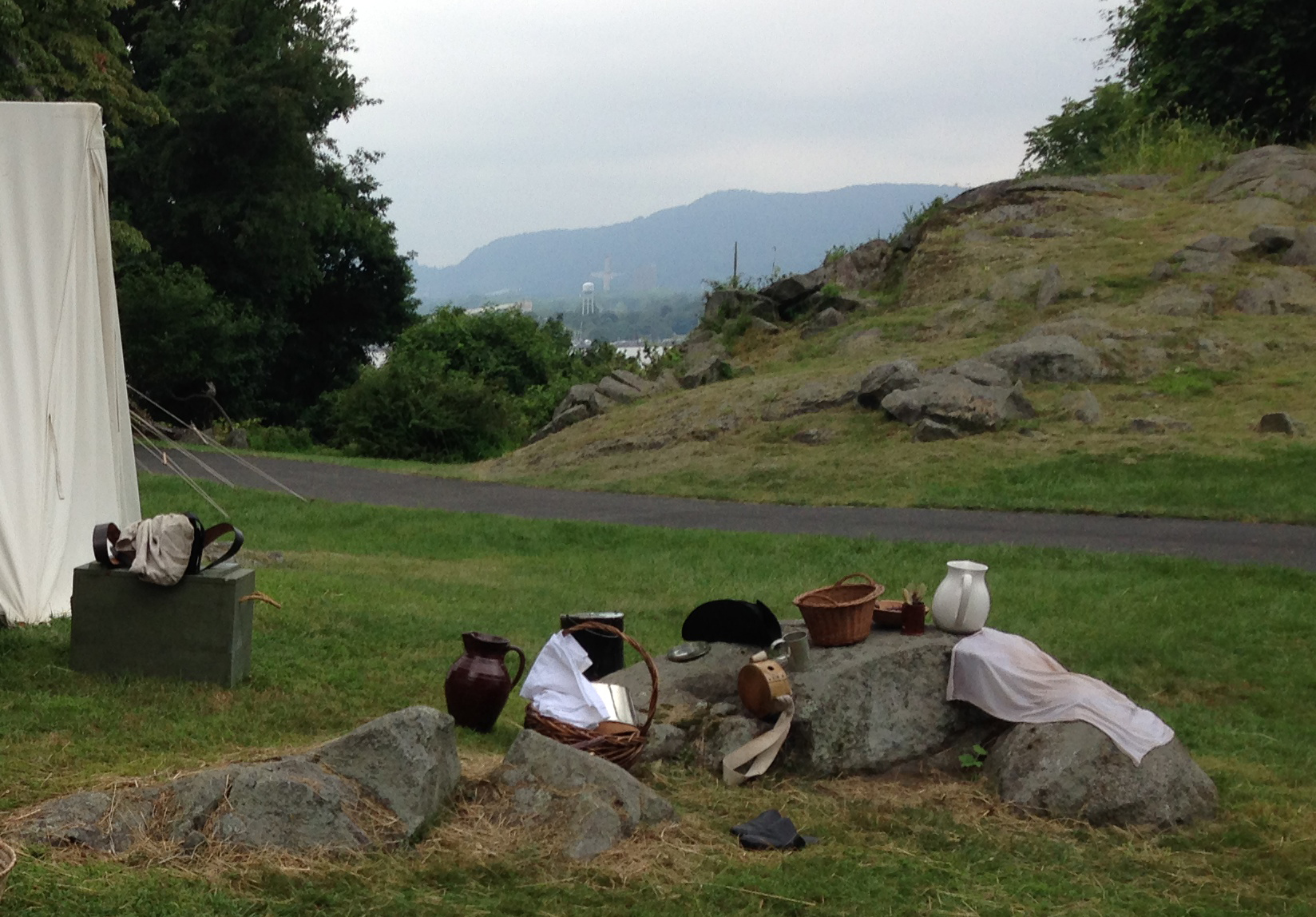
Colonial breakfast on a rock

“Furniture”

Are the compromises people make balanced and understood? My family and I ar among the people who go to events in “wearable but not done” clothes, and that’s OK in our world. While we have period shoes, they are not always perfectly correct: the gents wore buckles in 1812 and the Young Mr definitely doesn’t get a second pair of shoes until we know his feet won’t grow larger than they are now….

Interpretation and Imagination
Did you have one, maybe two, really-really best friends in grade school? Did you play dress-up, imaginative games, engage in narrative play? Did you enjoy the school play (and insist on leading the writing of a research-based script)?If you did, you are probably looking for folks who played the way you did as a child.
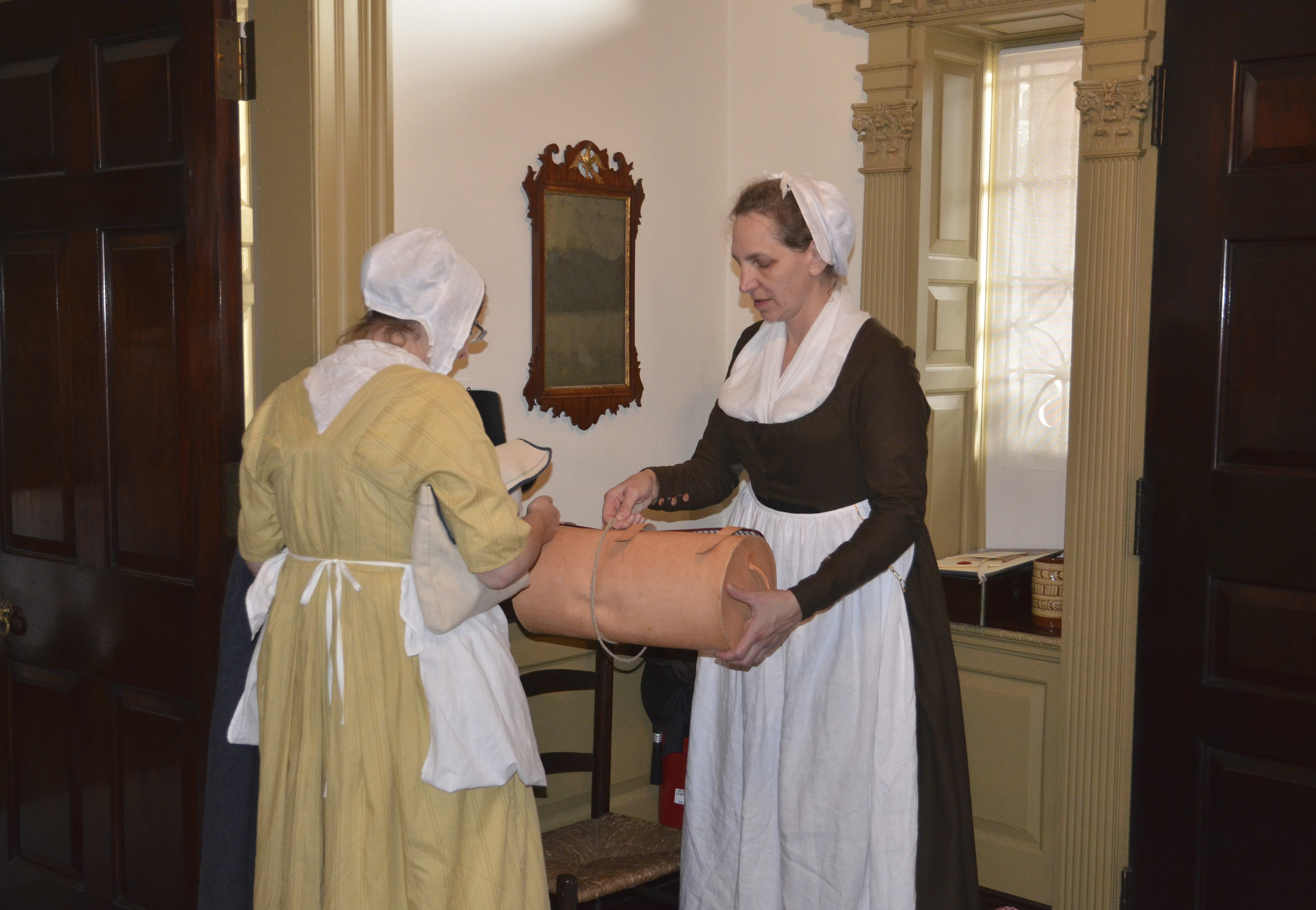
Esther takes Mr Herreshoff's case to his room

What kind of interpretation do you prefer?

Good interpretation requires that someone in the group have an active and vivid imagination, and that people are willing to take risks. Interpretation is a risk: will this portrayal of a captain’s death, a washerwoman’s trial, a wayward apprentice’s punishment, actual work? Do we trust each other enough to slip into new roles?

Trust is key: will the other people in the group bail you out if you freeze, encourage you if you run with an idea, and meet you in the same moment? You will have to spend time with people to find out how well you can all play together but, happily, you will quickly learn if you cannot. If your questions about who you are, why you are in a place, and if you should be wearing a 1781 coat at a 1777 event are rebuffed, you may need to consider other options.

Another time: What are your options?

Share this:

  • Share on Facebook (Opens in new window) Facebook
  • Share on Pinterest (Opens in new window) Pinterest
  • Email a link to a friend (Opens in new window) Email
  • Share on X (Opens in new window) X
Like Loading...

Hand-woven Linens by Subscription

06 Wednesday Aug 2014

Posted by kittycalash in Clothing, Living History, Making Things

≈ 2 Comments

Tags

18th century clothes, authenticity, Costume, dress, fashion, interpretation, Justin Squizzero, living history, Making Things, resources, sewing, style

In the few short years I have been doing costumed interpretation and living history, I have made three shifts and four shirts and am making up a fifth shirt, with a possible sixth needing to be made, as well as four aprons. I’m not crazy, I just sew that way…for three people (one still growing) who dress for the decades between 1763 and 1812.

linen sample

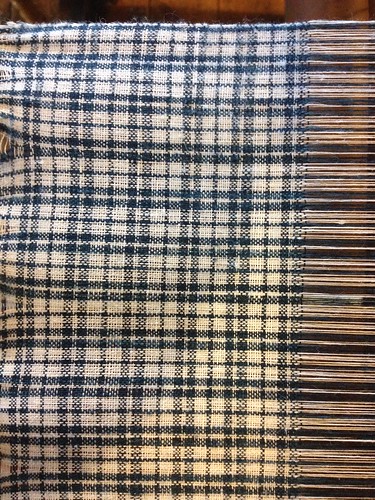
Hand-woven linen: the top edge is the selvedge

There are several annoying factors when sewing historic clothing with modern materials– mostly that the modern materials aren’t quite right, and can be quite wrong. As Sharon Burnston explains on her website, much of this has to do with selvedges— which are not hard, and rarely tucked, now. The other trouble is width: many fabrics now come 54 to 60 inches wide, which means that you have to cut them down when making shift.

There is a solution: hand-woven, period-correct linen, available now by subscription from Justin Squizzero [email to order: justin(dot)levi(at)ymail(dot) com].

Mr Squizzero will weave both plain and check to the width you want: 3/4 (27″), 7/8 (31.5″) and yard (36″) widths, perfectly correct for period clothing.

Hand-woven checked linen

Hand-woven checked linen

The prices are $130/yard for plain bleached, $160/yard for checks– and what checks! Indigo dyed blue and white check in a pattern documented to New England at the turn of the 19th century? Oh, yes, please: I must save my allowance and sew only from my stash.

Although we debated fabric weights this past weekend, here’s what I think, and have found through wearing: shirts for soldiers and artisans– but not the elite–can certainly be made of the white and the check; I would made a shift from the white, but I prefer how my heavier shift body feels and behaves under stays. The check would be ideal, too, for an apron, which would require only one yard.

If you’re wearing a coat made from $120/yard wool dyed with documented colors, shouldn’t you wear the most correct shirt possible underneath? Entirely hand-woven (and hand-dyed in the case of the checks), you’re buying art– but isn’t that what you’re making and creating when you hand-sew your clothes and step into the past?

Share this:

  • Share on Facebook (Opens in new window) Facebook
  • Share on Pinterest (Opens in new window) Pinterest
  • Email a link to a friend (Opens in new window) Email
  • Share on X (Opens in new window) X
Like Loading...

Ceci n’est pas une cruche

29 Tuesday Jul 2014

Posted by kittycalash in Events, Fail, History, Living History, personal, Reenacting, Snark

≈ 1 Comment

Tags

10th Massachusetts, authenticity, Brigade of the American Revolution, common people, common soldier, cooking, food, interpretation, living history, Reenacting, Revolutionary War

This is not a pitcher

Sometimes a pitcher is not a pitcher. In the same way that Matthiessen‘s Snow Leopard is not about a snow leopard, this was not about me: this was about the woman who approached me as I walked with Cat to the water bubbler with this white ceramic pitcher from Home Goods.

She stopped me to say, “You shouldn’t have a pitcher in camp. You should have a bucket.”

This is true, as far as it goes: but really, I should have a tin kettle (and I do). But the reasoning I was given had to do not so much with the fragility of the pitcher (which I pack in a basket or wrap in our towels and stuff into something in the supply wagon) as it did with the myth of Molly Pitcher. For an explication of the Molly Pitcher myth, I refer you to the Journal of the American Revolution, because, as I said to the woman who approached me, “It’s not my fight.”

So what’s the point? Maybe there are several:

One might be, Everyone has a hobby horse. Some of us are made mad by The Bodice. Some of us cannot abide makeup on “camp followers” who look like stragglers from a high school production of Sweeny Todd. Some of us are material culture and camp equipment fanatics– begone, ironware! Still others twitch at the baggy, off-the-rack cut and fit of some uniforms.

For another, This wasn’t about me– or my pitcher. The woman who approached me had a thing about Molly Pitcher and the myth of the woman on the battlefield with a pitcher, bringing water to the men. My pitcher and I were merely a trigger.

colonial woman with pitcher and kettle

Everybody’s got something to hide ‘cept for me and my…pitcher? or kettle?

And for a third, We all make choices and compromises. I chose not to bring the antique family copper coffee pot into the field, and also chose not to let the coffee and water sit overnight in the tin kettle. I chose, too, to use the white pitcher and a redware one for water that we drank all day long. When it’s hot, I slice lemons or limes into the water to make it easier to drink as much water as we need to in a day spent sweating outdoors, and it prevents scurvy to boot.

Fourth? We can all, always, make better choices. Few among us achieves true 18th century purity– I can assure you that even had I dashed my pitcher to the ground Saturday and dropped to my knees in repentance, I was not 18th century to the skin. There are monthly occurrences that I won’t go old school on, and on this point I shall not be moved.

But back at my ‘rock maple’ table, I could do better. We could/should have but one wooden bowl (mine), and the boys could/should have tin bowls, and we could/should swap out the redware canns with the handles broken off, but they make a nice refugee statement and until they break completely…

And there is a fabulous copper cistern by Goose Bay Workshops that I covet for its copper glory, but since it is not tinned inside, no lemons or limes would be allowed, and it would be hard to argue it for a Light Company. That puts me at another tin kettle, designated for water, and dipping our cups in. I can probably live with that choice.

But then, if I encounter someone who wants to talk about Molly Kettle, I’ll know I’m in real trouble.

Share this:

  • Share on Facebook (Opens in new window) Facebook
  • Share on Pinterest (Opens in new window) Pinterest
  • Email a link to a friend (Opens in new window) Email
  • Share on X (Opens in new window) X
Like Loading...

Tactical Strategies

30 Wednesday Apr 2014

Posted by kittycalash in Events, Living History, Reenacting

≈ Comments Off on Tactical Strategies

Tags

10th Massachusetts, 18th century, authenticity, Brigade of the American Revolution, common soldier, interpretation, petite guerre, Research, Revolutionary War

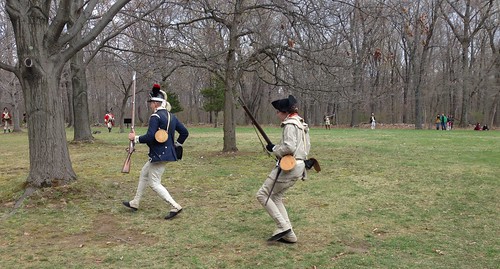
One of the things I liked best about this year’s School of Instruction was the Petite Guerre demonstration that followed a discussion of those tactics by Dr Stoltz of the 5th NY.

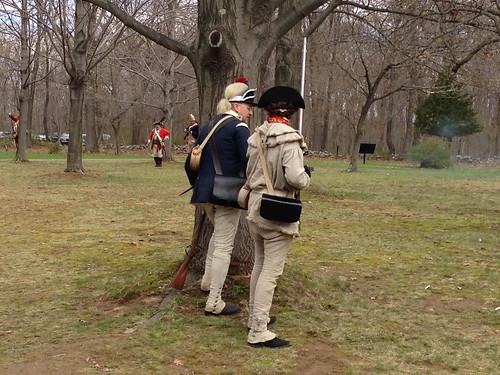
Mr McC & the Young Mr share a tree; note British officer and Hessian

Demonstrating skirmishes instead of linear warfare makes sense, given the numbers of men who take the field at events, and the smaller engagements will reflect exchanges common between the sides during the war.

What I like in particular is that using ‘petite guerre’ tactics requires the commanders and soldiers to tailor their actions to a site (site specific immersive experience: you cannot go wrong) and as the action unfolds, soldiers at all ranks are forced not only to move but also to think. Any action where the interpreters have to think is likely to create a better experience for visitors—and no great surprise, that usually makes a better experience for interpreters. It also flatters the site managers and visitors, who will appreciate that you’ve taken the time to explore and understand their place, and its place in history.

While you don’t necessarily want to fight the Battle of the Comfort Station, skirmishing around a site with buildings provides an objective, while multiple buildings and some woods or undergrowth provide cover for the Light Infantry troops and opportunities for deceit.

Of course, depending on troop size, it may be that each man needs his own tree. On Sunday, the Young Mr kept close to Mr McC, demonstrating troop [leg] length.

It’s hard to be invisible when you’re tall.

But I do mean this seriously: scaling events to available resources allows for a better interpretation.

That’s common sense, and sound museum practice, and that’s pretty much the business living history practioners (aka reenactors), are in: interpreting the past to visitors. Best practices for professionals and hobbyists are grounded in the same principles:

  • Primary source research
  • Material culture research
  • Site, resource, and audience- appropriate delivery
IMG_1386

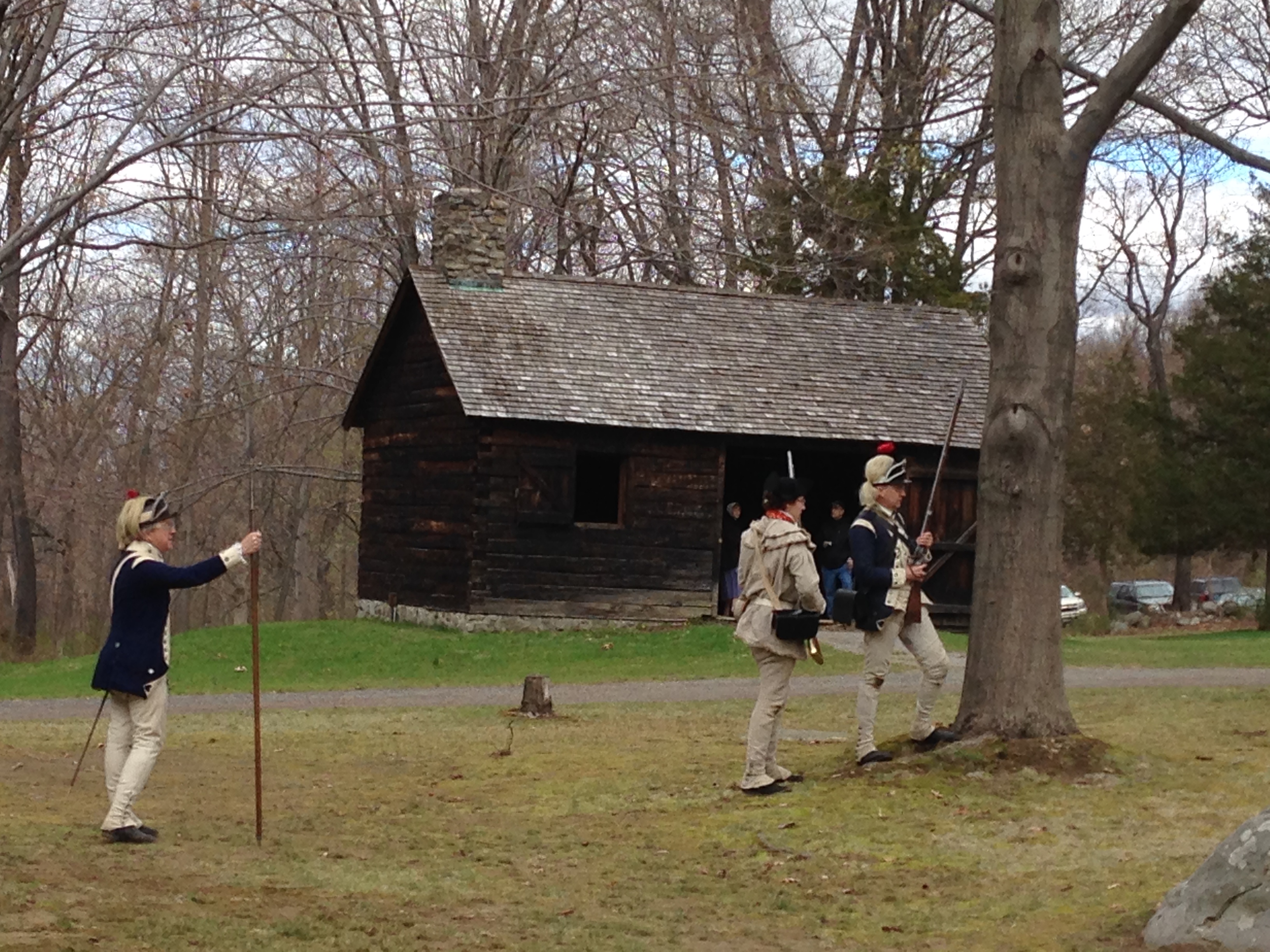
Direction provided by Mr C with spontoon.

Building an encampment and tactical demonstration on the first two principles grounds the event in in historical authenticity. Adding the third principle, and increasing the use of smaller group tactics, tailored to the participants and site, would be a subtle but strategic shift to build a more engaging experience that better educates visitors and might even attract new recruits.

Share this:

  • Share on Facebook (Opens in new window) Facebook
  • Share on Pinterest (Opens in new window) Pinterest
  • Email a link to a friend (Opens in new window) Email
  • Share on X (Opens in new window) X
Like Loading...

Interpretation 101

28 Monday Apr 2014

Posted by kittycalash in Events, History, Living History, Reenacting, Research

≈ 4 Comments

Tags

10th Massachusetts, 18th century, Bridget Connor, Brigade of the American Revolution, common dress, common people, common soldier, first person interpretation, interpretation, living history, museum practice, Museums, Reenacting, Research, resources, Revolutionary War

This slideshow requires JavaScript.

On Saturday morning, I gave a presentation at the BAR School of Instruction on Interpretation. The slides are above, and the presentation (with my notes) is here.

The handouts and bibliography I used in thinking about Bridget Connor an be found on the Interpretation 101 page.

Share this:

  • Share on Facebook (Opens in new window) Facebook
  • Share on Pinterest (Opens in new window) Pinterest
  • Email a link to a friend (Opens in new window) Email
  • Share on X (Opens in new window) X
Like Loading...
← Older posts
Newer posts →

Archives

wordpress statistics

Creative Commons License
Kitty Calash blog by Kirsten Hammerstrom is licensed under a Creative Commons Attribution-NonCommercial-ShareAlike 4.0 International License.

Website Built with WordPress.com.

  • Subscribe Subscribed
    • Kitty Calash
    • Join 621 other subscribers
    • Already have a WordPress.com account? Log in now.
    • Kitty Calash
    • Subscribe Subscribed
    • Sign up
    • Log in
    • Report this content
    • View site in Reader
    • Manage subscriptions
    • Collapse this bar
 

Loading Comments...
 

    %d