• Home
  • Completed Costumes/Impressions
  • Emma and Her Dresses
  • Free Patterns and Instructions

Kitty Calash

~ Confessions of a Known Bonnet-Wearer

Kitty Calash

Tag Archives: Making Things

Getting Better, and Giving Back

10 Wednesday Jul 2013

Posted by kittycalash in Clothing, Living History, Making Things, Thanks

≈ 2 Comments

Tags

10th Massachusetts, common soldier, fitting, living history, Making Things, menswear, Revolutionary War, uniforms
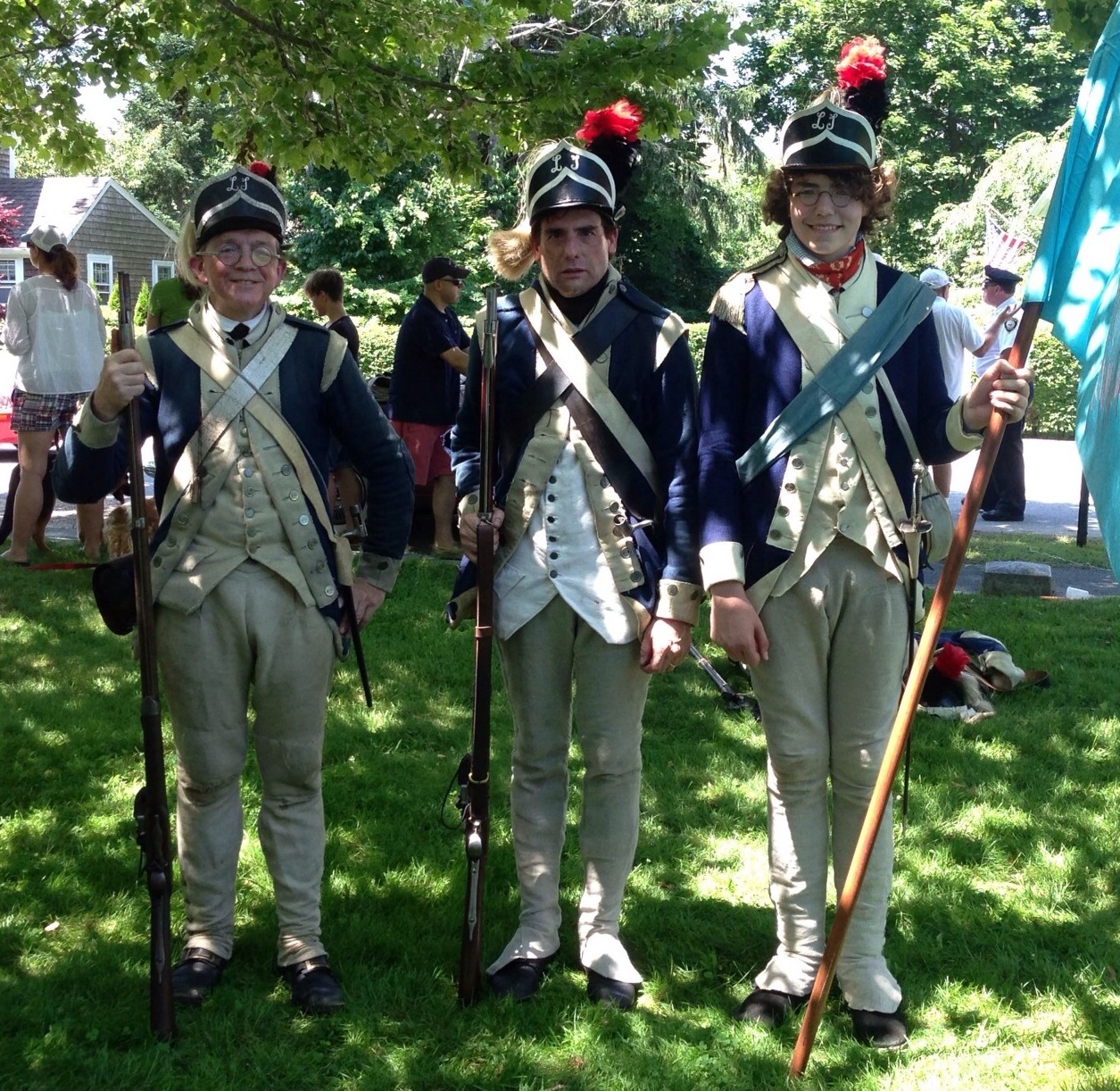
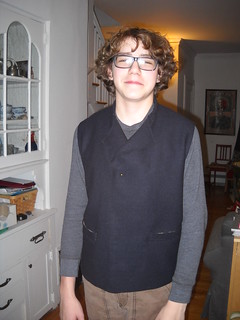
Mr Cooke, Mr S and the Young Mr.

10th Mass fittings: Mr Cooke, Mr S and the Young Mr.

There is good, if slightly terrifying, news about how to get better at sewing. It took me two years to get to a decent place, but this sped up considerably in the past year because of the weeks when I sewed for 30 or 40 hours a week. This business is about practice, looking, and patience … and also asking for help. Some of the help you can get online, some of the help you can get from whatever human is handy, and some you need a master for.
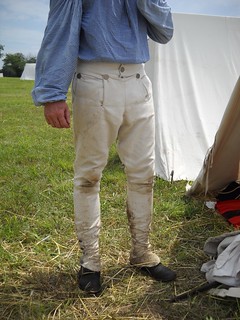
The Rhode Island pair, pattern by me based on Mill Farm breeches.

Online tutorials have saved my bacon: I make gowns with Koshka’s tutorial handy because after intensive menswear, I forget how this gown business works. The random human help I get comes from Mr S, who patiently takes photos as I try to fit backs or see what’s wrong. Trust me: you cannot see your own back in a mirror, so take a photo, or get someone else to. The masters who have helped me are Sharon Burnston and Henry Cooke. From both of them I’ve learned how to look and how to think about historic costumes. Sharon’s workshop really helped my sewing, and watching Henry has taught me a lot about fit. Also from both: patience.

When it came to Mr S’s overalls, I needed a professional bail out. Mr Cooke offered to help after watching me basting the things at MMNHP, and here’s what I wrote in reply:

[the] overalls have reached a rather bad place, and are now only half-basted on the legs after a third fitting attempt. He appears to have lost more weight. The fit in the seat confounds me, and when I get one leg right, the other twists. Your help would be deeply appreciated…

In the end, my basting was ripped out and Mr Cooke sat on the floor and basted the overalls on to Mr S. The process took a bit more than an hour, during which time Mr S became very familiar with the curtain material in Mr Cooke’s workroom, and realized that it was identical to the curtains he’s had as a child. This memory transported him back to a childhood trip to Williamsburg, when he yearned to be one of the costumed interpreters at CW. It was a transformative afternoon for Mr S and his overalls.

Now that they’ve been worn, I know that I need to:

  1. Adjust the waistband and seat
  2. Add a leather strap under the foot
  3. Finish the in-and out-seams (with fit proven, felling can begin)
  4. Switch ankle buttons from plain and RI mix to all plain or 10MA
  5. Take a pattern from the legs!

There is hardly any seam allowance over Mr S’s single-speed bike-riding-up-hills calves, so a pattern from the legs would make the next pair that much easier. He has two pairs, so why should I bother? Because he will undoubtedly wear these out doing as many belly crawls, stream fordings, nettle bush tangoes and other light infantry activities as he possibly can. At some point, mending will cease to be an option.

So how would I pass on the lessons I’ve learned? In some ways, by writing honestly about the struggles and successes in getting these things right, and to let you know that practice really does make a difference. It’s also become clear that maintaining an open, curious mind willing to accept criticism and new ideas will make you a better sewer, and maybe even a better living historian/reenactor…dare I say person?

Share this:

  • Click to share on Facebook (Opens in new window) Facebook
  • Click to share on Pinterest (Opens in new window) Pinterest
  • Click to email a link to a friend (Opens in new window) Email
  • Click to share on X (Opens in new window) X
Like Loading...

Shoulders and Sleeves

26 Friday Apr 2013

Posted by kittycalash in Clothing, Living History, Reenacting

≈ Comments Off on Shoulders and Sleeves

Tags

10th Massachusetts, 18th century, 18th century clothes, common dress, hunting shirt, living history, Making Things, menswear, Revolutionary War, uniforms

Dante's Own Infernal Sleeve of Poof

Dante’s Own Infernal Sleeve of Poof

Twenty-four hours on, this is where we are: Poofy, shoulder-popping sleeve of doom. How can that be a uniform sleeve?

Well, Pilgrim, this is how:

Oh. They're all Infernal Sleeves of Doom.

Oh. They’re all Infernal Sleeves of Doom.

So glad I have that near-feral hunting shirt, because without it I would have ripped this out completely. Could the Poof of Doom be there to allow movement?

Subject was detained for photography.

Before school, even.

Before school, even.

Arm out, doubts remain. Arm down, less terrifying.

I do feel sorry for him, but at the same time, I have to fit it to him.

I do feel sorry for him, but at the same time, I have to fit it to him.

It’s possible that the poof at the apogee of the shoulder is due to the intense pressing I gave this to retain the center line, and the fact that, despite washing, the linen is still pretty stiff. When I compare the two– the completed shirt and the in-progress shirt, I can see that while both display a tendency to drift up, the gathers on the adjutant’s shirt are more evenly distributed. You know what that means…and that’s why the sleeve is only basted in. Might as well change it now as on Sunday, because it must be done. So in the end, I am ripping it out completely, but with the knowledge that 1) the upward angle seems to be correct as shown in the finished garment, and 2) evening out gathers may reduce the Poof of Doom.

Share this:

  • Click to share on Facebook (Opens in new window) Facebook
  • Click to share on Pinterest (Opens in new window) Pinterest
  • Click to email a link to a friend (Opens in new window) Email
  • Click to share on X (Opens in new window) X
Like Loading...

King of the Coats

29 Friday Mar 2013

Posted by kittycalash in Clothing, Living History, Museums

≈ 3 Comments

Tags

18th century clothes, Clothing, Costume, fabric, fashion, Making Things, menswear, sewing

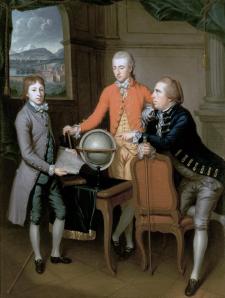
Douglas, 8th Duke of Hamilton on his Grand Tour, © National Museums Scotland A.1991.156

He’s hard to miss, the 8th Duke of Hamilton, in his red coat. I’d hazard it wool, because of the contrast with the sheen of the blue coat his physician, Dr John Moore (at right), is wearing. Dr Moore’s coat gleams like silk; the Duke’s looks dull and woolen. (Look at the way the light strikes the Dr’s shoulder; another clue is the way the button holes are worked.)

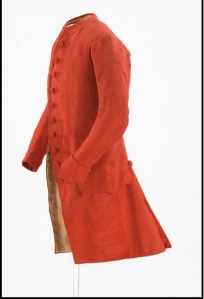
The coat below is a simpler, provincial relative of the Duke’s coat. This is the Amos King coat, owned by Colonial Williamsburg. I love the description:

“Wool plain weave fulled and napped “broadcloth”; twill worsted “shalloon” lining; tabby linen lining center back. Pocket flap lined with twill worsted; sleeves lined with tabby linen; right lower pocket is linen; left pocket is leather; inside pocket on left breast is linen, with broadcloth welt.”

Man's Coat, red broadcloth ca. 1770, CW 1953-59

Man’s Coat, red broadcloth
ca. 1770, CW 1953-59

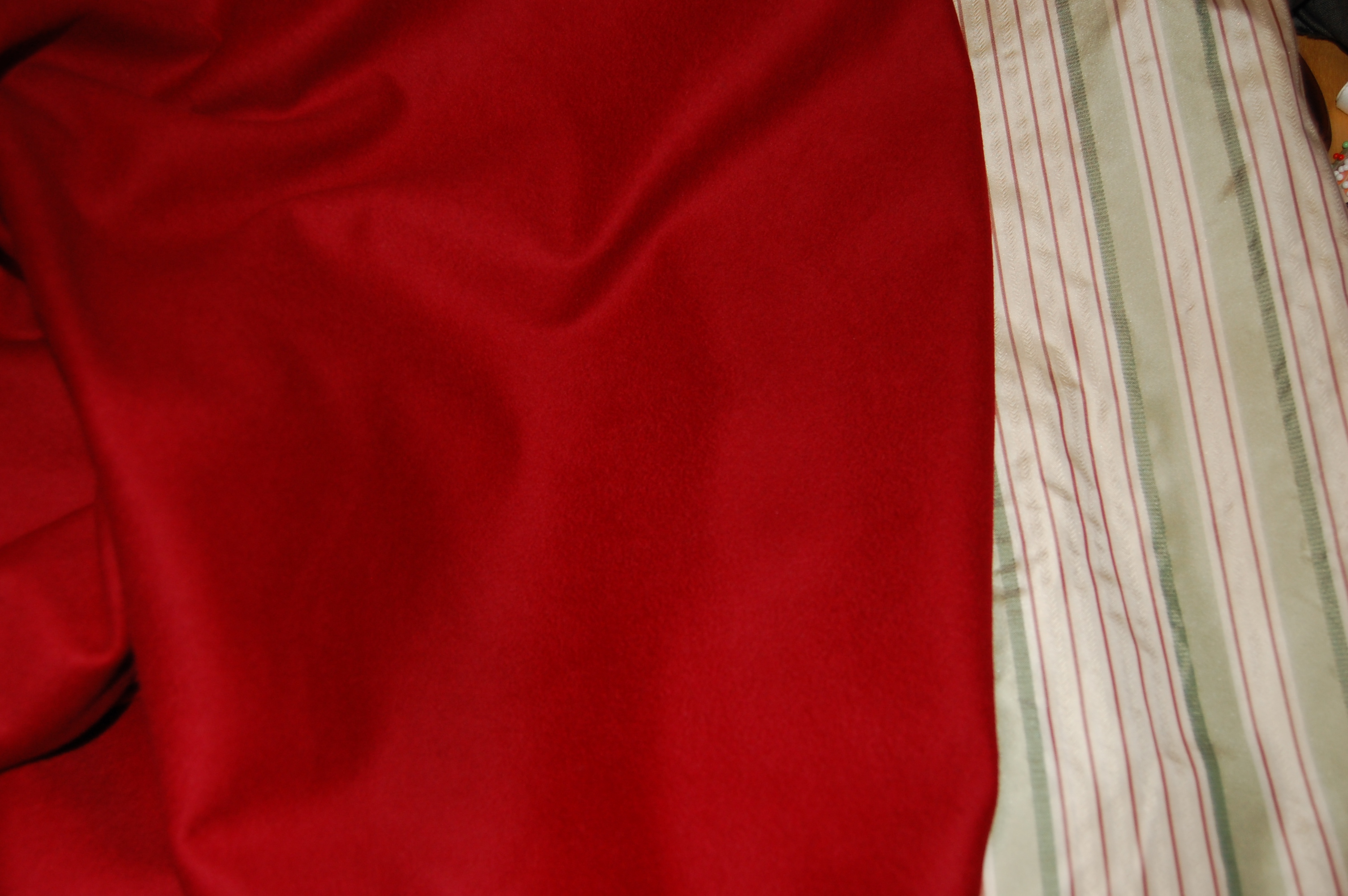
Shalloon. Tabby. Pocket leather. That paragraph is comprised of many of my favorite fabric and clothing words. And fabrics. And a leather pocket. As you may recall, I have a thing for fabric that is not at all about hoarding, and but rather about establishing reserves. When I see two yards of quality material at discount and purchase it, that yardage becomes part of the Strategic Fabric Reserve so vital to this nation’s safety. (We are all unsafe when a fabric addict is deprived of his or her fix. I’ve got a threaded needle, and I’m not afraid to use it!)

Part of this household's Strategic Fabric Reserve.

Part of this household’s Strategic Fabric Reserve.

Yardage arrived in the patriotic red, white and blue “if it fits, it ships” box on Wednesday, and when opened, we all proceeded to pet the lovely nap of the wool. Mr S wrapped himself in it, and I knew then that I would be making a red broadcloth coat of one kind or another.

It probably won’t be the “Quemans Pattern” coat John Buss mentions, not when I’ve got silk fabric for a waistcoat. The silk is from the remnant table at Artee Fabrics in Pawtucket. With careful cutting and a plain back for at least one waistcoat, there should be just enough to make both a 1770s and a 1790s waistcoat. We’ll get fancy around here eventually.

Share this:

  • Click to share on Facebook (Opens in new window) Facebook
  • Click to share on Pinterest (Opens in new window) Pinterest
  • Click to email a link to a friend (Opens in new window) Email
  • Click to share on X (Opens in new window) X
Like Loading...

Brown Gown

18 Monday Mar 2013

Posted by kittycalash in Clothing, Making Things

≈ 2 Comments

Tags

18th century clothes, authenticity, Battle Road 2013, Clothing, common dress, en fourreau, history, living history, Making Things, robe a l'anglaise, sewing

Gown, ca. 1765. CW 1985-117,1

Gown, ca. 1765. CW 1985-117,1

The very first dress in the Costume Close Up book matches my measurements pretty well, so I thought I’d be quite clever and pattern it up for my own use. I want a stomacher front open robe for Battle Road and a 1763 event this summer, so what better place to start than with an original ca. 1756-1760 gown?

I laced up my stays on Friday and spent much of the day measuring, drawing, cutting, and sewing. By mid-afternoon, I had a muslin with the devil’s own sleeve and a large measure of frustration.

Yes, I ate, it wasn’t just low blood sugar that caused all this unhappiness. For the public safety, there are no photos of the ensuing debacle. But the situation was not irreparable, as I have been in this miserable place before.

Patterned up from the little illustration.

( To add to the fun, my stays have stretched, and now give the impression that they slip down throughout the course of the day. They do this even while I am not especially active: I’d dismissed the sensation at Fort Lee. Oh, it’s the hours in the non-18th century seat, it’s running around the site, it’s one more lame excuse I’m making up. Nope. Suckers have stretched and will require attention. Also, for being slightly more than one year old, ought they to have wear marks from tying on petticoats? Next time, I’m using cotton, since it doesn’t stretch like linen.)

Gown, 1750-17651988-223, CW

Gown, 1750-1765,  CW 
1988-223

I got out the basic bodice block I’d patterned in June, and adjusted that to have a straighter, more horizontal waist line and made the bodice fronts narrower. The robings with be pleated to have a layered look, for which this Norwich wool gown at CW is the inspiration. I stitched up a muslin of the altered bodice block, and wouldn’t you know, it fit. It’s a relief to know that some measure of frustration eventually pays off. Maybe.

By Saturday night, I had the lining sewn up and Sunday morning, I attached the lining sleeves (I like to check the fit and have something to beat the fashion fabric sleeve against.) That meant I was ready for the terrifying step of cutting and sewing the actual wool. I have enough of it that I can mess up and redeem the problem, what I don’t have enough of is time. Certain gentlemen have garments in need of alteration, and creation, you see.

The back, with pleats sewn down, and skirts on their way.

Since this is the third or fourth or fifth time I have wrestled with the 18th century gown cut en fourreau, I know what I am getting in to. I know about the three hours for four pleats. I know the heartache of hand stitching the back only to realize you have introduced a wiggle. What I don’t know is how to keep this in perspective.

I followed along with Koshka the Cat’s en fourreau tutorial, which I found incredibly helpful. It won’t keep you from introducing a wiggle into your seams, but you will get the seams in pretty much the right place, as long as you’re honest about your measurements. It’s only a little bit Richard III up there in the center seam….

It’s good to be a perfectionist, but sometimes you have to just let go and sew. I’m still learning how to live with that.

Share this:

  • Click to share on Facebook (Opens in new window) Facebook
  • Click to share on Pinterest (Opens in new window) Pinterest
  • Click to email a link to a friend (Opens in new window) Email
  • Click to share on X (Opens in new window) X
Like Loading...

Work, work, workman’s jacket

04 Monday Mar 2013

Posted by kittycalash in Clothing, Historical Sew Fortnightly, Making Things, Reenacting

≈ 4 Comments

Tags

18th century clothes, Battle Road 2013, common dress, Historical Sew Fortnightly, living history, Making Things, Revolutionary War

It fits! It might be painful, though.

Ah, yes. Work. It continues on the workman’s jacket for the Young Mr to wear at Battle Road, and for next week’s HSF deadline. There are some additional views of him in the same pose here. I tacked the lapels down because I have seen that detail on an original garment, and because if I don’t, they’re likely to bother the kid.

The nice thing about a workman’s jacket is that a waistcoat is optional underneath it. This short, only post-RevWar waistcoats look alright. So for Battle Road, long underwear may be in order. It wasn’t last year, but who knows?

Paul Sandby, A Sandpit. YCBA B1975.3.930

Paul Sandby, A Sandpit. YCBA B1975.3.930

Sandby, Roslin Castle detail, YCBA, B1975.4.1877

Paul Sandby, Roslin Castle detail, YCBA, B1975.4.1877

The form is authentic, thank goodness, for working men’s clothes; on the left, in a detail from Sandby’s A Sandpit, is a jacket in blue. On the right, in a detail from Roslin Castle, Midlothian, is another jacket that looks short, worn without a waistcoat. It may not be as short, but I am encouraged by the lack of waistcoat, though I will insist on shoes…

The form persists for a long time, and is seen in military wear as well, in light infantry and dragoon troops, as well as in sailor’s clothing.


Share this:

  • Click to share on Facebook (Opens in new window) Facebook
  • Click to share on Pinterest (Opens in new window) Pinterest
  • Click to email a link to a friend (Opens in new window) Email
  • Click to share on X (Opens in new window) X
Like Loading...
← Older posts
Newer posts →

Archives

wordpress statistics

Creative Commons License
Kitty Calash blog by Kirsten Hammerstrom is licensed under a Creative Commons Attribution-NonCommercial-ShareAlike 4.0 International License.

Website Built with WordPress.com.

  • Subscribe Subscribed
    • Kitty Calash
    • Join 621 other subscribers
    • Already have a WordPress.com account? Log in now.
    • Kitty Calash
    • Subscribe Subscribed
    • Sign up
    • Log in
    • Report this content
    • View site in Reader
    • Manage subscriptions
    • Collapse this bar
 

Loading Comments...
 

    %d