• Home
  • Completed Costumes/Impressions
  • Emma and Her Dresses
  • Free Patterns and Instructions

Kitty Calash

~ Confessions of a Known Bonnet-Wearer

Kitty Calash

Tag Archives: Reenacting

Who do you play with?

08 Friday Aug 2014

Posted by kittycalash in Living History, Philosophy, Reenacting

≈ 4 Comments

Tags

authenticity, engagement, history, interpretation, living history, philosophy, Reenacting

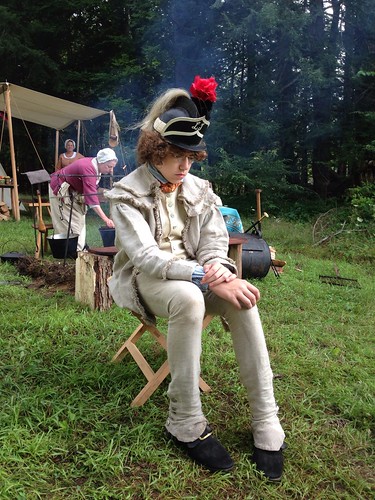
sad light infantry private

Don’t just sit there pouting…

Solving romantic troubles is not my forte, but just as your first crush may not be the person you spend your life with, the first living history/reenactment group may not be your last.

Some folks are serial joiners, just as there are people who engage in a series of medium-term relationships: as long as everybody knows what’s going on, things should be fine and no one will be set anyone else’s goldfish free and leave each other twisting in the wind. But some of us want a long-term home in history: what should we consider?

In no particular order, I offer the follow areas to examine:

Communication Style & Frequency
Surprised to discover members of your group at an event you thought they weren’t attending, so you went with someone else? Find yourself alone at an event that people said they were attending, but dropped at the last moment? Just because all life is like middle school, there’s no need to recreate scenes from Gidget in historic clothing: communicate.

Everyone requires different amounts of information, but after considerable time working, I think it’s hard to over-communicate. Folks, if it’s too many emails, hit the delete key. But if you do not get the basics– a list of events and potential attendees, reminders as the event approaches, coordination of food, canvas and powder supplies– and end up powderless and alone at an event, you may want to reconsider your allegiance.

Level of Activity & Engagement
“It’s just event after event after event,” whined the Young Mr last summer, and I hadn’t even made him march to Fort Ti and sleep under a brush arbor. Some people need to mix primitive camping in funny clothes with a few days at the beach, others spend their entire summers living life as old-school as they can. Some perform the classic turn-your-back maneuver described on Peabody’s Lament (pro tip: don’t do that!) while others actively seek opportunities to engage the public. Some like to be in first person, and others are always and only in third person.
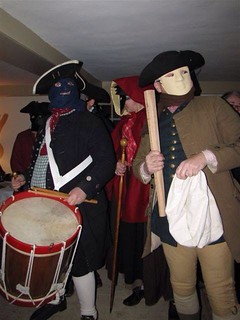
Mummers at Major John Buttrick House

How many activities can you fit into your year?

What’s your preference? If you want to try immersive, first-person interpretations, you need a unit that will support that, and opportunities to try it out. And if you want to go out often, you may need some flexibility in time period and activity.

But even beyond the times when you’re dressed in historic clothing and working with the public, you want to be with a group that includes people who are set a variety of RPMs. If you’re all super-intense original garment/gear/methods copying maniacs, you might not be balanced. As a newcomer, you need an environment that mixes challenges and support– like a good kindergarten.

Authenticity Standards
On that super-intense original garment/gear/methods copying theme, if the group doesn’t manage to meet a certain level of authenticity, or is not striving to improve, and to learn and try new things, is that the right group for you? I find that a curious mind is a necessity, one willing to accept that research advances and what we thought was right in the past may be proven wrong.

The other key here is, how does the group help you meet standards? Are there workshops to help you make up kit or improve what you already have? How deep do the standards go: clothing only, or to camp set up? What about how you cook, what you eat, and what you eat it with?
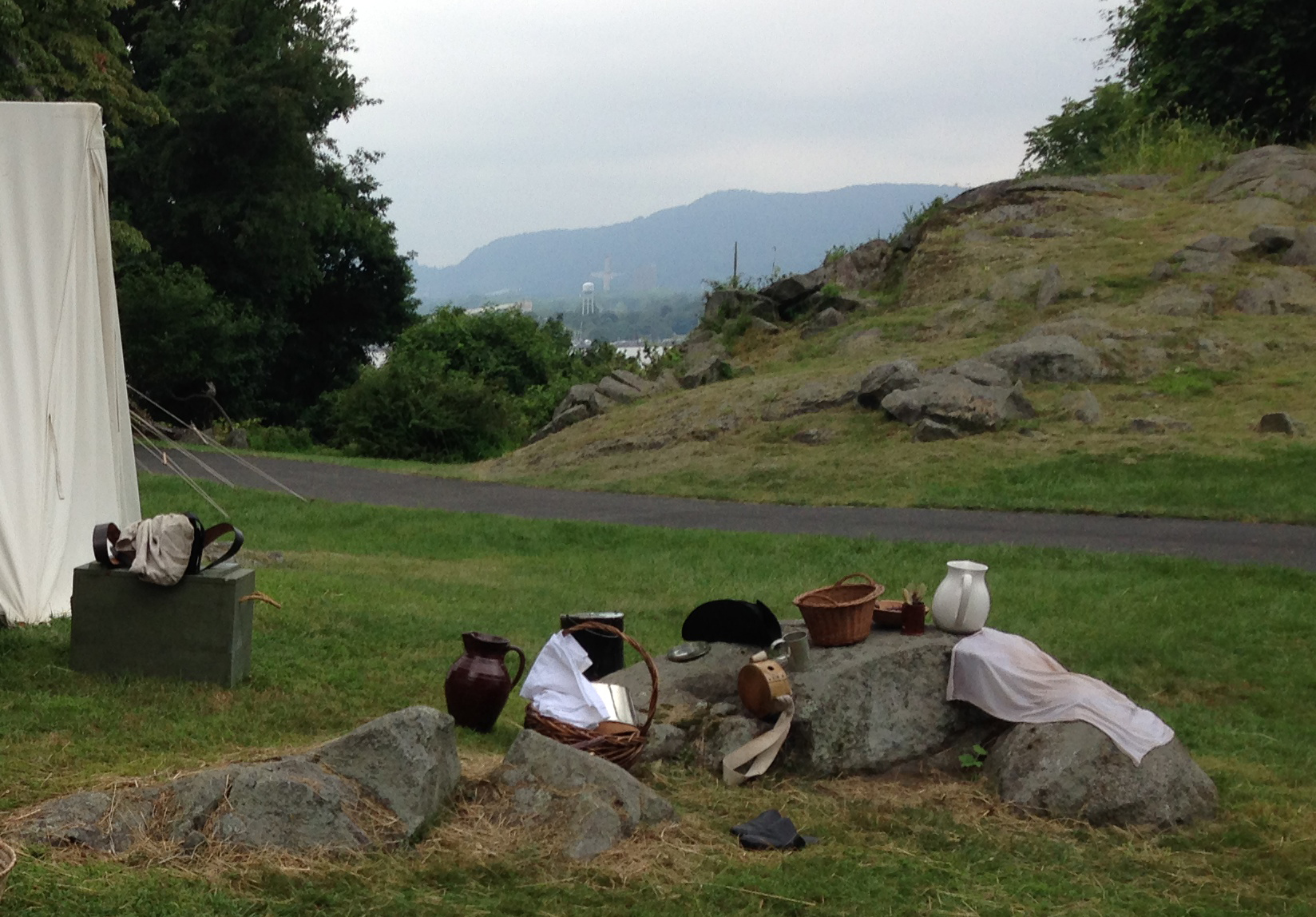
Colonial breakfast on a rock

“Furniture”

Are the compromises people make balanced and understood? My family and I ar among the people who go to events in “wearable but not done” clothes, and that’s OK in our world. While we have period shoes, they are not always perfectly correct: the gents wore buckles in 1812 and the Young Mr definitely doesn’t get a second pair of shoes until we know his feet won’t grow larger than they are now….

Interpretation and Imagination
Did you have one, maybe two, really-really best friends in grade school? Did you play dress-up, imaginative games, engage in narrative play? Did you enjoy the school play (and insist on leading the writing of a research-based script)?If you did, you are probably looking for folks who played the way you did as a child.
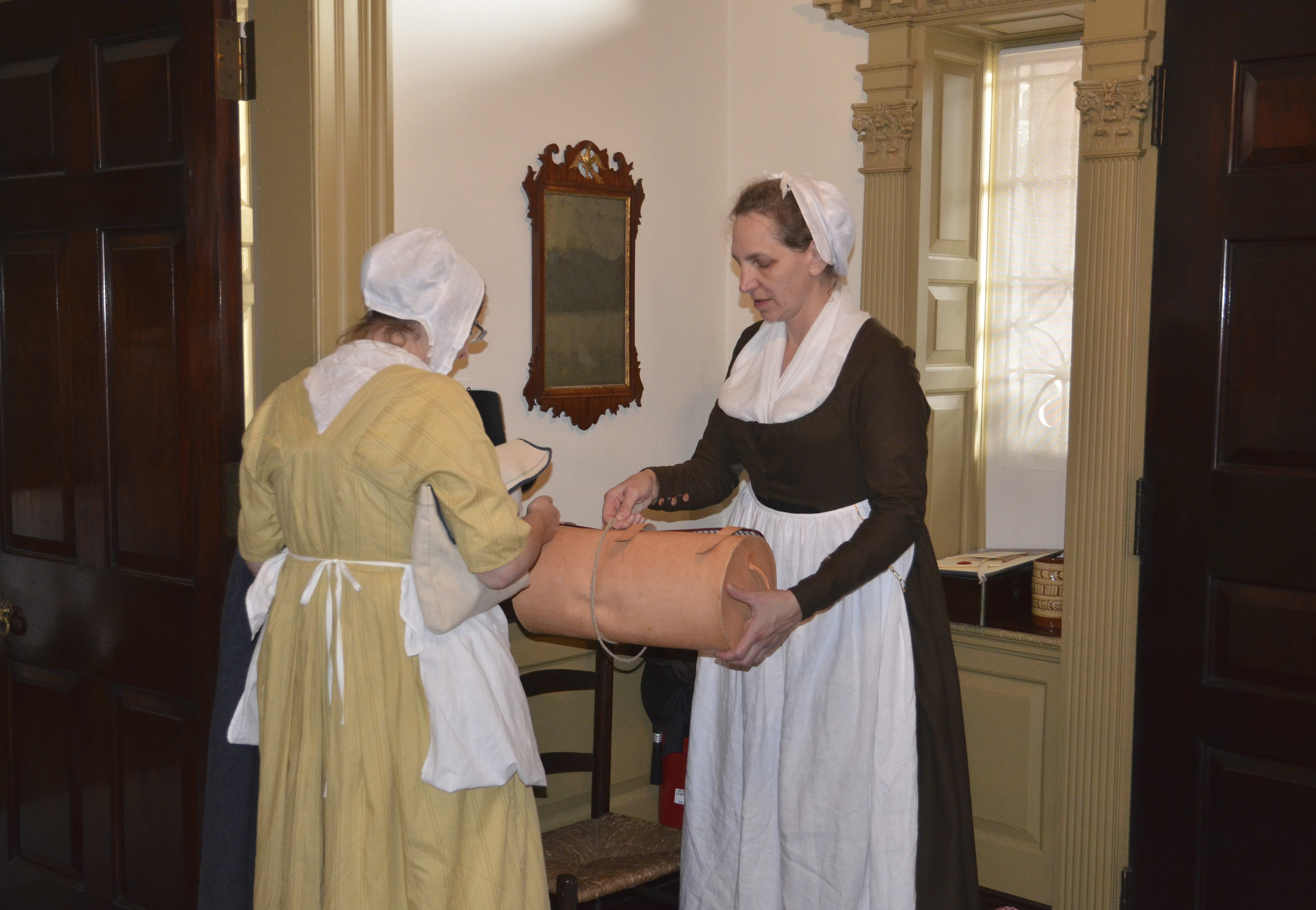
Esther takes Mr Herreshoff's case to his room

What kind of interpretation do you prefer?

Good interpretation requires that someone in the group have an active and vivid imagination, and that people are willing to take risks. Interpretation is a risk: will this portrayal of a captain’s death, a washerwoman’s trial, a wayward apprentice’s punishment, actual work? Do we trust each other enough to slip into new roles?

Trust is key: will the other people in the group bail you out if you freeze, encourage you if you run with an idea, and meet you in the same moment? You will have to spend time with people to find out how well you can all play together but, happily, you will quickly learn if you cannot. If your questions about who you are, why you are in a place, and if you should be wearing a 1781 coat at a 1777 event are rebuffed, you may need to consider other options.

Another time: What are your options?

Share this:

  • Share on Facebook (Opens in new window) Facebook
  • Share on Pinterest (Opens in new window) Pinterest
  • Email a link to a friend (Opens in new window) Email
  • Share on X (Opens in new window) X
Like Loading...

Stony Point Part the Second

31 Thursday Jul 2014

Posted by kittycalash in Events, Fail, Food, Reenacting

≈ 1 Comment

Tags

10th Massachusetts, Brigade of the American Revolution, failure, food, hose water, Reenacting, Revolutionary War, Stony Point

DSC_5121

No, it’s not my photo of the Young Mr: I didn’t even take a real camera on this trip. These top two photos are thanks to Gary V’s Flickr stream.

Here the kid is eating. I think he spent most of the weekend eating. There are some fine calves in the 10th Mass, aren’t there? Look what a well-fitted pair of overalls can do for you.

10th MA and 2nd RI: Mr S, Mr HC, Mr P, YM, Mr FC, Mr B, Mr  H

We all benefited from hanging around Niel DeMarino’s historic bakery. Broken cookies are just as delicious as whole, if not better, and the ginger cakes were the best I’d ever had. It’s a pity that one can’t really bake in camp…

Mr S thinks I should tell the story of my 90-minute stint in solitary at Stony Point, but I’m not quite prepared for that.

Instead, I shall recount the Hose Water Coffee.

As fans of the 18th century know, orange water and rose water are not uncommon flavors in the receipts found in Hannah Glasse or Amelia Simmons‘ cookbooks.

Hose water is something else again. It is not improved with age.

At Stony Point, there was water at a stone ‘bubbler’ (props to those who used this Rhode Island term for the street furniture known elsewhere as a drinking fountain), which was hard to see in the gathering dusk the night we arrived. There was also a hose, proximate to a saw horse with a sign for Pedestrian Only traffic, and just down the path from our tents.

Colonial breakfast on a rock

Our kitchen, dining table, and parlour

Following Heather’s excellent advice, I planned to make cold coffee overnight so that we could be caffeinated in the morning. Lazily and unwisely, I used the hose to fill the pitcher of doom that first evening.

What is the essence of tire? L’eau latex? That’s what we had: strong coffee with a strong base note and unmistakable top note and bountiful middle notes of hose. Did we drink it? Of course we did: we were up at 5, and coffee was not provided until 8:30, when we all had second breakfast.

Saturday night, I skulked back to the bubbler and filled the pitcher again for Sunday’s coffee. This time, the clear, strong liquid was redolent only of coffee, and was judged better than the hot coffee (which had, in fairness, not been made with hose water, either). I’ll definitely repeat the coffee experiment, though I think I can use a little less coffee to water– not that I measured.

Share this:

  • Share on Facebook (Opens in new window) Facebook
  • Share on Pinterest (Opens in new window) Pinterest
  • Email a link to a friend (Opens in new window) Email
  • Share on X (Opens in new window) X
Like Loading...

Ceci n’est pas une cruche

29 Tuesday Jul 2014

Posted by kittycalash in Events, Fail, History, Living History, personal, Reenacting, Snark

≈ 1 Comment

Tags

10th Massachusetts, authenticity, Brigade of the American Revolution, common people, common soldier, cooking, food, interpretation, living history, Reenacting, Revolutionary War

This is not a pitcher

Sometimes a pitcher is not a pitcher. In the same way that Matthiessen‘s Snow Leopard is not about a snow leopard, this was not about me: this was about the woman who approached me as I walked with Cat to the water bubbler with this white ceramic pitcher from Home Goods.

She stopped me to say, “You shouldn’t have a pitcher in camp. You should have a bucket.”

This is true, as far as it goes: but really, I should have a tin kettle (and I do). But the reasoning I was given had to do not so much with the fragility of the pitcher (which I pack in a basket or wrap in our towels and stuff into something in the supply wagon) as it did with the myth of Molly Pitcher. For an explication of the Molly Pitcher myth, I refer you to the Journal of the American Revolution, because, as I said to the woman who approached me, “It’s not my fight.”

So what’s the point? Maybe there are several:

One might be, Everyone has a hobby horse. Some of us are made mad by The Bodice. Some of us cannot abide makeup on “camp followers” who look like stragglers from a high school production of Sweeny Todd. Some of us are material culture and camp equipment fanatics– begone, ironware! Still others twitch at the baggy, off-the-rack cut and fit of some uniforms.

For another, This wasn’t about me– or my pitcher. The woman who approached me had a thing about Molly Pitcher and the myth of the woman on the battlefield with a pitcher, bringing water to the men. My pitcher and I were merely a trigger.

colonial woman with pitcher and kettle

Everybody’s got something to hide ‘cept for me and my…pitcher? or kettle?

And for a third, We all make choices and compromises. I chose not to bring the antique family copper coffee pot into the field, and also chose not to let the coffee and water sit overnight in the tin kettle. I chose, too, to use the white pitcher and a redware one for water that we drank all day long. When it’s hot, I slice lemons or limes into the water to make it easier to drink as much water as we need to in a day spent sweating outdoors, and it prevents scurvy to boot.

Fourth? We can all, always, make better choices. Few among us achieves true 18th century purity– I can assure you that even had I dashed my pitcher to the ground Saturday and dropped to my knees in repentance, I was not 18th century to the skin. There are monthly occurrences that I won’t go old school on, and on this point I shall not be moved.

But back at my ‘rock maple’ table, I could do better. We could/should have but one wooden bowl (mine), and the boys could/should have tin bowls, and we could/should swap out the redware canns with the handles broken off, but they make a nice refugee statement and until they break completely…

And there is a fabulous copper cistern by Goose Bay Workshops that I covet for its copper glory, but since it is not tinned inside, no lemons or limes would be allowed, and it would be hard to argue it for a Light Company. That puts me at another tin kettle, designated for water, and dipping our cups in. I can probably live with that choice.

But then, if I encounter someone who wants to talk about Molly Kettle, I’ll know I’m in real trouble.

Share this:

  • Share on Facebook (Opens in new window) Facebook
  • Share on Pinterest (Opens in new window) Pinterest
  • Email a link to a friend (Opens in new window) Email
  • Share on X (Opens in new window) X
Like Loading...

Stony Point: The Overview

28 Monday Jul 2014

Posted by kittycalash in Events, History, Living History, Reenacting

≈ 2 Comments

Tags

10th Massachusetts, 18th century clothes, Brigade of the American Revolution, common dress, common people, common soldier, Events, living history, Reenacting, Revolutionary War

Stony Point Battle Field

In a word: hilarious.

The Young Mr started the weekend with a 5 Hour Grump (no sugar crash!) that started at home and lasted until he spotted a deer in the woods near West Point at 7:17 PM. The situation improved somewhat when we arrived at Stony Point Battlefield and saw Mr and Mrs P. Perhaps at that point he finally believed me that this was going to be similar to Saratoga or Sturbridge: people he knew, doing the things we normally do, in the usual funny clothes.

There’s a rhythm to these that is predictable and therefore comforting: Mr and Mrs P arrive first, then we show up with our traveling circus, and once we are set up and in bed, we stay awake because Mr HC will arrive after dark, and we keep the mallet out to help him, even though he doesn’t really need our help.

I made new IRL friends with people I’d seen on the interwebs, which is always nice, and made solid progress on that 1812 coat, which also passed a fit inspection (thank goodness! I can be taught!).

Cat and Kitty at Stony Point

But the Young Mr really stole the show on Saturday.

Mr FC arrived on Friday morning with his Young Master W in tow, and they were welcome additions, especially when the Young Mr loitered in his tent after nooning, shirking a fatigue. Mr FC and Mr HC each grabbed one of those enormously long legs, and pulled the giggling private from his tent, the sergeant yelling at him all the while. When the kid got on his feet, his slick leather soles betrayed him and he went ass over teakettle in a classic 360 degree Stan Laurel or Harold Lloyd slapstick maneuver that left him unscathed and back upright with surprising rapidity…and all the while, the sergeant yelled at him, “Hurry up! Get dressed and into line! Don’t tell me you still don’t know how to put on your equipment!” which only makes the kid laugh harder, but fortunately also makes him work harder.

I skipped the battle, though I’m told there were some very satisfying deaths at a cedar tree on a small rise; Mr S went down, and the Young Mr tried to revive him with water, but succeeded only in soaking his hunting frock.

The Usual View of the Usual Suspects

Afterwards the battle and a great deal of water, there were not the usual cooking and fire minding chores, since the site provided dinner. Mr FC’s Young Master W had charge of his mother’s camera for the weekend, and since his brother had declined to come, Master W thought it would be a fine thing to take photos of the frequent trains to torment his train-loving brother with.

So Mr FC, Young Master W, Mr S, the Young Mr and I all trooped down the hill to the train tracks, accompanied by Lambchop, who was, in fairness, only wearing a wig and a round hat and not Lambchop itself, and should therefore be known here as Mr M.

So yes: four Continental soldiers and their laundress trooped down the hill with a boy to watch a freight train go by, and to say, Wow! and Oooh! as it sped past hauling containers, some stacked double height, and barely missing the railroad bridge, or so it seemed to us.

Share this:

  • Share on Facebook (Opens in new window) Facebook
  • Share on Pinterest (Opens in new window) Pinterest
  • Email a link to a friend (Opens in new window) Email
  • Share on X (Opens in new window) X
Like Loading...

Frivolous Friday: Footwear

20 Friday Jun 2014

Posted by kittycalash in Clothing, Frivolous Friday, History, Reenacting

≈ 1 Comment

Tags

18th century clothing, comfort, fashion, Metropolitan Museum of Art, Reenacting, resources, Robert Land, shoes, style

Shoes, 1810-1820. Gift of Miss M. Lee. T.385&A-1960, Victoria & Albert Museum.

Shoes, 1810-1820. Gift of Miss M. Lee. T.385&A-1960, Victoria & Albert Museum.

Like my grandmother, I love shoes. Also like my grandmother, I have “problem feet.” Finding a pleasing ladies’ shoe in a size 11 narrow is no mean trick, and with arthritis and activity, fit becomes ever more important. Standing all day in ill-fitting shoes will not improve your ability to interact with the public in a pleasant way, nor will it improve your stamina, which you will need if you are cooking for a motley assortment of ‘gentlemen.’

Many reproduction historic shoes (and most contemporary shoes) just don’t fit me, so I can’t order from common suppliers and I can’t alter affordable fashion shoes. Like Cinderella’s stepsisters, the shoes don’t fit.

Robert Land's Regency Lady's Shoe

Robert Land’s Regency Lady’s Shoe

That means that sometimes my shoes are not quite-quite correct. For 1799-1800 events, I wear Robert Land’s 1812 shoe, which is modeled on a shoe in the V&A collection. I find Land’s lasts are long and narrow, he makes my size, and lo and behold! Last time I ordered, the shoes arrived in four weeks. My mileage has varied in that regard, and yours may, too. They aren’t cheap, but they are well-made, straight-lasted, and most importantly, they fit. (I’ve been wearing them to work this week, because their flatness is more comfortable than my modern shoes.)

Shoes, 1810-1829. Probably British. MMA 2009.300.1471a–d

Do I wish they came in silk? Yes. Do I wish he’d make ladies’ 18th century shoes? Yes. But I have a workaround for the 18th century that I debuted on Flag Day: Mules. They won’t work for every event– I don’t think these are the shoes for climbing Stony Point in July–but they have their benefits. For one thing, you can take them off. Barefoot is best (maybe not in Boston), and not having to wear stockings when it’s 80+ degrees is nice, though only permissible if you’re named Bridget and have a shirt problem.

Burnley & Trowbridge men's mules

Burnley & Trowbridge men’s mules

Burnley & Trowbridge shoes also run narrow, and their men’s mules work for me, because I like a very low, flat heel. In winter, wool stockings make up any size differential, and in summer, these flats are pretty comfortable and even walkable. They may not be perfectly correct (though documented here), but comfort plus documentation goes a long way in my book.

What I’d really like, at least for late War interpretations, are a pair of these red velvet shoes at the MFA. Latchets for buckles, low heels, and they’re red? While I wonder about the date, the features I like might outweigh any misgivings– except that I cannot afford Sarah Juniper‘s work, and I can’t make my own shoes (yet).

Pair of women’s shoes, 1780s. MFA Boston, 44.493a-b

Share this:

  • Share on Facebook (Opens in new window) Facebook
  • Share on Pinterest (Opens in new window) Pinterest
  • Email a link to a friend (Opens in new window) Email
  • Share on X (Opens in new window) X
Like Loading...
← Older posts
Newer posts →

Archives

wordpress statistics

Creative Commons License
Kitty Calash blog by Kirsten Hammerstrom is licensed under a Creative Commons Attribution-NonCommercial-ShareAlike 4.0 International License.

Website Built with WordPress.com.

  • Subscribe Subscribed
    • Kitty Calash
    • Join 621 other subscribers
    • Already have a WordPress.com account? Log in now.
    • Kitty Calash
    • Subscribe Subscribed
    • Sign up
    • Log in
    • Report this content
    • View site in Reader
    • Manage subscriptions
    • Collapse this bar
 

Loading Comments...
 

    %d