• Home
  • Completed Costumes/Impressions
  • Emma and Her Dresses
  • Free Patterns and Instructions

Kitty Calash

~ Confessions of a Known Bonnet-Wearer

Kitty Calash

Tag Archives: Research

The Checkered Past

26 Tuesday Nov 2013

Posted by kittycalash in Clothing, History, Research

≈ 3 Comments

Tags

18th century clothes, authenticity, Clothing, common dress, common people, common soldier, Costume, dress, exhibits, fashion, living history, Research, resources, Rhode Island

Coat, 1790s American CB: 38 in. Gift of The New York Historical Society, 1979.346.42. MMA
Textile Sample Book, 1771. British Rogers Fund, 156.4 T31, MMA

Some gentlemen I know should consider what they might want to do to avoid (or alternately, encourage) having this coat made for them. It’s really a lovely thing, found as the best things are, while looking for something else.

It reminded me, too, of the textile sample book at the Met, currently on display in the Interwoven Globe exhibition. (No, I haven’t seen it; I’m going to try, but…).

Wm Booth has a new linen coming in the winter, and as the men in my house have outgrown or outworn their shirts, I am thinking of making new check shirts. I did finish a white shirt at Fort Lee, which will go to the Young Mr (his small clothes being now his too-small clothes). I will have to make Mr S a white shirt for best wear, but they could each use a second working shirt. At least with checks you get “cut here” and “sew here” lines.

Last week, I found a weavers’ book in the Arkwright Company Records (Box 1, Folder 1, 1815). It’s a slim, blue paper-covered volume with small samplers glued in to the pages, and full of checks and stripes. Blue and white, red and blue, checks and stripes were prevalent in the late 18th and early 19th centuries. The more I look at extant garments, sample books, and ads, the more I think the streets must have been a vibrant, if grimy, visual riot.

Share this:

  • Share on Facebook (Opens in new window) Facebook
  • Share on Pinterest (Opens in new window) Pinterest
  • Email a link to a friend (Opens in new window) Email
  • Share on X (Opens in new window) X
Like Loading...

‘A perfidious wretch’: A Sermon on Benedict Arnold

24 Sunday Nov 2013

Posted by kittycalash in History, Research

≈ Comments Off on ‘A perfidious wretch’: A Sermon on Benedict Arnold

Tags

Benedict Arnold, Enos Hitchcock, Research, Revolutionary War

Reverend Enos Hitchcock, pastel on paper. RIHS 1970.23.1

By now you probably know how much I like the Reverend Enos Hitchcock in all his forms and centuries. I am lucky enough to have near-constant access to a collection of his papers, and in going through them folder by folder looking for clues to the Reverend’s waistcoat habits, I came upon a seemingly innocuous folder: Notes, untitled and undated sermons, commonplace book. You won’t find receipts for pink satin in there, but every folder is worth a look.

This folder was worth every minute I have spent on it, and every other folder in that box.

I found an undated sermon, but was able to date it by the content: October 1, 1780.

In his diary, Hitchcock notes the days of divine service, and the verses he used.

Diary of Enos Hitchcock, published by the RIHS, 1899.

Diary of Enos Hitchcock, published by the RIHS, 1899.

PS 122, 6,7,8 refers to the text he used, Psalms 122, A Prayer for the Peace of Jerusalem. He quotes it at the very end of the sermon.

As I read this manuscript, I was struck by the anger in it, and wondered if the “perfidious wretch” could really be who I thought it was, and yes, it was true: I had found Hitchcock’s sermon on Arnold’s treason.

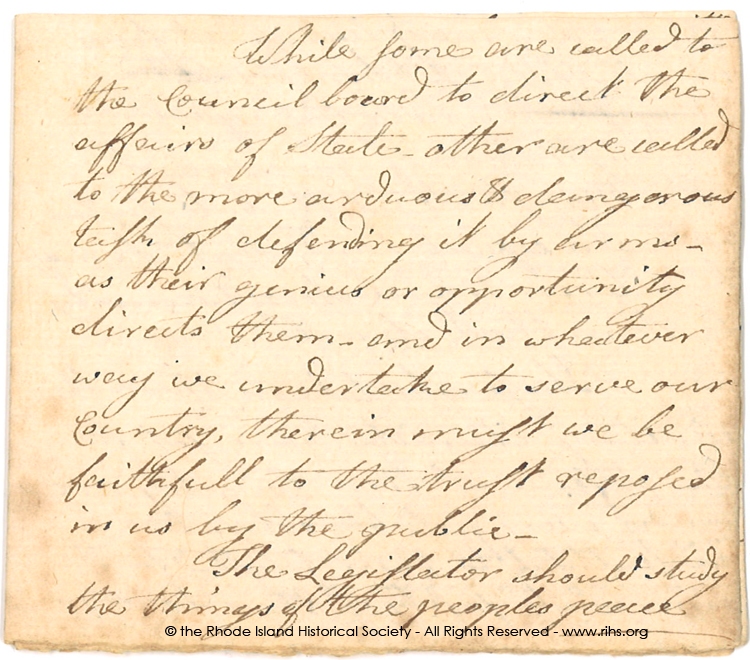
...faithfull to the trust reposed in us...

…faithfull to the trust reposed in us…

Here is the full transcript of the text:

MSS 78 Enos Hitchcock Papers
Box 1 Folder 57 Sermons: Notes, not titled and undated sermons

While some are called to the Council board to direct the affairs of State other[s] are called to the more arduous & dangerous task of defending it by arms- as their genius or opportunity directs them- and in whatever way we undertake to serve our Country, therein might we be faithfull to the trust reposed in us by the public.

The Legislator should study the things of the peoples [sic] peace that they may lead quiet lives in all Godliness & honesty The Magistrate under the equal administration of Government. The Magistrate distribute [sic] Justice with an equal hand, that he may be a terror to Evil doers & security to them that do well.

Those who take on them the Military Character & are set for the defence of their Country, are under every possible obligation to be faithful to their trust—for the immediate safety of their country depends on it. They have committed to you their liberties & their all & they look up to their Army for protection & security- and your own is connected with theirs in common—that in betraying your trust, you might would involve your country in all the miseries consequent upon the invasion of an unbridled Enemy- reduce Millions to absolute subjection to British Tyranny- ages & generations yet unborn to all the wretchedness of Slavery. What then can tempt the Soldier to desert his colours & treaterously [sic] betray the trust reposed in him – besides being guilty of perfidy, he must share in the consequences with them, must be afraid of the face of his Countrymen- or if he take refuge with the Enemy, must live an Exile in a State of Banishment & despised by every noble Spirited Friend to their interest. A Deserter- A Runaway- a perfidious wretch who has once betrayed his trust & therefore no confidence can ever be placed in him again! detestible [sic] Character! May every American Soldier have a Spirit above it.

If this be the danger & disgrace of Soldiers [sic] deserting his Country’s Cause & perfidiously betraying his trust- What Language will convey a Just Idea of the magnitude & blackness of that horrid plot, laid, by the Commander of a Department, for the tame Surrendery of the most important fortress in America? here language fails us! A design, black as Hell! a plot laid at the root of American Liberty! Millions of Subjects bartered away for a little shining dust!

“What chosen curse, what hidden vengeance in the Store of heaven Thunderbolt red with uncommon wrath, shall blast the man who owes his greatness to his greatness [sic] to his Country’s ruin?”

O Lucifer how art those fallen! Arnold, lately proclaimed, by our Orators, the thunderbolt of war, now a vile perfidious refugee with the Enemy, must live despised & die accurst by every generous Lover of his Country! May that day ever be remembered by America in which the discovery was made of the plot which must have nearly determined its fate!

While we regret the Treason, let us with gratitude acknowledge the goodness of providence in effecting the discovery. The train of minute circumstances which led to it, at once shews a superintending providence guideing [sic] the affairs of mankind, and that the justice of our cause challenges the divine patronage.

The Annals of history don’t afford a more striking instance of baseness & ingratitude, nor a more special interposition of divine providence. Tis the language even of the infidel, that the hand of providence is visible in this event, and indeed how can he do otherwise when he considers all the steps that lead to the discovery. A combination of circumstances, small in themselves, wholly independent of each other and yet necessarily connected in producing this Event & could all these take place in their proper order by merely chance or accident? Most certainly they shew an observant Eye penetrating thro’ all the secret machinations of vile, designing men- & a wise hand skillfully conduct the little adventitious events which opened the way to this important discovery.

Let us, my candid and generous fellow Soldiers, acknowledge with gratitude & the goodness of divine providence in this event- and express the sense we have of it by resigning ourself [sic] & all our concerns to the service of that God who governs all things in wisdom. & by a steady & uniform adherence to the cause & interests of our Country-

It often happens that the worst & most wicked designs of men are overruled in such a manner as to be productive of the greatest good. What advantages we shall derive from this cruel & vilainous [sic] act may be more clearly seen a twelvemonth than at present.

We have so often experienced the secret but powerful operations of divine providence concerning itself for our good, producing event very different from the designs of our enemys, leaving us no room to dispond but to hope its continuance to work out out [sic] real good & happiness & doubtless it will if we are not wanting in duty to God, our Country, & ourselves.

Pray, then with humble confidence in divine providence, for the peace of America: they shall prosper that love thee.

Peace be within thy walls and prosperity within thy palaces.

For my Brethren & Companion’s sake, I will now say peace be within thee.

Because of the house of the Lord, I will seek thy good.

Amen

Share this:

  • Share on Facebook (Opens in new window) Facebook
  • Share on Pinterest (Opens in new window) Pinterest
  • Email a link to a friend (Opens in new window) Email
  • Share on X (Opens in new window) X
Like Loading...

Book Review: Book of Ages

17 Sunday Nov 2013

Posted by kittycalash in Book Review

≈ 1 Comment

Tags

18th century, book review, Boston, common people, history, Massachusetts, Research, resources, women's history

Book of Ages, by Jill Lepore.

Book of Ages, by Jill Lepore.

This is a book about reading and writing as much as it is a book about Jane Franklin, Benjamin Franklin’s little sister. Book of Ages has been reviewed elsewhere, and Lepore wrote a really lovely piece in the New Yorker called The Prodigal Daughter that is unfortunately behind a subscription firewall, but which I have read on actual paper. If you can get hold of it, I do recommend reading it before you read Book of Ages. It makes the book all the more poignant to know something about Lepore’s process.

This is, in many ways, another book about mud and misery (see the best bits of Longbourn). Because Jane Franklin Mecom (her married name– she married at 15) left behind so little, Lepore builds much of her story out of the context of Boston and New England in the mid-18th century.

It’s not exhaustive in its detail, and that’s fine: the book is an easy, comfortable read that still provides well-researched information about the lives of women in the 18th century. I finished it over a week ago, but details still remain (and that is a testament to Lepore– these could have been supplanted in my mind by details of exterior water meters, skunk removal techniques, or indexes for early vital records). Among the details I recall: Funerary and mourning customs, from published sermons to the distribution of mourning gloves and rings; soap making and trades practiced by small holders in home workshops; Jane Franklin Mecom’s wartime flight to Rhode Island; the power and practice of extended family networks.

It also reminded me of the differences in educational methods or standards for boys and girls, which helps remind us all of the importance and significance of the ideal of free public education for all. (We had some early proponents here in Rhode Island.) What might Jane Franklin’s life have been like in other circumstances? Honestly, even if she’d been well-off and well-educated, as as woman in the 18th century, she would never have had the same chances as her brother, no matter how evenly their intellects might have been matched.

If anything, that’s reason alone to read Lepore’s book, to celebrate the life of a woman who was both ordinary and extraordinary, and to recognize how much closer to all the anonymous, disappeared women of the past we can get through this example.

Share this:

  • Share on Facebook (Opens in new window) Facebook
  • Share on Pinterest (Opens in new window) Pinterest
  • Email a link to a friend (Opens in new window) Email
  • Share on X (Opens in new window) X
Like Loading...

(Not) Spencer Closure

14 Thursday Nov 2013

Posted by kittycalash in Clothing, Making Things, Research

≈ 2 Comments

Tags

18th century clothes, authenticity, Costume, fashion, LACMA, menswear, Metropolitan Museum of Art, museum collections, Research, sewing

Jacob Issacs by Ralph Earl, 1788. Dayton Art Institute

No, I still haven’t written to the museum in Sweden– I had fabric shopping to do. Well, not had to, but when someone offers to take you to a new den of iniquity crack house fabric store you haven’t seen before, you go.

Reader, I scored. Mr S will have a new fabulous and toasty waistcoat thanks to a 5/8 of a yard remnant of the coziest Italian double faced wool I have ever petted. It should be a kitten! Mr Isaacs here has a lovely black waistcoat and while I cannot achieve that fabulousness without a new pattern (sigh) and I think that waistcoat is silk, you get the general green-and-black idea. Mr S totally has that hat.

Coat, French, 1790s. MMA 1999.105.2

But in thinking about the Spencer issue (and yes, I scored some on-sale broadcloth so I can make another one on the way to cutting into that K&P wool), I asked Mr Cooke about clasps, since the Spencers I’m interested in are so very clearly grounded in menswear generally, and uniforms particularly. The answer was what I’d expected: buttons and buttonholes or braid loops on dragoons’ and hussars’ coats, hooks and eyes sandwiched between shell and lining on center-front closing uniform coats.

So I went back to look at menswear, because somewhere the phrase “miniature frock coat” rattled in my head, and I knew I wanted to re-draft the pattern for the front anyway, to get closer to the high stand and fall collar of the Swedish original.

The other collection that’s extremely useful is the LACMA collection, because they have patterns up on their website.

Man's Banyan Textile: China; robe: the Netherlands, Textile: 1700–50; robe: 1750–60 (M.2007.211.797)

Man’s Banyan
Textile: 1700–50; robe: 1750–60 (M.2007.211.797)

I’ve already started to crib a new two-part sleeve pattern from a frock coat pattern, so now I think the next step to getting the look I want is to crib from the LACMA banyan pattern. It’s earlier than the Spencer by some 30 years or more, but the neckline looks like a better place to start.

And, bonus, along the way I’ll learn more about menswear to the ultimate benefit of those guys I sew for.

Share this:

  • Share on Facebook (Opens in new window) Facebook
  • Share on Pinterest (Opens in new window) Pinterest
  • Email a link to a friend (Opens in new window) Email
  • Share on X (Opens in new window) X
Like Loading...

Laundry!

12 Tuesday Nov 2013

Posted by kittycalash in Events, Living History, Reenacting, Research

≈ 2 Comments

Tags

10th Massachusetts, 18th century, 18th century clothes, authenticity, Clothing, common soldier, laundry, Research, washing

James Malton, 1761-1803, A Military Encampment in Hyde Park, 1785, Watercolor with pen in black ink, with traces of graphite on moderately thick, moderately textured, beige, laid paper, Yale Center for British Art, Paul Mellon Collection

James Malton, 1761-1803, A Military Encampment in Hyde Park, 1785, Watercolor with pen in black ink, with traces of graphite on moderately thick, moderately textured, beige, laid paper, Yale Center for British Art, Paul Mellon Collection

I’ve been thinking about laundry, and not just because I did wash yesterday, but also because I’m committed now to learning more about the women of the 10th Massachusetts (dude, it’s on paper). Since I won’t be able to get up to the Mass Archives or MHS until the holiday break, one place I can start is with the material culture of army women’s lives. This is also helpful as I am thinking about asking for a laundry tub for Christmas. (I had an aunt who got a toilet seat for Mother’s Day, and my husband once gave his siblings fire extinguishers for Christmas, so you cannot deny that we have a proud history of gift-giving.)

There’s a lot to love in the detail above, and while there are some things I don’t think you’d find in the 10th Mass camp — from red coats to chairs, even broken–we can still find useful information. After all, if your chair is broken, you have more of a leg to stand on for having a chair.

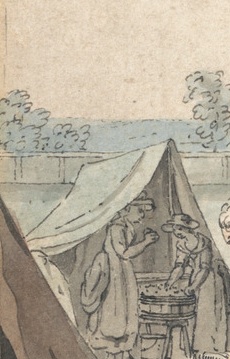
The buckets and washtubs have wooden hoops: that’s a fine detail, and one I appreciate, with my very particular bucket. That means, though, that the washtubs I have in mind might not work, as they have metal bands. My bucket man took a long time to get my bucket right, and he doesn’t make washtubs…but maybe the local man would consider trying a smaller tub. Hard to know, but size will be an issue. It appears there may be two sizes of tub in the image above: a larger tub on the makeshift table at left, and a smaller one on the broken chair.

Detail, James Malton, 1761-1803, A Military Encampment in Hyde Park, 1785, Watercolor with pen in black ink, with traces of graphite on moderately thick, moderately textured, beige, laid paper, Yale Center for British Art, Paul Mellon Collection

Detail, James Malton, 1761-1803, A Military Encampment in Hyde Park, 1785, Watercolor with pen in black ink, with traces of graphite on moderately thick, moderately textured, beige, laid paper, Yale Center for British Art, Paul Mellon Collection

The improvised clothesline is a reassuring detail, being pretty much what I have in mind for our camps, pending some riverbank logging. These taller sticks would then join our kettle or musket-rack sticks as part of the permanent equipage carried by the Subaru baggage train.

We’d been talking about doing a cold wash at work, where a friend was advocating NOT digging a pit and boiling laundry on the lawn, so these washing women intrigued me: none of them are boiling clothes. In fact, there’s no fire to be seen! But look again at where those kettles are. In the detail above and again at left, note a large kettle adjacent to every washtub. Could it be that water was boiled in a larger (enormous) kettle, and dipped into these smaller kettles? The other thing to note is that this seems to be family-based washing  and not regimental-scale washing. Given that I’d probably only have two shifts and four shirts to wash on a good day (they’re wearing their shirts, you see), could this model work?

None of the reenactments we see achieve anything like the scale of the events or activities we’re trying to recreate. Very few of us can cook with five pounds of flour, and there are never enough guys to make up a full brigade in the field. Those truths don’t mean we should skimp or cut corners, but they do mean that we should cut our coat to our cloth. Smaller scale washing could still convey the hassle, necessity, and gender division of the work.

Share this:

  • Share on Facebook (Opens in new window) Facebook
  • Share on Pinterest (Opens in new window) Pinterest
  • Email a link to a friend (Opens in new window) Email
  • Share on X (Opens in new window) X
Like Loading...
← Older posts
Newer posts →

Archives

wordpress statistics

Creative Commons License
Kitty Calash blog by Kirsten Hammerstrom is licensed under a Creative Commons Attribution-NonCommercial-ShareAlike 4.0 International License.

Website Built with WordPress.com.

  • Subscribe Subscribed
    • Kitty Calash
    • Join 621 other subscribers
    • Already have a WordPress.com account? Log in now.
    • Kitty Calash
    • Subscribe Subscribed
    • Sign up
    • Log in
    • Report this content
    • View site in Reader
    • Manage subscriptions
    • Collapse this bar
 

Loading Comments...
 

    %d