• Home
  • Completed Costumes/Impressions
  • Emma and Her Dresses
  • Free Patterns and Instructions

Kitty Calash

~ Confessions of a Known Bonnet-Wearer

Kitty Calash

Tag Archives: Revolutionary War

Stony Point: The Overview

28 Monday Jul 2014

Posted by kittycalash in Events, History, Living History, Reenacting

≈ 2 Comments

Tags

10th Massachusetts, 18th century clothes, Brigade of the American Revolution, common dress, common people, common soldier, Events, living history, Reenacting, Revolutionary War

Stony Point Battle Field

In a word: hilarious.

The Young Mr started the weekend with a 5 Hour Grump (no sugar crash!) that started at home and lasted until he spotted a deer in the woods near West Point at 7:17 PM. The situation improved somewhat when we arrived at Stony Point Battlefield and saw Mr and Mrs P. Perhaps at that point he finally believed me that this was going to be similar to Saratoga or Sturbridge: people he knew, doing the things we normally do, in the usual funny clothes.

There’s a rhythm to these that is predictable and therefore comforting: Mr and Mrs P arrive first, then we show up with our traveling circus, and once we are set up and in bed, we stay awake because Mr HC will arrive after dark, and we keep the mallet out to help him, even though he doesn’t really need our help.

I made new IRL friends with people I’d seen on the interwebs, which is always nice, and made solid progress on that 1812 coat, which also passed a fit inspection (thank goodness! I can be taught!).
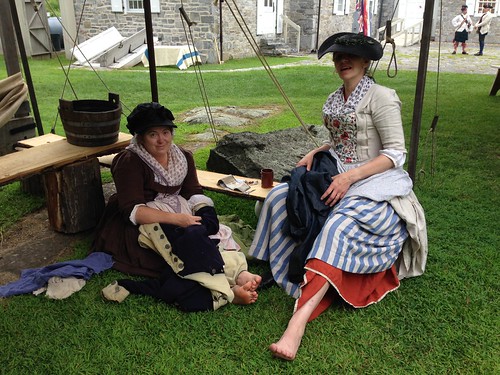
Cat and Kitty at Stony Point

But the Young Mr really stole the show on Saturday.

Mr FC arrived on Friday morning with his Young Master W in tow, and they were welcome additions, especially when the Young Mr loitered in his tent after nooning, shirking a fatigue. Mr FC and Mr HC each grabbed one of those enormously long legs, and pulled the giggling private from his tent, the sergeant yelling at him all the while. When the kid got on his feet, his slick leather soles betrayed him and he went ass over teakettle in a classic 360 degree Stan Laurel or Harold Lloyd slapstick maneuver that left him unscathed and back upright with surprising rapidity…and all the while, the sergeant yelled at him, “Hurry up! Get dressed and into line! Don’t tell me you still don’t know how to put on your equipment!” which only makes the kid laugh harder, but fortunately also makes him work harder.

I skipped the battle, though I’m told there were some very satisfying deaths at a cedar tree on a small rise; Mr S went down, and the Young Mr tried to revive him with water, but succeeded only in soaking his hunting frock.
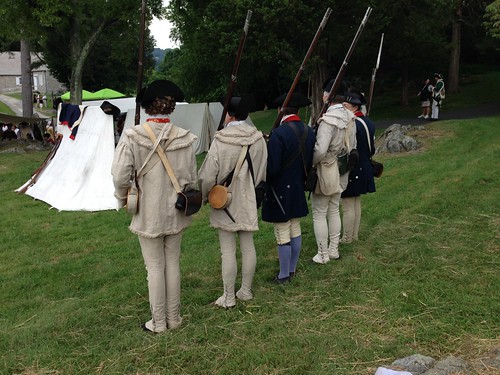
The Usual View of the Usual Suspects

Afterwards the battle and a great deal of water, there were not the usual cooking and fire minding chores, since the site provided dinner. Mr FC’s Young Master W had charge of his mother’s camera for the weekend, and since his brother had declined to come, Master W thought it would be a fine thing to take photos of the frequent trains to torment his train-loving brother with.

So Mr FC, Young Master W, Mr S, the Young Mr and I all trooped down the hill to the train tracks, accompanied by Lambchop, who was, in fairness, only wearing a wig and a round hat and not Lambchop itself, and should therefore be known here as Mr M.

So yes: four Continental soldiers and their laundress trooped down the hill with a boy to watch a freight train go by, and to say, Wow! and Oooh! as it sped past hauling containers, some stacked double height, and barely missing the railroad bridge, or so it seemed to us.

Share this:

  • Click to share on Facebook (Opens in new window) Facebook
  • Click to share on Pinterest (Opens in new window) Pinterest
  • Click to email a link to a friend (Opens in new window) Email
  • Click to share on X (Opens in new window) X
Like Loading...

Breaking Up By Letter

09 Wednesday Jul 2014

Posted by kittycalash in Events, Living History, Reenacting

≈ 2 Comments

Tags

10th Massachusetts, 18th century clothing, history, living history, Massachusetts, Revolutionary War

Mr S, always slightly suspicious

Mr S and I joined other members of the 10th Mass and National Park Service staff and volunteers at the North Bridge in Concord, Mass last Saturday for the postponed reading of the Declaration of Independence. It was one of those perfect New England summer days, breezy blue skies and dry wind smelling of grass and flowers: days like that I finally get the Transcendentalists.*

Some of those present in modern and historic clothes alike had never heard or read the Declaration all the way through; it is one of my favorite documents, and not just because I was in a 5th grade play about the document. Questions of slavery and principles aside, the Declaration is a great poem of a break-up letter. It makes poetry of the list of King George III’s crimes and reminds us of the core principles that undergird our government and that began with the Magna Carta, limiting the power of the king.

Governments are instituted among Men, deriving their just powers from the consent of the governed

Leaning against a tree near the North Bridge, you could close your eyes to the shorts and kayaks and baseball caps and listen to a document being read as it would have been 238 years ago, and imagine what it was like to hear this for the first time (at least until the airplane passed overheard).

I have a complicated relationship with patriotism, which makes me a curious candidate for this living history business. But that moment in Concord reminded me of the enthusiasm I had for history as a child, and the passion I had for what educators now call narrative play, and what some of us now grown up call reenacting, and others call historical re/creation.

There is something we can learn, as participants, and that the public can learn, as we go about this business of re-investigating the past, through making clothing and reading and cooking and re-learning historic processes and crafts. We may not always learn what we expect to about the past or about our selves, but if some in the audience enjoyed the smell of grass in the wind, and heard the true poetry of Jefferson’s text, maybe that’s enough to be getting on with. Because for all the questions about how a musket works, the real point of all of these events isn’t the musketry, it’s the history.**

*They clearly did not wake up to the “what the hell’s that smell?” game tidal canals like to start on summer mornings.

** Sorry, lads, but I think it’s true: wars are about words backed by muskets or other weapons.

Share this:

  • Click to share on Facebook (Opens in new window) Facebook
  • Click to share on Pinterest (Opens in new window) Pinterest
  • Click to email a link to a friend (Opens in new window) Email
  • Click to share on X (Opens in new window) X
Like Loading...

Musical Monday: Chester

16 Monday Jun 2014

Posted by kittycalash in Events, History, Living History, Reenacting

≈ Comments Off on Musical Monday: Chester

Tags

10th Massachusetts, common people, common soldier, history, living history, Reenacting, Revolutionary War, singing

Virtue Rewarded

Virtue Rewarded

Saturday was Flag Day, but you knew that, right? There are a lot of holidays we no longer pay much attention to, from Armed Forces Day (when Mr S and I once hosted a very amazing and lengthy party in an 1870s brick row house in St. Louis) to Arbor Day to Flag Day.

To celebrate the Bicentennial of the Star Spangled Banner, the Paul Revere House asked us (which means Mr HC) to lead the visitors in the national anthem. “Never miss an educational opportunity” could be one of the 10th Massachusetts’ mottoes, so with the regimental colors unfurled, the time was right to lead the assembled company in a rendition of Chester, written in 1770 and perfected in 1778 by William Billings, and the song to which the men are accustomed to march. (It is also the song mostly likely to play accidentally on my phone while it’s in my pocket.)

So here they are, the 10th Massachusetts and Members of the Publick, led in Chester by Mr Cooke.

IMG_1590

IMG_1590


As mentioned elsewhere, it is nearly impossible to read and sing simultaneously. It is also clear that we do not generally sing in our daily lives, or not nearly as often as people did in the past. Most of us think we have awful voices and refuse to sing, though we endure singing in school, or did. It’s an art that we should enjoy more and more often. You don’t have to be Idina Menzel to please the right audience (in my case, some cats).

Share this:

  • Click to share on Facebook (Opens in new window) Facebook
  • Click to share on Pinterest (Opens in new window) Pinterest
  • Click to email a link to a friend (Opens in new window) Email
  • Click to share on X (Opens in new window) X
Like Loading...

History is Not a Competition

15 Sunday Jun 2014

Posted by kittycalash in Events, History, Living History, Reenacting

≈ 1 Comment

Tags

10th Massachusetts, 18th century, 18th century clothes, Amasa Soper's Company, Boston, historic houses, history, living history, Massachusetts, Paul Revere House, Reenacting, Revolutionary War

IMG_1583

Drilling by the Sergeant

Saturday was my first post-operative foray into costumed interpretation, up to Paul Revere House on Flag Day. This went much better than my first attempt at Paul Revere House, which ended in ignominy as I missed the train. In April, I managed to convince Mr S to drive in Boston, which he usually refuses to do (in fact, he nearly abandoned me once at the Old State House one Saturday after a miserable drive that had us stuck in the Downtown Crossing vortex).

I’m so glad we managed this, Despite anticipatory near-tears and epic pouting by the Young Mr, we managed to have a rather nice time.

Poise, with extra elevation by the Young Mr

Poise, with extra elevation by the Young Mr

We were in the courtyard, and Mr HC and Mr FC told the story of Amasa Soper’s company and its members several times to the streams of tourists. They solicited recruits and ran them through the 1764 drill using the nicest wooden muskets I’ve ever seen, though with mixed results. Some new volunteers held their muskets backwards, and the Young Mr’s ramrod got stuck in the barrel, though that is a known issue with that particular musket.

I sat on my ladder-back chair near the house and made the tiniest hems I could on Mr S’s next shirt, which will be for best. People asked about the sewing and my clothes, and I had a chance to talk about what women wore, typical fabrics and fibres, supplying the army, and who made what.

The day was warm, but fortunately not overwhelming, and as a museum person, I found the crowd quite interesting. This is a facet of Boston I don’t usually see: the tourist experience.

In one memorable moment, a pair of young women stood just outside the door to the house.
Young Woman Number One: “Is this really his house?”
Young Woman Number Two: “Yes, this is where Paul Revere lived.”
YWNO: “Oh, my God! I’m so excited! This is so neat!”
Kitty Calash: <eats heart out with jealousy> “Why can’t my museum do that?”

The celebrity factor of Paul Revere is undeniable. There were tourists with guide sheets in Chinese, and tourists who made me wish I still remembered my college German. Some seemed to be hitting every Boston landmark they could in one day, carrying white cardboard pastry boxes; some seemed to be going more slowly, looking, and trying to figure out what they were seeing, and what it meant.

Virtue Rewarded

Virtue Rewarded

What living history means is something I’ve been thinking about lately, or trying to. It’s tangled up with questions of authenticity and appropriateness, but what I learned on Saturday, or re-learned, was how very happy this business makes me. I like history, and historic costume. It doesn’t matter to me if we are talking Revolutionary War or New Republic or Lewis and Clark.

My favorite visitors were a mother and daughter from Steamboat Springs, Colorado, visiting Boston for the first time with a young man from New Hampshire. The mother said, “There’s so much more history here than where we’re from. Our town’s only 100 years old.”

That’s a challenge I’m always ready for, so I asked where they were from. Colorado to me means Native American settlements reaching back a thousand years, Spanish explorers and conquistadors, French, and then American, fur traders. It means hundreds of years of history, and a chance to remind people this isn’t a competition for “oldest” or “mostest.”

Knowing where our country came from is important: so yes, please visit Boston, and Paul Revere House, and Providence and Newport, too! But knowing where you are is just as important. There’s history all around you, and your local historical site, society and museum would love to tell you about it.

Share this:

  • Click to share on Facebook (Opens in new window) Facebook
  • Click to share on Pinterest (Opens in new window) Pinterest
  • Click to email a link to a friend (Opens in new window) Email
  • Click to share on X (Opens in new window) X
Like Loading...

A Whale-Safe Bonnet

23 Friday May 2014

Posted by kittycalash in Clothing, History, Living History, Making Things, Reenacting, Research

≈ 6 Comments

Tags

18th century, 18th century clothing, bonnets, common dress, common people, engravings, fashion, Marquis of Grandby, millinery, Research, Revolutionary War, sewing, style

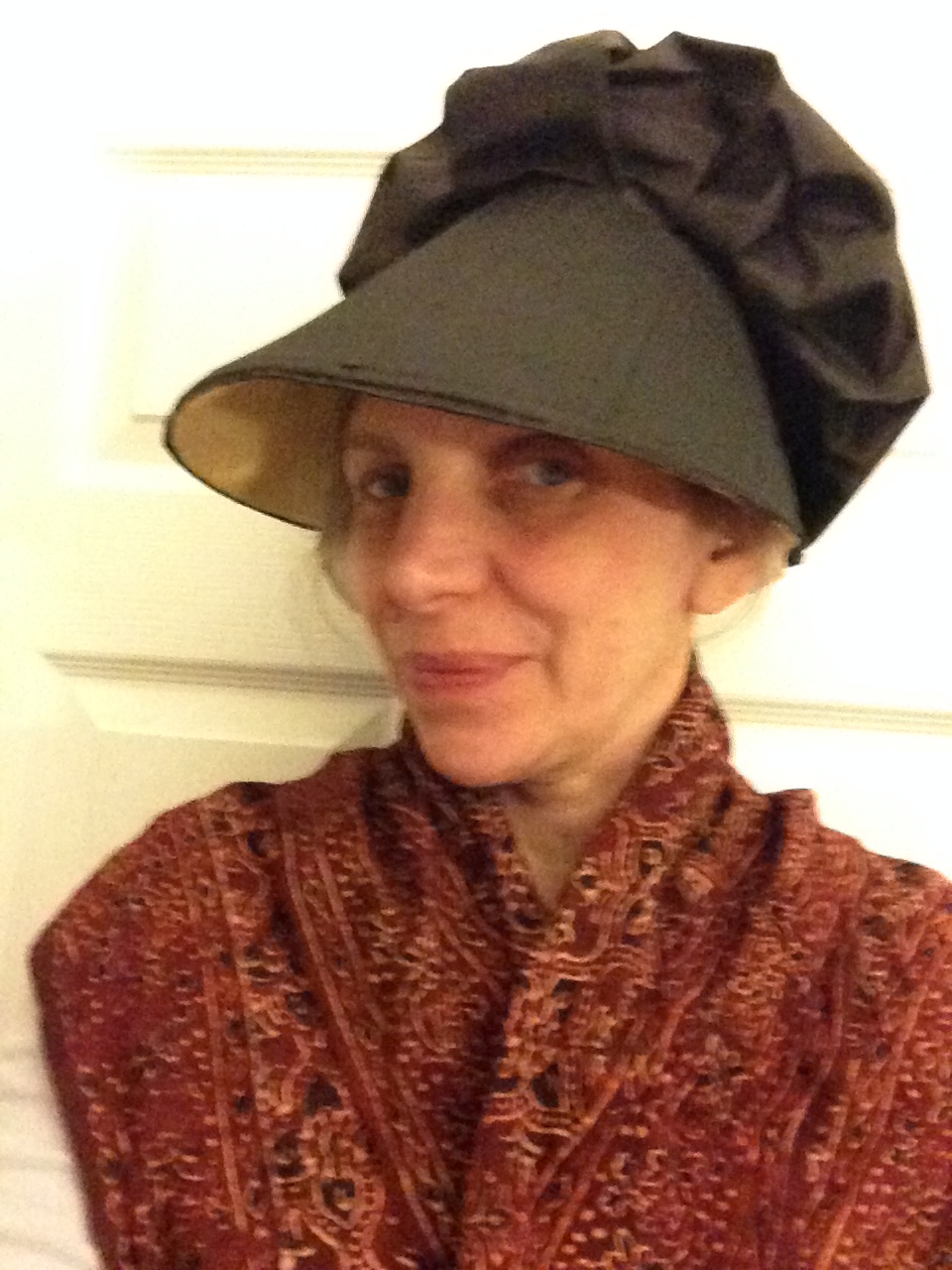
Complete with my interpretation of "Hat Face"

Complete with my interpretation of “Hat Face”

As promised, my interpretation of the ribbed bonnet in the 1789 engraving. There are a few problems with this beyond the model. (Which is not to say that I don’t like this bonnet– I do!)

I used the Kannik’s Korner bonnet pattern (view F, I think) as the basis for this because I already had a brim, lining, and caul cut and in a drawer. Given my current medicated state, using something pre-cut seemed advisable. That means I didn’t play with the brim to create the line of the Williamsburg bonnet, or the curve of the brim in the “Fortune Teller” engraving.

Detail, The Marquis of Grandby

Detail, The Marquis of Grandby

Is this style acceptable for the period I typically interpret (1775-1783)? Well… there are other examples of the lampshade-style bonnet, as in the Edward Penny painting of the Marquis of Granby. This painting is dated “after 1765” so there’s some room for interpretation there…too much room. But if that’s 1765-1770, and the “Fortune Teller” is 1789, I think we have comfortably covered the 1775-1783 time frame, even if it is a bit like a queen-sized blanket on a twin bed.

Front view: more lamp-shade like.

Front view: more lamp-shade like.

As you can see, the bonnet does have some lamp-shade-like tendencies on my head, which I consider a benefit. I like the way the ribs are visible, even if I remain unconvinced by the caning. I think it’s a little too wide, and lacks resiliency, though to be honest, I have only felt baleen at the New Bedford Whaling Museum, where there is a large sample on the second floor.

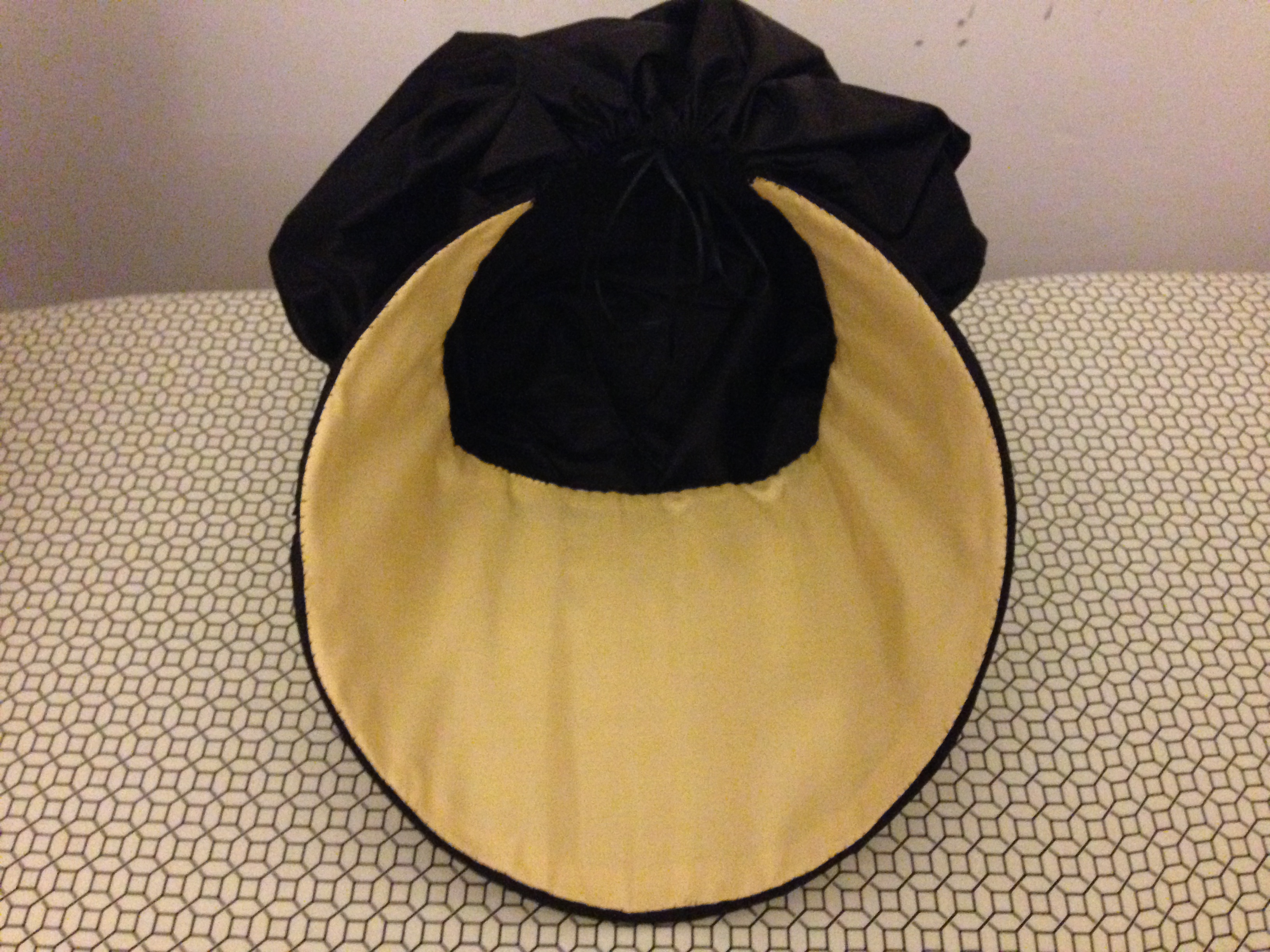
To compensate for the disappointing cane in the brim, I slipped a piece of millinery wire into the pocket underneath the cane. The layers in the brim are:

  • black taffeta
  • horsehair canvas
  • linen buckram
  • yellow taffeta

The channels are all hand-sewn, and then the cane was slipped in. I stitched the black taffeta caul to the first three layers, and then lapped the yellow taffeta over the raw edges and stitched it down to finish the brim/caul seam.

No, I didn’t take any in-process pictures…probably because this took considerable snake-eyed concentration last weekend. IMG_1477 IMG_1476

Usually, I line the cauls of my bonnets, but through shear laziness or distraction, I opted not to this time, and I think I’ll leave it this way for a while. You will also note that I have not trimmed this: I have some black silk ribbon coming, and I may try that. I don’t have enough black taffeta left to cut self-fabric ties, and there do seem to be some plain examples. A plainer, lamp-shade-like bonnet may be just the ticket for Bridget.

What would I do differently? Next time I would definitely play with the brim shape using a paper template. I’d like a lower, curvier, brim. Once I had the shape worked out in paper, I would use that as a template to cut the taffeta and horsehair or light buckram layers.

The Edenton Tea Party

The Edenton Tea Party

I’d also try zip ties. I know: not period correct! But short of risking federal prosecution resulting from a trip to New Bedford with some shears, I’m not sure that anything other than plastic will have the resiliency and spring that baleen has, and that made these bonnets so special. I thought of them while making this bonnet, but I think Mr S used them all at work in the past two months. A Facebook friend has been thinking of zip ties, though, and has a hankering for one of these bonnets. I can’t say that I blame her– and honestly, I think I might join her.

Share this:

  • Click to share on Facebook (Opens in new window) Facebook
  • Click to share on Pinterest (Opens in new window) Pinterest
  • Click to email a link to a friend (Opens in new window) Email
  • Click to share on X (Opens in new window) X
Like Loading...
← Older posts
Newer posts →

Archives

wordpress statistics

Creative Commons License
Kitty Calash blog by Kirsten Hammerstrom is licensed under a Creative Commons Attribution-NonCommercial-ShareAlike 4.0 International License.

Website Built with WordPress.com.

  • Subscribe Subscribed
    • Kitty Calash
    • Join 621 other subscribers
    • Already have a WordPress.com account? Log in now.
    • Kitty Calash
    • Subscribe Subscribed
    • Sign up
    • Log in
    • Report this content
    • View site in Reader
    • Manage subscriptions
    • Collapse this bar
 

Loading Comments...
 

    %d