• Home
  • Completed Costumes/Impressions
  • Emma and Her Dresses
  • Free Patterns and Instructions

Kitty Calash

~ Confessions of a Known Bonnet-Wearer

Kitty Calash

Tag Archives: Rhode Island

Small Obsessions

09 Saturday Jan 2016

Posted by kittycalash in Uncategorized

≈ 6 Comments

Tags

18th century, 19th century clothing, art, art history, interpretation, living history, miniatures, paint boxes, paintings, Rhode Island, Rhode Island history, women's work

IMG_5625Some of you may recall that I am a recovering artist with a fairly constant need to keep my hands busy. To encourage industry and the domestic arts, and to keep me out of trouble generally, a thoughtful friend provided me with a start to furnishing an early nineteenth century-style paint box. They’re hard to come by, these paint boxes, and extant examples fetch far more than we can afford chez Calash, being in somewhat reduced circumstances of late.

Thomas Reeves & Son Artists watercolor paint box c. 1784 to 1794. Whimsie Virtual Museum of Watercolor Materials

Thomas Reeves & Son
Artists watercolor paint box c. 1784 to 1794. Whimsie Virtual Museum of Watercolor Materials

Researching paint boxes and miniature painting in the early Federal era has been a happy fall down a deep rabbit hole. It’s clear that Reeves watercolors were being sold in Providence in the early 19th century; Peter Grinnell & Sons include “Reeves watercolor boxes” among the extensive list of items for sale in an 1809 newspaper ad. Frames and cases were also to be had; John Jenckes, gold and silver-smith and jeweler, advertised gold miniature cases in 1800.

Distraction is always easy to come by, tunnels leading from main entrance to the warren. Painting manuals, scholarly articles, and extant examples, which prove most distracting of all. SO shiny.

George Catlin Artist: John Wood Dodge (1807–1893) Date: 1835 Medium: Watercolor on ivory Dimensions: 2 3/16 x 1 13/16 in. (5.6 x 4.6 cm) Classification: Paintings Credit Line: Rogers Fund, 1926 Accession Number: 26.47

George Catlin byJohn Wood Dodge, 1835, MMA 26.47

Searching the Met’s collection, I found a portrait of George Catlin, remarkably similar in pose to an image of a friend I considered copying, but had thought too modern. My assumption has been proved wrong, and I am delighted. And then I found the HIDEOUS checked neck wear, always distracting. Historic New England provided super-tiny-bowtie man, and then I really had to focus, since I’m only enabling, not making, neck wear.

My real focus, of course, is on female miniaturists, especially in Rhode Island (gallery of RI miniatures can be found here.) From the scant number of women I’ve found advertising in the local papers, (okay, two: Miss Mary R. Smith, in 1820, and Mrs Partridge in 1829) I’ll have to expand my search geographically. Nantucket Historical Association had an image attributed to Anna Swain, and ten attributed to Sally Gardner.
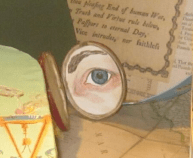
Eye

The Met, repository of so many wonders, has works by six women miniaturists, including Sarah “Wowza” Goodridge and Anna Claypoole Peale. For all we know, some of the works by unidentified makers might be the work of female painters. The extant miniatures in all collections, range in quality from excellent to amateur, giving hope to those of us unpracticed in portraiture, and regaining our hand.

Share this:

  • Share on Facebook (Opens in new window) Facebook
  • Share on Pinterest (Opens in new window) Pinterest
  • Email a link to a friend (Opens in new window) Email
  • Share on X (Opens in new window) X
Like Loading...

Mr Hiwell Chased by a Chihuahua, and Other Minor Disasters

15 Tuesday Dec 2015

Posted by kittycalash in Fail, Living History, personal, Reenacting

≈ 4 Comments

Tags

18th century, domestic adventures, preparations, Rhode Island, silliness, walking, weekend

Of course we can read maps. GPS has not spoilt us at all.

Of course we can read maps. GPS has not spoilt us at all.

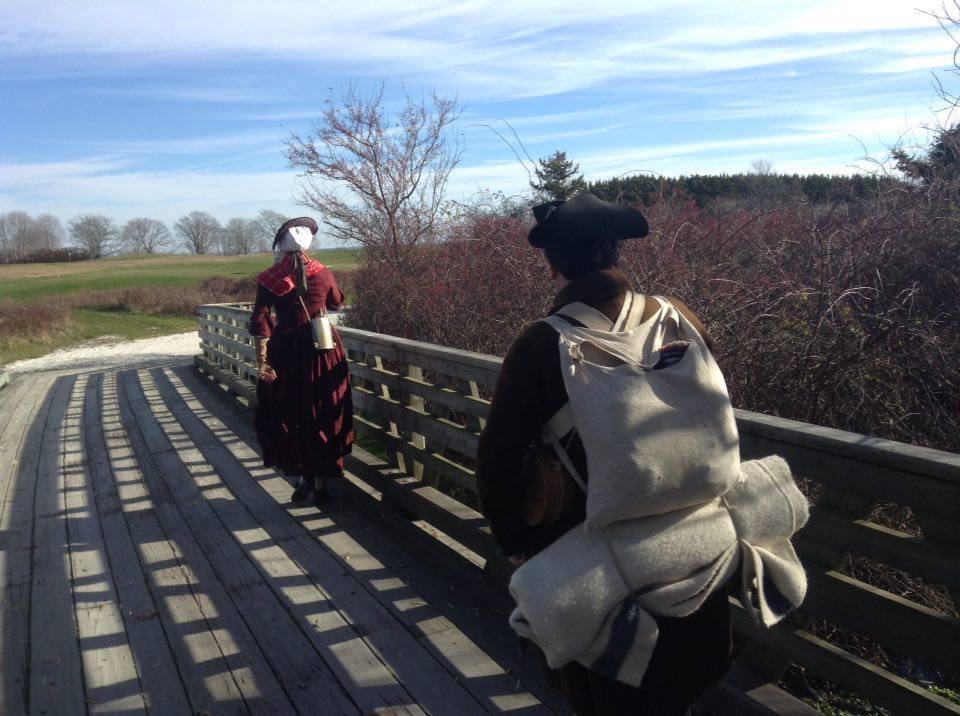
Bored over the Thanksgiving holiday weekend and possibly jealous of images we might have seen on social media, Mr HiWell, Low Spark, and I concocted a plan. Or perhaps I made a suggestion that seemed like a good idea at the time. Screen caps of message threads indicate that I probably was the root of the evil of getting up early Saturday morning to put on historical clothing and take a multi-mile walk.

File_006

We know it was at least seven miles, and may have been nine…we went off the trail in a couple of places. But the lads are going to Trenton, and need to get in some walking time, and now that it’s shotgun deer season, the number of places we can safely hike are fewer. There’s no blaze orange in broadcloth– yet.

And this wasn't the squeeziest photo op.

And this wasn’t the squeeziest photo op.

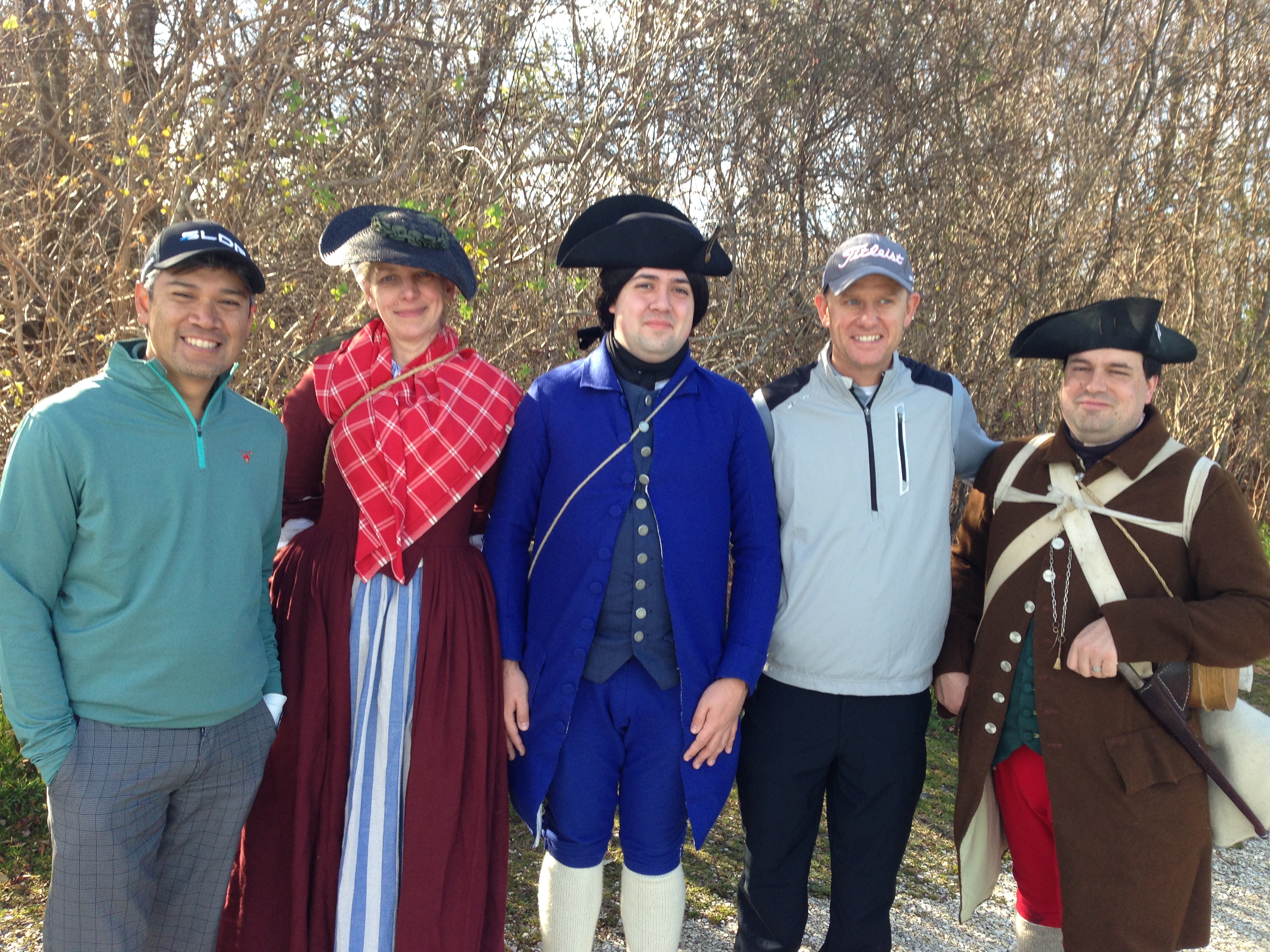
The walk began harmlessly enough, through corn fields and brush. We forded a stream the easy way (I suggested fording a la the 40th but the lads opted for the bridge.) The Sakonnet Greenway Trail maintained by the Aquidneck Land Trust is pretty mellow. Flat (unusual here), relatively free of traffic noises, and used by dogwalkers, it seemed safe. Then we met the golfers as the trail skirts the edge of the Newport National Golf Course. We were too nice and said yes, they could have photos with us. Of course, they had clubs and we didn’t.

File_002(2)

We could have ridden in style.

When we went off trail to loop up to East Main Road, we encountered many homeowners and many barking dogs. When we told one woman we were off to a Paul Revere and the Raiders tribute band concert, she noted that “the kicks get harder to come by.” Further on up the road, two boxers charged the fence that enclosed their yard, startling us– but the real danger came from the chihuahua that charged up the road after us, barking madly. The children’s rhyme about “the beggars have come to town” seemed all to relevant.

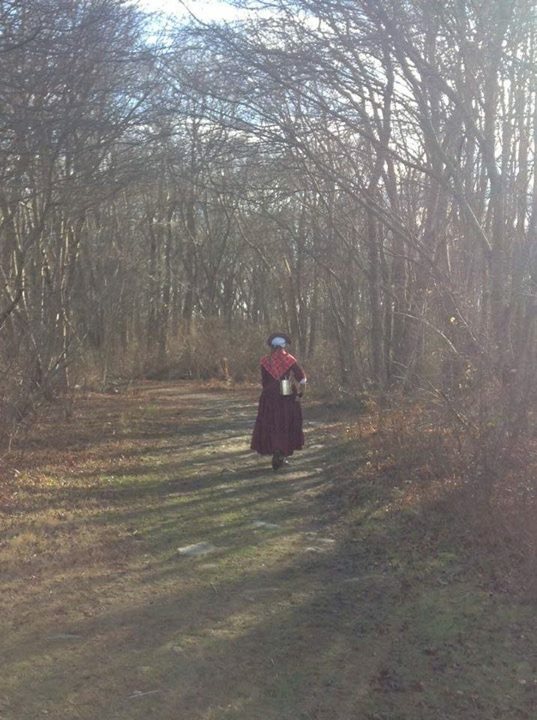
The Kitty Who Walked Alone

The Kitty Who Walked Alone

By the end of the walk, there were many references to Captain Sobel and Currrahee, though I thought more of Rudyard Kipling’s The Cat That Walked By Himself.

But when he has done that, and between times, and when the moon gets up and night comes, he is the Cat that walks by himself, and all places are alike to him. Then he goes out to the Wet Wild Woods or up the Wet Wild Trees or on the Wet Wild Roofs, waving his wild tail and walking by his wild lone.

Share this:

  • Share on Facebook (Opens in new window) Facebook
  • Share on Pinterest (Opens in new window) Pinterest
  • Email a link to a friend (Opens in new window) Email
  • Share on X (Opens in new window) X
Like Loading...

Checked Linen Aprons post-1800

16 Monday Feb 2015

Posted by kittycalash in Clothing, History, Living History, Museums, Reenacting, Research

≈ 6 Comments

Tags

19th century clothing, apron, authenticity, checks, Clothing, common dress, common people, Costume, dress, fashion, Federal New England Fashion, New England, Newport, Rhode Island, Rhode Island history, sewing, style

Not that this is an exhaustive or final chronicle, but Jackie asked about the apron.

Spring Cleaning, 2012

Spring Cleaning, 2012

I first encountered this form of apron at Old Sturbridge Village, on display in the Firearms and Textiles exhibit space, which I think of as “Muskets and Muslins.” The accession number given on the exhibit label was 26.39.4, but the object does not appear in the OSV online collections database (they do warn that it contains just a selection of their total 60K-plus object holdings). The original at OSV, as sketched and described by me in April 2012 has a drawstring at the neck, straps that button, string at the back opening, and is slim, without gathers. That means the bodice is very similar to the gown bodices of the early part of the 19th century.

Smock, Checked cotton, Pocumtuck Valley Memorial Association. #2000.01.869.

Smock, 2000.01.869 PVMA

There is another original checked bodiced apron in the Pocumtuck Valley Memorial Association collection in Deerfield, MA. This original appears in color in The Needle’s Eye by Marla Miller. As you can see in the images of my apron, I mashed the two styles together to suit the amount of material I had on hand, the skills I had three years ago, and the amount of time I had between seeing the apron and the day of the program, which was probably two days during which time I had pleurisy.*

This is also wrong, but funny.

This is also wrong, but funny.

To refocus: I chose to wear this apron at Whitehorse House in 1820 for a really wrong reason: it was what I had.

Prints in the British Museum show a maid in a yellow gown with a black apron, no bib; there is another, with a maid in a green gown, in a wikigallery, that I could not fully track down; a London Market scene; and a French print from 1818 that does show a bibbed black apron on a shop assistant. The visual research I’d done for the 1820 program suggested that black aprons were the height of fashion, and that they did not always have bibs.

Papering the Saloon at Tickford Hall, watercolor by Diana Sperling, 1816.

Papering the Saloon at Tickford Hall, watercolor by Diana Sperling, 1816.

Since we deal in confessions here, I will tell you that I did buy material for a black apron, and I planned to make a strapped or bibbed one, much like the one Sabine made. The appearance of the dark apron in Diana Sperliing’s watercolor of the ladies papering the saloon at Tickford Park put the dark strapped and sometimes bibbed apron the in English-speaking world. And still I did not manage to make one. If I were to do an 1820 program again, or even an 1813 or later millinery shop again, I like to think I would find the time to make a black strapped and possibly bibbed apron. I do think they were the height of fashion, and are likely to have been worn by women in shops, and by maids.

Do I think the checked apron is wrong? Given that I can rationalize anything, of course not! I think a checked apron is probably reasonably appropriate within the context of a kitchen, even in 1820, especially in New England. Since we did not cook on Saturday, the black apron would have been ideal, but I think the checked apron passes. To make it pass with a higher grade, I will freely admit it requires button and tape upgrades. Since the next dates on the horizon are 1775 and 1780, chances are good those upgrades won’t happen anytime soon. * Do not attend an all-day outdoor event in the cold when you are not well. Do not attend said event without your cloak, or in stays you have laced up a little too firmly. Do not deny that the cold you have might actually be the start of something bigger, when it includes a productive cough. Lo, the lessons of living history are many.

Share this:

  • Share on Facebook (Opens in new window) Facebook
  • Share on Pinterest (Opens in new window) Pinterest
  • Email a link to a friend (Opens in new window) Email
  • Share on X (Opens in new window) X
Like Loading...

A Valentine’s Puzzle Purse

14 Saturday Feb 2015

Posted by kittycalash in Events, History, Living History, Making Things, Museums

≈ 2 Comments

Tags

1820s, 19th century, common people, living history, Making Things, Museums, Newport, Rhode Island, Rhode Island history

Puzzle Purse Valentine. RIHS Graphics Collection Lot 42

Puzzle Purse Valentine. RIHS Graphics Collection Lot 42

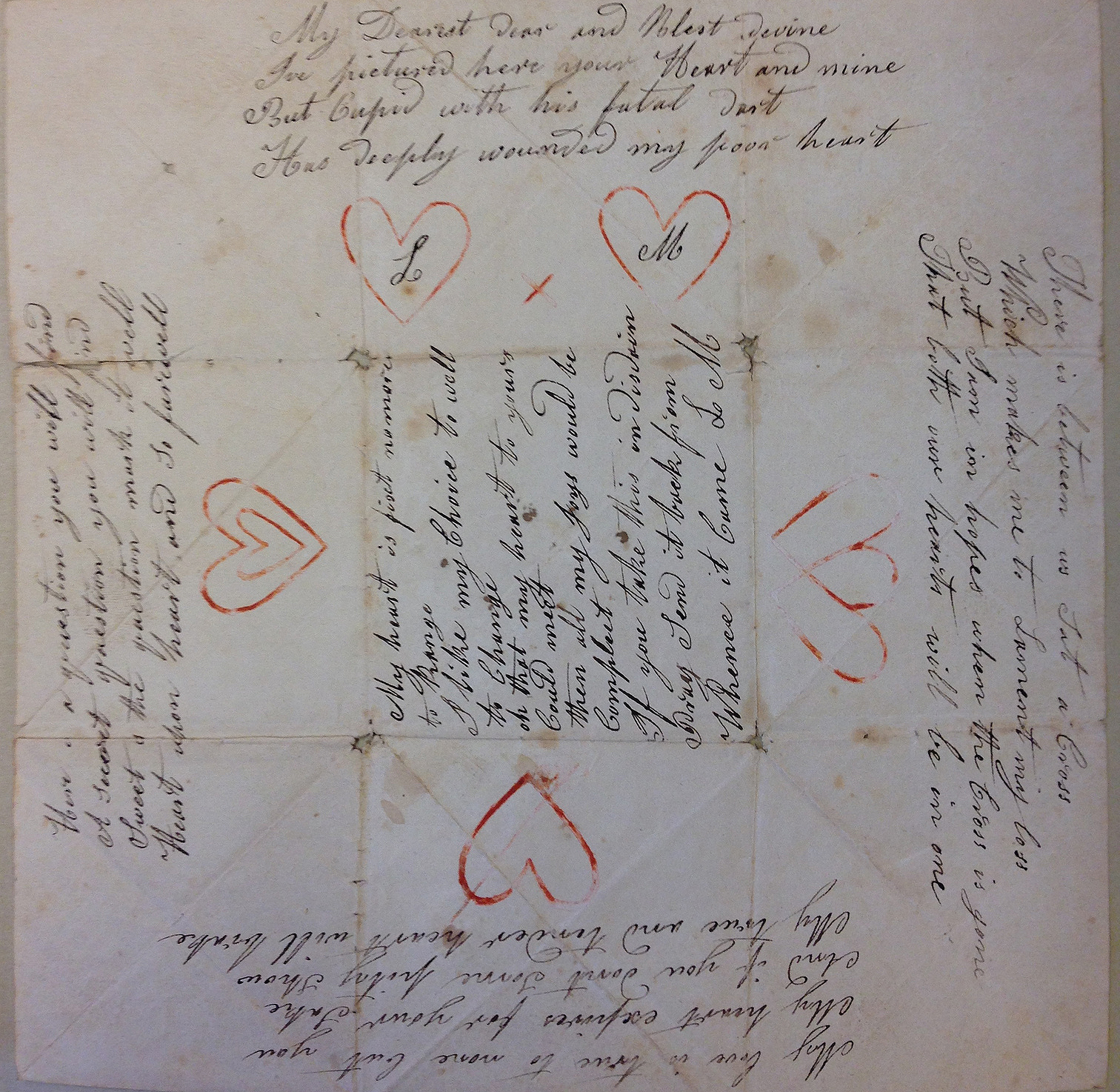
Here’s a nifty little thing you can make: A puzzle purse. This is from the collections of the Rhode Island Historical Society, but the form seems to have been fairly common; I know I’ve seen other fancifully-folded letters.

Because I’ll be spending Valentine’s Day in 1820, I thought I’d try to replicate this token. News on how it turned out later… I don’t feel clever enough to write my own verse, but here is the Rhode Island example transcribed.

My love is true to none but you
My heart expires for your sake
And if you don’t me pity show
My true and tender heart will brake

Here a question you will find
A sweet question you will find
Sweet is the question mark it well
Heart upon heart and so farewell

My Dearest dear and Blest Devine
I’ve pictured here your Heart and mine
But Cupid with his fatal dart
Has deeply wounded my poor heart

There between us sat a Cross
Which makes me to Lament my loss
But I am in hope when the Cross is hone
That both our hearts will be in one

My heart is fix’t no more to Range
I like my Choice to well to Change
Oh that my Heart to yours could meet
Then all my joys would be compleast
If you take this in disdain
Pray send it back from
Whence it Came L M

Share this:

  • Share on Facebook (Opens in new window) Facebook
  • Share on Pinterest (Opens in new window) Pinterest
  • Email a link to a friend (Opens in new window) Email
  • Share on X (Opens in new window) X
Like Loading...

Gingerbread (in the) House

21 Sunday Dec 2014

Posted by kittycalash in Clothing, Food, Making Things, personal

≈ 2 Comments

Tags

cats, cooking, gingerbread, Gingerbread cake, Holidays, preparations, recipe, recipes, Rhode Island, Rhode Island history, Tasha Tudor

Illustration by Tasha Tudor

Illustration by Tasha Tudor

Here we are again, at the time of year known as Impending Parental Visit, which causes a variety of reactions ranging from full-on repaint the kitchen and both baths freak out (whilst nursing an 8-week-old Young Mr) to Eh, she’s got a dog acceptance.

This year, Mr S had the freak out, and has undertaken a living room painting project which he has carried out on weekends since Thanksgiving. It does look good, and I am grateful for his persistence, because this year’s late fall and early winter brought me a serious case of the blues.

That's a happy cat!

happy cat!

I’m in the midst of trying to finish a dress before my mother arrives (my sewing area is really our dining table, with the Strategic Fabric Reserve stowed in sideboards and cupboards). Yesterday, I tried it on: it fits, and looks rather nice (grey wool, and when it’s done, you’ll see it). But it fails in intention: clearly, it is no maid’s dress.

But I felt so much happier in my stays and petticoat that I dug up the wool dress made for farm adventures, put on my apron, and made ginger bread.

The cat approves of my reading material.

The cat approves of my reading material.

The recipe, which I shared recently with a friend, is an old Rhode Island family receipt, and very similar to the Tasha Tudor cookbook receipt. (The Howling Assistant approved of Tasha’s Roast Chicken receipt. She is a poultry fan.)

When copying over the receipt for my friend, I forgot the hot water, and failed to warn him that this gingerbread cake is best eaten with a fork. Delicious, but sticky, here it is:

1/4 cup butter, room temperature or a little softer
1 cup sugar
1 teaspoon baking soda
1 cup boiling water
Combine the last two ingredients and pour over the butter & sugar.
Add 3/4 cup molasses
Combine well.

Sift into the liquid mixture:
1.5 cups flour
1/2 teaspoon ginger (I use a heaping 1/2 tsp)
1 teaspoon cinnamon
pinch salt

Combine gently. Into the mixture drop one unbeaten egg.
Beat the whole with a hand-cranked eggbeater or whisk.

Pour into greased 9×13 pan, and bake at 350F for 35 to 40 minutes, or until a toothpick comes out clean.

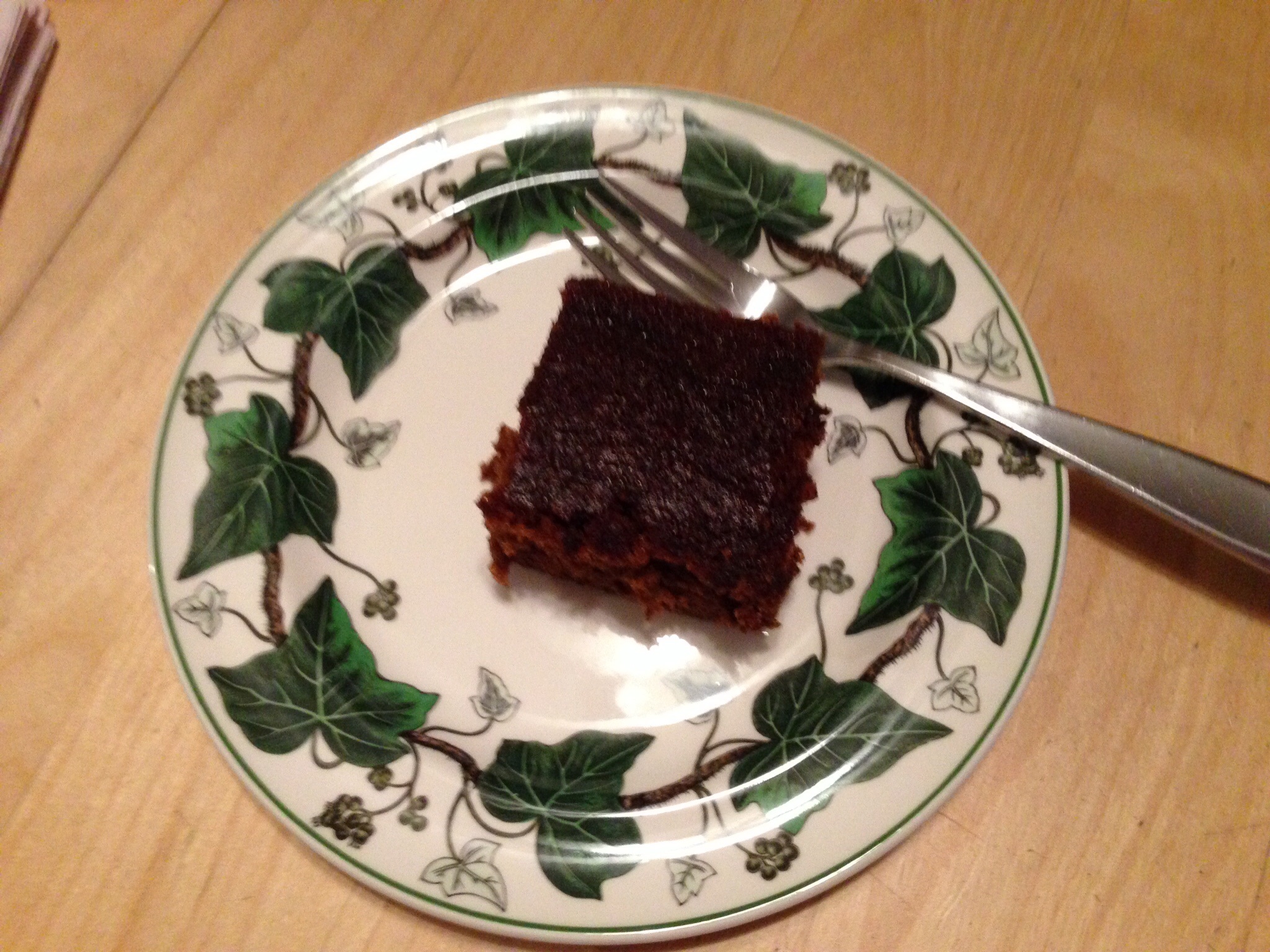
Gingerbread cake

Gingerbread cake

Good with tea, coffee and clementines. I’ve made this perhaps a dozen times, once without the egg, and it’s always edible. (The egg provides some leavening, so made without it, the cake is dense and extra sticky.) Baking it makes the whole house smell good and it’s a simple, one-bowl receipt. For an easy holiday treat to share, I recommend this Rhode Island Gingerbread Cake.

Share this:

  • Share on Facebook (Opens in new window) Facebook
  • Share on Pinterest (Opens in new window) Pinterest
  • Email a link to a friend (Opens in new window) Email
  • Share on X (Opens in new window) X
Like Loading...
← Older posts
Newer posts →

Archives

wordpress statistics

Creative Commons License
Kitty Calash blog by Kirsten Hammerstrom is licensed under a Creative Commons Attribution-NonCommercial-ShareAlike 4.0 International License.

Website Built with WordPress.com.

  • Subscribe Subscribed
    • Kitty Calash
    • Join 621 other subscribers
    • Already have a WordPress.com account? Log in now.
    • Kitty Calash
    • Subscribe Subscribed
    • Sign up
    • Log in
    • Report this content
    • View site in Reader
    • Manage subscriptions
    • Collapse this bar
 

Loading Comments...
 

    %d