• Home
  • Completed Costumes/Impressions
  • Emma and Her Dresses
  • Free Patterns and Instructions

Kitty Calash

~ Confessions of a Known Bonnet-Wearer

Kitty Calash

Author Archives: kittycalash

Same as it Never Was

18 Sunday Feb 2018

Posted by kittycalash in Living History

≈ Comments Off on Same as it Never Was

I wrote this two years ago and never published it (I was still looking for a job at the time). It’s still relevant. 

Every time I go to a museum, I see a lost or wasted opportunity: galleries where connections aren’t made to collections I know an institution owns, changing galleries featuring a seemingly endless rotation of amateur local artists instead of meaningful interpretation of local objects– or, better yet, a show challenging those same artists to react to a museum’s collection. The same is true of many reenactment events.
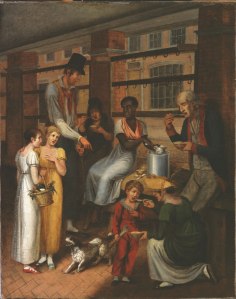
Pepper-Pot: A Scene in the Philadelphia Market
John Lewis Krimmel, American (born Germany), 1786 – 1821. Oil on canvas, 1811. Philadelphia Museum of Art, 2001-196-1. 125th Anniversary Acquisition. Gift of Mr. and Mrs. Edward B. Leisenring, Jr., 2001

I remain deeply frustrated with the way reenacting can use documentary evidence– which rarely includes women– as a means to perpetuate 18th century misogyny in a 21st century setting. The same evidence means events often lack enough children, African Americans, American Indians, and other non-white people to create an accurate vision of the past. We know this because the demographic evidence exists, even when a manuscript fails to mention a mixed group of people in a specific place and time. (When an 18th century newspaper account uses the word “people,” you can bet that the group described included women and non-white men; if the account is about “men,” then it’s white men. Language is always coded.) The changes in the past years to include more accurate working class impressions go a long way towards creating a more nuanced vision of the past, but we’re still stuck with scenes that lack the complexity of the past.

My discomfort with this bothers me greatly. To what degree is my dissatisfaction also grounded in the understanding that recreating events in small, stagey spaces and times can de-contextualize a historical event, ultimately rendering the experience shallow and ritualistic, leaching it of meaning?

To what degree does our fixation on the appearance of participants (clothing standards) over interpretive standards or research materials serve to perpetuate shallow, surface-only events? And does the smallness of events create a zero-sum game in which someone’s talents will always be wasted, unused, and unrecognized, further feeding resentment of the “progressive” reenacting culture, sometimes even by its adherents?

All of that seems so over-thought, but in the midst of overthinking, and while deeply admiring Not Your Momma’s History on Racked, I thought about the critiques I read on @twitter, especially the part of #blacktwitter I follow, and I had a more important thought: Lead, Follow or Get Out of the Way.

Maybe it’s time for the white women to get out of the way, and to expend our energy supporting the people who aren’t included at all. Maybe I need to STFU and invest my energy where it matters more: helping ensure the really unheard voices are heard. Cheney McKnight, Dread Scott, and Michael Twitty all have important things to say about history- American history, African American history- that, at this moment in time, matter far more than what I have to say. Go follow them. Make a difference.

Share this:

  • Share on Facebook (Opens in new window) Facebook
  • Share on Pinterest (Opens in new window) Pinterest
  • Email a link to a friend (Opens in new window) Email
  • Share on X (Opens in new window) X
Like Loading...

Night Clubbing

16 Friday Feb 2018

Posted by kittycalash in Events, Fail, Living History, personal

≈ 3 Comments

Tags

bow out gracefully, Events, find another gig, new wave, nightclubs, punk

Mountebanks at night. watercolor by Paul Sandby, 1758 Royal Collection Trust/© Her Majesty Queen Elizabeth II 2014

Mountebanks and miscreants: how we love them. I have found myself in a situation of late that feels altogether too much like high school, and as a means of understanding it, I have a story to tell. It will, sadly, confirm what my parents thought was happening, but hoped was not.

Let’s step back to the time when I was known as the Rat, when I spoke truth to adolescents and paid the price of ostracism and harassment. I was already largely outside whatever cliques there were in high school, for I’m not certain you can call an assemblage of despised literary hopefuls in a hallway window seat a clique, so the harassment hurt more than the exclusion. Harassment these days comes not in the form of people chanting at you in person, but rather in online trolling, which can be deleted, unless people take the energy to rise to doxing or swatting, and few in the living history world seem to– and that’s not a challenge, kids.

So, operating within a loose-knit band of misfits more Donnie Darko than Ferris Bueller, I began breaking the rules, taking films back to the public library for my teachers and spending the rest of the day at the art museum or bookstore, or combing thrift shops for my nearly-all-vintage wardrobe. I could not find a place to be, so I stepped out.

Naked Raygun at the Metro (not the club in question)

Along the way, I met some very interesting people: punk musicians, artists, dancers, and students who introduced me to a very different world than the one my classmates lived in. It was a kind of mid-western Desperately Seeking Susan, or perhaps Something Wild, only I suppose I was Susan seeking myself. I saw great bands and terrible bands, and continued my forays even after I’d left the city for college, which leads me to a moment that resonates fiercely with me in light of the past few days of highly localized re-enactor drama.

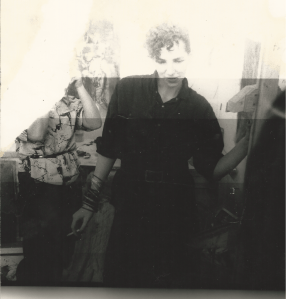
portrait of a wanna-be-artist

I had a sometime-boyfriend who was ahead of me in college, at a different university, who worked as a DJ in northside night clubs. On one summer trip to the city, I found myself walking out of a nightclub where I’d been dancing, eager for some fresh air. At the door were two of my former classmates– too much acquaintances to be called frenemies– trying, and failing, to get in. I caught their eyes, agog, as I walked out.

“You come here?” one asked. “How’d you get in?“
“I know a guy,” I said. “I’ve been coming here all summer,” and walked up the street to catch the bus to the next party.

Share this:

  • Share on Facebook (Opens in new window) Facebook
  • Share on Pinterest (Opens in new window) Pinterest
  • Email a link to a friend (Opens in new window) Email
  • Share on X (Opens in new window) X
Like Loading...

Compare and Contrast

28 Sunday Jan 2018

Posted by kittycalash in Clothing, Events, Living History, Reenacting

≈ Comments Off on Compare and Contrast

Tags

18th century clothes, 18th century clothing, Boston Massacre, Bostonian Society, Events, living history, women's history, women's work

2016's 1770
2016’s 1770
2018's 1770
2018’s 1770

Boston Massacre planning is underway for everyone involved at every level, including me.

I’ve made changes to what I plan to wear, in part because I have a newer gown that fits better and keeps me warmer, and because I have learned more, and looked at more, in the intervening time. Since 2016, I’ve made/upgraded a quilted petticoat (in a bronze silk, a color documented to Rhode Island quilted ‘coats), settled in to wearing my cap tied under my chin, and made both a new apron and a new bonnet.

2017's 1777
2017’s 1777
2018's 1770
2018’s 1770

Cap and bonnet shape and shoes help make time period distinctions between 1777 and 1770; if I could find the wool I made the gown from, I would add the cuffs it desperately needs. The heeled shoes skew earlier than 1770, but they are the only heeled shoes I have….if the weather is wretched, I will wear the flats for safety and comfort.

2016's Bonnet
2016’s Bonnet
2018's Bonnet
2018’s Bonnet

The bonnet, which I affectionately call “Lampshade,” is meant to have the shape of pre-1770 bonnets as seen in Sandby’s illustrations, and which I have been working on for a while.

Martha Collins, Thomas Sandby’s Cook. watercolor on paper by Paul Sandby, 1770-1780. RCIN 914339

I know from reading the standards that the understanding of mitt material has evolved, and my time this morning looking for an elusive apron shape raises questions for me as well. Here’s Martha Collins, painted by Paul Sandby. What’s that black thing on her arm? A mitt? An arm warmer? Is it knit, or woven? There’s always more to figure out, and more to make.

Cuffs on my gown don’t seem like a big enough deal to warrant buying wool for a whole new gown (with only six weeks to go), so my choices are live with no cuffs, alter the red gown of 2016’s event to fit properly, or initiate an extensive search for the scraps left over from the green gown…which may or may not be buried in storage. Tick tock.

Share this:

  • Share on Facebook (Opens in new window) Facebook
  • Share on Pinterest (Opens in new window) Pinterest
  • Email a link to a friend (Opens in new window) Email
  • Share on X (Opens in new window) X
Like Loading...

Where You Come From

24 Sunday Dec 2017

Posted by kittycalash in History, personal

≈ 1 Comment

Tags

blurry photos, family, family portrait, personal, photography, Research

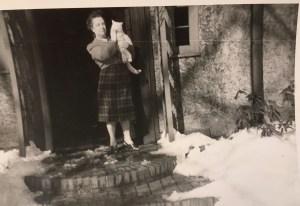
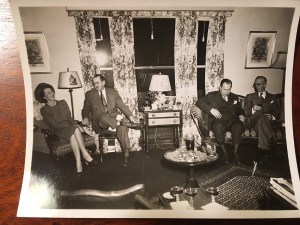
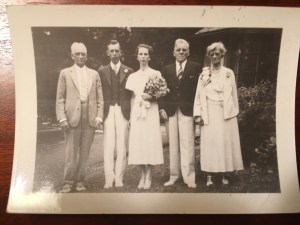
A selection from the box, mostly documenting the first two decades of my mother’s life

Mumblety-odd years ago, my first museum job was in a photograph and print collection, working as a photo researcher both finding and processing collections. There was a voyeuristic quality to the work, sometimes when going through a photographer’s more personal images, but especially when working on a family collection.

As I continued to work in the field, I started meeting with donors, and learned to talk them into giving their collections to the museum. It was easy enough to talk to them about making their memories tangible, creating and preserving a legacy of their lives so that others could understand the past and the contribution they, in particular, had made. How they typified an important part of a state or region’s history.

Susie the Cat makes many appearances

Sporadically, I organized my own photos and ask my mother for images of our family. I certainly took plenty of photos of my own son, but as time went on– and whether this is due to smartphones or trying to live in the moment, or not wanting to break the magical spell of an experience– I stopped taking pictures. I could still talk people into donations, and still enjoyed going through their family albums, but recording my own life didn’t make much sense to me, and I began to consider pitching images and letters and postcards, especially as I packed to move south. Keeping photographs for myself didn’t make sense.

Federal furniture: always central in my family

Sitting in bed on Friday night, Drunk Tailor and I looked through a box of snapshots my mother keeps in a fabric-covered box. He said, “Photographs are what you use to show people what you used to look like,” and to a degree that’s true. They are also proof that you had a life before this moment (think Blade Runner) and proof– perhaps– that you are who you think you are (think Blade Runner 2049). But even more like the Blade Runner movies, photographs of your past, or your family’s past, tell you where you come from, and where you might belong. Love them or leave them, you fit in somewhere in a larger story of people, and that shapes your identity, what you do, who you love, and how you live.

1936: My grandmother’s wedding.

As every year ends, I look back with some sadness at things I wish I had done differently, people I wish I had not hurt, people I wish I’d hugged more. The box of snapshots reminds me that I’m all too common, all too normal. Everyone has those pangs of nostalgia, the words they wish they’d said, the loss they feel as they lose the people they love.

Saint Lucia Day ca 1947

And that’s the point, I suppose: love one another. Be excellent to each other. Take the photos, label them (in pencil, on the back, listen to your archivist), and look at them when you can’t remember who you are, where you came from, or why you matter.

Share this:

  • Share on Facebook (Opens in new window) Facebook
  • Share on Pinterest (Opens in new window) Pinterest
  • Email a link to a friend (Opens in new window) Email
  • Share on X (Opens in new window) X
Like Loading...

Reading the Night

18 Monday Dec 2017

Posted by kittycalash in material culture, Research

≈ 3 Comments

Tags

art history, context, engravings, lithographs, prints, semiotics

Francois-Robert Ingouf after Sigmund Freudenberger (French, 1747 – 1812 ), La soiree d’hyver, 1774, etching and engraving, Rosenwald Collection 1943.3.4377

Details. It’s all in the details, right? I see this print multiple times every day, and contemplate the little stories in the details of the room.

Francois-Robert Ingouf after Sigmund Freudenberger (French, 1747 – 1812 ), La soiree d’hyver, 1774, etching and engraving, Rosenwald Collection 1943.3.4377

Perhaps the first thing I noticed that jarred my eye (and my thinking) was the row of glass vases for forcing bulbs. They look so modern, don’t they? But the shape is classic– form following function– and findable today. How pleasing that my mother’s winter ritual of filling windowsills and mantles with forcing bulbs can be visually documented to one of my favorite eras–and was, indeed, common in the past. This is one of those “everybody did it” ideas I can endorse.

French François Linke Louis XVI Style Gilt Bronze and White Marble Clock
Francois-Robert Ingouf after Sigmund Freudenberger (French, 1747 - 1812 ), La soiree d'hyver, 1774, etching and engraving, Rosenwald Collection 1943.3.4377
Francois-Robert Ingouf after Sigmund Freudenberger (French, 1747 – 1812 ), La soiree d’hyver, 1774, etching and engraving, Rosenwald Collection 1943.3.4377

What else is on the mantle? A clock, undoubtedly ormolu– though it could be much worse. And yes, the cupid on the clock has meaning in this print.

And then there’s this: the hot water urn– or is it?

Tucked into the fire place, I was initially pretty sure that’s a hot water/tea/coffee urn, meant to go with the tea or coffee cup on the mantle (see above; it’s in front of the bulb vases). Hot tea or coffee would be welcome on a cold winter’s evening, and the water would stay warmer tucked close to the fire.

Francois-Robert Ingouf after Sigmund Freudenberger (French, 1747 - 1812 ), La soiree d'hyver, 1774, etching and engraving, Rosenwald Collection 1943.3.4377
Francois-Robert Ingouf after Sigmund Freudenberger (French, 1747 – 1812 ), La soiree d’hyver, 1774, etching and engraving, Rosenwald Collection 1943.3.4377
Tea urn. Silver, by John Carter II. 1773-1774. Metropolitan Museum of Art, 11.28a–f

18th Century Cast and Wrought Iron Fireplace Fire Grate

But it could also be a decorative fender, ornamented with urns at the ends. The fireplace grate shown here is English, made ca. 1780 according to the seller) but should you have space cash burning a hole in your pocket, there’s a similar 19th century reproduction of the one in the print for sale on the interwebs, should you care to recreate this image (I know some of you have the clothes). In fact, there are quite few fenders-with-urns, once you start looking, some in bronze and some in steel.

And what of this? Is that an 18th century dog house or covered dog bed? Yes, it is.

Dog kennel, by Claude I Sené, 1775-1780. Metropolitan Museum of Art, 1971.206.18
R-20100527-0015.jpg

The bouillotte candlestand on the table is another nice household detail, illuminating a book lying open on the table set against the wall.

R-20100527-0015.jpg
Screenshot 2017-12-17 10.48.42

It has taken me some time of looking at period images to accept these candle stands as correct, since my experience with them was grounded in electrified reproductions in suburban Colonial Revival dens and family rooms– a location I will admit I was prejudiced against to begin with, having grown up in a city surrounded by architects devoted to (and buildings by) Mies van der Rohe.

But therein lies the point of looking: what initially seems absurd (Versailles-quality dog beds) or simply anachronistic (candlestands with shades) slides into place when seen and understood, within its proper context.

Share this:

  • Share on Facebook (Opens in new window) Facebook
  • Share on Pinterest (Opens in new window) Pinterest
  • Email a link to a friend (Opens in new window) Email
  • Share on X (Opens in new window) X
Like Loading...
← Older posts
Newer posts →

Archives

wordpress statistics

Creative Commons License
Kitty Calash blog by Kirsten Hammerstrom is licensed under a Creative Commons Attribution-NonCommercial-ShareAlike 4.0 International License.

Website Built with WordPress.com.

  • Subscribe Subscribed
    • Kitty Calash
    • Join 621 other subscribers
    • Already have a WordPress.com account? Log in now.
    • Kitty Calash
    • Subscribe Subscribed
    • Sign up
    • Log in
    • Report this content
    • View site in Reader
    • Manage subscriptions
    • Collapse this bar
 

Loading Comments...
 

    %d