• Home
  • Completed Costumes/Impressions
  • Emma and Her Dresses
  • Free Patterns and Instructions

Kitty Calash

~ Confessions of a Known Bonnet-Wearer

Kitty Calash

Category Archives: Book Review

Fabric Selection Resources: Printed & Online

09 Friday Jan 2015

Posted by kittycalash in Book Review, Clothing, Living History, Making Things, Reenacting, Research

≈ 1 Comment

Tags

fabric, Research, resources, sewing, shopping, style

Jackie asked about fabrics: how do you choose?

I’m going to start with prints, cottons, linens and silks; the second part will cover wools and sutlers.

There’s no substitute for feeling up the real thing, or samples, and while I do not have the book, I’m told by a very reliable source that it is worth buying Swatches from Wm Booth or from Hallie. I also order Burnley & Trowbridges swatch sets, which are often  more extensive than what’s on their website. Those samples help me gauge fabrics online– comparing the actual square with a thumbnail online is helpful.

Barbara Johnson: a typical page

Barbara Johnson: a typical page, this from 1803

Where else can you look for guidance? One of the best books that spans a wide range of living history time periods is the Barbara Johnson book of swatches. Owned and published by the Victoria and Albert Museum, A Lady of Fashion is out of print, but the pages have been scanned and are available online. The print version is better– it’s big!– but you can download the images and get a better sense of the scale of the samples.

What is particularly useful is that Barbara Johnson dated the samples, and wrote down how they were used. You can’t get better than that!

Susan Greene’s Wearable Prints is neither small nor cheap, but it is extensive, covering 1760 to 1860. This is a very hand book to have to help sort out typical looks for different time periods, and the likely range of colors.

Textile Sample Book, 1771. Metropolitan Museum of Art. 156.4 T31

Textile Sample Book, 1771. Metropolitan Museum of Art. 156.4 T31

Other museums have digitized sample books: the Met, for example, has multiple images of woven fabrics from a 1771 sample book online.

What you need to remember here is fibre: those homespuns at JoAnn will not behave the way linens behave, even if they look the same. Hand and drape are everything, and cotton, or cotton-poly will not do want linen does. Buy the linen, it’ll look, feel, and wear better.

There are many more sample books, but you have to be careful: some are dated only “19th century.” Great. That’s where Susan Greene and Barbara Johnson can help you sort out which *part* of the 19th century you’re looking at.
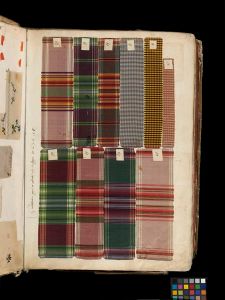
Swatch book, 1763-1764. Victoria and Albert Museum, T.373-1972

Swatch book, 1763-1764. Victoria and Albert Museum, T.373-1972

For silks, you can see a very specific and detailed range of silks in Selling Silks, which reproduces another sample book at the Victoria and Albert. Not all samples are 1763-1764; you will need to read the descriptions, but this can be helpful in figuring out how to use fabrics. I have come into some red silk damask that I can make into a gown; it’s vintage silk from France, probably pre-World War II. The pattern is large, replicating a 1740s fabric, but when I make up my gown, I think it can be 1760s, but not a lot later.

Part of looking and buying is understanding how textiles might be bought, saved, made up, reused and repurposed over time.


Share this:

  • Share on Facebook (Opens in new window) Facebook
  • Share on Pinterest (Opens in new window) Pinterest
  • Email a link to a friend (Opens in new window) Email
  • Share on X (Opens in new window) X
Like Loading...

Anachronisms, ahoy!

14 Friday Feb 2014

Posted by kittycalash in Art Rant, Book Review, History

≈ Comments Off on Anachronisms, ahoy!

Tags

18th century, 4th Massachusetts, anachronisms, common people, common soldier, deborah sampson, history, Light Infantry, masquerade, Research

Deborah Sam[p]son (Gannett), oil on paper by Joseph Stone, 1797. RIHS Museum Collection, Gift of Jesse Metcalf, 1900.6.1

Deborah Sam[p]son (Gannett), oil on paper by Joseph Stone, 1797. RIHS Museum Collection, Gift of Jesse Metcalf, 1900.6.1

There’s a petition circulating in certain government circles in support of a campaign to give Deborah Sam[p]son her very own stamp. This is, in part, fueled by the upcoming 250th anniversary of the founding of Sharon, MA.

I’ve got no problem with that—commemoration is something we humans do and need. And Deborah Samson’s is an interesting story, but possibly not for the reasons cited in the letters from officials who shall remain nameless. They describe her as “a pioneer of promoting women’s rights and eliminating gender barriers” and “a trailblazer for gender equality,” phrases that would have been just about nonsense in the Revolutionary war period.

And that’s my problem with it: the anachronistic representation of a woman’s story, bent to the purposes of the present. Don’t get me wrong—I’m a feminist, I’ve enjoyed Deborah Samson’s story since I read about her as a kid in one book or another, so I sympathize with the Stamp Movement.

What makes me crazy is bad history.

Hannah Snell, as depicted in an excerpt from "The Life and Adventures of a Female Soldier," the narrative of the most famous cross-dressing British soldier of the century. It appeared in Isaiah Thomas's New England Almanack (Boston, 1774). Printers recycled the image on other imprints. American Antiquarian Society.

Hannah Snell, as depicted in an excerpt from “The Life and Adventures of a Female Soldier,” the narrative of the most famous cross-dressing British soldier of the century. It appeared in Isaiah Thomas’s New England Almanack (Boston, 1774). Printers recycled the image on other imprints. American Antiquarian Society.

In Masquerade, Alfred Young tells Sampson’s story well, busting myths that both we—and she—created. (This short bio is a good overall sketch of Deborah’s life. ) What struck me the most about Deborah Samson’s life was the lack of certainty, stability, and material comfort. We’ll never know the specific circumstances that led her to enlist, though Young does yeoman’s work to unearth everything he can about her life and circumstances, and the context in which she lived.

I’m not an unbiased reader—I did get a little shouty on the third floor when I read “trailblazer for gender equality,” and that phrase has lingered and grown tattered as my colleagues and I have chewed it over—but Young’s point about women of the lower sorts is well taken.

Here’s an excerpt from an interview with Young about the book:
“In cross-dressing, Deborah was like a good many other plebeian women we are discovering who were in flight: to escape indentured servitude, to avoid the shame of a pregnancy, to get out of the reaches of the law, and so on. But to explain why she carried it off so long, you have to fall back on her skills and resourcefulness.”

So much for that pioneer of promoting women’s rights—Samson was a pioneer in skillful deceit (no mean feat) and in using that deceit to further the main chance, that is, Deborah Samson’s chance. What’s wrong with that? I like that better, and that’s my bias and my interests.

Reading about Deborah Samson helped me think about Bridget Connor and the women like her, probably less skilled and less educated than Samson, probably even more impoverished. It’s a mysterious mix of personality and circumstances that drives us all, but considering what we can know about Deborah Samson helps us understand her not so much as a pioneer for gender equality but as a self-interested human being acting for herself despite the barriers of class, education, and gender. And that can help us understand the people we can know even less about, like Bridget Connor.

For a taste of historical prose, you can find an annotated version of Samson’s story written by Herman Mann here, at Harvard University Library’s digital page delivery system.

Share this:

  • Share on Facebook (Opens in new window) Facebook
  • Share on Pinterest (Opens in new window) Pinterest
  • Email a link to a friend (Opens in new window) Email
  • Share on X (Opens in new window) X
Like Loading...

Book Notice: Wearable Prints, 1760-1860

29 Wednesday Jan 2014

Posted by kittycalash in Book Review, History, Living History, Research

≈ 7 Comments

Tags

books, fabric, fashion, history, prints, Research, resources, style

This just in, literally, from the mail carrier: Susan W. Greene’s long-awaited book, Wearable Prints, 1760-1860. It’s discounted (and out of stock) at Amazon, but should be shipping soon, since I have one right here on my desk.

It’s fair to call this book lavishly illustrated (1600 full-color images in almost 600 pages), and while I have access to a copy at work, I am seriously thinking of buying my own copy, based solely on about 10 minutes skimming the book. There are images not just of fabric samples but also of garments, paper dolls and illustrations that help put the fabrics into context. Images of garments from collections I can’t get into? Delicious! Information to help me understand how to use a printed cotton? Even better.

The book is organized in three main sections: Overview, Colors, and Mechanics. Appendices include timelines, prohibitions, price comparisons, print characteristics, and more, as well as a glossary and an extensive bibliography.

The photographs are amazing, and show a range of print designs of greater variety than we may have credited heretofore. Particularly useful is the section on evaluating and identifying printed dress fabrics, and the questions one should ask about fabrics. I think that the criteria could be used forensically on modern as well as historic textiles, and we could think more critically about the fabrics we use.

ETA: I wrote this while the downstairs room was being painted with oil paint, and it’s loopier than I expected. The book is still an excellent resource, and I highly recommend it. While it’s heavy for carrying to the fabric shops, it would be dead useful while shopping online. I have definitely seen bolts of fabrics very similar to those illustrated in Greene’s book. As Anna notes on her blog, Ms Greene’s collection is now at Genessee Country Village.  Wow. It’s amazing. If you can’t get there easily, well, the book will certainly help, and the images will you visual access to a plethora of collections. 

Share this:

  • Share on Facebook (Opens in new window) Facebook
  • Share on Pinterest (Opens in new window) Pinterest
  • Email a link to a friend (Opens in new window) Email
  • Share on X (Opens in new window) X
Like Loading...

Book Review: Book of Ages

17 Sunday Nov 2013

Posted by kittycalash in Book Review

≈ 1 Comment

Tags

18th century, book review, Boston, common people, history, Massachusetts, Research, resources, women's history

Book of Ages, by Jill Lepore.

Book of Ages, by Jill Lepore.

This is a book about reading and writing as much as it is a book about Jane Franklin, Benjamin Franklin’s little sister. Book of Ages has been reviewed elsewhere, and Lepore wrote a really lovely piece in the New Yorker called The Prodigal Daughter that is unfortunately behind a subscription firewall, but which I have read on actual paper. If you can get hold of it, I do recommend reading it before you read Book of Ages. It makes the book all the more poignant to know something about Lepore’s process.

This is, in many ways, another book about mud and misery (see the best bits of Longbourn). Because Jane Franklin Mecom (her married name– she married at 15) left behind so little, Lepore builds much of her story out of the context of Boston and New England in the mid-18th century.

It’s not exhaustive in its detail, and that’s fine: the book is an easy, comfortable read that still provides well-researched information about the lives of women in the 18th century. I finished it over a week ago, but details still remain (and that is a testament to Lepore– these could have been supplanted in my mind by details of exterior water meters, skunk removal techniques, or indexes for early vital records). Among the details I recall: Funerary and mourning customs, from published sermons to the distribution of mourning gloves and rings; soap making and trades practiced by small holders in home workshops; Jane Franklin Mecom’s wartime flight to Rhode Island; the power and practice of extended family networks.

It also reminded me of the differences in educational methods or standards for boys and girls, which helps remind us all of the importance and significance of the ideal of free public education for all. (We had some early proponents here in Rhode Island.) What might Jane Franklin’s life have been like in other circumstances? Honestly, even if she’d been well-off and well-educated, as as woman in the 18th century, she would never have had the same chances as her brother, no matter how evenly their intellects might have been matched.

If anything, that’s reason alone to read Lepore’s book, to celebrate the life of a woman who was both ordinary and extraordinary, and to recognize how much closer to all the anonymous, disappeared women of the past we can get through this example.

Share this:

  • Share on Facebook (Opens in new window) Facebook
  • Share on Pinterest (Opens in new window) Pinterest
  • Email a link to a friend (Opens in new window) Email
  • Share on X (Opens in new window) X
Like Loading...

Longbourn: Book Review

19 Saturday Oct 2013

Posted by kittycalash in Book Review, Literature

≈ 6 Comments

Tags

18th century, book review, common dress, common people, common soldier, literature, servant girls, servants

The Chocolate Girl is adapted for the cover of Jo Baker’s new book

 On Sunday, I read the NYT review of Jo Baker’s new book, Longbourn. As soon as I finished the review, I ordered the book, which arrived Wednesday evening. By 2:00 AM Thursday, I had finished it.

I like Austen, but my favorite Austen novel is Mansfield Park, not Pride & Prejudice. The BBC and other adaptations sometimes make the world of her novels seem too cloistered, too precious, and too refined to me. (Mrs Hurst Dancing can be a helpful corrective.) So of course I was captivated by the premise of Longbourn: “The world of the people who laid the fires, cooked the meals and fetched the horses for Jane Austen’s Bennet family.”

The story was engaging–heck, I stayed up until 2:00AM  to find out how it ended–and while I found it slightly romantic for my taste, on the whole, the world was believable.

For one thing, there is plenty of mud. And Sarah the housemaid must clean the mud off the Bennett girls’ petticoats. The hauling of water, laying of fires, and the chill and exhaustion the maids feel is pretty well rendered. Baker addresses the question I’ve always had, How did servants tolerate servitude? by portraying Sarah’s struggle with resentment and resignation to her lot.

I thought, too, that the way Baker described women as “breeding” was also good; she referred as well to Elizabeth Bennett’s “dark, musky” armpits, and that seemed a nice way to slip in historical hygiene information. But women in English gentry were valued for their breeding capabilities: the need for a male heir didn’t die with Henry VIII, and it is much of what drives, or drove, the plot of Downton Abbey. For women, the past was a smaller world, and Sarah’s life is particularly small. Her carriage rides help define the very real confinement of her world.

There are a few slips: backpack instead of knapsack once or twice, but not many. It feels well-researched, well imagined, and believable. I don’t want to wreck it for you, so I won’t go into too much…there are some classic plot twists and devices that I put up with because they’re so typical of the literature of the period. I particularly enjoyed that Sarah reads from Mr Bennett’s library, including Pamela. It was a nice way to reinforce Wickham’s creepiness, and the echoes between the novel derived from a novel, in which  fictional characters read real novels, delighted me. (Being a fictional character myself.)

Jo Baker’s not Hilary Mantel-– this isn’t the kind of writing where the language stops you cold and sentences leave you breathless with awe, but for historical fiction derived from Jane Austen, Baker’s book is excellent and well-written.

Share this:

  • Share on Facebook (Opens in new window) Facebook
  • Share on Pinterest (Opens in new window) Pinterest
  • Email a link to a friend (Opens in new window) Email
  • Share on X (Opens in new window) X
Like Loading...
Newer posts →

Archives

wordpress statistics

Creative Commons License
Kitty Calash blog by Kirsten Hammerstrom is licensed under a Creative Commons Attribution-NonCommercial-ShareAlike 4.0 International License.

Website Built with WordPress.com.

  • Subscribe Subscribed
    • Kitty Calash
    • Join 621 other subscribers
    • Already have a WordPress.com account? Log in now.
    • Kitty Calash
    • Subscribe Subscribed
    • Sign up
    • Log in
    • Report this content
    • View site in Reader
    • Manage subscriptions
    • Collapse this bar
 

Loading Comments...
 

    %d