• Home
  • Completed Costumes/Impressions
  • Emma and Her Dresses
  • Free Patterns and Instructions

Kitty Calash

~ Confessions of a Known Bonnet-Wearer

Kitty Calash

Category Archives: Fail

Contextualize This*

26 Thursday Nov 2015

Posted by kittycalash in Events, Fail, History, Living History, Reenacting, Research

≈ 6 Comments

Tags

authenticity, common people, history, interpretation, living history, Reenacting, Research, resources, Revolutionary War

Right on, Mr. Hiwell: The music of the Army being in general very bad is a post I could never write, because I lack the detailed knowledge, or the desire to acquire music-specific knowledge (just as Mr Hiwell could give two rats’ about stay-making details, or the subtleties of stew). But here’s the gist of his post, on which I wish to elaborate, and which has been touched on elsewhere: You’re Doing It Wrong.

Let’s take this:

I’m tired of going to events, knowing all the camp duties fifers and drummers played from sunrise to sunset and never playing a single one of them besides Drummer’s Call and Assembly.

One of my favorite hobby horses: lack of discipline and camps that look like that Infamous Catalog just puked on a field. Why on earth can we not see tents are set up properly, in rows, with appropriate numbers of kitchens instead of wobbly lines, marquee tents that disgorge giggling teenage girls in bodices, and enough iron to make the scrap man sing with joy? 

But even then, even if people are too lazy or stubborn to leave stuff at home, why can’t a camp run the way it would’ve? There’s ample documentation on which to draw. Quite aside from the voluminous papers of General Washington and General Greene, and the massive archives in Britain, every regiment had orderly books, of which many survive. They’re hilarious reading and full of things to do.

Most reenactments are boring. Well, so was army life. The 10th Massachusetts was constantly in trouble up on the Hudson late in war, and the Marshall book at the Society of the Cincinnati contains the proof.
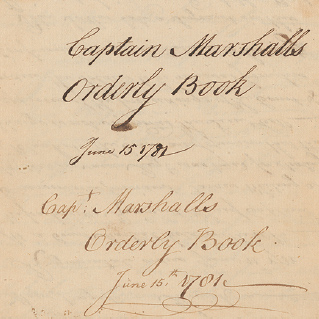
Here’s something fun to do: inspection. Huts, cabins, tents: they all needed to be kept neat., and apparently weren’t.

Some part of the Camp and about the long Barracks in particular is relaxing into nastiness. Regimental QuarterMasters have been ordered to have them Clean and keep them so. An Officer of each Company has been ordered to visit the Barracks every day and to Confine & Report those who throw bones of meat Pot Liquor or filth of any kind near the Barracks. Yet all this has been done and no report has been made. it is hatefull to General Howe to Reitterate orders as it ought to be shamefull those who make it necessary.

Don’t like to clean, prefer cooking? Marching?

Regimnl Orders June 6th 1782

the Regiment will turn out to Morrow Morning at the Beating of the Revelee and to March By Six oClock they are to pack there clothing and kook there provisions this Evening when they have arivd on the Ground for Encamping the officer commanding on the Spot will order a partry if Forty men from the Regiment a Capt and two Sub’s to Command them to Return to the Encampment in order to asist in Bringin on the Baggage the Soldiers are to Carry there kittles in there hands and are to Leave there arms and pakes &c at the New Encampment any Soldier who is found Plundering another pack is to be tyd up and punished with out Trial..

Tyd up and punished without Trial. You know there’s a guy who’s up for that in every unit.

And lest you think that there’s nothing for women in these books, let me assure you, there is:

Regimental Orders, July 23rd 1782

At a Regimental Court Martial whereof Capt Francis is president, Briget Conner a Woman Belonging to the 10th Massachusetts Regiment was tried for purchesing a publick Shurt from a Soldier in Sd. Regiment found Guilty and Sentanced to Return the Shurt to the person from whom she purshest it and loos what She gav for the Shurt.

The Colo approves the opinion of the Court and orders it to take place Immediately

Regimental orders July 25th 1782

Bridget Conner a woman Belonging to the 10th Massachusetts Regiment is Directed to Leave Camp Between this and to Morrow Morning at Roal Call for her Insolence to the officers of sd Regiment on pane of Being Treated with Severity

This is easy, people. Authenticity, accuracy, and Stuff to Do increases exponentially if you use documentation to recreate a “normal” day in either army.  There’s Cuthbertson, for example.

cuthbertson.png

There’s Lochee, if you want to get in tents. And orderly book after orderly book. And if I, a mere woman, can find these things, there is no excuse for you men not to read, absorb, and use these sources well.

Inspections. Returns. Reports. There’s so much to do in a day, and running a camp or a barracks by the regulations would give everyone so much more to interpret, and begin to present real history instead of merely heritage. This is where the real splits are going to come, and sooner than you think. It won’t be about uniform details, or stitch and thread counts, but about actually engaging historical interpretation. If interpreters aren’t engaged, the public won’t be either.


*If you know me, you know what the next word is.

Share this:

  • Share on Facebook (Opens in new window) Facebook
  • Share on Pinterest (Opens in new window) Pinterest
  • Email a link to a friend (Opens in new window) Email
  • Share on X (Opens in new window) X
Like Loading...

A Side of Oysters

24 Tuesday Nov 2015

Posted by kittycalash in Art Rant, Events, Fail, History, Reenacting

≈ 2 Comments

Tags

authenticity, common people, history, interpretation, living history, Reenacting, women's history, women's work, work

Or, Fleshing Sexism into History

06512-2

Here’s a bitter blog post instead of the angry one someone expected after the Turkey Shoot. It started elsewhere with a discussion of this print: there’s more going on in this, and in many genre images of oyster girls and oyster sellers, than you notice at first glance. (First glance is that fab-u-lous bonnet.) There are clues, though, that she is selling more than just oysters. It’s a code, remember? The gaze is one clue, though it reminds me of a cholera victim’s languor.

Yes: this image suggests she is also selling herself.

It’s something I’ve thought about doing as part of my street vendor/Bridget impression. Transgressive, dangerous: true. As a milliner, I’ve had a money bag shaken in my face, coins rattling suggestively, a sailor eager to spend his pay. Milliners and seamstresses both had reputations as women of exploitable, if not overtly easy, virtue. They’re a classic trope in 19th century literature, though I suspect the real reason for the suggestion of looseness was economic independence. But women certainly were selling themselves in the past, so why not portray that reality with carefully selected, trusted role players?

circle_of_francis_wheatley_ra_the_oyster_girl_d5466162h

For one thing, it’s dangerous. You’d have to script it, and interact only with really trustworthy people. It’s not family friendly, though despite the strenuous efforts of some sites, actual history isn’t family friendly either. (I’m looking at you, CW .)

I ponder this role, and women’s lack of power historical, as I ponder Fort Ti and nurses’ reputations, carefully maintained in Army hospitals in later wars. (Not to fear, I will behave, honest.) And I also ponder it as I continue to struggle to understand the Gun Show, the misogyny in the hobby, and the general misogyny of American culture. Like many others, I’ve read this blog post,, and some of the more annoying comments. Yes, I, too, de-escalate now and have in the past. Some of the changes I’ve made in my life revolve back to this concept, and have to do with authenticity and stepping back from de-escalation, subsumation, and self-repression. So why would I not continue that process into my historical work and play?

philip_mercier_the_oyster_girl_d5714611h

As I wonder how to spin a feminist interpretation of women’s marginal roles and drudgery in the past, it occurs to me that forcing the women’s economic disparity and lack of agency to the foreground might provide an answer. Selling myself along with oysters, apples, or cherries might finally make the points I want to not just about women’s lives historically, but about women’s roles today.

(I’ve already made the jokes about hands-on demonstrations, so y’all can keep ‘em yourselves, okay?)

Share this:

  • Share on Facebook (Opens in new window) Facebook
  • Share on Pinterest (Opens in new window) Pinterest
  • Email a link to a friend (Opens in new window) Email
  • Share on X (Opens in new window) X
Like Loading...

Rodentia, or, A Parable for Our Times

29 Wednesday Jul 2015

Posted by kittycalash in Fail, personal, Philosophy

≈ 4 Comments

Tags

Chicago, fail, French class, high school, John James Audubon, Lord of the Flies, narrative, personal, substitute teacher

Once upon a time, as most of us were, I was in high school. It was not a stellar experience for me, but it was defining. Aside from the very few people who became my friends, and whom I follow along with even now, high school was populated with people who did not particularly care for me. Then as now, détente was a reasonable, if not always achievable, hope. But for some, there was a literal breaking point: a Rubicon, if you will. It started in sophomore French class.

John James Audubon. Marsh Shrew, Plate CXXV

John James Audubon. Marsh Shrew, Plate CXXV

We had a substitute teacher one Fall Monday. Her English was not perfect, though her French was; she was a regular teacher stepping in for our regular instructor. This was a pre-lunch class, but there were three 20-minute lunch periods. My class had second lunch; this meant that about 20 minutes into French class, a bell would ring, signaling the beginning of first lunch. After another 20 minutes, a second bell would ring, signaling the end of class and the beginning of second lunch.

John James Audubon. Bridled Weasel, Plate LX

John James Audubon. Bridled Weasel, Plate LX

On our first day with the substitute, when the first bell rang, two boys convinced her that class was over, and no one contradicted them: we left at the 20-minute bell. The next day, the same boys tried the same ruse. Three quarters of the class walked out, but at least two other girls and I stayed: I raised my hand and explained that the first bell was not the end of our class period.

John James Audubon. Black Rat, Plate XXIII

John James Audubon. Black Rat, Plate XXIII

My nickname became then and stayed The Rat. My classmates taunted me and chanted The Rat in the halls. Drawings of rats were stuck to and shoved inside my locker. This lasted until graduation, when we had almost forgotten the origin of my nickname.

When I tell this story now, I don’t look for pity or sympathy: this is a pathetic Lord of the Flies played out in the grey-carpeted halls of a Chicago Gold Coast private school, where the stakes were low so the repercussions were high. This was where I learned about clothing conformity in the guise of Polo shirts, Tretorn sneakers, Levi’s 501 jeans, and Brooks Brothers shirts. I wore my classmates’ fathers’ hand-me-down shirts from the thrift shop; I wore their grandmothers’ dresses. A Rat requires some style.

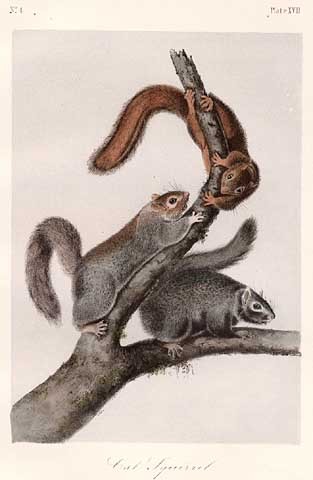
John James Audubon Cat Squirrel, Plate XVII

John James Audubon. Cat Squirrel, Plate XVII

As an adult, I find that people haven’t changed all that much. The cliques still exist, and while adults don’t usually shout at you, ostracism and snubbing are deployed regularly. But I learned long ago how to be alone, or with a few true friends. Evidence always speaks for itself.

Share this:

  • Share on Facebook (Opens in new window) Facebook
  • Share on Pinterest (Opens in new window) Pinterest
  • Email a link to a friend (Opens in new window) Email
  • Share on X (Opens in new window) X
Like Loading...

Context is Critical

15 Wednesday Jul 2015

Posted by kittycalash in Clothing, Events, Fail, Living History, Research

≈ 10 Comments

Tags

18th century, 18th century clothes, authenticity, common dress, common people, Events, fashion, living history, Research, Revolutionary War

Context: it’s everything, right? We so dislike our statements taken out of context. But what about our clothes? They make statements, too, and so do our accessories.

A friend noticed that market baskets were fairly prominent carriers used by reenactors portraying the Boston gentry greeting L’Hermione this past weekend, and asked, “What gives? Is there something I missed?”

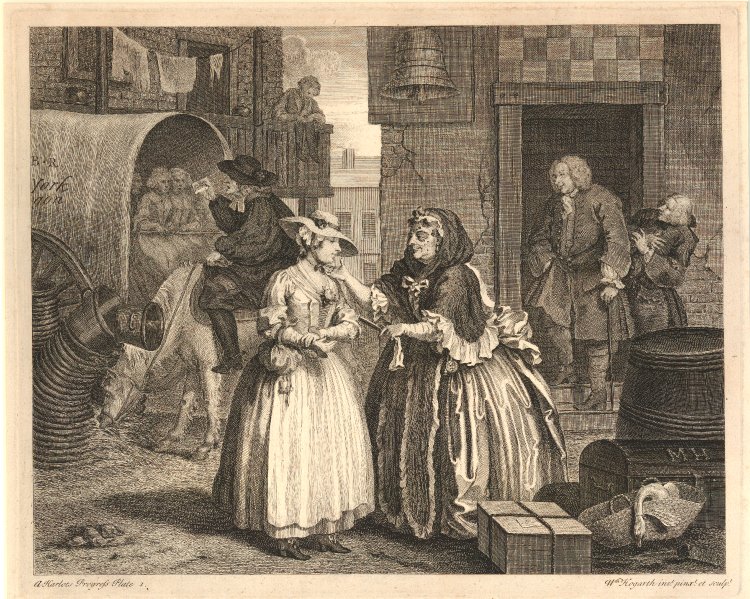
There are two images that people often turn to in documenting these baskets:

The Farmer’s Return, by Zoffany

Johan Joseph Zoffany RA, 1733–1810, German, active in Britain (from 1760), David Garrick and Mary Bradshaw in David Garrick’s “The Farmer’s Return”, ca. 1762, Oil on canvas, Yale Center for British Art, Paul Mellon Collection

and

The Harlot’s Progress, Plate 1

The Harlot's Progress, Plate 1. William Hogarth.

The Harlot’s Progress, Plate 1. William Hogarth.

In both of these, the context is working class and food-oriented. As my friend asked, “Are these floppy baskets for floppy birds?”

Two images from 1740 to 1760 aren’t a lot of documentation to go on for 1775-1783, so I checked the Rhode Island newspapers for 1770-1790, searching for “basket.” No mention in ads, but “baskets of grapes” appeared in stories, and a mention of Chinese dogs in cotton-lined baskets (apparently the “basket dog” is the 18th century equivalent of today’s purse dog).

As satisfying as basket-dogs might be, they’re not helpful in this instance.

The Yale Center for British Art helpfully adds keywords or tags to their catalog records, which allows one to look for “basket.” Aside from The Farmer’s Return, this ovoid, market-basket form isn’t really seen. What is seen?

For one thing, not many upper-class women carrying baskets, or any kind of burden or bundle. A woman carrying a kind of ovoid basket over her arm is shopping for food, not perambulating.

The upper class girl with her father has an open basket full of flowers (hint: probably symbolic) which appears to be made of what we lump into “wicker,” in an open design. (BTW, that’s not a pinner apron; zoom in and you will see shoulder straps. Fight at your leisure.)

Arthur Devis, 1712–1787, British, An Unknown Man with His Daughter, between 1746 and 1748, Oil on canvas, Yale Center for British Art, Paul Mellon Collection

In the most class-appropriate image, The Virtuous Comforted by Sympathy, the workbasket at the woman’s feet is a tidy, round form with a lid, more similar to Nantucket baskets* than to market baskets. It really doesn’t look like the kind of thing you’d leave home with. It’s a sewing basket.

Edward Penny RA, 1714–1791, British, The Virtuous Comforted by Sympathy, 1774, Oil on canvas, Yale Center for British Art, Paul Mellon Collection

Edward Penny RA, 1714–1791, British, The Virtuous Comforted by Sympathy, 1774, Oil on canvas, Yale Center for British Art, Paul Mellon Collection

On balance, I think it appears that public basket carrying is more suited to carrying foodstuffs than personal items, and that the most common use of baskets in this period is to collect and carry food, whether from a greengrocer, fish stall, or gathering apples— at least if you are trying to be quite precise in the use of documented accessories. If you’re using a market basket to carry food, you do so knowing that it’s only (thus far) documented to England, and that the handles must be woven and not leather riveted to the side.

The material from which the baskets are made is another question altogether, along with the proper woven form. As I noted to my friend, I don’t care that much. And why?

Balthazar Nebot, active 1730–1762, Spanish, active in Britain (from 1729), Fishmonger's stall, 1737, Oil on copper, Yale Center for British Art, Paul Mellon Collection

Balthazar Nebot, active 1730–1762, Spanish, active in Britain (from 1729), Fishmonger’s stall, 1737, Oil on copper, Yale Center for British Art, Paul Mellon Collection

Pockets, of course. My enormous pockets contain multitudes, sometimes even camera and water bottle along with wallet and phone, even if that much stuff distorts the line of my skirts somewhat. I can also fit my knitting in a pocket, and a slim, if dangerous novel (perhaps Moll Flanders). For carrying more than that, a wallet is probably best, or a cloth bag, or a portmanteau. But for a day in town, even if you’re a lady, you can carry quite as much in your pockets as I can as Bridget, though of course of a better quality.

* I am not advocating carrying Nantucket baskets, to be quite clear.

Share this:

  • Share on Facebook (Opens in new window) Facebook
  • Share on Pinterest (Opens in new window) Pinterest
  • Email a link to a friend (Opens in new window) Email
  • Share on X (Opens in new window) X
Like Loading...

The Boarding Party, or, Trip to the Wrong Ship

12 Sunday Jul 2015

Posted by kittycalash in Events, Fail, Living History, Reenacting, Snark

≈ 7 Comments

Tags

10th Massachusetts, 18th century, 18th century clothes, Boston, Events, failure, L'Hermione, living history, Massachusetts, ship, weekend

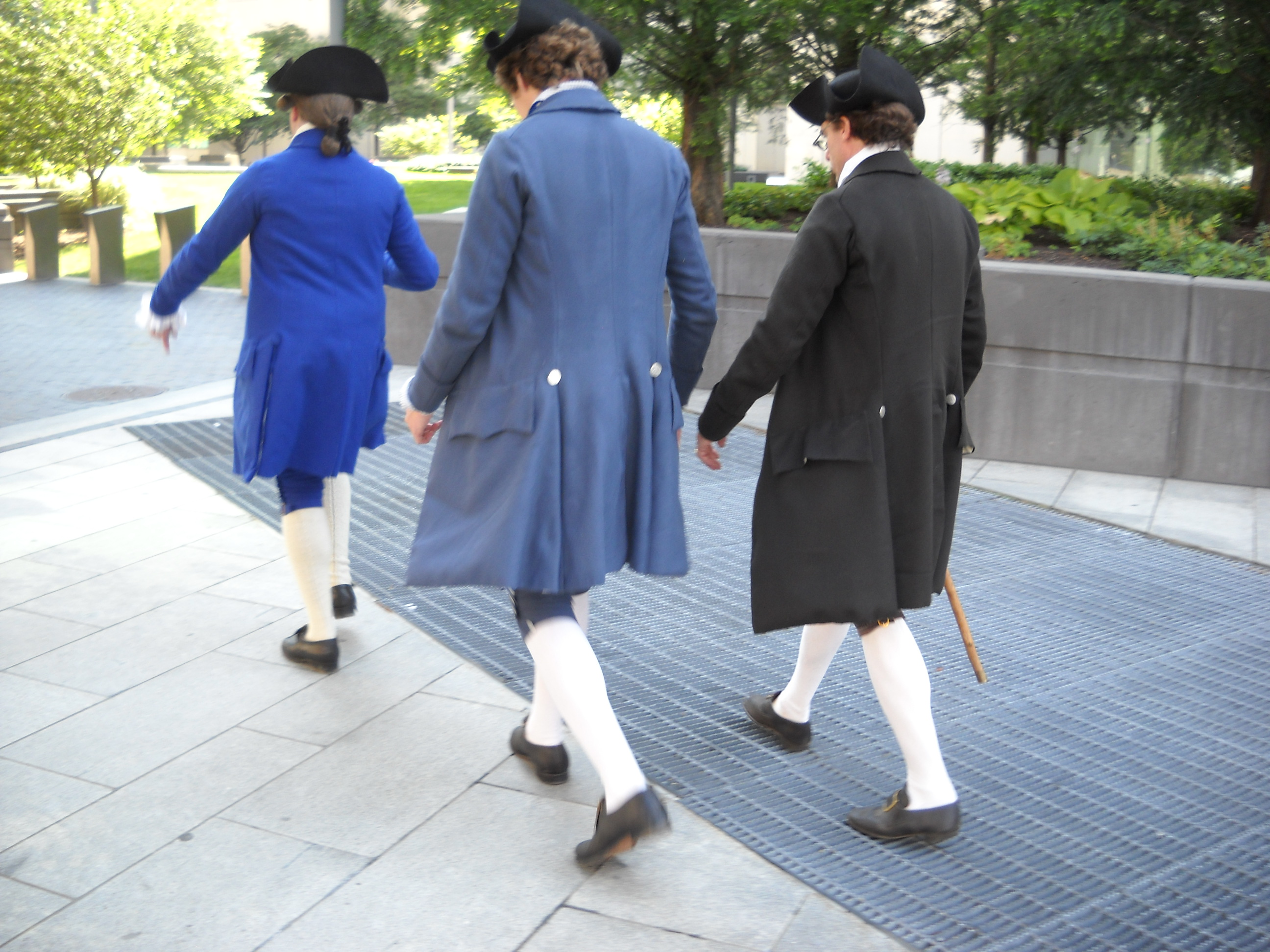
Three gentlemen at the Providence Station

Three gentlemen at the Providence Station

L’Hermione, remember her? That French ship? We were asked back in January if we wanted to be part of a group of Citizens of Boston in 1780 who came out to greet L’Hermione when she arrived in port. Yesterday (July 11) was the day she finally came to town, and most of the Rhode Island contingent of our Massachusetts group went up on the MBTA to see her. The train was totally the way to go, though Mr Hiwell did consume three Diet Cokes before we even got to the ship. Turns out the Henry Cooke frock coat pattern pockets can each hold three cans– a full six pack per coat, should you care for such a thing.

Walk fast, it's the city!

Walk fast, it’s the city!

We got to Rowe’s Wharf in time for the national anthem– or, as we like to call it, The Anacreontic Song. There was much speechifying, and though we were not talking too much, water was required. Those pockets came in handy again, as did my own capacious pockets. Good thing, too: the line was long and the sun was hot. One woman offered to let us go ahead of her in line, but that seemed wrong: if you have to wait in line, you have to wait, and the rule we have absorbed is that the public comes before reenactors. But, since we’d been asked to come, we decided to check the situation, and went to inquire. The “bouncer” at the head of the line told us to come back later, so we decided it was time for some lunch.

Lead, follow, get out of the way, or take another photo of backs.

Lead, follow, get out of the way, or take another photo of backs.

By lunch, things were a little surreal as we sat at a table with people I never imagined sitting down with. No worries: it was all good, just a little weird that you have to leave Rhode Island to meet Rhode Islanders. The Young Mr inhaled his lunch, and probably made a lasting, if Hooverish, impression on our new acquaintances. The fact that the entire new contingent of the 10th Massachusetts sat on one side of the table, and that 80% of us were from RI, also made an impression. We are why you can’t have nice things.

Refreshed, we journeyed back to the ship, meeting more friends along the way. To be fair, Mr S and I had agreed beforehand that going up to Boston was as much about seeing our very dear and far-away friends as it was about the ship, and we were delighted to see every one of them. But at last, we thought, we can get on board.

Totally justified.

Totally justified.

No soap, as they say. The line was closing at 1:00 and we were too late to make it into the last crowd that would get on– it was the longest line I’d ever seen– and, even worse, many members of the public waited in the hot sun and failed to board. For us, five and a half months of anticipation were dashed in a moment.

But wait! Well found again, Mr and Mrs B and Baby B. Mr S was delighted to meet Georgiana (he has a thing for babies, and an uncanny ability to guess their ages, and to tease and delight them), whom he had very much wanted to see. L’Hermione was not the only tall ship in the sea: we considered the dry-docked USS Constitution, but chose the Sagres instead, as she is only in port for a few days. Off we went on another trek, waylaid often for photos. The Young Mr in particular kept getting stopped.

Gulliveresque, relly.

Gulliveresque, relly.

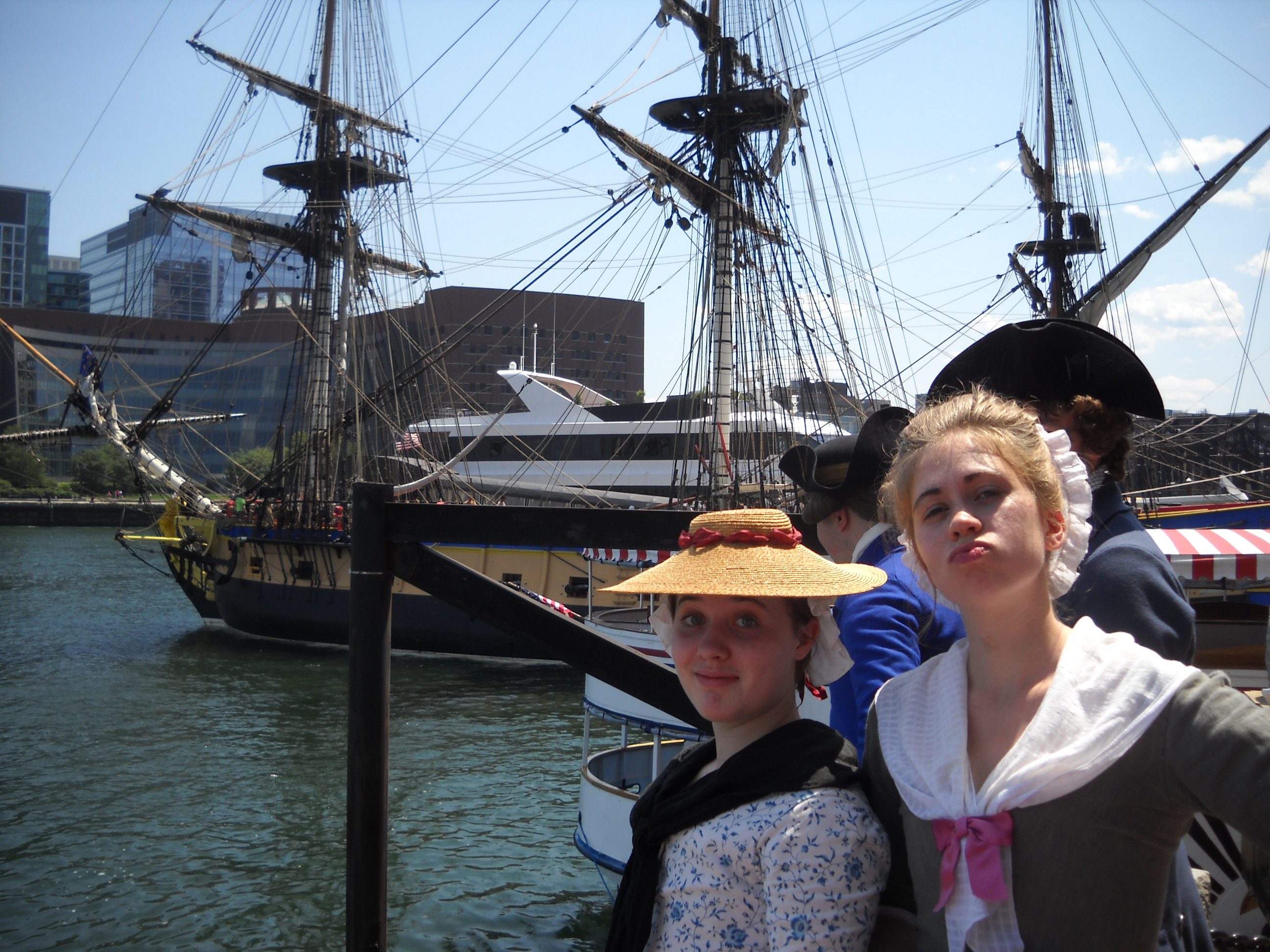
At least there was some shade here, and a bench. We took it in turns to go on the Sagres. Mr and Mrs B and I watched from the shore, and could see this happening. I don’t know how they trapped Mr S in this, but they did.

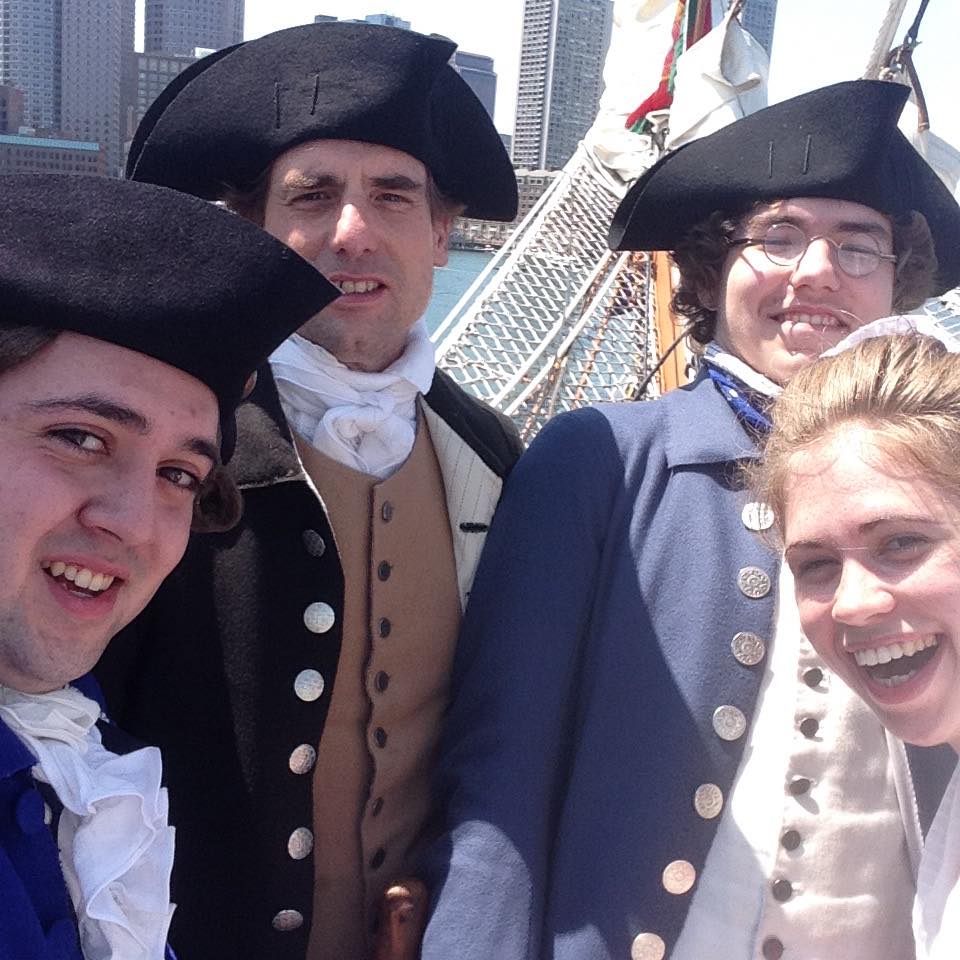
SagresSelfie

After an excursion to the ICA (which we are, as temporal performance art) for water, bathrooms, and some AC, the second shift got to visit the boat. We must have been cursed, because there was another line! At least this one moved, and however slowly and carefully in leather-soled shoes, we managed to go aboard.

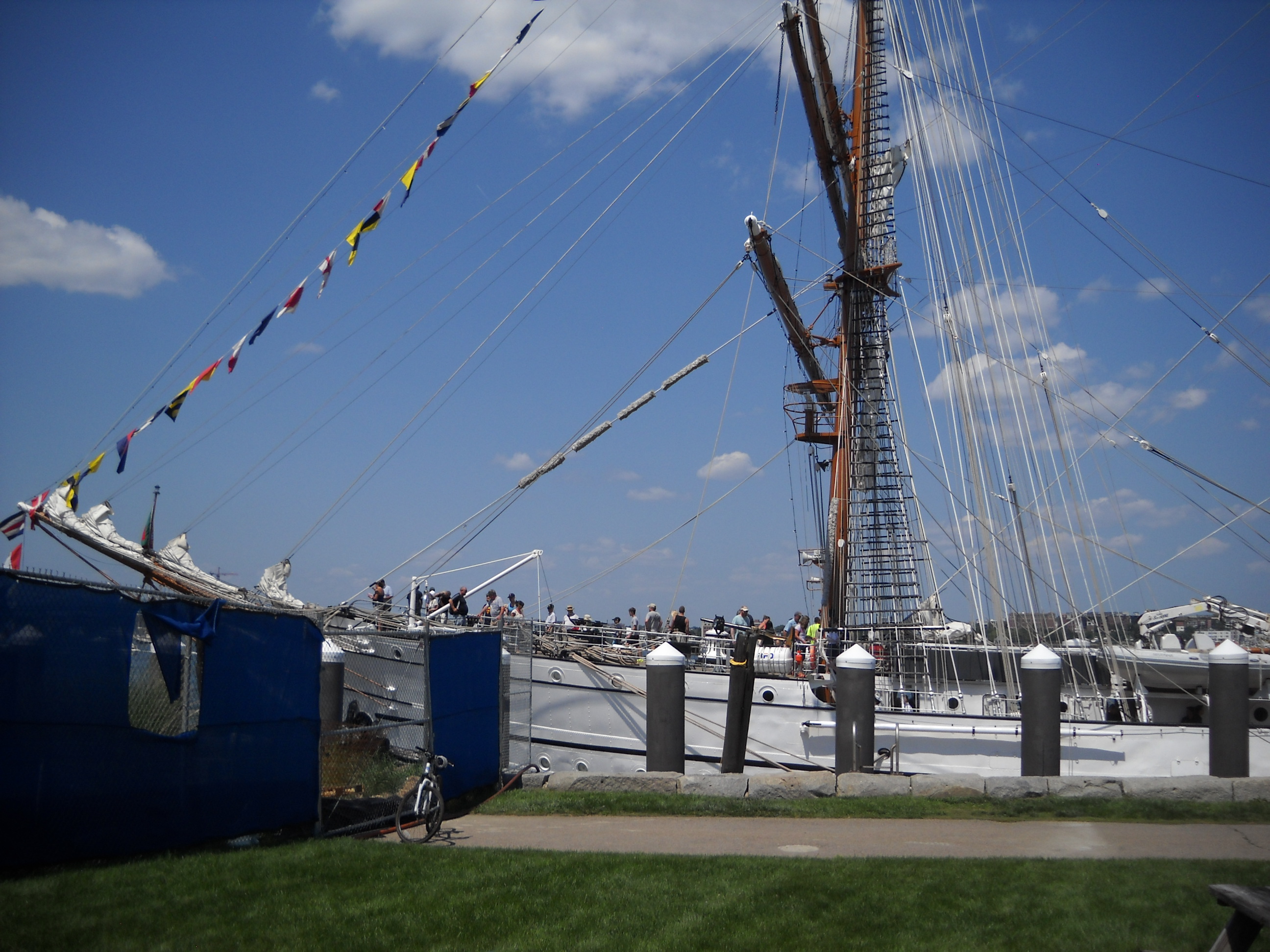
Hey, it's got masts.

Hey, it’s got masts.

Mr B was right: oversized yacht. Still very happy to have gone on a ship and to have seen many interesting things, including a very specific kind of display.

Portugal. The Best Fish in the World.

Portugal. The Best Fish in the World.

Mmmm, fish. All the packages were, in fact, empty. At this point we decided it was time for ice cream, and headed back. The Rhode Island Party ended up back at South Station for frozen yogurt and a bit of a rest. I don’t normally wear heels– ever– so a day in 18th century women’s shoes was a pedal workout. (We considered renting bikes, because if you have to be anachronistic, you might as well go all the way.)

Mr Hiwell and I considered the day: it wasn’t bad. We didn’t even get close to achieving what we thought was our goal. But we made our own fun with wonderful friends, had an adventure, and went at least three places we did not expect to go and had not been  to before. All in all, success, even in failure to board.

If they sleep on the way home, it wasn't a bad day.

If they sleep on the way home, it wasn’t a bad day.

Share this:

  • Share on Facebook (Opens in new window) Facebook
  • Share on Pinterest (Opens in new window) Pinterest
  • Email a link to a friend (Opens in new window) Email
  • Share on X (Opens in new window) X
Like Loading...
← Older posts
Newer posts →

Archives

wordpress statistics

Creative Commons License
Kitty Calash blog by Kirsten Hammerstrom is licensed under a Creative Commons Attribution-NonCommercial-ShareAlike 4.0 International License.

Website Built with WordPress.com.

  • Subscribe Subscribed
    • Kitty Calash
    • Join 621 other subscribers
    • Already have a WordPress.com account? Log in now.
    • Kitty Calash
    • Subscribe Subscribed
    • Sign up
    • Log in
    • Report this content
    • View site in Reader
    • Manage subscriptions
    • Collapse this bar
 

Loading Comments...
 

    %d