• Home
  • Completed Costumes/Impressions
  • Emma and Her Dresses
  • Free Patterns and Instructions

Kitty Calash

~ Confessions of a Known Bonnet-Wearer

Kitty Calash

Category Archives: Living History

More Color, Brighter Color

12 Wednesday Apr 2017

Posted by kittycalash in Clothing, Events, Living History, Making Things

≈ 1 Comment

Tags

19th century clothing, Costume, dancing, dress, Events, fashion, Federal style, sewing

Not the side I ended up using.

“More colah! brightah colah!” was the refrain of one of the printmaking professors at my undergrad program (hilariously, I met him again last summer here in the Ocean State, and nothing much had changed). This is useful advice for someone stuck in the doldrums of late winter New England. It was late January when I got some disappointing news and set off to cure my blues at the fabric store. There’s a bodice in the plaid underway for another silk gown (eventually to be sold, I think; how many can one have?), but I grew dissatisfied with the fabric. Too pale. I wanted More Color. Brighter Color.

Lucky for me, it was on sale. Fabric Mart Fabrics has been good for me in the past, and a silk sale was a success this time, too. The bright and bold dress in the FIT collection was my inspiration, and I dearly hoped I would not manage to cut the cross-barred pattern to match, so of course I pretty much did.

IMG_9649
IMG_9650

My tried-and-true pattern based on the 1815 roller print gown at Genesee Country Village was the base pattern for the silk gown: I know how to adjust it so that I can get dressed on my own, drawstrings the saving grace for the solitary woman who wants a back-closing gown.

I didn’t alter my pattern enough to really capture that neckline, because, in truth, I wanted to get this done! I did concede to trim, of course, and while conducting Drunk Tailor on a (fruitless for him) tour of regional fabric stores, found, at last, the trim I wanted, at the Fabric Place Basement in Natick. Good thing, too, because I was convinced that we were going to die in the traffic backup on whatever that road is in Framingham that creeps in at petty pace from day to day,To the last syllable of recorded time. But no, we lived, after I was fed, and trim was found, saving the day. (Seriously, I don’t think I have ever been on that stretch between Natick and Framingham and not been in a traffic jam since I first encountered it in 1988.)

IMG_0362
IMG_0343

But the dress, that’s the point. It’s done, at least enough to wear, though I did not buy enough trim for the hem and will have to trek back up to Natick for another few yards with which I can trim the hem. A lovely young woman named Tanya did get a photo of me in full regalia, down to the gloves (yes! leather opera gloves!) but I haven’t found it yet out on the interwebs, so my hotel room selfies must suffice.

What I find most satisfying– aside from the dancing– is how versatile a very simple dress pattern can be. Fabric choices, trims, hem length, minor sleeve alterations, and accessories make this one pattern work both for a day dress and a dancing dress.

Share this:

  • Share on Facebook (Opens in new window) Facebook
  • Share on Pinterest (Opens in new window) Pinterest
  • Email a link to a friend (Opens in new window) Email
  • Share on X (Opens in new window) X
Like Loading...

History Hurts

23 Thursday Feb 2017

Posted by kittycalash in Clothing, Fail, History, Living History, Making Things, personal

≈ 10 Comments

Tags

18th century clothing, alterations, authenticity, common dress, common people, living history, Reenacting, stays, women's work

We have been here before: terrible stays, stays in need of minor mods, and “it isn’t history till it hurts.” New this past weekend was the Busk Bust Blister (Bursting) which didn’t make History hurt, but sure did bring a sting to the wind-down afterwards.


Insides!
Insides!
I was determined, and now they are bound.

These new stays are, so far, the best I’ve ever had and well worth the blood, sweat and swears it took to make them. Gowns do seem to fit better over these stays; they held up well at muggy Monmouth and in polar Princeton, but the last two rounds at Ti left me feeling like I’d taken a hoof to the ribs.

What gives, kidneys? At least this time I made it past Fort Ann and all the way into a private room in Glens Falls before I had to free the sisters and release the lower back.

IMG_7298

But this time, there was a bonus: the previously indicated Bust Blister. On the left side (I’m right handed), I developed a fairly robust .25” x .125” blister that crowned the top of a nearly 2” red mark, mirrored on the right by a less red and slightly less long mark. The culprit?

The Busk of Doom, of course.


dscn4568

Strictly speaking, I should not sport a busk when I desport as Captain Delaplace’s serving woman, or as a refugee cooking up the last of the bread, eggs, and milk. I’ve earned these marks and (potential) future scars by dressing above my station, and need to adjust accordingly.

Step one: Rounding down the busk edges (now in the capable hands of Drunk Tailor).
Step two: Foregoing the busk when working.
Step three: Wearing partially-boned stays when working.

Two is the easiest; three is the hardest. Which do you think I am, therefore, actually contemplating as a necessary next step?

But of Course: Step Three, Pathway to Finger Cracks and Stained Stays.

d'oh! surgical tape made this *much* better later.

d’oh! surgical tape made this *much* better later.

Fortunately I have people close to me who will ensure that I work through steps One and Two before embarking upon step Three, but I certainly want to know more about (and will look much more closely at images of) working women in the third quarter of the 18th century. My suspicion is that women who are performing labor that requires movement– up and down before a fire, back and forth across a floor, bending over a tub– may not be wearing stays made in exactly the way high style stays are made for ladies who bend over an embroidery hoop, glide back and forth across a ballroom floor, or move up and down the stairs of a well-built home they supervise.

Or my busk pocket is too big, my busk edges too square, and my actions too fast and continuous.

Paul Sandby. At Sandpit Gate circa 1752 Pencil, pen and ink and watercolor. RCIN 914329

Paul Sandby. At Sandpit Gate circa 1752
Pencil, pen and ink and watercolor. RCIN 914329

What are these women wearing? They certainly look fully boned. What can I change to make my stays work better for working? No matter what, where there are variables, there are experiments to run, and that’s what really makes history fun (even when it hurts).

Share this:

  • Share on Facebook (Opens in new window) Facebook
  • Share on Pinterest (Opens in new window) Pinterest
  • Email a link to a friend (Opens in new window) Email
  • Share on X (Opens in new window) X
Like Loading...

Workshop Wednesday: Accessory to the Past in June!

22 Wednesday Feb 2017

Posted by kittycalash in Clothing, Living History, Making Things, Reenacting

≈ Comments Off on Workshop Wednesday: Accessory to the Past in June!

Tags

authenticity, Clothing, dress, fashion, sewing, workshops

Neck stocks: just so.

Neck stocks: just so.

Drunk Tailor and I will be up to more mischief this summer, and you can join us! We’re teaching a class this June at Historic Eastfield Village. Among the things you can learn to make are chemisettes, reticules, gaiters and neck stocks.

We plan to start with the basic question: who are you? And what does that mean for what you wear? What visual and extant sources can inform your choices? From John Lewis Krimmel to Sophie Du Pont, images help paint a picture of a distinctive early American style.

Mrs Pabodie attempts to remember when she was born (1771). Photo by J. D. Kay

Mrs Pabodie attempts to remember when she was born (1771). Photo by J. D. Kay

Collections from Rhode Island to New York contain examples of early garments that help us understand how people dressed in the early 19th century, as well as diaries that tell us how they lived. Fortune telling? Sewing for money? Bored with quilting? Church as a social experience? There’s much more to the early nineteenth century than Jane Austen. Come find out more this June.

Share this:

  • Share on Facebook (Opens in new window) Facebook
  • Share on Pinterest (Opens in new window) Pinterest
  • Email a link to a friend (Opens in new window) Email
  • Share on X (Opens in new window) X
Like Loading...

Serving Delaplace

21 Tuesday Feb 2017

Posted by kittycalash in Events, History, Living History, material culture, Museums, Reenacting

≈ 2 Comments

Tags

18th century, authenticity, cleaning, common soldier, cooking, Drunk Tailor, Fort Ticonderoga, interpretation, living history, Revolutionary War, servants

dscn4628

With 400 miles between us, Drunk Tailor and I have few chances to explore the past together, so I was both delighted and nervous when he agreed to join the British Garrison 1775 event at Fort Ticonderoga as one of Captain Delaplace’s servants.  Even better, we were also joined by the itinerant Deep North Yankee who wandered around the Fort (possibly seeking roofing shingles, of which he is much in need).

dscn4631

Friday nights are always magical, candle and firelight (and only the warmth of the fire) as we drink cider and talk about history. But morning always comes: Saturday, cold and clear, Mr S and I woke and blinked across the room at each other, and I wondered to what degree I really wanted to ever crawl out of bed…only hunger and an eventual need to pee (and fear of a Sergeant) propelled me.

Yup, you cook 'em on a board.

Yup, you cook ’em on a board.

First order of business: breakfast. Mr S, supplied with his corn meal of choice, made us johnnycakes, which provided perhaps more interpretive than nutritive value. Still, they were warm and tasty and he is the only person I know who can make them; my efforts end up as FEMA disaster sites.

cooking
img_20170218_110626

Captain Delaplace’s servants were tasked with cooking for his mess, so Mr S and I got a start. We had a chicken, an onion (I traded onion # 2 for some bacon), butter, carrots, potatoes, a butternut squash, salt, and some port. I don’t know where this English serving woman of 1775 encountered mis en place, but she accidentally introduced coq au vin to the Captain’s table with the dinner meal.

Captain and Mrs Delaplace dining, manservant in attendance

Captain and Mrs Delaplace dining, manservant in attendance

The Captain and his Lady dined on chicken braised in butter and bacon with root vegetables in a port sauce; we servants waited until they were done before we could eat. (Confession: I need to eat a lot, and have a sensory overload problem, so when visitors fully crowded the room, I had to dash across the parade ground for a Clif Bar and an Ativan before I could continue to wait for my dinner.) In the afternoon, dishes were washed at the table, as was common (at least in early New England), dried, and set away, while the Captain’s lady and child played in the cabbage patch between the beds.

dscn4657

When the room was empty, servants were able to eat (huzzay!) and found the meal very tasty indeed. I would certainly make this again, and learned more about cooking– a typically female task I generally try to avoid– than I had expected to. Then we had yet another round of dishes before it was time to tidy the room and make ready for tea or supper.

To that end, we cleared the table and broke it apart to reveal the floor and hearth, which needed to be swept of bread crumbs, squash peels, dead leaves, and other detritus. The best way to sweep an unfinished floor in the 18th century (per Hannah Glasse et al) is to strew the floor with wet sand and then sweep. I mixed sand with lavender-infused vinegar and threw it on the floor; this keeps the dust down as you sweep months of dust and dirt out of the corners and from behind tables and chests.

img_20170218_144218
img_9513

The trick is to sweep in one direction (more or less) from the back of the room to the front, and then to gather up the sand (here in a shovel) and pitch it off the landing. Much was thrown out the door and over the stair rail, just as servants would have done in 1775. (And I am told it is soothing to nearly hit the sergeant, but perhaps that’s merely hearsay, if not heresy.)

img_9478

When we were done, we restored the table (Drunk Tailor noticed the height of the ceiling, and wondered about hanging birds in cages whist awaiting the return of the tabletop), fully reset with cloth, candlesticks, plates, and knives, ready for the supper we didn’t cook, as we skipped away at the close of the day to find our own meal in Glens Falls, where live music is inescapable on a Saturday night.

Share this:

  • Share on Facebook (Opens in new window) Facebook
  • Share on Pinterest (Opens in new window) Pinterest
  • Email a link to a friend (Opens in new window) Email
  • Share on X (Opens in new window) X
Like Loading...

“Exteriorizing,” or, Showing the Past: Part II

16 Thursday Feb 2017

Posted by kittycalash in History, Living History, Reenacting

≈ 2 Comments

Tags

authenticity, first person interpretation, living history, Reenacting, Research

Part II of the two-part guest posts by Sharon Burnston. Part I is here. ( Just below, if you are scrolling)

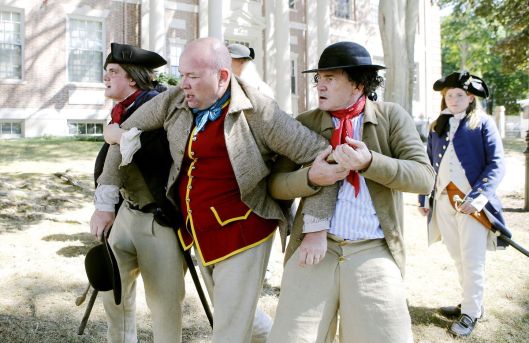
In the previous blog post, I explained the concept of “Yes, and”. But in the case of the naval press gang reenactment last summer in Newport, the “Yes, and” dialogue that I expected didn’t happen. When the press gang invaded the tavern I was mistress of, and started grabbing sailors, I attempted to intervene. This would have allowed me to put into words, for the benefit of the public watching, what this intrusion into our community would do to the town, in terms of the loss of the local men both collectively and individually.

Melee in the Square, Newport RI, August 2016

Melee in the Square, Newport RI, August 2016

In attempting to defend my customers, I as tavern mistress could have functioned as a token representative of all the other women of Newport, all of whom had economic, social, and maybe personal ties to the impressed men. The public would have had a better chance to grasp what the impressment actually meant to the people of Newport. But this failed to happen. Nobody in the press gang picked up on my gambit, they went about their business with a very convincing and no doubt authentic silent ruthlessness. One brandished his club and snarled, “Silence, woman!” which effectively shut down my efforts entirely. However one of my “customers” picked up on my gambit and began pleading to be released on account of his wife and children, but he got essentially the same response that I did, and he was also shut down.

Alex Cain impressed in Newport, August 2016. Photo by Philip Sherman, Newport Daily News

Alex Cain impressed in Newport, August 2016. Photo by Philip Sherman, Newport Daily News

I didn’t put all that effort into my tavern and tavern mistress impression just to be a scenic backdrop for the press gang. It was my expectation that there would be interaction between the tavern owner and the naval crew, which would serve to better educate the public by exteriorizing what we roleplayers were thinking and feeling about what was happening. My mistake was in taking for granted that this would be obvious to the other role players, and that the naval crew would give me a “Yes, and” response for the benefit of the audience.

In short, I think we could have done a better job of *interpreting* what was happening if we hadn’t all been quite so focused on doing it as *authentically* as possible. I do not in any way fault the guys who were portraying the naval crew. To their credit, they played their roles with superb accuracy. If anything the fault was mine for assuming we’d be all on the same page, and ready to interact with one another. It is my opinion that as an interpretive exercise, this living history scenario would have benefited from being just a teensy bit less “authentic” and a little bit more theatrical.

A Cribbage Party in St. Giles. Thomas Rowlandson, 1787. Royal Collection Trust.

A Cribbage Party in St. Giles Disturbed by a Press Gang. Thomas Rowlandson, 1787. Royal Collection Trust.

In talking afterward with members of the public, I found too many of them confused, they saw the action but didn’t really understand what was going on, nor what was at stake for the various individual characters involved. It would have been so easy to get the essential points across while the scene was unfolding, and it doesn’t take long, a few sentences exchange is enough. But all participants have to understand in advance the merits of this, and be prepared for it when it happens.

DSCN4459

In my opinion it’s great, but not enough, to know the best possible historical information on the event we are presenting, and to replicate the clothing and equipment so meticulously. We also should be prepared to join together to learn how to portray it in the most informative and articulate way possible. This can only make our first-person historical reenactments even better than they already are.

Share this:

  • Share on Facebook (Opens in new window) Facebook
  • Share on Pinterest (Opens in new window) Pinterest
  • Email a link to a friend (Opens in new window) Email
  • Share on X (Opens in new window) X
Like Loading...
← Older posts
Newer posts →

Archives

wordpress statistics

Creative Commons License
Kitty Calash blog by Kirsten Hammerstrom is licensed under a Creative Commons Attribution-NonCommercial-ShareAlike 4.0 International License.

Website Built with WordPress.com.

  • Subscribe Subscribed
    • Kitty Calash
    • Join 621 other subscribers
    • Already have a WordPress.com account? Log in now.
    • Kitty Calash
    • Subscribe Subscribed
    • Sign up
    • Log in
    • Report this content
    • View site in Reader
    • Manage subscriptions
    • Collapse this bar
 

Loading Comments...
 

    %d