• Home
  • Completed Costumes/Impressions
  • Emma and Her Dresses
  • Free Patterns and Instructions

Kitty Calash

~ Confessions of a Known Bonnet-Wearer

Kitty Calash

Category Archives: Making Things

We Have Data

26 Thursday Oct 2017

Posted by kittycalash in Living History, Making Things, Philosophy, Reenacting, Research

≈ 1 Comment

Tags

authenticity, interpretation, Reenacting, Research, survey

My assistant misunderstood the exercise, and is disappointed that we will not be turning the government over to him.

Data Cat says it’s clear: Cats Rule.

What is clear is that 501 people from around the world (really: people responded from the US, Canada, Australia, Europe, Great Britain) were interested enough to see what we could find out by asking questions about what, how, and why we make and wear these funny clothes. I’m immensely grateful that Google tools are easy to use, as I can present Graphs Without Tears:

Here’s how that breaks down:
Strongly disagree: 1.8%
Disagree: 0.6 %
Neutral: 3%
Agree: 30.9%
Strongly agree: 63.7%

That is, 94.6% of respondents agree that they try to make the most period-correct clothing they can. The “strongly disagree” folks (9 of them) are interesting to me, because it’s a position that’s foreign to me. (This is why recording your email was an option, so I could clarify the data.)

Next, let’s look at Authenticity:
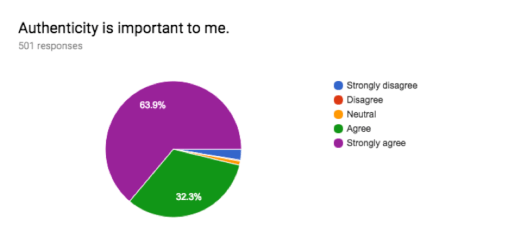
Here’s how that breaks down:
Strongly disagree: 2.6%
Disagree:.2 %
Neutral:1%
Agree:32.3%
Strongly agree:63.9%

And on the use of Primary Sources:

Yes: 94.4%
No: 5.6 %

When I dug into what sources people use, and consider “primary sources,” I realized I have more questions to ask, and there are some folks who could use some research help. Not handed to them on a plate or in a slideshow, but in terms of process, and in recognizing primary versus secondary sources, and how they can be used together for maximum understanding.

Then I asked, Why is documentation important to you? 

Those responses will also inform another round of questions. Many were very revealing of thought processes and approaches; some made me a little sad. A couple of people said, essentially, I don’t want other reenactors to laugh at me.  I think we can do better than that, right? Let’s try empathy on for size, and be as helpful as we can in guiding people to an understanding of what they want to do, and how best to go about it.

Because the answers varied in length, I started reading them to discern the essence of the response, and I came up with five categories; the sixth slice represents the answers left blank.

Accuracy: 73.4%
Immersion: 11.6%
Learning: 6.1%
Respect (of ancestors, history): 4.0%
Personal (fun; satisfaction): 0.5%
No answer: 4.5%

Accuracy is the main reason documentation matters to people, and they gave good answers for why accuracy mattered.

I want to have the resource itself, rather than someone else’s interpretation of it. If everyone bases their impression off of somebody else, rather than going to the source first, it becomes a game of telephone.

It’s like medical documentation. If it’s not written down, it didn’t happen. There’s enough open source imagery and documents on the internet, let alone physical ones or surviving garments, that there really is no excuse for wild supposition.

Because everything else is unsubstantiated conjecture or hearsay and feels inauthentic to me and to those around me.

Because I use my impression to communicate about history, and history is grounded in factual, accurate information.

Documentation is the truth behind the fiction of a living history impression.

Immersion had interesting answers, too:

I want to accurately portray my impression for the public. As an added bonus, wearing the correct clothing and using period correct items, helps me connect with the people I portray on a personal level.

Because the point of living history (to me) is to recreate the past enough to learn from the visceral experience of *living* it, so it needs to be pretty accurate! Documentation is how I can know if what I’m doing is accurate (or close to accurate).

It tells us a lot about the larger picture of what was going on: trade, manufacturing, diplomacy, economics

Learning:
Because if we’re teaching people history, teaching them something that’s wrong is a disservice and an embarrassment on our part. We have the ability to learn what’s correct.

Researching and documenting my impression is why I am proud to put on my clothes. I enjoy the challenge and detective work that comes before I ever cut into any fabric.

Respect:
We owe it to our ancestors to tell their stories as accurately as possible.

For the class of person I represent, documentation can be very difficult to get at. Some documentation indicates that the garment(s) in question possibly existed, 3 pieces of documentation is ideal, but 2 will sometimes do, depending on my instincts about something. I have regretted only going for two in the past because my intention is generally to represent something very common. Documentation is important because it shows respect for the historical people I am trying to represent, it shows respect for my own work and time and it shows respect to the hobby (which, in historical circles, is often far more important than people give it credit for).

There’s a lot to think about in considering what you all think about, and I am really grateful for your help! As I look at the answers over the next days/weeks, I’ll let you know what else I see, and once I figure out how to ask the next round, there will be more questions! Thanks again! (And if you didn’t get to participate this time, no worries: you can join in next time; the easiest way is to follow the Kitty Calash FB page, but I’ll also post a link here.)

Taking the Census. oil on canvas, 1854. Francis William Edmonds. Gift of Diane, Daniel, and Mathew Wolf, in honor of John K. Howat and Lewis I. Sharp, 2006 2006.457 Metropolitan Museum of Art.
Share this:

  • Share on Facebook (Opens in new window) Facebook
  • Share on Pinterest (Opens in new window) Pinterest
  • Email a link to a friend (Opens in new window) Email
  • Share on X (Opens in new window) X
Like Loading...

Stick-to-it-iveness

14 Thursday Sep 2017

Posted by kittycalash in Events, Living History, Making Things, Reenacting

≈ 3 Comments

Tags

18th century, 18th century clothing, authenticity, common people, Events, living history, peddler, petty sutler, Revolutionary War, sutler

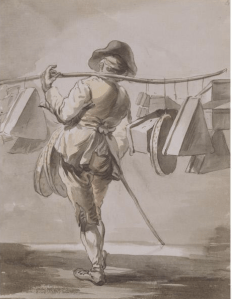
Band Box Seller, pen and watercolor by Paul Sandby, n.d. The Huntington Library, Art Collections, and Botanical Gardens, 67.18

It has been a long time since I participated in a traditional “reenacting” event, the kind with tents and pew and kettles and a TWD but here we go, borne back into the past to where it all began, more or less. I remain as uncomfortable as ever in the camp follower role, constantly questioning the likelihood of my being a follower, and the activities I would participate in. It’s a historical personality disorder, trying to figure out who one was, complicated by all the modern politics of gender roles, relationships, and unit rules.

Now that I’ve switched sides, Bridget Connor is no longer open to me. By nature I’m a townie, happiest in a mercantile endeavor if I’m not able to take on the role of an officer’s servant.

So what to do? Petty sutlery is much on my mind, for I have need of the money and a habit of making things. Lately, i’ve been band-boxing, so I was delighted to find the Huntington had digitized this Sandby drawing of a band-box seller, placing the trade firmly in the middle of the 18th century. Triangular boxes for cocked hats, circular boxes for bergeres, rectangular boxes for gloves and (neck)handkerchiefs, I presume.

Glass coral and garnet necklaces
Red wool pincushions

I’ll have band boxes and a bonnet or two in addition to a custom order delivery, coral, glass, and garnet necklaces for girls and women, pincushions, handkerchiefs, possibly garters, and, if my hands hold up, boxes for hats and bergeres, all on a stick. Look for me between the 17th and the 7th, hindering or helping laundresses.

Share this:

  • Share on Facebook (Opens in new window) Facebook
  • Share on Pinterest (Opens in new window) Pinterest
  • Email a link to a friend (Opens in new window) Email
  • Share on X (Opens in new window) X
Like Loading...

Reap what you Sew

12 Tuesday Sep 2017

Posted by kittycalash in Clothing, History, Living History, Making Things, material culture, Reenacting

≈ 1 Comment

Tags

bonnets, George Stubbs, living history, Making Things, museum collections, Research

Too big!

Lampshade: She’s been the Holy Grail of bonnet making.

There were several failures in the winter of 2016, and some revisiting of the Whale-Safe Bonnet as I tried to figure out the brim and the caul. My first efforts made a caul that was waaaaay too small. That’s not necessarily a bad thing, as I’ve made plenty of too-big bonnets. (Too small did not make the move from RI to VA, but trust me: too small a caul was far too small.)

Reapers 1785 George Stubbs 1724-1806 Purchased with assistance from the Friends of the Tate Gallery, the Art Fund, the Pilgrim Trust and subscribers 1977 http://www.tate.org.uk/art/work/T02257
Haymakers 1785 George Stubbs 1724-1806 Purchased with assistance from the Friends of the Tate Gallery, the Art Fund, the Pilgrim Trust and subscribers 1977 http://www.tate.org.uk/art/work/T02256

This morning, I took another look at George Stubbs’ paintings of working women. I know the lampshade-like bonnet is pre-1770, but where are we at the end of the Revolutionary War period? Well, BIG was in, obviously. (We can have a healthy debate about the likelihood of these gowned women depicting actual working women, but for now, let’s stick to bonnet brim shapes.)  They’re a little cone-like, aren’t they? With generous (yuuuge) cauls, though.

IMG_1921
IMG_1922

Now, I have gone about this all a bit backwards, which is to admit that I picked up the shellacked brim of yesteryear that did make the move down to VA, and decided to make it up as a bonnet yesterday. The brim is easy– trace and cut with a seam allowance– but the caul? I winged it, using a selvage edge for the inside of the back drawstring (I like my headwear to be adjustable and pack flat) and economized on fabric to leave plenty of taffeta left over. So there’s nothing particularly well-researched about this, except for all the years of looking and thinking and drawing and making that came before the moment I threw this all together yesterday afternoon watching North by Northwest and drinking a Manhattan.*

Part I like best?
Part I like best?
The way it hides my face!

Making this up raises more questions: how individually fitted were bonnets to wearers? Did caul and brim size vary depending on wearer? What’s the class line below which a woman doesn’t have a bonnet, but only a hat? How quickly did styles change? The sort-of-conical black bonnet is seen on “older” women in paintings well past the height of the style. But as I’ve asked before, what do we really understand about the portrayal of age in art? Are we really reading the symbols correctly? How well do we grasp the semiotics of the 18th century? All of those questions are present when we try to replicate the past using only visual sources. Yes, there is an extant 18th century black silk bonnet at Colonial Williamsburg, and we can use that in conjunction with images to make the things we wear. But pondering all of these questions makes me think it’s time for another troll through collections in Great Britain, just in case new cataloging has put old bonnets online.

*See my other blog, TipsyMilliner, for more.

Share this:

  • Share on Facebook (Opens in new window) Facebook
  • Share on Pinterest (Opens in new window) Pinterest
  • Email a link to a friend (Opens in new window) Email
  • Share on X (Opens in new window) X
Like Loading...

Headspace: Where I Work

16 Wednesday Aug 2017

Posted by kittycalash in Making Things, personal

≈ 4 Comments

Tags

CoBloWriMo, Making Things, personal, workspace

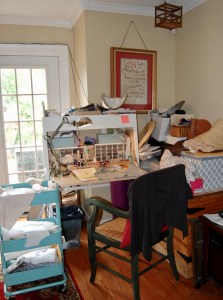
An Ikea secretary of my own keeps most stuff organized.

I haven’t had a proper studio since I was just out of grad school and living in a three room apartment with one room dedicated to making. Since then, as I’ve taken on the baggage and responsibilities that come with two- and four-legged associates, I’ve given up a room of my own. Instead, I have have a desk of my own. And the dining table when I need it, which is most days until it’s dinner time. It works within the space we have, and best of all, the secretary can be folded closed when we go away, protecting delicious feathers and tempting beads and ribbons from marauding cats.

And the dining room table, of course.

Whatever space I have, or you have, I find the most important space is the one in my head. That’s where projects are born and die, where they’re planned and tweaked, where problems are solved. It’s the first space you have to get in order if you’re going to do your best work. Walks help. When I get stuck writing or sewing, walking usually shakes loose the next idea or solution.

A break from sewing, coming soon to the shop

To keep that headspace clear and organized, and happy working, I find music more helpful than TV, though many a Nazi Mega Weapons or screwball comedy has eased an evening of backstitching long seams. Lately, Spotify has been my go-to, thanks to these playlists. Listening to them is listening to how someone else’s brain works, which is incredibly enlightening. Whatever your art form, stepping outside your usual genre can be more inspiring than endlessly revisiting the same galleries and sources. Who better than the writer of Hamilton to show us the way?

Share this:

  • Share on Facebook (Opens in new window) Facebook
  • Share on Pinterest (Opens in new window) Pinterest
  • Email a link to a friend (Opens in new window) Email
  • Share on X (Opens in new window) X
Like Loading...

Draping and Dreaming

14 Monday Aug 2017

Posted by kittycalash in Clothing, Making Things, personal, Research

≈ 2 Comments

Tags

18th century clothing, 19th century clothing, alterations, Balenciaga, Charles James, CoBloWriMo, projects

Why have just one dream project when you can have more than you can possibly achieve? Here, in no particular order, are things I’d like to make or achieve but probably never will:

Charles James (American, born Great Britain, 1906–1978)
“Cossack”, 1952
American,
wool; Length at CB: 46 in. (116.8 cm)
The Metropolitan Museum of Art, New York, Brooklyn Museum Costume Collection at The Metropolitan Museum of Art, Gift of the Brooklyn Museum, 2009; Gift of Muriel Bultman Francis, 1966 (2009.300.402)

Charles James: American master of draping fabric. I have nowhere and no reason to make or wear this coat, but the lines and fabric appeal to me. This skill level is currently beyond me, but I recognize that I have enough historical clothing that I could get out of the 18th and 19th centuries to concentrate on learning the couture techniques of the 20th century. Many muslins went into making this, and a deep understanding of fabric. One of the best things about the Met’s Charles James collection is the large number of muslins. Costume and clothing designers’ sketches, muslins give us a good sense of how a designer thought, and what steps went into a garment.

Balenciaga is another favorite. Evening gowns, suits, and coats, all deliciously draped.

House of Balenciaga (French, founded 1937)
Rain ensemble, fall/winter 1965–66
French,
cotton ; Length (a): 42 1/2 in. (108 cm) Length (b): 24 in. (61 cm)
The Metropolitan Museum of Art, New York, Gift of Rachel L. Mellon, 1987 (1987.134.23a, b)

Lest you think I only like coats, the “Tulip” dress is equally interesting.

House of Balenciaga (French, founded 1937)
Evening Dress, 1964
French,
silk ;
The Metropolitan Museum of Art, New York, Gift of Baroness Philippe de Rothschild, 1973 (1973.21.8)

Thanks to the V&A, there are digital animations of the construction of the tulip dress, which has deceptively simple pattern pieces. The video was created in support of teh V&A’s Balenciaga exhibition, which I am sorry not to be able to see.

Equally out of reach is this: a remodeled silk lampas gown. The idea is to make the first gown– that is, the gown suitable for the fabric’s earliest date (which is probably not 1790, but closer to 1740-1750) and then alter that gown to the late 18th century style.

Gown, 1790s. Silk, French, Purchase. C.I.64.32.2
Metropolitan Museum of Art, C.I.64.32.2

Unknown maker. Gown, 1790. French, silk, The Metropolitan Museum of Art, New York, Purchase, Irene Lewisohn Bequest, 1964, (C.I.64.32.2)

This last “dream” project is more achievable, though somewhat academic. Silk lampas fabric can be found, and there’s a simpler alteration project in lampas at the V&A

Gown, Spitalfields silk, ,
1740 – 1749 (weaving) 1740 – 1749 (sewing)
1760 – 1769 (altered) 1950 – 1959 (altered)
Given by Mrs H. H. Fraser Victoria and Albert Museum, T.433-1967

.

Share this:

  • Share on Facebook (Opens in new window) Facebook
  • Share on Pinterest (Opens in new window) Pinterest
  • Email a link to a friend (Opens in new window) Email
  • Share on X (Opens in new window) X
Like Loading...
← Older posts
Newer posts →

Archives

wordpress statistics

Creative Commons License
Kitty Calash blog by Kirsten Hammerstrom is licensed under a Creative Commons Attribution-NonCommercial-ShareAlike 4.0 International License.

Website Built with WordPress.com.

  • Subscribe Subscribed
    • Kitty Calash
    • Join 621 other subscribers
    • Already have a WordPress.com account? Log in now.
    • Kitty Calash
    • Subscribe Subscribed
    • Sign up
    • Log in
    • Report this content
    • View site in Reader
    • Manage subscriptions
    • Collapse this bar
 

Loading Comments...
 

    %d