• Home
  • Completed Costumes/Impressions
  • Emma and Her Dresses
  • Free Patterns and Instructions

Kitty Calash

~ Confessions of a Known Bonnet-Wearer

Kitty Calash

Category Archives: personal

Night Clubbing

16 Friday Feb 2018

Posted by kittycalash in Events, Fail, Living History, personal

≈ 3 Comments

Tags

bow out gracefully, Events, find another gig, new wave, nightclubs, punk

Mountebanks at night. watercolor by Paul Sandby, 1758 Royal Collection Trust/© Her Majesty Queen Elizabeth II 2014

Mountebanks and miscreants: how we love them. I have found myself in a situation of late that feels altogether too much like high school, and as a means of understanding it, I have a story to tell. It will, sadly, confirm what my parents thought was happening, but hoped was not.

Let’s step back to the time when I was known as the Rat, when I spoke truth to adolescents and paid the price of ostracism and harassment. I was already largely outside whatever cliques there were in high school, for I’m not certain you can call an assemblage of despised literary hopefuls in a hallway window seat a clique, so the harassment hurt more than the exclusion. Harassment these days comes not in the form of people chanting at you in person, but rather in online trolling, which can be deleted, unless people take the energy to rise to doxing or swatting, and few in the living history world seem to– and that’s not a challenge, kids.

So, operating within a loose-knit band of misfits more Donnie Darko than Ferris Bueller, I began breaking the rules, taking films back to the public library for my teachers and spending the rest of the day at the art museum or bookstore, or combing thrift shops for my nearly-all-vintage wardrobe. I could not find a place to be, so I stepped out.

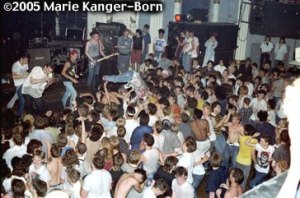
Naked Raygun at the Metro (not the club in question)

Along the way, I met some very interesting people: punk musicians, artists, dancers, and students who introduced me to a very different world than the one my classmates lived in. It was a kind of mid-western Desperately Seeking Susan, or perhaps Something Wild, only I suppose I was Susan seeking myself. I saw great bands and terrible bands, and continued my forays even after I’d left the city for college, which leads me to a moment that resonates fiercely with me in light of the past few days of highly localized re-enactor drama.

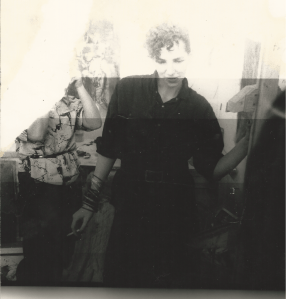
portrait of a wanna-be-artist

I had a sometime-boyfriend who was ahead of me in college, at a different university, who worked as a DJ in northside night clubs. On one summer trip to the city, I found myself walking out of a nightclub where I’d been dancing, eager for some fresh air. At the door were two of my former classmates– too much acquaintances to be called frenemies– trying, and failing, to get in. I caught their eyes, agog, as I walked out.

“You come here?” one asked. “How’d you get in?“
“I know a guy,” I said. “I’ve been coming here all summer,” and walked up the street to catch the bus to the next party.

Share this:

  • Click to share on Facebook (Opens in new window) Facebook
  • Click to share on Pinterest (Opens in new window) Pinterest
  • Click to email a link to a friend (Opens in new window) Email
  • Click to share on X (Opens in new window) X
Like Loading...

Where You Come From

24 Sunday Dec 2017

Posted by kittycalash in History, personal

≈ 1 Comment

Tags

blurry photos, family, family portrait, personal, photography, Research

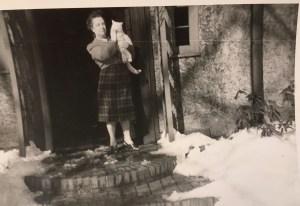
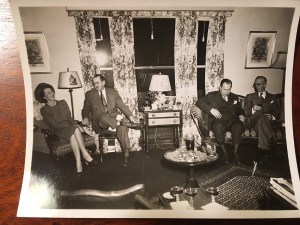
A selection from the box, mostly documenting the first two decades of my mother’s life

Mumblety-odd years ago, my first museum job was in a photograph and print collection, working as a photo researcher both finding and processing collections. There was a voyeuristic quality to the work, sometimes when going through a photographer’s more personal images, but especially when working on a family collection.

As I continued to work in the field, I started meeting with donors, and learned to talk them into giving their collections to the museum. It was easy enough to talk to them about making their memories tangible, creating and preserving a legacy of their lives so that others could understand the past and the contribution they, in particular, had made. How they typified an important part of a state or region’s history.

Susie the Cat makes many appearances

Sporadically, I organized my own photos and ask my mother for images of our family. I certainly took plenty of photos of my own son, but as time went on– and whether this is due to smartphones or trying to live in the moment, or not wanting to break the magical spell of an experience– I stopped taking pictures. I could still talk people into donations, and still enjoyed going through their family albums, but recording my own life didn’t make much sense to me, and I began to consider pitching images and letters and postcards, especially as I packed to move south. Keeping photographs for myself didn’t make sense.

Federal furniture: always central in my family

Sitting in bed on Friday night, Drunk Tailor and I looked through a box of snapshots my mother keeps in a fabric-covered box. He said, “Photographs are what you use to show people what you used to look like,” and to a degree that’s true. They are also proof that you had a life before this moment (think Blade Runner) and proof– perhaps– that you are who you think you are (think Blade Runner 2049). But even more like the Blade Runner movies, photographs of your past, or your family’s past, tell you where you come from, and where you might belong. Love them or leave them, you fit in somewhere in a larger story of people, and that shapes your identity, what you do, who you love, and how you live.

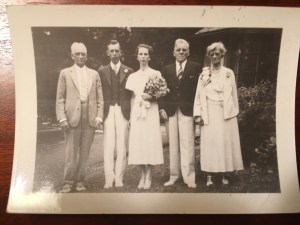
1936: My grandmother’s wedding.

As every year ends, I look back with some sadness at things I wish I had done differently, people I wish I had not hurt, people I wish I’d hugged more. The box of snapshots reminds me that I’m all too common, all too normal. Everyone has those pangs of nostalgia, the words they wish they’d said, the loss they feel as they lose the people they love.

Saint Lucia Day ca 1947

And that’s the point, I suppose: love one another. Be excellent to each other. Take the photos, label them (in pencil, on the back, listen to your archivist), and look at them when you can’t remember who you are, where you came from, or why you matter.

Share this:

  • Click to share on Facebook (Opens in new window) Facebook
  • Click to share on Pinterest (Opens in new window) Pinterest
  • Click to email a link to a friend (Opens in new window) Email
  • Click to share on X (Opens in new window) X
Like Loading...

The Stuff of Life

07 Tuesday Nov 2017

Posted by kittycalash in Art Rant, Collecting, material culture, personal

≈ Comments Off on The Stuff of Life

Tags

art history, collections, interpretation, material culture, meaning, objects, provenance

We all love things, don’t we? Things in the literal, corporeal, piled-in-a-heap sense: plates, shoes, books, chairs, necklaces, models. But what makes us love them? How deeply do we really love them?

Someone posed the questions, What would you take if you had to pack in a hurry to leave home forever? What will your kids remember you by?

Those are hard to unpack: how will other people remember us? Often, we have no idea what we mean to other people, even the ones closest to us. It’s easier for me to know what I would take or keep to remember someone else by– a single sleeve link; a wooden train engine; a stainless steel spoon; a necklace of handmade beads. None of those things reflects what is truly meaningful to me about them, that is, without my knowledge, these aren’t particularly interesting or aesthetic objects. What makes them special is the story I attach to them.

That is, of course, the key to interpreting objects in a social history context: the story is what makes the object more interesting, more important, more compelling. It’s the difference between a provenanced and an unprovenanced object, between a roundabout (or corner) chair in context, and one out of context.

Corner chair, probably John Goddard. Metropolitan Museum of Art, L2014.9.1a,b Lent by the Wunsch Collection, 2014

This is not to say that beautiful things are without value removed from context, but what makes that Goddard chair more compelling is knowing who made it, who it was made for, and when– knowing that it was part of a set of furniture ordered to furnish a house for Providence newlyweds, made in Newport by one of the hottest makers of the time. It’s the people who make the object more interesting, who make it worth having, seeing, holding on to– whether it’s a $6 million chair or a $25 mug, memories and stories make things compelling beyond our associations with them.

Part of a museum curator’s job is understanding those stories, placing objects in context, and connecting them back to their stories, to their makers, users, owners, and keepers. We may buy things because they’re beautiful or useful, but often we keep them because of their meaning– which is, more often than not, about people. Unprovenanced objects have less meaning; an object sold outside, or without, its context will not fetch as much. Value resides in people, not in things.

I think of this not only because a portion of my work is to recreate or reestablish the human contexts and connections for things, but because there is a human instinct to grab onto something tangible (like an object), rather than something ethereal (like a memory), even though what will sustain us in the end is not things, but other people, and our memories of them.

Share this:

  • Click to share on Facebook (Opens in new window) Facebook
  • Click to share on Pinterest (Opens in new window) Pinterest
  • Click to email a link to a friend (Opens in new window) Email
  • Click to share on X (Opens in new window) X
Like Loading...

Clear and Present Danger

24 Tuesday Oct 2017

Posted by kittycalash in Living History, personal, Philosophy, Reenacting

≈ 3 Comments

Tags

authenticity, Critical Theory, difficult interpretations, feminism, interpretation, rant, Revolutionary War, ripostes

A Female Philosopher in Extasy at Solving a Problem. London, England; about 1770 Mezzotint and engraving with watercolor on laid paper
Colonial Williamsburg Foundation

Scandal and outrage rock the reenacting world as reading comprehension lags and The Gentle Author is accused of presentism– or, at least, that’s the most reasonable translation I have for comments made about me last night on social media, including:

Yeah- she’s got great stuff. But I feel awful that she fell into a modern-think trap.

and, my favorite,

I’d say its a post modern Critical Theory think trap. Frankfort [sic] School is gushing from the pores.

Let’s take this apart, shall we? The Frankfurt School (not this place) was a social and political movement based in Frankfurt am Main in the immediate post-World War I years. After 1933, the school, formally known as the Institute for Social Research, moved to Columbia University in New York city. Being insulted by association with the likes of Walter Benjamin and Theodor Adorno is a new experience for me; I’m more usually associated with the ideas of Mary Daly and Jacques Derrida but I’ll take backhanded intellectual flattery where I can get it. (Also, thanks for thinking of me, but Kitty does not require your pity.)

More seriously, the postings last night (which happened while I was in class and have been deleted) brought to mind two powerful issues in living history and the reenacting community: Presentism and Feminism (with its unholy shadow, mansplaining).

Let’s go over these:

Presentism: uncritical adherence to present-day attitudes, especially the tendency to interpret past events in terms of modern values and concepts.

Feminism: The radical notion that women are people. the theory of the political, economic, and social equality of the sexes.

My recent post about MoAR’s Occupied Philadelphia event was accused of presentism, or “falling into a modern-think trap” and a “Critical Theory trap.” Here’s how that post came about:

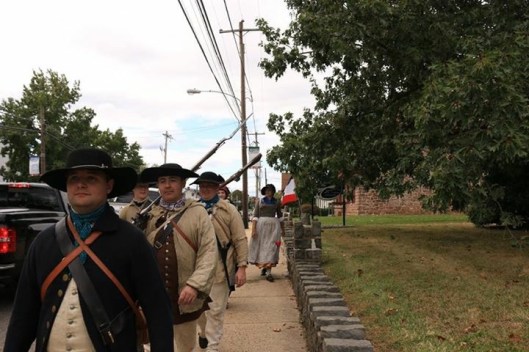
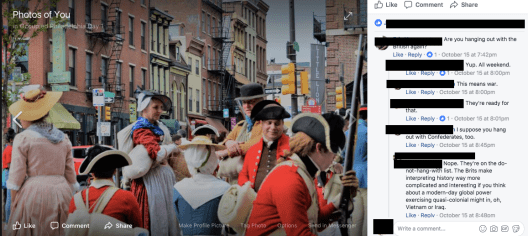
Images were posted to Facebook, and I was tagged in one that showed me in the midst of a crowd that included members of the 17th Regiment of Infantry, one of the forces that occupied Philadelphia in 1777. My cousin, ever the wag, commented:
click to enlarge in a new window

“I suppose you hang out with Confederates, too,” had some bite. What surprised me was my well-educated and thoughtful cousin’s facile conflation of Confederates and British. Is the world that easily black-and-white, good-and-bad, Manichaen? Not usually, and certainly not usually to my cousin. Explanations seemed in order. Why had I done what I did, and what did I do? What was Occupied Philadelphia about?*

To me, it offered the chance for some complicated interpretation that’s more readily accessible via living history than by exhibit panel, or at least significantly more engaging than text. How do you elucidate the complexity of the American Revolution? How do you get people to think about the past in the past’s terms? How do you get them to query and interrogate their accepted understandings of history?

Apparently that position towards living history– that it is complicated, worthy of criticism, can be used to create a complicated look at the past, and can be understood through cultural criticism– is deserving of the dog-whistle scorn of men hiding behind false names on social media. It elicits from them suggestions for interpretation that include impressions already being done, and referenced in the original post. It elicits suggestions based on 1811 paintings of Philadelphia, because of course, nothing helps illuminate 1777 Philadelphia like a genre painting made 34 years later.

If anything, I was suggesting that complicated interpretations (that is, showing how an “occupying force” might be “good” for the population) can further an understanding of the past that helps us understand the present. Isn’t that the mission of most history organizations? Understanding the past to illuminate the present and shape the future? It’s unsettling to realize so immediately how people who practice history use it to reinforce the status quo, and use misreadings of interpretation to further their own sense of superiority.

That’s where feminism comes in: suggesting “new” roles for women in living history (Laundry? How ’bout being a Quaker?) on a page dedicated to women’s history is a dizzying feat of sexist thinking. It is particularly delightful given that the Gentle Author and her associate, Our Girl History, are among the people who have suggested new roles for women, and have organized events that included suggested roles, and in fact required them. But please, tell me what to do. Belittle me by association with some of the leading critics of the 20th century. Because when you do, you reveal yourself not only to me, but to others.

Sarah Churchill, Duchess of Marlborough. Oil on canvas by Charles Jervas.

As Our Girl History wrote recently, women’s voices in living history are too often silenced in the present by excuse of the past. That anti-feminist approach was on view last night, and continues to be the default setting for many men in living history. It reflects a persistent bias against intelligent, educated women, like the Female Philosopher.  It reflects a persistent position that women should “know their place:”

The greatest sin a woman could commit was to participate in any sort of public life, be it theatre, politics, or social causes – this made her immediately ‘difficult’

–Margaret Perry on “difficult” women in the long 18th century.)

It will not remain a viable position for long.


*Brits-as-Nazis is not my origination, but the distillation of a comment made about the dedication of a monument at Guilford courthouse and subsequently reported to me. Despite a commenter’s attempt to attribute the equation to me, it is not mine, as should have been clear from “in certain circles.” Not my circles, not my monkeys.

Share this:

  • Click to share on Facebook (Opens in new window) Facebook
  • Click to share on Pinterest (Opens in new window) Pinterest
  • Click to email a link to a friend (Opens in new window) Email
  • Click to share on X (Opens in new window) X
Like Loading...

Living Like a Refugee

11 Wednesday Oct 2017

Posted by kittycalash in Events, History, Living History, personal, Reenacting

≈ 5 Comments

Tags

1777, 17th Regiment of Foot, authenticity, common people, difficult interpretations, interpretation, Pennsylvania, refugees, Revolutionary War, Trappe PA

At the Speaker’s House. Photo by Drunk Tailor.

When I was in middle school, we were given an assignment that is now considered inappropriate: we were asked to trace our family history or genealogy as a way to help understand historical time, stories of immigration, and the ways in which we are all American (according to the then-prevalent “melting pot” model of being American). Exercises like that are now discouraged as educators recognize the myriad ways in which people form families, though in my middle school, what was revealed was not adoptions or absent parents but the yawning chasm of class and privilege. My people are more peasant than princess, so the women I portray in living history make sense to me. They don’t wear silk. They make things, and they sell things.

Walking back from Augustus Lutheran Church, Trappe, PA

Portraying a refugee was a little trickier to wrap my head around. Whiny I can do– if I wasn’t teaching workshops in New Jersey this November, I’d be in 1587 North Carolina pining for England and wondering why I didn’t listen to my mother instead of marrying that head-in-the-sky Virginia colonist. What made being a refugee tricky for me was finding something to do. Obviously I shared in the cooking chores and the walk to Augustus Lutheran Church, but projecting “refugee” was tricky for me.

Looking back, I can see that straggling after a militia company may well have been enough– not wanting to leave their “protection,” not having a place to be, illustrates displacement. Even dressed as a middle-class or lower-middle-class woman, I am out of place sitting on grass or following armed men.

Displacement: I had not previously considered this as a means of provoking informed interpretation. Interpreting lack or absence can be as effective as interpreting presence. “No shoes” or “no musket:” these are easier, more obvious, but as a refugee, I had no home, no place, and no belonging. That seems even more important to understand and interpret today, at least for those of us concerned with making the past present, and the ways we can study the past to understand the present.

Share this:

  • Click to share on Facebook (Opens in new window) Facebook
  • Click to share on Pinterest (Opens in new window) Pinterest
  • Click to email a link to a friend (Opens in new window) Email
  • Click to share on X (Opens in new window) X
Like Loading...
← Older posts
Newer posts →

Archives

wordpress statistics

Creative Commons License
Kitty Calash blog by Kirsten Hammerstrom is licensed under a Creative Commons Attribution-NonCommercial-ShareAlike 4.0 International License.

Website Built with WordPress.com.

  • Subscribe Subscribed
    • Kitty Calash
    • Join 621 other subscribers
    • Already have a WordPress.com account? Log in now.
    • Kitty Calash
    • Subscribe Subscribed
    • Sign up
    • Log in
    • Report this content
    • View site in Reader
    • Manage subscriptions
    • Collapse this bar
 

Loading Comments...
 

    %d