• Home
  • Completed Costumes/Impressions
  • Emma and Her Dresses
  • Free Patterns and Instructions

Kitty Calash

~ Confessions of a Known Bonnet-Wearer

Kitty Calash

Category Archives: personal

Frivolous Friday: Fashion Flashback

18 Friday Nov 2016

Posted by kittycalash in Frivolous Friday, History, Making Things, personal, Research, Thanks

≈ 3 Comments

Tags

18th century clothing, authenticity, Costume, cotton print, East India trade, fashion, friends, party clothes, sewing, thanks

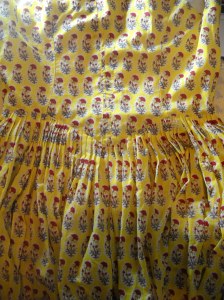
IMG_6945
I don’t know about you, but the past ten days or so have been surreal in a way that I haven’t experienced in a dozen years or so. Numerous creative folks I know are working hard to find new, engrossing projects and sharing what they find with others. As always, Satchel Paige has excellent advice: Don’t look back, something might be gaining on you.

What project shall I take up again, to distract myself from the shorter days and colder temperatures?

This is actually making reasonable progress, and might even be done by early December.
dscn4571

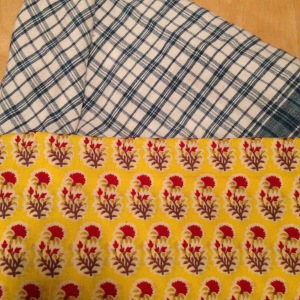
It’s satisfying work, pleating and stitching this lightweight cotton, tiny stitches in white linen thread. I’ve made some modifications to the pattern, but not many, aiming for a 1780-1782 style. Judicious cutting and generous friends will, fingers crossed, even yield a matching petticoat, which is very exciting indeed– and an unusual fashion statement chez Calash. Here, we focus on clash, but the fabric itself takes care of that for me.

dscn4572
dscn4573

Now, if only I had bright red morocco leather shoes to wear with this, that would be a sight indeed.

Share this:

  • Share on Facebook (Opens in new window) Facebook
  • Share on Pinterest (Opens in new window) Pinterest
  • Email a link to a friend (Opens in new window) Email
  • Share on X (Opens in new window) X
Like Loading...

The Art of Deviance

01 Tuesday Nov 2016

Posted by kittycalash in History, Living History, personal, Philosophy, Reenacting, Research

≈ Comments Off on The Art of Deviance

Tags

18th century clothes, authenticity, common people, difficult interpretations, interpretation, living history, Research

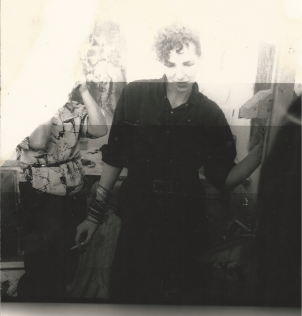
portrait as a process test

portrait as a process test

Some regular readers know I was part of Chicago’s punk rock scene in the early 1980s: my first foray into unusual music and natty dressing.* I think that’s me and my keffiyeh at a Naked Raygun show in the Chicago episode of Sonic Highways. But more to the point, I was on the fringes of an underground, taking style tips from obscure English zines, and being told I looked like a whore by a variety of men using Chicago’s public transit system. Judge not lest ye be judged aside, I’m accustomed to occupying uncomfortable spaces by design and by accident. (I wasn’t looking to be called a whore on the Fullerton El platform when I dressed in a below-the-knee vintage skirt and lot of Bakelite jewelry combined with bullet belts and studded leather, but everybody’s a critic when it comes to women’s appearance.)

The Frail Sisters, 1794

The Frail Sisters, 1794

Now that I live in Providence, where indoor prostitution was legal for decades, if not centuries, my interest in gender role non-conformity extends to finding ways to document and represent sex workers in Rhode Island history. The adult section of the now-defunct Providence Phoenix, ‘zines, and diaries help record at least some aspects of this facet of our culture, but how do we represent it, and do it well? Jamie Lee Curtis in Trading Places is not a realistic model.

In discussing this lately, I’ve found consistent themes in representing sex workers in the 18th century: white face powder, rouge, bright clothing, visible stays, friendliness rather than reserve. There are lithographs to guide the portrayal through clothing, and visual tropes that signified a lack of virtue in the 18th century. In considering the local variations on this theme, my thought had been to expand upon the visual imagery by reading the Providence and Newport town papers, and the records of the Colony of Rhode Island, along with the contemporary newspapers.

The Tar's Triumph, or Bawdy-House Battery, print by Charles Mosley, 1749. British Museum 1868,0808.3896

The Tar’s Triumph, or Bawdy-House Battery, print by Charles Mosley, 1749. British Museum 1868,0808.3896

Nothing is likely to be quite as good as the Nort’ Providence chief of police who, in the midst of Tropical Storm Irene, pursued a stripper who took clients on the side when she ran a red light in her SUV. She crashed into a parked car in Pawtucket and abandoned the car, at which point the chief of police searched the vehicle, found her open purse, and stole the cash she’d earned that morning. When questioned later, he was at pains to explain why the money was wet…** in any case, the Providence brothel riot of 1782 aside, I do not expect to find anything quite as lurid.

The Bargain Struck, or Virtue conquer'd by Temptation. Mezzotint, 1773. British Museum 1935,0522.1.130

The Bargain Struck, or Virtue conquer’d by Temptation. Mezzotint, 1773. British Museum 1935,0522.1.130

My sartorial choices for a prostitute would include a rather over-fancy cap with a worn silk ribbon, rouge and a velvet patch, a silk gown stained on the back, silk petticoat stained at the knees, laddered stockings, and heeled shoes tied with silk ribbons, or fastened with paste buckles. If my character worked from a brothel, the dress could be brighter and cleaner, but in either case, neck handkerchiefs would be optional or silk and askew, showing my stays and cleavage.

This is not an easy impression. It’s not just that I do not want to parody an 18th century prostitute, but that I want to honor the memory of these largely forgotten women. They had families– in all likelihood they had children, as we know from the story of Mary Bowen and Eliza Jumel– they had feelings, desires, dreams, felt love and pain. They were likely desperate.

They were human.

We owe them the respect of representing them well– of representing them at all– if we strive to recreate a more complete picture of the past.


*What else is this crazy thing we do?

**You cannot make this stuff up.

Share this:

  • Share on Facebook (Opens in new window) Facebook
  • Share on Pinterest (Opens in new window) Pinterest
  • Email a link to a friend (Opens in new window) Email
  • Share on X (Opens in new window) X
Like Loading...

Documented Fantasies

08 Monday Aug 2016

Posted by kittycalash in Clothing, Events, History, Living History, Museums, personal, Reenacting, Research

≈ 5 Comments

Tags

19th century, 19th century clothing, art history, authenticity, Events, fashion, Federal style, happenings, interpretation, living history, performance art, Reenacting

It was three years ago on a warm August afternoon in the museum room we’d turned into a photo studio when I quipped, “All my fantasies are documented.” It’s been hard to live down ever since.

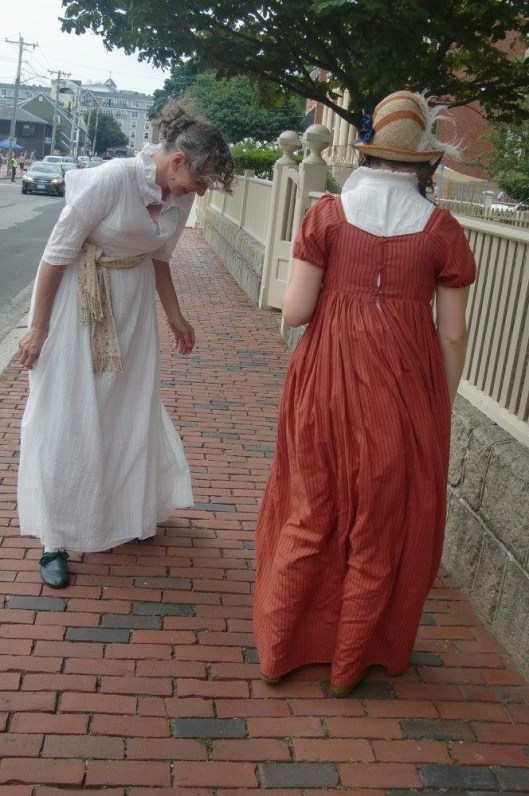
With Mrs B watching Miss B self-perambulate upon the sidewalk.

With Mrs B watching Miss B self-perambulate upon the sidewalk.

Documentation, research: we all do it, everyone who reads this blog does it. What matters is how you use it– or, maybe even more importantly, how well you understand how you are using your research. This past weekend was the Salem Maritime Festival, and round number three for me in the West India Goods Store (WIGS, which sounds far more political than it is). The year was 1804, and as you may recall, that required a new dress.

Reader, I wore it. And it survived!

Yes, it is made from an IKEA curtain. The pattern is my own, derived from examples in Janet Arnold, at Genesee, and the KCI. Once again, I discovered the power of upper body strength and leverage. It’s not that my stays are too big necessarily. The busk is too long, that I will grant you. But I think the shoulder straps are as well, and the shift– that slattern! She was rolling a la Renaissance Faire, which is completely unacceptable, of course, as she slid down my right shoulder by the end of the day when the shop had been unpacked into the conveyance.

So let us focus on the non-slattern part of the day, when a mercantile enterprise briefly overtook the WIGS.

Behind the Counter
Behind the Counter
DSCN4425

There was some custom, though numerous debts were recorded in the ledger.  (Somehow, there are no images of Mr K sweating over the figures in the book, though I recall them clearly.)

IMG_7634 (1)

The shop was hot, but we attempted to stay fed and hydrated, as we discussed the various kinds of goods imported to places like Salem and Providence in 1804. Politics were rather difficult to discuss, as Mr K has a marked antipathy for Mr Jefferson that caused a mild agitation; expanding the country does seem a bold and perhaps unconstitutional move, given the deal Mr Jefferson has struck with Bonaparte, but perhaps this is for the best. The Indians will surely benefit from Christianity and education.*

It’s engaging in the moment, and we’ve done our research. But it’s a fantasy nonetheless, a kind of happening grounded in primary sources and material culture. I’m OK with that– I understand what I am doing– but I wonder sometimes if the people I’m watching on social media understand what they are doing with the fantasies they portray.


* To be SUPER clear, I’m staying in character here. I worked in Missouri and I have enough understanding of “manifest destiny” to disagree with this point of view.

Share this:

  • Share on Facebook (Opens in new window) Facebook
  • Share on Pinterest (Opens in new window) Pinterest
  • Email a link to a friend (Opens in new window) Email
  • Share on X (Opens in new window) X
Like Loading...

The Landscapes of Things

20 Wednesday Jul 2016

Posted by kittycalash in Collecting, Living History, material culture, personal

≈ Comments Off on The Landscapes of Things

Tags

collecting, collections, history, interpretation, landscape, material culture

Or, you never know where things will end up.

New post, Old post, Cataloger

New post, Old post, Cataloger

You can learn a lot about a place by visiting its antique and junk shops. Here, where the China Trade was A THING, you can practically fall over Chinese export porcelain (and its imitators) of a variety of types every day. It can become a bad habit. You can become an enabler.

IMG_7449

Elsewhere, the objects for sale tell a different story. I’m fond of the haphazard antique malls museum of things world, and while on a tea pot delivery mission to Maryland, went to one in Mount Vernon. It was astonishing.

Mid-century modern furniture, the Arabia Anemone tableware of my childhood, and shelves of geisha dolls, Kabuto, ceramics, and the occasional sword confused me at first until I realized these were probably the jumbled contents of a prior generation of military and civil servants’  homes emptied by their children. The aesthetics were markedly different from what I typically encounter in southeastern New England, where I am accustomed to reading subtle variations between the states I frequent.

14

Local variations occurred in Vermont as well, though the general flavor was more familiar.

16
17

Some things are universal: chaotic piles of partially-identified snapshots can be found anywhere, stacks of pelts and dog-like foxes, not so much. Origins debatable, ethics questionable, the late mammals tempted the tourist trade in St. Johnsbury, where we stopped as we headed south for home.

12

We influence our landscape more than we credit: from changes in the land wrought by farming to climate change to the differences in what we cast off and what we collect, the visible human influence is undeniable. Material culture can be about place as much as it is about thing.

Share this:

  • Share on Facebook (Opens in new window) Facebook
  • Share on Pinterest (Opens in new window) Pinterest
  • Email a link to a friend (Opens in new window) Email
  • Share on X (Opens in new window) X
Like Loading...

Serious Saturday: Security Concerns

09 Saturday Jul 2016

Posted by kittycalash in Fail, History, Museums, personal

≈ 1 Comment

Tags

historic house museums, Museums, preparations, safety, security, work

Warning: Museum Content Ahead

Woman Selling Salop. William Henry Pyne. The Costume of Great Britain. 1805.

Woman Selling Salop. William Henry Pyne. The Costume of Great Britain. 1805.

Night watchmen. We’ve been over them before, tangentially, but never in an experienced way. Sure, sleeping overnight at museum sites, I’ve encountered the night watchman making his rounds. And as a museum visitor, I’ve met the guards who monitor how I’m wearing my messenger bag, and how close I get to various works of art.

But what I don’t think about enough, and don’t observe being thought about, is the safety of people over objects. The Museum Security Network has posts on art theft, forgery, and vandalism— all of which are important topics– but there’s a clear focus. For years, decades, that was our focus at work: stuff, buildings, not people.

That changed in our Library five years ago with one obstreperous patron who touched–didn’t hurt, but was angry, and put a hand on– one of our librarians. Now we think about books, papers, and people. But it’s hard: for as long as I’ve worked in this field, and it’s fully half my life, I’ve had the mission drummed into me: access. We preserve these materials, these objects, these sites, for the use and enjoyment of the public, and that means everyone.

The radical democracy of object care (everything we own is preserved with the best care we can provide, from 17th century basket to 21st century advertising hard hat) translated for me into the radical democracy of access: everyone gets in. (It helps that I’ve worked at places where we could provide a lot of free access, and where we continue to strive for as much free access as possible.)
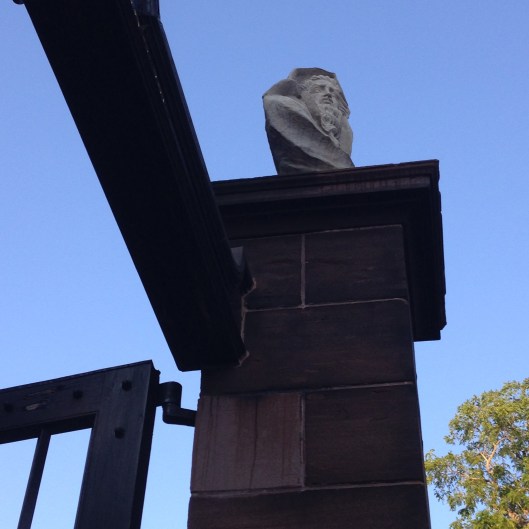
Hades atop the front gate pillar

Hades atop the front gate pillar

Everyone gets in. Everyone can appreciate our shared cultural heritage. And then I met Mr Hades. That’s not his real name, but the young man who has been visiting us at the museum (after coming to the library last summer in a quieter mode) has developed an obsession with Hades. He came in Thursday, asking about the front gates, about Hades being the god of Hell, and whether the gates of hell were in our basement. I’ve heard a lot of myths about our basement, but not that one. After ten minutes, and before we could connect to 911, Mr Hades left.

But he was back yesterday, more erratic than before, sunglasses hiding his wide and striking pale green eyes, ranging through the house from front to back streaming a rap song on his phone. He paid for the tour, but left after 10 minutes in the house. He’s clearly been on a tour before.

So we met two police officers from the local substation, and we know to call them immediately if Mr Hades returns. A little research (that’s what we do) turned up a lot of interesting information about Mr Hades, and we suspect that there are officers and judges and guards who are pretty familiar with him, and that he needs help as much or more than he needs incarceration. But he disturbs our visitors, and agitates the staff, and that’s a bad visitor experience. (Thanks to my anti-anxiety meds, I don’t get anxious; I just get a stomach ache and keep talking with Mr Hades to try to keep him focused.)

But last night, talking about safety and Mr Hades with Drunk Tailor, I realized that we don’t think enough about the security of our staff. We put our visitors and our objects before the staff, and that’s not right. This incident made me put the safety of our staff above that of the objects, but we can’t help our visitors be safe unless we take care of ourselves.

oxygen-mask

If your staff members know their routines, know how to respond and have the tools they need to respond, they’ll be better able to care for and direct visitors to safety. I know we have to shift our thinking and procedures where I am; chances are your procedures are up for their annual review, too. For many of us, the new fiscal year has just begun. What better time for review and changes?

Share this:

  • Share on Facebook (Opens in new window) Facebook
  • Share on Pinterest (Opens in new window) Pinterest
  • Email a link to a friend (Opens in new window) Email
  • Share on X (Opens in new window) X
Like Loading...
← Older posts
Newer posts →

Archives

wordpress statistics

Creative Commons License
Kitty Calash blog by Kirsten Hammerstrom is licensed under a Creative Commons Attribution-NonCommercial-ShareAlike 4.0 International License.

Website Built with WordPress.com.

  • Subscribe Subscribed
    • Kitty Calash
    • Join 621 other subscribers
    • Already have a WordPress.com account? Log in now.
    • Kitty Calash
    • Subscribe Subscribed
    • Sign up
    • Log in
    • Report this content
    • View site in Reader
    • Manage subscriptions
    • Collapse this bar
 

Loading Comments...
 

    %d