• Home
  • Completed Costumes/Impressions
  • Emma and Her Dresses
  • Free Patterns and Instructions

Kitty Calash

~ Confessions of a Known Bonnet-Wearer

Kitty Calash

Category Archives: Research

Reflecting Fashion

21 Thursday Jan 2016

Posted by kittycalash in Clothing, History, Museums, Research

≈ 1 Comment

Tags

fashion plates, Federal style, frock coats, menswear, miniatures, portraits, tailoring

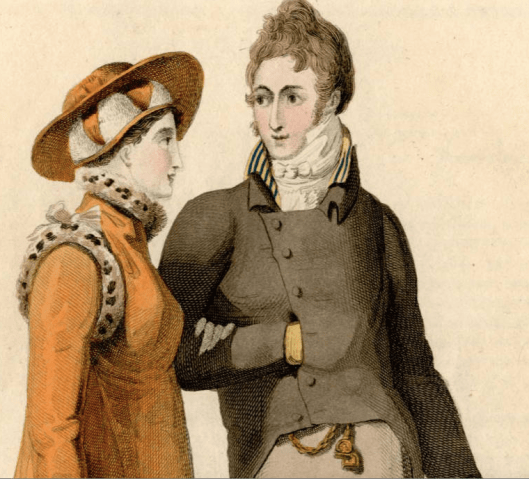
Whilst serving as the commandant for a research-paper writing prison*, I spent some time perusing the Met’s digital collections, in particular the Costume Institute’s collection of Men’s Fashion Plates, because, you know, stuff.

Men's Wear 1790-1829, Plate 002, 1807. Gift of Woodman Thompson Costume Institute Fashion Plates Metropolitan Museum of Art
Men’s Wear 1790-1829, Plate 002, 1807. Gift of Woodman Thompson Costume Institute Fashion Plates Metropolitan Museum of Art
John Myers. Oil on canvas by Thomas Sully, 1814. MFA Boston 45.894 Gift of Maxim Karolik for the M. and M. Karolik Collection of American Paintings, 1815–1865

I stopped at Plate 002, because I knew I’d seen that coat somewhere before. Why, yes: at the MFA in the Art of the Americas Wing, where I recently spent a pleasant afternoon with the Drunk Tailor. After some initial joy at discovering dust on a teapot, we got down to the business of setting off proximity alarms, reading labels, and contemplating  the occasional neck stock.

Mr Myers stopped me, though: what a handsome coat. High shoulder seams, long cuffs, buttoned all the way up. Nifty high-waisted grey trousers, too, and what seems to be a yellow waist coat. The portrait is dated 1814, and the fashion plate 1807.

Detail, 1807 fashion plate

Detail, 1807 fashion plate

Hmmmm…

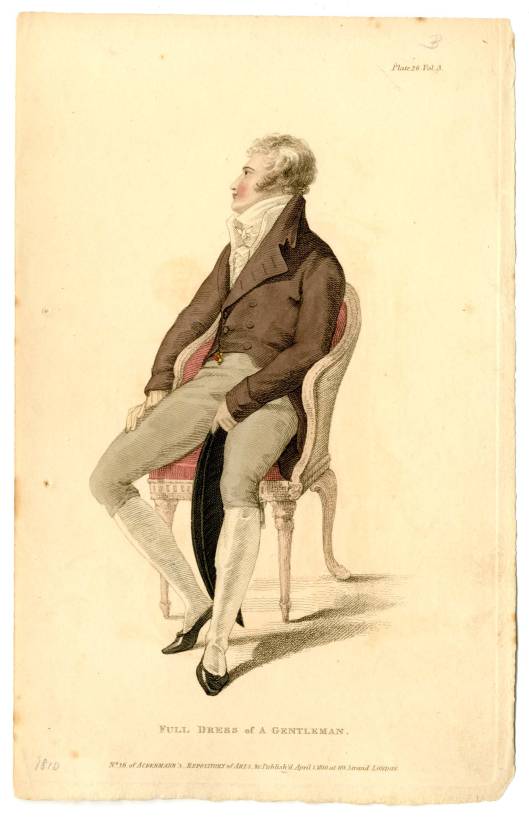
Men's Wear 1790-1829, Plate 005, 1807. Gift of Woodman Thompson, Metropolitan Museum of Art

Men’s Wear 1790-1829, Plate 005, 1807. Gift of Woodman Thompson, Metropolitan Museum of Art

The brown M-notch collar coat is clearly a thing in 1807. It’s popular in 1802. So popular. 1802 on the left. On the right, 1812.

Portrait of a Gentleman of the Society of the Cincinnati. Miniature by James Peale, American, 1802. Philadelphia Museum of Art, 2000-137-11
Portrait of a Young Man by James Peale, 1812. Philadelphia Museum of Art, 1944-47-1


And our friend Sully paints one in 1814.

After seeing Copley and other early American painters use English prints as references for portraiture, I wondered if Sully was at all influenced by fashion plates, and then to what degree American men and their tailors were influenced by published fashion plates.

Portrait of the Artist. Thomas Sully, 1821. Metropolitan Museum of Art, 94.23.3

Brown coats are clearly classic: Sully’s got one himself in 1821. I’m sure there’s a dissertation out there somewhere on the influence of fashion plates on American men’s  fashion and representation in portraiture–  I can almost remember stumbling across the reference. So that echoes and re-echoes and reflects through time even as I recall not just the the folk wisdom about brown suits, but the significance of well-tailored suit. Maybe from 1802-1821, brown is the new black.


*Ah, teenagers. The Young Mr failed to complete a paper by the due date, so I spent some quality time ensuring he got back on track.

Share this:

  • Share on Facebook (Opens in new window) Facebook
  • Share on Pinterest (Opens in new window) Pinterest
  • Email a link to a friend (Opens in new window) Email
  • Share on X (Opens in new window) X
Like Loading...

High Style/Low Brow

08 Friday Jan 2016

Posted by kittycalash in Collecting, History, Research

≈ 3 Comments

Tags

18th century, american art history, art history, auctions, Clothing, Costume, history, interpretation, paintings, Robert Feke, Sotheby's

It’s auction season again, the best one of all: the major Americana sales and the Winter Antiques Show in New York. I won’t be at any of the exhibitions or sales, which is just as well for me; my friends know the twitchy “must-touch” finger motion that means I need to leave my wallet and checkbook in wiser, saner hands.

Still, even if we can’t buy, we can learn. This time around, I was delighted by the juxtaposition of two pre-1750 paintings in the Sotheby’s sales.

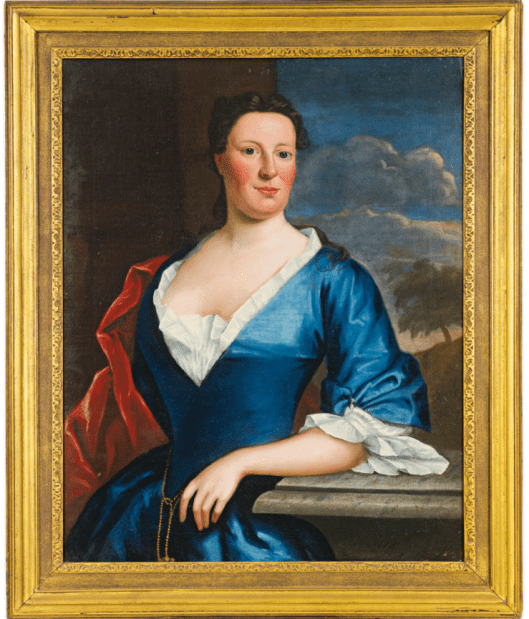
First, the ever-delightful Robert Feke’s portrait of Mrs Tench Francis.

Robert Feke (1707 - 1752) PORTRAIT OF MRS. TENCH FRANCIS In what appears to be the original frame; Bears a label on the back of the frame: Mr. Willing, Bryn Mawr. Painted circa 1746. Label on the back of the stretcher: Philadelphia Museum of Art, Robert Feke, Portrait of Mrs. Tench Francis, 11-1969-2. Lender: Mr. E. Shippen Willing, Jr. Oil on canvas 36 by 28 1/2 in. Sotheby's Sale N09456 Lot 1595

Robert Feke (1707 – 1752)
PORTRAIT OF MRS. TENCH FRANCIS
In what appears to be the original frame; Bears a label on the back of the frame: Mr. Willing, Bryn Mawr.
Painted circa 1746.
Label on the back of the stretcher: Philadelphia Museum of Art, Robert Feke, Portrait of Mrs. Tench Francis, 11-1969-2. Lender: Mr. E. Shippen Willing, Jr.
Oil on canvas
36 by 28 1/2 in.
Sotheby’s Sale N09456 Lot 1595

Francis. Shippen. Willing. This thing is DEEP in the history of Philadelphia, and by my fave 18th century RI painter.

But does she Remind you of anyone? Like a Smibert, maybe? Or perhaps it’s a Copley?

Mrs Samuel Browne by Smibert, RIHS 1891.2.2
Mrs Joseph Mann by Copley, MFA Boston, 43.1353

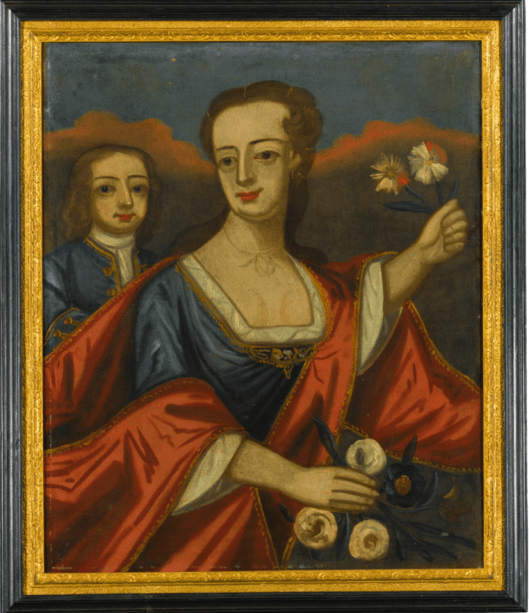
It was a THING, that blue silk gown business with a red silk wrapper. Better yet? This one:

Attributed to J. Cooper 1685 - 1754 WOMAN WITH YOUNG BOY Appears to retains its original frame attributed to J. Cooper. oil on canvas 30 in. by 25 in. CIRCA 1715. Sotheby's Sale N09466, Lot 398

Attributed to J. Cooper 1685 – 1754
WOMAN WITH YOUNG BOY
Appears to retains its original frame attributed to J. Cooper.
oil on canvas
30 in. by 25 in.
CIRCA 1715. Sotheby’s Sale N09466, Lot 398

What I love about the J. Cooper is how crude it is: that painting looks more like a woolwork picture than a painting. But that vernacular adaptation tells us how prevalent this portrait style was, and how desirable.

Share this:

  • Share on Facebook (Opens in new window) Facebook
  • Share on Pinterest (Opens in new window) Pinterest
  • Email a link to a friend (Opens in new window) Email
  • Share on X (Opens in new window) X
Like Loading...

Contextualize This*

26 Thursday Nov 2015

Posted by kittycalash in Events, Fail, History, Living History, Reenacting, Research

≈ 6 Comments

Tags

authenticity, common people, history, interpretation, living history, Reenacting, Research, resources, Revolutionary War

Right on, Mr. Hiwell: The music of the Army being in general very bad is a post I could never write, because I lack the detailed knowledge, or the desire to acquire music-specific knowledge (just as Mr Hiwell could give two rats’ about stay-making details, or the subtleties of stew). But here’s the gist of his post, on which I wish to elaborate, and which has been touched on elsewhere: You’re Doing It Wrong.

Let’s take this:

I’m tired of going to events, knowing all the camp duties fifers and drummers played from sunrise to sunset and never playing a single one of them besides Drummer’s Call and Assembly.

One of my favorite hobby horses: lack of discipline and camps that look like that Infamous Catalog just puked on a field. Why on earth can we not see tents are set up properly, in rows, with appropriate numbers of kitchens instead of wobbly lines, marquee tents that disgorge giggling teenage girls in bodices, and enough iron to make the scrap man sing with joy? 

But even then, even if people are too lazy or stubborn to leave stuff at home, why can’t a camp run the way it would’ve? There’s ample documentation on which to draw. Quite aside from the voluminous papers of General Washington and General Greene, and the massive archives in Britain, every regiment had orderly books, of which many survive. They’re hilarious reading and full of things to do.

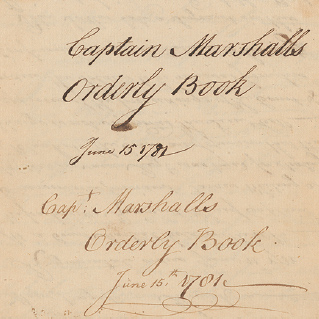
Most reenactments are boring. Well, so was army life. The 10th Massachusetts was constantly in trouble up on the Hudson late in war, and the Marshall book at the Society of the Cincinnati contains the proof.

Here’s something fun to do: inspection. Huts, cabins, tents: they all needed to be kept neat., and apparently weren’t.

Some part of the Camp and about the long Barracks in particular is relaxing into nastiness. Regimental QuarterMasters have been ordered to have them Clean and keep them so. An Officer of each Company has been ordered to visit the Barracks every day and to Confine & Report those who throw bones of meat Pot Liquor or filth of any kind near the Barracks. Yet all this has been done and no report has been made. it is hatefull to General Howe to Reitterate orders as it ought to be shamefull those who make it necessary.

Don’t like to clean, prefer cooking? Marching?

Regimnl Orders June 6th 1782

the Regiment will turn out to Morrow Morning at the Beating of the Revelee and to March By Six oClock they are to pack there clothing and kook there provisions this Evening when they have arivd on the Ground for Encamping the officer commanding on the Spot will order a partry if Forty men from the Regiment a Capt and two Sub’s to Command them to Return to the Encampment in order to asist in Bringin on the Baggage the Soldiers are to Carry there kittles in there hands and are to Leave there arms and pakes &c at the New Encampment any Soldier who is found Plundering another pack is to be tyd up and punished with out Trial..

Tyd up and punished without Trial. You know there’s a guy who’s up for that in every unit.

And lest you think that there’s nothing for women in these books, let me assure you, there is:

Regimental Orders, July 23rd 1782

At a Regimental Court Martial whereof Capt Francis is president, Briget Conner a Woman Belonging to the 10th Massachusetts Regiment was tried for purchesing a publick Shurt from a Soldier in Sd. Regiment found Guilty and Sentanced to Return the Shurt to the person from whom she purshest it and loos what She gav for the Shurt.

The Colo approves the opinion of the Court and orders it to take place Immediately

Regimental orders July 25th 1782

Bridget Conner a woman Belonging to the 10th Massachusetts Regiment is Directed to Leave Camp Between this and to Morrow Morning at Roal Call for her Insolence to the officers of sd Regiment on pane of Being Treated with Severity

This is easy, people. Authenticity, accuracy, and Stuff to Do increases exponentially if you use documentation to recreate a “normal” day in either army.  There’s Cuthbertson, for example.

cuthbertson.png

There’s Lochee, if you want to get in tents. And orderly book after orderly book. And if I, a mere woman, can find these things, there is no excuse for you men not to read, absorb, and use these sources well.

Inspections. Returns. Reports. There’s so much to do in a day, and running a camp or a barracks by the regulations would give everyone so much more to interpret, and begin to present real history instead of merely heritage. This is where the real splits are going to come, and sooner than you think. It won’t be about uniform details, or stitch and thread counts, but about actually engaging historical interpretation. If interpreters aren’t engaged, the public won’t be either.


*If you know me, you know what the next word is.

Share this:

  • Share on Facebook (Opens in new window) Facebook
  • Share on Pinterest (Opens in new window) Pinterest
  • Email a link to a friend (Opens in new window) Email
  • Share on X (Opens in new window) X
Like Loading...

The Myth of Perfection

02 Wednesday Sep 2015

Posted by kittycalash in Art Rant, Clothing, History, Living History, Philosophy, Reenacting, Research

≈ 4 Comments

Tags

18th century, 18th century clothing, authenticity, Clothing, historical clothing, interpretation, paintings

Ain’t nothin’ perfect.

Jackie’s got good points, and although I think they are slightly tangential to where I thought I was going on Monday, let’s pick them up.

Completely 1819 to represent 1819? My standard reply to pretty much every question is: It depends. Who are you, where are you, what are you doing? Middle class or higher bride? You are so 1819 it’s scary, from your skin out, head to toe. Lower class? You’ve altered your best dress, if not made a new one, and refreshed your accessories.

The Kaunitz Sisters (Leopoldine, Caroline, and Ferdinandine), graphite on laid paper by Jean Auguste Dominique Ingres, 1818. Metropolitan Museum of Art, 1998.21
Costume Parisien, 1818.

Look, folks: part of our problem is that we forget that the people in the past had the same covetous, jealous hearts that we have. They had wants and yearnings, for each other, for new bonnets, for velocipedes and overcoats. They were just as interested in impressing each other as we are, even if they sublimated desire into poetic images of greater obscurity than James Brown ever used.

I thought about this notion of mixed up times for clothing as I stood on a landing at work yesterday. Skin out, here’s what I wore on 1 September 2015:

  • Black Natori sports bra, purchased in Boston on January 10, 2014 (I saw my surgeon so I remember.)
  • White cotton tank top, label gone, acquired ca. 2013, possibly from Target
  • Blue and white striped cotton 3/4 sleeve J. Crew blouse, 2006
  • Black Nike undershorts, 2010
  • Lucky brand jeans, August, 2015
  • Red suede belt with brass buckle, ca. 2004
  • Red suede Naya oxfords, late winter, 2014

The oldest thing was the belt, followed by the blouse. The most stylistically determinate item is probably the jeans, since waistline height and cut of the legs fix trouser/jeans style. So, what could this mean for us, when we dress for the past?

Let’s start with dressing for the American Revolutionary War period, 1775-1783. What you wear depends of course on who and where you are; here I am in New England, wishing I was middling sorts.

Detail, Mrs Richard Skinner, oil on canvas by John Singleton Copley, 1772. MFA Boston, 06.2428

Detail, Mrs Richard Skinner, oil on canvas by John Singleton Copley, 1772. MFA Boston, 06.242

If I wear an open-front stomacher gown in 1775, will I still feel comfortable in that in 1783, when the ladies of means around me have switched to closed-front gowns? Or will I feel like I’m wearing bell bottoms and a macrame vest to high school, while the cool girls are wearing pegged Guess jeans and Fair Isle sweaters? (Not what happened to me, but you follow my point). Think how much American fashion changed between 1975 and 1983, and while you will surely see pieces carried over– watches, headbands, socks, Tretorn sneakers– they will be primarily small pieces, accessories, and not main garments.

Lady Williams and Child, oil on canvas by Ralph Earl, 1783. Metropolitan Museum of Art, 06.179

Lady Williams and Child, oil on canvas by Ralph Earl, 1783. Metropolitan Museum of Art, 06.17

That’s really want I think we want to get at: Yes, people mixed up clothes, wore favorite things, wore things out. But then as now, they wanted to be stylish. The more care you put into imagining yourself in the past, really being that person, the more convincing you’ll be. You won’t be perfect, and authenticity is as unachievable as objective truth, but you will be closer to real, and yes, even the public will know.

Share this:

  • Share on Facebook (Opens in new window) Facebook
  • Share on Pinterest (Opens in new window) Pinterest
  • Email a link to a friend (Opens in new window) Email
  • Share on X (Opens in new window) X
Like Loading...

Hobby Misogyny

04 Tuesday Aug 2015

Posted by kittycalash in Living History, Reenacting, Research

≈ 29 Comments

Tags

18th century clothes, authenticity, Clothing, common dress, Costume, interpretation, Reenacting

What do you see and remember at events? At every event I go to, I see a range of impressions, or historic expressions.

unknown artist, 18th century, The Encampment in the Museum Garden, 1783, Aquatint, hand-colored, Yale Center for British Art, Paul Mellon Collection

unknown artist, 18th century, The Encampment in the Museum Garden, 1783, Aquatint, hand-colored, Yale Center for British Art, Paul Mellon Collection

There are Good things: a chintz bedgown that’s actually becoming; a checked suit I wish the kid would wear; the Ugly Dog Coat Mr S wants, the umbrella I want to make just for its lines.

The Bad and the Ugly are present, too.

Drawstring shift necks, makeup, infernal bodices, Birkenstocks, sofa-size prints… “light” troops with dining flies, tables, and tin roasters. Stores tents packed with plastic packaging. White “trews” baggy as painters pants, breeches reaching below the knee, haversacks as man-purses, tube socks, sneakers, peacock feathers on women’s hats, girls with undressed hair and no caps.

What is the meaning of these bodices and tube socks: are they the disease, or a symptom? I think they’re a symptom, telling us about a deeper problem.

If “authenticity” is a journey and not a destination, everyone starts this journey at a different point, and some people are more sophisticated consumers of knowledge than others. Hard as it is to fathom, some people—even with decades of time in this— don’t know any better. I’ve encountered half-correctly dressed wives of men who’ve been to Battle Road who didn’t even know workshops are available to help them with stays and gowns. The ignorance is not always willful, even if it seems that way.

Why are some women such a mish-mash of reasonably accurate jacket with acceptable petticoat worn without stays, a drawstring shift, an OK cap, modern glasses, and a purse?

Paul Sandby RA, 1731–1809, British, Washerwomen, between 1790 and 1805, Graphite and brown wash on moderately thick, cream, rough laid paper, Yale Center for British Art, Paul Mellon Collection

Paul Sandby RA, 1731–1809, British, Washerwomen, between 1790 and 1805, Graphite and brown wash on moderately thick, cream, rough laid paper, Yale Center for British Art, Paul Mellon Collection

Do they not see the return on investment for stays and a gown and shoes and a cap and glasses and no makeup? Perhaps they don’t feel pretty when they venture out of their normal realm, and they’re only visiting, anyway. Is this the reason for the half-baked costume approach?

Or could it be that the unit commanders have set no standards for the women? That they don’t consider the women to really be unit members? Or that the women don’t consider themselves members? That they don’t matter the way the muskets do?

Could some women’s lack of authenticity—and by “authenticity” here I mean “period appropriate clothing”—be rooted in the phallocentric/musket-centric culture of the hobby? In some units, men and women seem to engage in parallel play, like toddlers, where the men field in the foreground, and the women cook in the background (women on the field is an issue I will not take up here). The men are in charge, making the decisions: the women, and what they wear, appear not to matter, and are nearly invisible. I think this is rooted in basic misogyny and the riptide of the hobby’s boys-club attitude.

If misogyny is part of why women perpetuate inauthentic impressions, then having women invested in their units and roles, with more research and more care, might be threatening to men who want weekends for themselves and their ‘war games.’ But I believe that without a significant investment by women, and by units in women’s roles, this hobby won’t survive, and it’ll be a lot less fun and educational for everyone.

That means, of course, that I think units will have to allow women a voice, and develop standards for women as well as men. Those units with the farthest to “travel,” authenticity-wise, will need to build up stores of wearable, authentic women’s clothing to loan, or include women’s workshops in their schedules. If they don’t want women and/or families participating, then that has to be clear, too, and women who do want to participate will have create their own civilian units. (I don’t have solutions for all of these issues.)

attributed to Hubert-François Gravelot, 1699–1773, French, active in Britain (1733–1745), Matrimonial Fisticuffs, with a Portrait of the Pugilist John Broughton, in the Background, undated, Watercolor, pen and black ink and graphite on medium, slightly textured, beige laid paper, Yale Center for British Art, Paul Mellon Collection

attributed to Hubert-François Gravelot, 1699–1773, French, active in Britain (1733–1745), Matrimonial Fisticuffs, with a Portrait of the Pugilist John Broughton, in the Background, undated, Watercolor, pen and black ink and graphite on medium, slightly textured, beige laid paper, Yale Center for British Art, Paul Mellon Collection

When the men around them don’t value or encourage their participation, and when units do not have men and women as equal members with clear standards for both, I think you end up with poor impressions—particularly women—and camps full of crap. These are symptoms of a larger problem of misogyny and silence.

Anthony Highmore, 1719–1799, British, Group of Three Ladies, undated, Watercolor, pen and brown ink, and graphite on medium, blued white, moderately textured laid paper, Yale Center for British Art, Paul Mellon Collection

Anthony Highmore, 1719–1799, British, Group of Three Ladies, undated, Watercolor, pen and brown ink, and graphite on medium, blued white, moderately textured laid paper, Yale Center for British Art, Paul Mellon Collection

In recent years there have been calls for greater attention to standards for women by unit commanders. But I think that we should go further, and call for greater participation of women in real leadership roles in the hobby. That’s when you will see real change, not just in clothing, but in presentations.

And that is where I think the future of this hobby lies: in recognizing that living history events are mobile museums, not just mobile monuments.

To get more complete, inclusive and, I think, authentic, experiences will take more inclusive leadership structures, from unit memberships to the boards of umbrella organizations. That would be one small step towards bringing leadership and management into line with the modern world and current best practices in management for cultural and historic organizations. Because that is what the umbrella organizations have become. The boys’ historic shooting clubs have grown up, and it’s time to let the girls play for real, and to value women’s roles past and present.

Share this:

  • Share on Facebook (Opens in new window) Facebook
  • Share on Pinterest (Opens in new window) Pinterest
  • Email a link to a friend (Opens in new window) Email
  • Share on X (Opens in new window) X
Like Loading...
← Older posts
Newer posts →

Archives

wordpress statistics

Creative Commons License
Kitty Calash blog by Kirsten Hammerstrom is licensed under a Creative Commons Attribution-NonCommercial-ShareAlike 4.0 International License.

Website Built with WordPress.com.

  • Subscribe Subscribed
    • Kitty Calash
    • Join 621 other subscribers
    • Already have a WordPress.com account? Log in now.
    • Kitty Calash
    • Subscribe Subscribed
    • Sign up
    • Log in
    • Report this content
    • View site in Reader
    • Manage subscriptions
    • Collapse this bar
 

Loading Comments...
 

    %d