• Home
  • Completed Costumes/Impressions
  • Emma and Her Dresses
  • Free Patterns and Instructions

Kitty Calash

~ Confessions of a Known Bonnet-Wearer

Kitty Calash

Category Archives: Research

Saturday to Saturday

02 Wednesday Oct 2013

Posted by kittycalash in 1763 Project, Clothing, Events, Living History, Museums, Reenacting, Research

≈ 6 Comments

Tags

18th century clothes, common dress, John Brown House Museum, living history, Museums, Research, What Cheer Day

Demonstration at the Old State House

Demonstration at the Old State House

That’s last Saturday, outside the Old State House, for the “People of 1763” event. Sew 18th Century and I provided a material culture/ladies’ clothing presentation in the Hands on History room. The guys drilled outside, had their photos taken, and represented the militia. The Bostonian Society had over 1200 people in the museum last Saturday, which is a pretty respectable number for a small place. It can also leave you feeling somewhat overrun. (All my photos turned out fuzzy: all I had was a shaky hand and my phone. Chalk it up to needing more sleep.)

Gossip!

Gossip!

This coming Saturday is What Cheer Day at the John Brown House Museum, and my sewing and research and house prep continues, if not apace, at a steady pace. Mannequins have been put away, furniture moved, and the accents practiced. By the time we were trying to say, “These are not the droids you’re looking for” with 18th century Maine vowels, we knew it was time to go home. Why this and not “I’ll put the kettle on to boil,” I do not know.

It’s still hard for me to get a handle on my character, and not so much her background as her attitude. I’m not very good at being servile or lady-like, which is why, if I’m still working for the Browns, I must be a relative of some kind.

My husband’s dead; he died in 1788, not long after the Browns moved into their new house; wounded in the Revolution, he never quite recovered and despite the best ministrations of Dr Bowen, Mr S succumbed at last. My son, now 18, was born not long after Mr S returned from the war (Mr S enlisted ‘for 3 years or the war’). Curiously, the chaplain of his regiment is also the pastor at the Congregational church in Providence.

I am a nearly non-observant Anglican, but I recognize Reverend Hitchcock, and know the work he has done in support of free public education. Mr Brown and his brother disagree on many things, but they have at least agreed upon the importance of free public education. My son and I can read, but if Tom had been better educated, perhaps he would not have gone away to sea.

Next I have to think about my cousin from Newport, and the Brown women, and what I think about them.

And there’s still the small matter of sewing two hems, three buttons and three button loops and hoping the whole business will fit properly. At least my friend finished my cap for me. I get just so far, and then I hate caps.
Share this:

  • Share on Facebook (Opens in new window) Facebook
  • Share on Pinterest (Opens in new window) Pinterest
  • Email a link to a friend (Opens in new window) Email
  • Share on X (Opens in new window) X
Like Loading...

Always the Lady’s Maid, Never the Lady…

26 Thursday Sep 2013

Posted by kittycalash in Clothing, Events, Living History, Museums, Research

≈ Comments Off on Always the Lady’s Maid, Never the Lady…

Tags

18th century clothes, common dress, dress, fashion, John Brown House Museum, maids, servants, What Cheer Day, widows

Testing the bodice and sleeve

but that’s fine, actually. I like to get dirty. The red Virginia cloth dress is now clay-splashed, and while it was made especially for the “People of 1763” event, it may no longer work. Fine for cherry-sellers, fine for hand-bill hawkers, it will not do for a lady’s maid, and I don’t especially want to clean it. Hope I can get my stays wrangled back into shape and that my cross-barred gown fits…but if not, I’ll be a recently promoted lady’s maid.

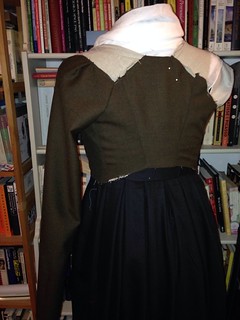
From the back.

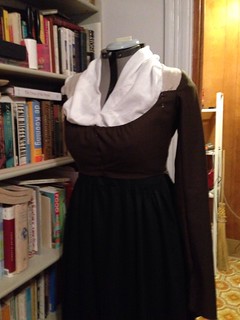
My other upcoming role as a maid will be at the John Brown House Museum, on October 5. This has required quite a bit of thinking and stewing about appropriate clothing and realistic background. I finally settled on a black-and-brown combination of petticoat and open robe, with the style of the open robe based on Paul Sandby drawings and extant garments, but determined by the scant three and a quarter yards of brown worsted that I was able to find.

Winter, 1795. The British Museum, 2010,7081.509

Winter, 1795. The British Museum, 2010,7081.509

The bodice back is based on the 1795-97 cross-front gown from Museum of Costume in Bath shown in The Cut of Women’s Clothes. The front is meant to be transitional: a little bit of gathering at the neck, but not a great deal, with the edges still pinning closed. The sleeves are long and slim, and will button at the wrist once I’ve gotten the length worked out.

The skirt will pleat, with fullness centered on the back triangle and decreasing to the front. For the black petticoat, I used the double inverted box pleat of the 1790s open robe in Costume in Detail. As you might imagine or just plain hope, they work! I’ve also made a small pad to help lift the skirt in the back and create the right profile; I’m thinking of adding buttons and loops so that it can migrate from gown to gown.

Share this:

  • Share on Facebook (Opens in new window) Facebook
  • Share on Pinterest (Opens in new window) Pinterest
  • Email a link to a friend (Opens in new window) Email
  • Share on X (Opens in new window) X
Like Loading...

Lovers & Fighters

24 Tuesday Sep 2013

Posted by kittycalash in History, Research

≈ 1 Comment

Tags

10th Massachusetts, 18th century, common people, common soldier, Revolutionary War, women, women's history

The wife of Bob Munn, Keeper at Sandpit Gate. Paul Sandby, Royal Collection Trust  RCN 914337

The wife of Bob Munn, Keeper at Sandpit Gate. Paul Sandby, Royal Collection Trust RCN 914337

On Sunday,  Mr FC mentioned that they knew the names of at least two of the women of the 10th Massachusetts, including one notorious woman, Bridget Mahoney. I mentioned this in an email to Mr HC, and got back four solid paragraphs of information. I sincerely and earnestly wish I had those retention skills, but embedded in one paragraph was that they knew of a woman in Wallcott’s company, because the brigade chaplain, Enos Hitchcock, had baptized the child of a soldier in Wallcott’s company.

Enos Hitchcock was the pastor of the First Congregational Church in Providence, and I happen to be fairly familiar with his pastel portrait and his diaries. The Rhode Island Historical Society published his diaries in 1899, and they can be read online thanks to the Open Library.

Here’s what I found, reading and searching:

April 25, 1779
Baptized child of Richard Northover, Soldier of the Train, by the name of Mary.

May 5, 1779
Married Sgt Bates and Mrs Lucy Gun

May 9, 1779
Baptized Lydda, daughter of George Wilson and Letty, his wife, of Capt. Buckland’s Train—Baptiized Adaulph, son of John Degrove of the above company

May 31, 1779
Sent for to go aboard the Lady Washington galley to marry John Thompson and Abia Chase

June 21, 1779
Married Henry Smith and Phebe Cockswain, late Brewer’s Regt.

Three baptisms and three marriages in just over 8 weeks: that’s a busy regiment.

Of course, they did their share of fighting, and not just on the field. I did not witness the fight instigated on Sunday morning by Mr FC, against the New York troops in which there was shoving, the beating of Mr S with a hat, and the deflection of Mr McC, who upon arriving with a shovel, was put to work digging.

September 17, 1777. Enos Hitchcock diary.

September 17, 1777. Enos Hitchcock diary.

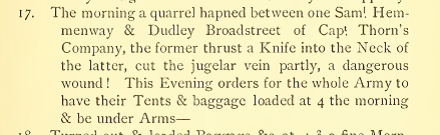
In Hitchcock’s diary, I found an account of a quarrel near Stillwater, NY on September 17, 1777. This was intramural knife-thrusting, but clearly, the 10th Massachusetts were very busy men.

Share this:

  • Share on Facebook (Opens in new window) Facebook
  • Share on Pinterest (Opens in new window) Pinterest
  • Email a link to a friend (Opens in new window) Email
  • Share on X (Opens in new window) X
Like Loading...

Missing the ‘maid’?

17 Tuesday Sep 2013

Posted by kittycalash in Events, History, Living History, Museums, Research

≈ 3 Comments

Tags

18th century, embroidery, John Brown, John Brown House Museum, Rhode Island, Ruth Smith, Sarah Brown, servant girls, servants, widows

Ruth’s seat is for a side chair. But there’s value in them thar seats. MMA 50.228.3

Sarah Brown had a sister, Ruth Smith. Ruth was good with a needle, and there is an extant chair seat made by Ruth. I’d always thought, in a fuzzy, not-thinking-too-hard kind of way, that Ruth had made the chair seat for her sister and brother-in-law because they were family, and how else would a lady spend her time but with her needle?

My thinking sharpened radically late last week when a colleague said, “Didn’t Ruth make shirts for John and James [Brown]?”

Yes, she did. In Ruth Smith’s 1785 daybook there are two entries, though the pages are lined for more.

The first records 5 shirts made for John Brown February; against this, in March, Ruth received a pair of shoes, and a pound of Hyson tea.

In April, she made 4 shirts for John Brown’s son, James; in May, she received 9 yards of lutestring from James.

The values didn’t seem to quite line up, so I’ll have to pull the day book again, but what seemed most important was Ruth’s trading shirts for shoes, silk, and tea. In “Dress of the People,” John Styles writes about servants drawing goods from merchants on their masters’ credit; did this transactional relationship allow Ruth wider access to the world of goods than her means might otherwise allow?

Shirt, ca. 1780. MMA 2009.300.62

And if Ruth makes shirts for John and James, are there other, less-well-off relations doing other work for the Browns? There are records of servants or slaves of African descent working in the house on Power Street, but we can only find evidence of three, one dedicated to the horses. That’s not nearly enough people to run a house with a dozen fireplaces and a kitchen, and six or seven occupants. It seems unfathomable that the Browns tended their fireplaces, hauled their water and cooked all their food themselves. John Brown writes to a daughter of “your Marr baking pies,” but it seems radically unlikely that Mrs John Brown, wife of the wealthiest man in Providence, would handle the heavy round of chores required to keep a household and its visitors fed, clothed, cleaned, and entertained.

Direct it, yes. Do it all herself, no.

Could we be missing the maids? Could we be overlooking evidence of work being done by extended family members “visiting” or “come to stay?” Could the poor and widowed and never married women of the Brown and Smith families be the people we should be looking for along with the servants or slaves of African descent? (By 1790 and later, it is not clear if the Browns’ slaves are working in the Power Street house, or if they are at the farm at Spring Green or Bristol, Rhode Island. Many records remain in private hands and others remain badly processed and arranged. I have referred herein to collections publicly held and well-processed.)

What this means, as always, is more research and more looking. It also means that the relationships between Mrs Brown and her ‘maids’ might be more complicated and more interesting. She knows these women, and their families, and how they fit into her world and her family. Could one be a distant cousin, a daughter of a mother no longer living, whose father is abroad, perhaps on a boat owned by John Brown or his companies? Might a young, unmarried woman in her twenties exchange work for room and board and credit with Brown & Francis? Perhaps.

Mourning Embroidery by Ann Barton, 1800. RIHS 1840.1.14

Mourning Embroidery by Ann Barton, 1800. RIHS 1840.1.14

That takes care of one or two of us–I’m looking for a widowed niece, with a son gone to  sea on a Brown ship to India. Mr S will have to tell me which battle he wants to widow me in, as he has rejected “lost at sea” and “frozen to death on the Oswego expedition” as possibilities. Actually, at my advanced age, I might have been widowed twice already. You’d think I would have done better with it.

Share this:

  • Share on Facebook (Opens in new window) Facebook
  • Share on Pinterest (Opens in new window) Pinterest
  • Email a link to a friend (Opens in new window) Email
  • Share on X (Opens in new window) X
Like Loading...

Chemisettes

16 Monday Sep 2013

Posted by kittycalash in Events, Making Things, Museums, Research

≈ 1 Comment

Tags

1800 event, 18th century clothing, bib and tucker, fashion, John Brown House Museum, patterns of fashion, Rhode Island, Rhode Island Historical Society, style, What Cheer Day

The Shooting Star: Snowy in his “best bib and tucker.”

Chemisette or tucker? By the time The Shooting Star was published in 1941-42, “bib and tucker” had wandered away from their original meanings. Tuckers were worn under women’s and girl’s bodices, taking on the role of neck handerchiefs or fichus, and what some people like to call “modesty pieces,” though the phrase always makes me think of the front panel of desks.

Janet Arnold includes chemisettes in Patterns of Fashion I, and you can buy a very nice one indeed from Cassidy at her Etsy store. (Reviewed here, and modeled, too!) But can you have one in Rhode Island in 1800? That is, of course, the question.

Hannah Weaver Peckham, RIHS 1958.3.2

Hannah Weaver Peckham, RIHS 1953.8.2

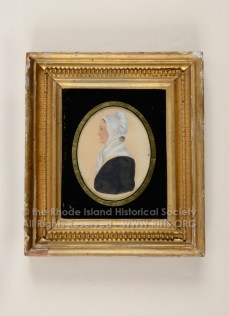
Turns out you probably can. Scrolling through the miniatures gallery, there was Hannah Weaver Peckham in her best tucker, and Miss Rhodes, while later, is also sports a chemisette or tucker. (Mrs Peckham looks a bit cranky, doesn’t she? Perhaps her busk is poking her.)

What you’d call it remains an open question.

The 1933 Oxford dictionary we have in the office defines “tucker” as “A piece of lace or the like, worn by women within or around the top of the bodice of the 17-18th C.”

Phoebe Smith Rhodes, RIHS  1918.3.6

Phoebe Smith Rhodes, RIHS 1918.3.6

The same dictionary tells me “chemisette” is 1807, from the French, diminutive of chemise. “1. A bodice, more or less like the upper part of a chemise. 2. An article, usually of lace or muslin, made to fill in the open front of a woman’s dress 1844.”

While I think that one could, in Rhode Island in 1800, wear a garment that filled in the upper part of a bodice, I’m not sure what one wold call that garment. The simplest thing to do is to wear a white kerchief  like Phoebe Smith Rhodes. Have I ever settled for the simplest thing? Not if I can help it.

Share this:

  • Share on Facebook (Opens in new window) Facebook
  • Share on Pinterest (Opens in new window) Pinterest
  • Email a link to a friend (Opens in new window) Email
  • Share on X (Opens in new window) X
Like Loading...
← Older posts
Newer posts →

Archives

wordpress statistics

Creative Commons License
Kitty Calash blog by Kirsten Hammerstrom is licensed under a Creative Commons Attribution-NonCommercial-ShareAlike 4.0 International License.

Website Built with WordPress.com.

  • Subscribe Subscribed
    • Kitty Calash
    • Join 621 other subscribers
    • Already have a WordPress.com account? Log in now.
    • Kitty Calash
    • Subscribe Subscribed
    • Sign up
    • Log in
    • Report this content
    • View site in Reader
    • Manage subscriptions
    • Collapse this bar
 

Loading Comments...
 

    %d