That Glint in Your Eye…

Tags

, , , ,

Winslow Homer, Snap the Whip. oil on canvas, 1872. Metropolitan Museum of Art, Gift of Christian A. Zabriskie, 1950, 50.41

Have you ever wondered what your friends would have been like to play with as kids? Mr S likes to, but he does have long hours on the commuter trains to fill, and I think by now he’s counted all the Bigfoot shelters along the route twice.

Sometimes we imagine one of our friends as the dirty, shirtless boy who plays hard until dark, until he realized he’s actually cut you with the stick sword, and you have to go home to get the blood cleaned up.

Another one might really be into building, but likes the process more than the result. Expect frank critiques, and lots of small parts, which ends in satisfaction and cookies. Sadly, when you come back, the creation is disassembled into neatly sorted constituent parts.

There’s the one who you partner with on a science fair project: you do the three-fold display with little samples of something, captioned. Too bad that when you win second prize and ask to take the display you designed and created home, you get hit under the eye with a lunch box for your trouble.

The Children of Nathan Starr. Oil on canvas by Ambrose Andrews, 1835. Metropolitan Museum of Art, 1987.404

Some friends are a little wilier: I don’t know how you get talked into licking something weird, but it can happen when you’re under ten. It’s not poisonous, but it is nasty. Sorry about that. Have some milk.

The bookish types aren’t all that safe either! Suddenly, on a windy day, you’re falling downstairs because Mary Poppins was far too convincing, and now Dad’s umbrella is ruined. Two strikes, and now your friend hears her mom calling her home? Pro tip: don’t play Wuthering Heights, Mill on the Floss, or Tess of the d’Urbervilles. Bonus note, and just trust me here: just leave the Brontes to Orson Welles.
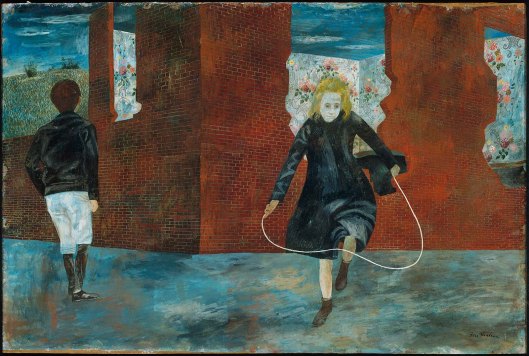
Girl Skipping Rope. Tempera on board by Ben Shahn, 1943. MFA Boston,  1971.702

Girl Skipping Rope. Tempera on board by Ben Shahn, 1943. MFA Boston, 1971.702

Don’t get me wrong: I enjoyed all the games and stories we made up and played when I was kid with all kinds of friends, and I enjoy everything my friends and I do today. But sometimes I see the glint in a friend’s eye, and I know we are in for something I might wish my mom wouldn’t let me do.

Can it!

Tags

, , , , , , , ,

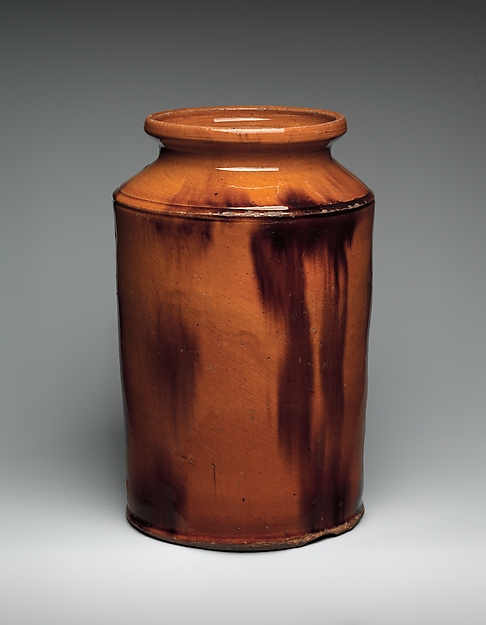
Jar. Paul Cushman, 1805-1833. Stoneware. 20032.475


Or, how do you keep your pickles?

At work, we have found that the road to history is paved with unexpected documents. As often happens, while looking for something completely different, m’colleague and I found two documents that might help illuminate the question of food preservation and storage in the 18th century.

Probate inventories: I read all the way through and had one of those d’oh! moments. Why? Because at the end, there’s all the kitchen stuff. Andirons, warming pans, roasting pans, kettles, firkins, kneading trays, piggins, barrels, casks, bottles. This is the stuff of cooking and keeping food.

There are clues in the receipts (recipes): Amelia Simmons gives a hint in the final instructions “To pickle or make Mangoes of Melons.”

“put all these proportionably into the melons, filling them up with mustard-seeds; then lay them in an earthen pot with the slit upwards, and take one part of mustard and two parts or vinegar, enough to cover them, pouring it upon them scalding hot and keep them close stopped.”

To pickle Barberries ends thusly:

“let it stand to cool and settle, then pour it clear into the glasses; in a little of the pickle, boil a little fennel; when cold, put a little bit at the top of the pot or glass, and cover it close with a bladder or leather.”

Jar, Thomas Commeraw.1797-1819. Stoneware. 18.95.13

To pickle cucumbers:

“put them into jars, stive them down close, and when cold, tie on a bladder and leather.”

To keep Green Peas till Christmas:

“have your bottles ready, fill them, cover the them with mutton suet fat when it is a little soft; fill the necks almost to the top, cork them, tie a bladder and a leather over them and set them in a dry cool place.”

If we tease these apart, we come up with some basics: preservation is done with pickling and “putting up” foodstuffs in pots, jars, bottles, and glasses. These are sealed with bladders, which are tied on; there is a sense in the first receipt that “close stopped” might imply corkage, but the repetition of bladders in the following receipts suggests otherwise for most of these; the entry for Emptins does state “will keep well cork’d in a bottle five or six weeks.”

Covered jar, Connecticut. Earthenware, 1800-1830. 18.27.1a, b

The other key? You’ve probably come across food packages that require storage in a “cool dry place,” and as we have cupboards in our kitchens, or perhaps in our pantries, early cooks also had pantries or butteries (say it but-trees). How’d they do it?

Jar,. Earthenware, 1800-1900. 18.95.11

Jar,. Earthenware, 1800-1900. 18.95.11

The 18th century house was not centrally heated. 18th century Providence residents recorded temperatures of 48 and 58 degrees indoors in the winter, in rooms with fireplaces. An unheated room or cellar would be cool, too; here in the Ocean State, maintaining dry conditions could be the bigger challenge.

What did those jars and pots look like? As you can see in this post, the Met has a few– fortunately, these appealed to collectors and wound up in museums. Closer to home for the original question, the Missouri History Museum has a collection with a number of jars. A cursory look showed dates in the 1830-1860 range, but the shares are consistent with those seen at the Met.

I’m not a food historian, and I don’t pretend to be, but as I think about answering a question, these are the steps I take. Recipes, collections, and then more looking. I just hadn’t remembered that probate inventories would list everything, so one might get a sense of a household’s contents and thus its eating and storage habits.

Shark Tank

Tags

, , , , , , , , , , , , , ,

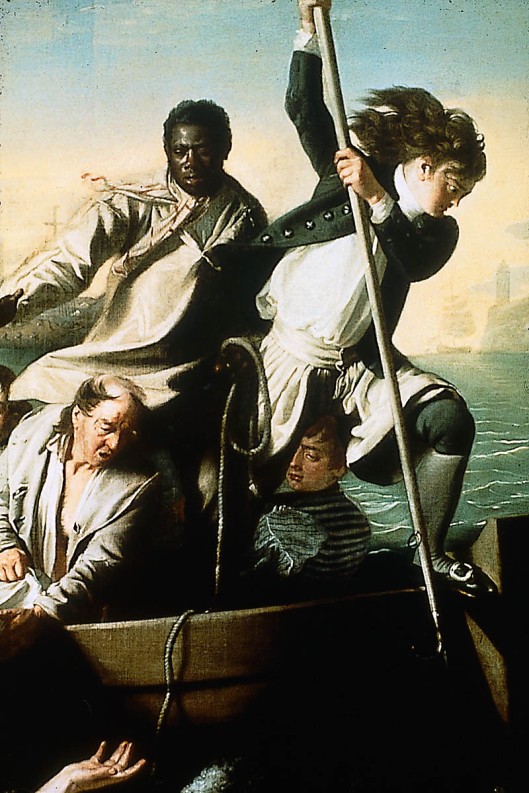
I’ve been thinking a lot about Watson and the Shark, at least when I am not thinking about the Raft of the Medusa, make of that what you will.

Here’s why: Waistcoats. Shirts. Open Jackets.

Detail, Watson and the Shark. MFA Boston 89.481

Detail, Watson and the Shark. MFA Boston 89.481

As you would expect from recent reports, the Young Mr has outgrown almost everything he owns, with the exception of his shirt. I put a lot of time into that blue wool jacket, so I’m not ready to sell it on Etsy yet, but I do have to replace it. Sewing new things means I get a chance to look again at sources for inspiration, and to do better this time around.

Since we’re in summer, I’m thinking blue linen, since I have access to very local inspiration in the form of Oliver Hazard Perry’s short jacket. But for earlier ideas, there’s Copley. I particularly like the horizontal stripe on the waistcoat, and what seems to be a striped shirt. Striped shirt! How exciting is that?

I’m thinking striped trousers, based on a Massachusetts letter, but we’ll see how far I get with that. The final deciding factor in wearing, of course, could be striped trousers are better than no trousers.

Frivolous Friday: A-Spalling Behaviour

Tags

, , , , , , , , , , ,

Mr. Turner, out now on iTunes and elsewhere, won’t be for everyone: M’damsel isn’t treated very well– artists are, you know, often narcissistic, driven users– but the landscapes thrill.

We talk sometimes about going to the antique store in historical clothing and asking why our chattel is for sale. I toy with similar naughty thoughts about visiting historic house and other museums, but Mr Turner inspires a dream of a simpler pleasure: dressing in period clothes to visit a period gallery.

Classic Mr Turner in the salon

Possibly my companion would grunt as Turner does, but we might also unnerve guards by pointing walking sticks at salon-hung still lifes or reacting with disgust at the sight of an Impressionist work. (Might as well take it all the way.)

Everybody’s a critic

No takers yet for this diversion, which is just as well. I expect it would be a quick way to meet security and police staff if you didn’t coordinate with the museum/gallery in advance. Still: what a stunt. Someday I’ll pull it off.

Room, Officers’, for the use of.

Tags

, , , , , , ,

Sometimes I feel like a third wheel at Rev War events. There is not always a lot for women to do besides chores, and the public often ignore us. Still, there is one maxim I know to be true: if you’re bored, work.

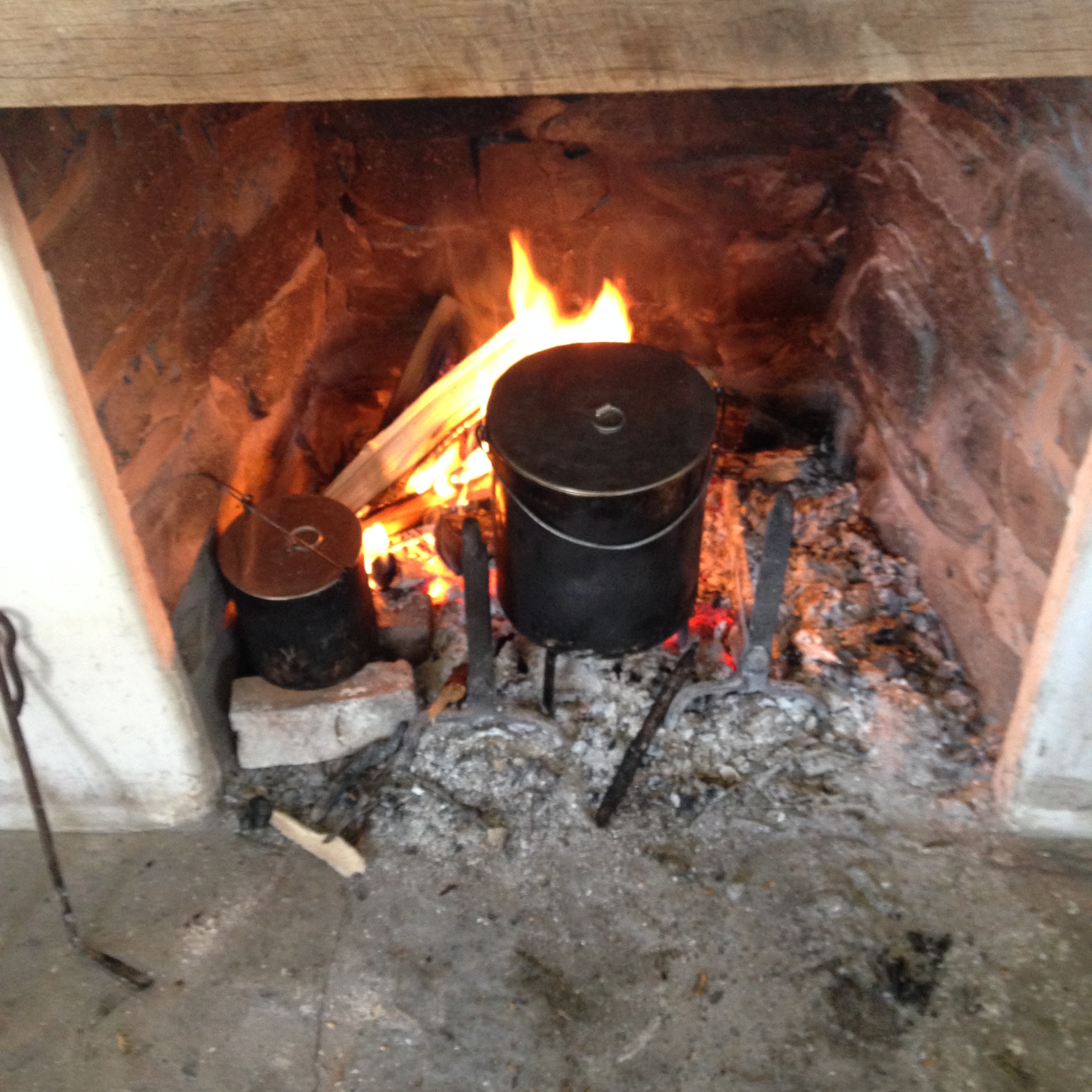
Thus, when I found myself drifting off Saturday, I started dinner. The best part was where I got to make dinner: in a chamber off the main room of the Temple at the New Windsor Cantonment. These two rooms were occupied by the 10th Mass this year. Last year, the unfinished room had been the scene of Dirt Stew.

Cutting vegetables on a table was a major upgrade; last year, I think I used the kettle lid, the floor being too gritty even for me.

IMG_3470

It’s End of Stored Root Vegetable season here, so largish carrots and parsnips went into the pot, along with potatoes, onions, and a cooked chicken disjointed by hand (a task I have experience in).

This year, we brought the only iron we own, a small trivet-like stand to put the big kettle on; the little one went on bricks from the Temple’s other fireplace. Was that slim piece of iron wrong? Probably, but in a place where we can’t dig a kitchen or make a fire outdoors, we compromised in the name of keeping supper unspilled.

IMG_3471

Why no fires outdoors? Red flag warnings, due to high winds and low RH. That all hobbies will be affected by climate change was clear on Saturday, as we discussed invasive species, transporting wood across state lines, and various site rules on using brush to build shelters. It’s not just about digging fire pits or kitchens and archaeology anymore.