• Home
  • Completed Costumes/Impressions
  • Emma and Her Dresses
  • Free Patterns and Instructions

Kitty Calash

~ Confessions of a Known Bonnet-Wearer

Kitty Calash

Tag Archives: 18th century clothing

Fashionable Friday: Floral Embroidery Galore

27 Friday Jun 2014

Posted by kittycalash in Clothing, Frivolous Friday, History, Museums, Research

≈ Comments Off on Fashionable Friday: Floral Embroidery Galore

Tags

18th century clothes, 18th century clothing, 19th century clothing, Bostonian Society, Costume, Events, exhibits, fashion, Massachusetts, museum collections, Museums, style
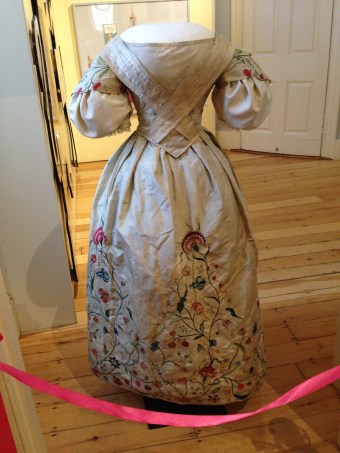
Colonial Wedding dress altered 1830

Elizabeth Bull Price’s Wedding Dress. Bostonian Society, 1910.50.35

On Tuesday evening, sensibility won over sense as my friend and I boarded the T for Boston to make a long day longer. The trip was worth it, though, for the One Night Only engagement of Elizabeth Bull’s wedding dress at the Bostonian Society. In truth, I bought the tickets for the event before I was even back at work and navigating our Fair City on my own– and who wouldn’t? That dress is amazing! (Tons more images of the embroidery are in the catalog record.)

Perhaps even more wonderful than the 14-year-old ElizabethBull’s needle skills is that the dress remains with us today. Kimberley Alexander and Tricia Gilrein reminded us on Tuesday of the many ways this dress, and other remnants of Bull’s wardrobe (oh, the petticoat, and the wonderful kerchief) connect us to the past in surprising ways. Elizabeth Bull was wealthy, married to Roger Bull, a Church of England official 22 years her senior: though they lived in Boston, they were British. (They were married in the 1730s, and Elizabeth died in 1780 at about 67.)

It’s a little hard to see past the 1830s alterations, but the embroidery of the gown helps chart that course, as well as the petticoat. As important to remember is that this wedding gown was not white: it has faded from a celadon green to its current off-white color. Wedding dresses weren’t white in the 18th century, or even long into the 19th, and it’s helpful to remember that as we look at what remains and reconstruct this in our mind’s eye.

It’s easy to forget we were British first here in the United States, and that the American War for Independence did not have a foregone conclusion. We forget, too, that churchmen and their wives were socialites as much as they were people of the cloth. Put Mr Collins out of your mind, and remember (my favorite minister & fashion maven) Reverend Enos Hitchcock and his pink satin waistcoat and suits of black silk.

Photograph of the altered gown. Bostonian Society, 1910.0050.057

Photograph of the altered gown. Bostonian Society, 1910.0050.057

Like many 18th century gowns, this one was remodeled in the 19th century, its shape altered to reflect the current fashion. We are lucky to have so much preserved, not just in the gown but also in the petticoat. Paths to understanding of women’s education, the customs and habits of Boston’s colonial elite, and the persistence of past can all be found within this object.


Share this:

  • Share on Facebook (Opens in new window) Facebook
  • Share on Pinterest (Opens in new window) Pinterest
  • Email a link to a friend (Opens in new window) Email
  • Share on X (Opens in new window) X
Like Loading...

Frivolous Friday: Footwear

20 Friday Jun 2014

Posted by kittycalash in Clothing, Frivolous Friday, History, Reenacting

≈ 1 Comment

Tags

18th century clothing, comfort, fashion, Metropolitan Museum of Art, Reenacting, resources, Robert Land, shoes, style

Shoes, 1810-1820. Gift of Miss M. Lee. T.385&A-1960, Victoria & Albert Museum.

Shoes, 1810-1820. Gift of Miss M. Lee. T.385&A-1960, Victoria & Albert Museum.

Like my grandmother, I love shoes. Also like my grandmother, I have “problem feet.” Finding a pleasing ladies’ shoe in a size 11 narrow is no mean trick, and with arthritis and activity, fit becomes ever more important. Standing all day in ill-fitting shoes will not improve your ability to interact with the public in a pleasant way, nor will it improve your stamina, which you will need if you are cooking for a motley assortment of ‘gentlemen.’

Many reproduction historic shoes (and most contemporary shoes) just don’t fit me, so I can’t order from common suppliers and I can’t alter affordable fashion shoes. Like Cinderella’s stepsisters, the shoes don’t fit.

Robert Land's Regency Lady's Shoe

Robert Land’s Regency Lady’s Shoe

That means that sometimes my shoes are not quite-quite correct. For 1799-1800 events, I wear Robert Land’s 1812 shoe, which is modeled on a shoe in the V&A collection. I find Land’s lasts are long and narrow, he makes my size, and lo and behold! Last time I ordered, the shoes arrived in four weeks. My mileage has varied in that regard, and yours may, too. They aren’t cheap, but they are well-made, straight-lasted, and most importantly, they fit. (I’ve been wearing them to work this week, because their flatness is more comfortable than my modern shoes.)

Shoes, 1810-1829. Probably British. MMA 2009.300.1471a–d

Do I wish they came in silk? Yes. Do I wish he’d make ladies’ 18th century shoes? Yes. But I have a workaround for the 18th century that I debuted on Flag Day: Mules. They won’t work for every event– I don’t think these are the shoes for climbing Stony Point in July–but they have their benefits. For one thing, you can take them off. Barefoot is best (maybe not in Boston), and not having to wear stockings when it’s 80+ degrees is nice, though only permissible if you’re named Bridget and have a shirt problem.

Burnley & Trowbridge men's mules

Burnley & Trowbridge men’s mules

Burnley & Trowbridge shoes also run narrow, and their men’s mules work for me, because I like a very low, flat heel. In winter, wool stockings make up any size differential, and in summer, these flats are pretty comfortable and even walkable. They may not be perfectly correct (though documented here), but comfort plus documentation goes a long way in my book.

What I’d really like, at least for late War interpretations, are a pair of these red velvet shoes at the MFA. Latchets for buckles, low heels, and they’re red? While I wonder about the date, the features I like might outweigh any misgivings– except that I cannot afford Sarah Juniper‘s work, and I can’t make my own shoes (yet).

Pair of women’s shoes, 1780s. MFA Boston, 44.493a-b

Share this:

  • Share on Facebook (Opens in new window) Facebook
  • Share on Pinterest (Opens in new window) Pinterest
  • Email a link to a friend (Opens in new window) Email
  • Share on X (Opens in new window) X
Like Loading...

Gentlemen Prefer Blue

19 Thursday Jun 2014

Posted by kittycalash in Clothing, History, Living History, Museums, Research

≈ Comments Off on Gentlemen Prefer Blue

Tags

1812, 18th century clothes, 18th century clothing, 19th century, 19th century clothing, Blue wool coat, common dress, common people, fashion, menswear, museum collections, Rhode Island, Rhode Island Historical Society, RIHS Museum Collection, style

Blue wool coat c. 1800. RIHS Museum Collection 1968.38.1

Blue wool coat c. 1800. RIHS Museum Collection 1968.38.1

Continuing the theme of wool coats that will make you itch in August, I present you with another Rhode Island coat. This coat has features I’m more familiar with: a smooth sleeve head, slightly fuller tail pleats, and tail pockets (I love secret pockets). The notched collar with its fine beak-like points makes me think this is later than 1790-1800, as the style heads in the direction of the white wool coat from yesterday’s post.

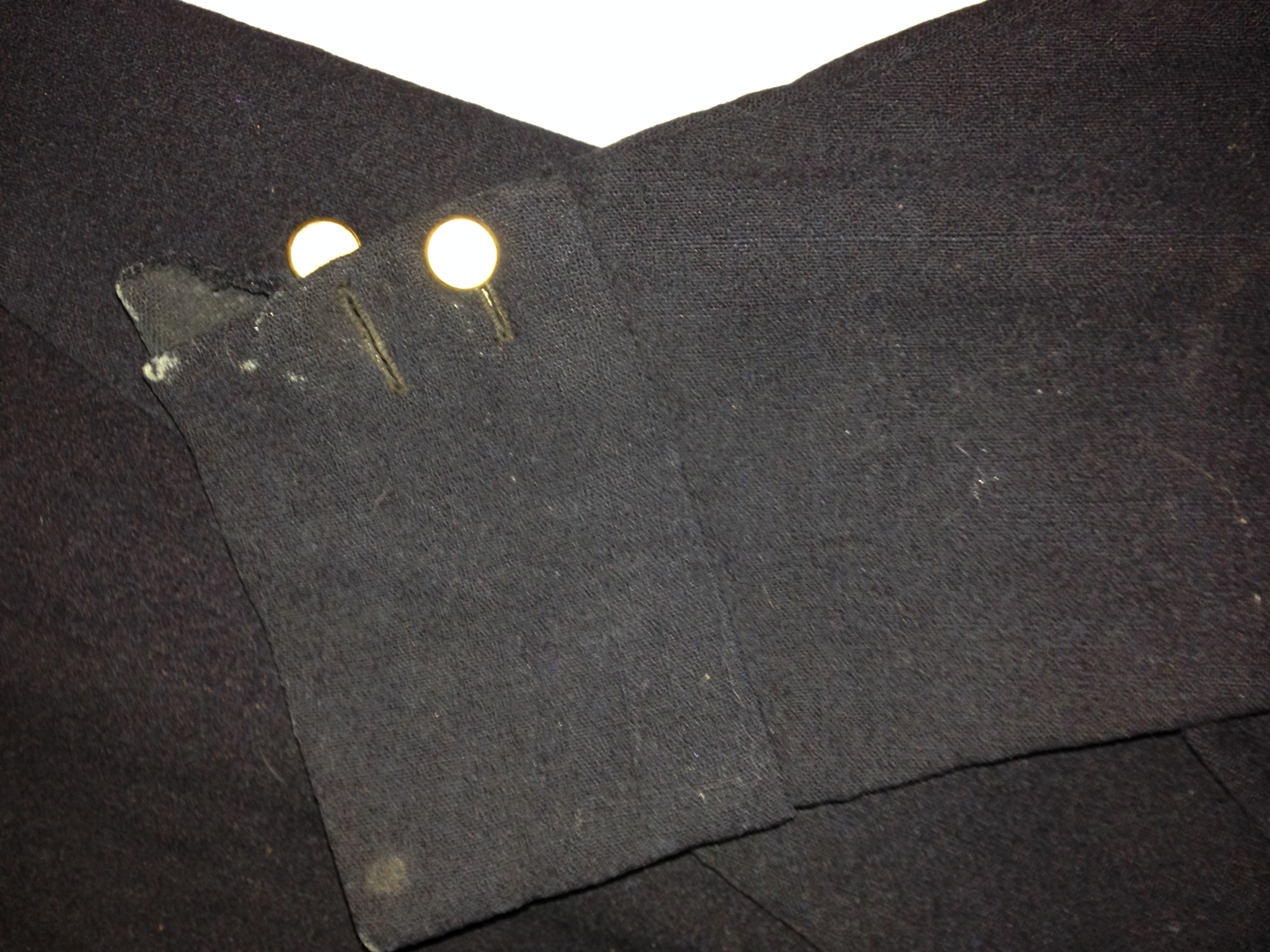
Slit cuff with two buttons, RIHS Museum Collections, 1968.38.1

Slit cuff with two buttons, RIHS Museum Collections, 1968.38.1

There’s no waist seam, so we can be pretty certain that this coat is earlier than 1818, if not 1810. Another telling measure of age is cuff treatment. This slit cuff seems to start in the 1780s or 1790s and persist into the early 19th century, (and beyond: gentlemen, check your coat sleeves and you’ll see what I mean).

That’s an awfully long range, 1780s to forever, but the smooth sleeve head and lack of waist seam help narrow the time frame. I’d hazard– and this is a hazardous business– ca. 1805 date for this coat, which would give me leeway for a common man to wear this into 1812, though make it more difficult for him to wear it in 1799/1800. (You can look back in fashion, but high style on the lower sorts is a tricky business and requires a lot of thought.)

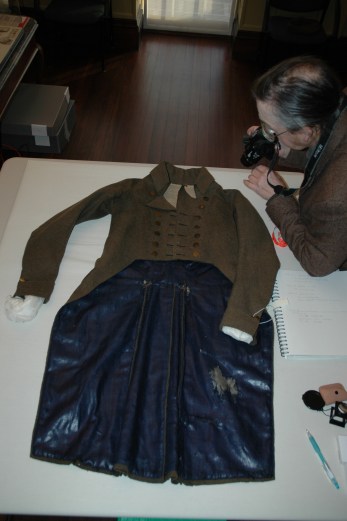
1925.11.1A, RIHS Museum Collection

1925.11.1A, RIHS Museum Collection

For travel to 1790-1800, I have another coat in mind, though it will probably be a long time before I get it made. This, too, has classic markers of its time, though the collar’s stand-and-fall style makes me think it is closer to 1790 than to 1800.

The lining of this coat is a particular treat: every time I’m able to pull this out for viewing (and since it’s boxed right now, that’s not happening), that blue glazed wool is a treat. The wear mark on the left proper tail lining is intriguing, too: sometimes those start as moth holes and progress, and sometimes they’re wear that’s later found to be delicious and expands by chomping. (Wool and silk and protein, and delicious treats for pests.)

I find these coats really exciting, and often feel a little “Make All the Coats,” but of course I can’t, not quickly, anyway. And these two don’t really solve my August in 1812 problem, as the clock ticks on…but I think there is a solution, thanks to Sharon Burnston and Fitting & Proper.

Share this:

  • Share on Facebook (Opens in new window) Facebook
  • Share on Pinterest (Opens in new window) Pinterest
  • Email a link to a friend (Opens in new window) Email
  • Share on X (Opens in new window) X
Like Loading...

Back Bump: The Regency Silhouette

03 Tuesday Jun 2014

Posted by kittycalash in Clothing, History, Making Things, Reenacting, Research

≈ 3 Comments

Tags

18th century clothes, 18th century clothing, authenticity, Costume, dress, fashion, fashion plates, history, living history, Making Things, Research, sewing

Ah! Quelle antiquité!!! Oh! Quelle folie que la nouveauté ... Engraving, 1797. 1892,0714.755 British Museuem

Ah! Quelle antiquité!!! Oh! Quelle folie que la nouveauté … Engraving, 1797. 1892,0714.755 British Museum

Regency, Federal, Early Republic:  we use these terms to cover (roughly) the period from 1790-1820, though technically the Regency period would mean only 1811-1820, when George IV served as Prince Regent, ruling for his incapacitated father, George III. In the United States, “Regency Costuming” is a bit of misnomer if you’re copying early American gowns, but it does serve as a handy short-hand we all tend to understand.

Grossly, the principles of dress are rooted in neo-classicism and republicanism rising from the American and French Revolutions. Specifically, we see a turning away from the heavily-boned, panniered, and formal gown styles to the looser, short-stayed, flowing, simpler gowns.  The transition is summed up for me in this satirical print.

So, you’re no longer side-to-side wide, baby: you gotta have back.

How do you get back? There are a couple of perfectly authentic tricks that do not require you to stuff a cat into the back of your dress, though you can do that if you want. The combination I have found to work is two-part: a small, crescent-shaped pad, and the method of pleating. How you deploy the pad and the pleats will give you the silhouette you desire.

First, though: which silhouette? In really the 1790s, the silhouette is rounder than you might think. It really is a round gown.

Ann Frankland Lewis, 1793. LACMA
The Frail Sisters, 1794

To get that look, I use a small rump pad, bustle pad, or bum roll (call it what you like), which is stitched to the inside of my petticoat.

Pad from the inside
Pad from the inside
Pad from the outside

That’s the white IKEA curtain petticoat I made during the extended snow days of last year, and which I have worn with the red curtain-along open robe and under the petticoat and open robe for What Cheer Day. The pad is the same natural light-weight linen I use for a many gown linings, filled with bamboo stuffing. If I’d had wool on hand in the small hours of the morning I made this pad, I would have used it, but all I had was bamboo in the rush to finish up and have something to wear for a photo shoot.

The other key factors are pleating styles and fabric weight. Pleats can add lift, but in general, the lighter the fabric, the more lift a small pad will give you.

Double and triple box pleats, exterior view
Double and triple box pleats, interior view

1780_1790
I’m particularly fond of the pleats used for the gown shown on page 75 of Nancy Bradfield’s Costume in Detail. I’ve used this as a guide several times, and I am very pleased with the results. They do vary, of course, depending on fabric weight, fibre, and length. Stiffer cottons, like the Waverly Felicity of the curtain-along gown, will make a round shape; tropical weight wool does fairly well, also, but the most amazing 1790s rendition I have achieved to date is the light-weight India print cotton short gown.

On Cassandra
On Cassandra
On me
On me

Now that’s 1790s back. The bustle-like shape surprised (OK, shocked) me, but on the whole, I think I’m pleased. So there you are: pad, petticoat and pleats: that’s how you get back.

Share this:

  • Share on Facebook (Opens in new window) Facebook
  • Share on Pinterest (Opens in new window) Pinterest
  • Email a link to a friend (Opens in new window) Email
  • Share on X (Opens in new window) X
Like Loading...

The East Indies Trade

28 Wednesday May 2014

Posted by kittycalash in Clothing, History, Research

≈ 5 Comments

Tags

18th century, 18th century clothing, 19th century clothing, dry goods, East India trade, fashion, merchants, newspapers, Rhode Island, saris, silks, style

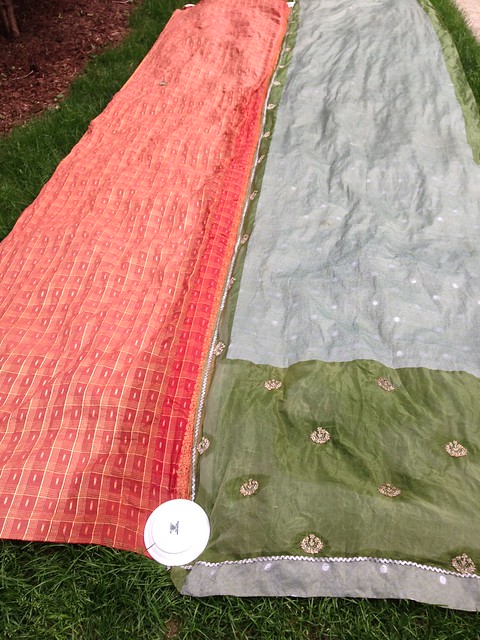
Saris drying after a vodka bath

Like any good Rhode Island trader, I am pleased to announce the acquisition of some India silks. To be fair, I have not burn tested these, so while they were sold as pure and not ‘art’ silk, one never knows till one puts fabric to flame.

As reported elsewhere, these did have an odor (as most vintage and used textiles do) but a bath in vodka and cold water solved that. They seemed color fast, and brighter after washed. It’s really nice when what you read on the interwebs is true, isn’t it? Thanks to the Laced Angel blog entry, Mr S and I found ourselves at the liquor store asking for the cheapest vodka they had. It came in a plastic bottle, and we were compelled to explain we were going to be cleaning with it. The manager seemed pleased to get the tip, since his wife has a collection of her aunt’s doilies and  things in their garage… I think Mr S was glad to drag me away, but he does get more human contact than I do, these days.

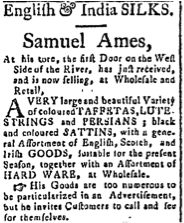
Samuel Ames, May 19, 1796

Samuel Ames, May 19, 1796

Besides just loving the fabrics and the potential for gowns and waistcoats, trading on Etsy with women in India pleases me logistically and historically. I retain a Huckle Cat fascination and delight with mail services, and am just astonished that a woman in New Delhi can wrap these up and put them into the India mail service and a week later they’ve made it to Rhode Island. How many trucks and airplanes does that take? And in the 18th and early 19th centuries, how many carts and ships and wagons?

Lopez and dexter 1809

By May 1796, the partnership of Brown & Francis was probably faltering (they dissolved that August, probably due to John Francis’ ill health), but Samuel James might well have boughtthe goods he advertised at wholesale from Brown & Francis. There were other importers, of course, in other Rhode Island ports, as Lopez & Dexter in Newport, advertising goods in 1809. Five cases of India silks! Four cases of fancy Prints!

It’s astonishing, the quantity of goods brought from the East, as astonishing in its way as the quantity of goods we bring from the East today. The range of colors, prints, and textures must have been incredible! For all the white muslin gowns of the Early Federal/Regency period that remain in collections, there must also have been numerous patterned gowns, shawls, and Spencers, and fancy ribbon trims, not to mention fancy silk waistcoats made up from the silks.   I think we underestimate the rich texture of the past at multiple class levels– these ranges of goods hint at how colorful and acquisitive our ancestors were.

Share this:

  • Share on Facebook (Opens in new window) Facebook
  • Share on Pinterest (Opens in new window) Pinterest
  • Email a link to a friend (Opens in new window) Email
  • Share on X (Opens in new window) X
Like Loading...
← Older posts
Newer posts →

Archives

wordpress statistics

Creative Commons License
Kitty Calash blog by Kirsten Hammerstrom is licensed under a Creative Commons Attribution-NonCommercial-ShareAlike 4.0 International License.

Website Built with WordPress.com.

  • Subscribe Subscribed
    • Kitty Calash
    • Join 621 other subscribers
    • Already have a WordPress.com account? Log in now.
    • Kitty Calash
    • Subscribe Subscribed
    • Sign up
    • Log in
    • Report this content
    • View site in Reader
    • Manage subscriptions
    • Collapse this bar
 

Loading Comments...
 

    %d