• Home
  • Completed Costumes/Impressions
  • Emma and Her Dresses
  • Free Patterns and Instructions

Kitty Calash

~ Confessions of a Known Bonnet-Wearer

Kitty Calash

Tag Archives: 19th century clothing

Small Obsessions

09 Saturday Jan 2016

Posted by kittycalash in Uncategorized

≈ 6 Comments

Tags

18th century, 19th century clothing, art, art history, interpretation, living history, miniatures, paint boxes, paintings, Rhode Island, Rhode Island history, women's work

IMG_5625Some of you may recall that I am a recovering artist with a fairly constant need to keep my hands busy. To encourage industry and the domestic arts, and to keep me out of trouble generally, a thoughtful friend provided me with a start to furnishing an early nineteenth century-style paint box. They’re hard to come by, these paint boxes, and extant examples fetch far more than we can afford chez Calash, being in somewhat reduced circumstances of late.

Thomas Reeves & Son Artists watercolor paint box c. 1784 to 1794. Whimsie Virtual Museum of Watercolor Materials

Thomas Reeves & Son
Artists watercolor paint box c. 1784 to 1794. Whimsie Virtual Museum of Watercolor Materials

Researching paint boxes and miniature painting in the early Federal era has been a happy fall down a deep rabbit hole. It’s clear that Reeves watercolors were being sold in Providence in the early 19th century; Peter Grinnell & Sons include “Reeves watercolor boxes” among the extensive list of items for sale in an 1809 newspaper ad. Frames and cases were also to be had; John Jenckes, gold and silver-smith and jeweler, advertised gold miniature cases in 1800.

Distraction is always easy to come by, tunnels leading from main entrance to the warren. Painting manuals, scholarly articles, and extant examples, which prove most distracting of all. SO shiny.

George Catlin Artist: John Wood Dodge (1807–1893) Date: 1835 Medium: Watercolor on ivory Dimensions: 2 3/16 x 1 13/16 in. (5.6 x 4.6 cm) Classification: Paintings Credit Line: Rogers Fund, 1926 Accession Number: 26.47

George Catlin byJohn Wood Dodge, 1835, MMA 26.47

Searching the Met’s collection, I found a portrait of George Catlin, remarkably similar in pose to an image of a friend I considered copying, but had thought too modern. My assumption has been proved wrong, and I am delighted. And then I found the HIDEOUS checked neck wear, always distracting. Historic New England provided super-tiny-bowtie man, and then I really had to focus, since I’m only enabling, not making, neck wear.

My real focus, of course, is on female miniaturists, especially in Rhode Island (gallery of RI miniatures can be found here.) From the scant number of women I’ve found advertising in the local papers, (okay, two: Miss Mary R. Smith, in 1820, and Mrs Partridge in 1829) I’ll have to expand my search geographically. Nantucket Historical Association had an image attributed to Anna Swain, and ten attributed to Sally Gardner.
Eye

The Met, repository of so many wonders, has works by six women miniaturists, including Sarah “Wowza” Goodridge and Anna Claypoole Peale. For all we know, some of the works by unidentified makers might be the work of female painters. The extant miniatures in all collections, range in quality from excellent to amateur, giving hope to those of us unpracticed in portraiture, and regaining our hand.
Share this:

  • Share on Facebook (Opens in new window) Facebook
  • Share on Pinterest (Opens in new window) Pinterest
  • Email a link to a friend (Opens in new window) Email
  • Share on X (Opens in new window) X
Like Loading...

Packing Meat

19 Thursday Nov 2015

Posted by kittycalash in 1830s, Clothing, Events, Reenacting

≈ 1 Comment

Tags

1830s, 19th century clothing, common dress, common people, dress, fashion, living history, Massachusetts, Old Sturbridge Village, sewing

If it bleeds, it leads.

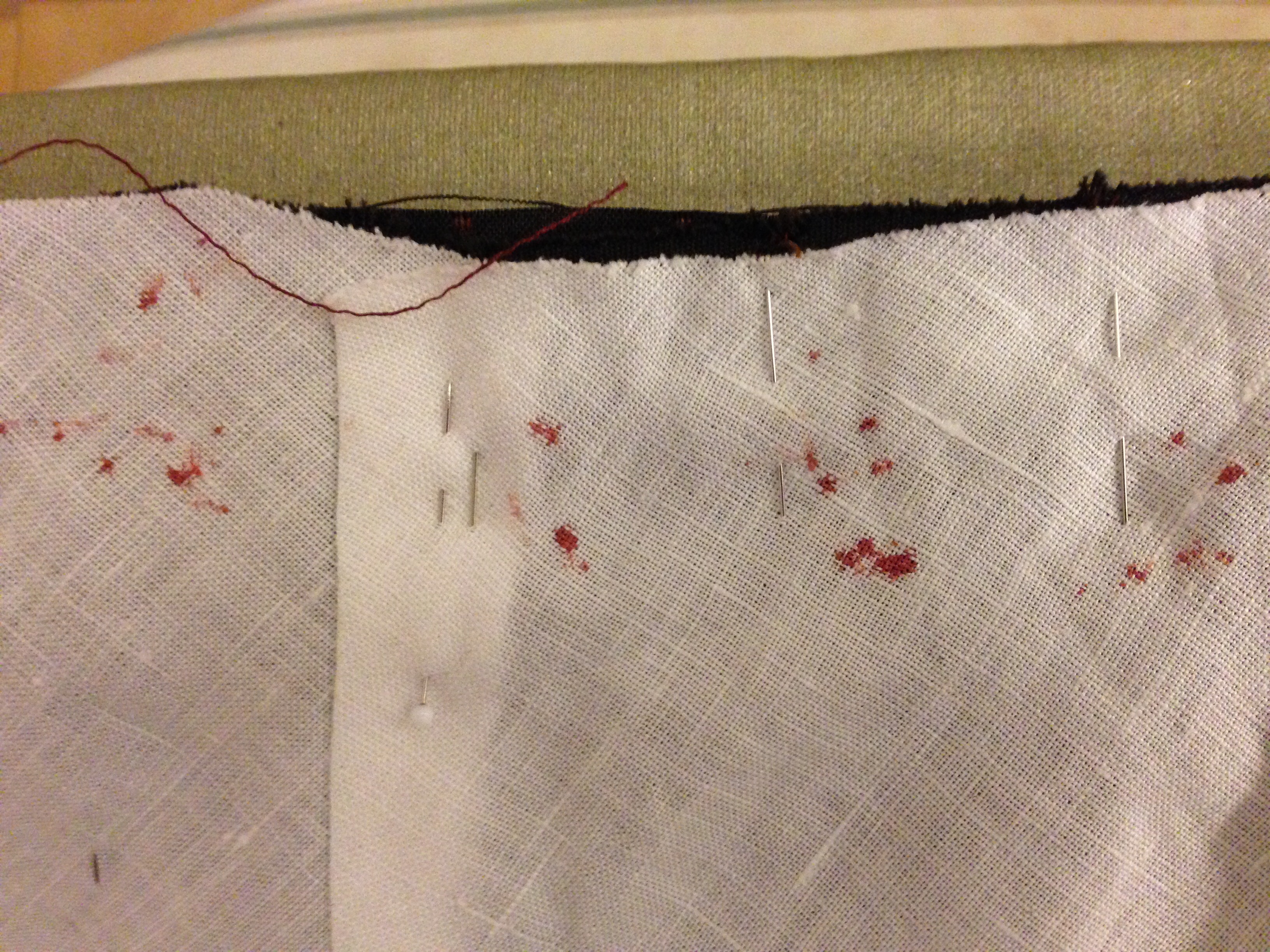
If it bleeds, it leads. Waistband pinning is surprisingly dangerous.

Sometimes you end up doing things for reasons you don’t entirely understand. Remember that brief flirtation with the 1830s? Well… we met again, and this time, I said yes to the dress.

Several friends are on the “shoot meat, win a target” program at OSV this weekend, and I agreed to go along. Yes, it’s a gun show. Yes, I’m compromising again.

Gentle reader, it gets worse. While I had not planned to dress, I rethought this choice last week. Awake in the early morning hours of November 11, I thought about dress patterns, wool petticoats, and the contents of the Strategic Fabric Reserve. One of my wool petticoats fit the waistline of my 1820s dress better than the 1800 dress I made it for, so I figured I was on my way towards being warm outdoors in November.

Spot the error. It's the dyslexic '30s.

Spot the error. It’s the dyslexic ’30s.

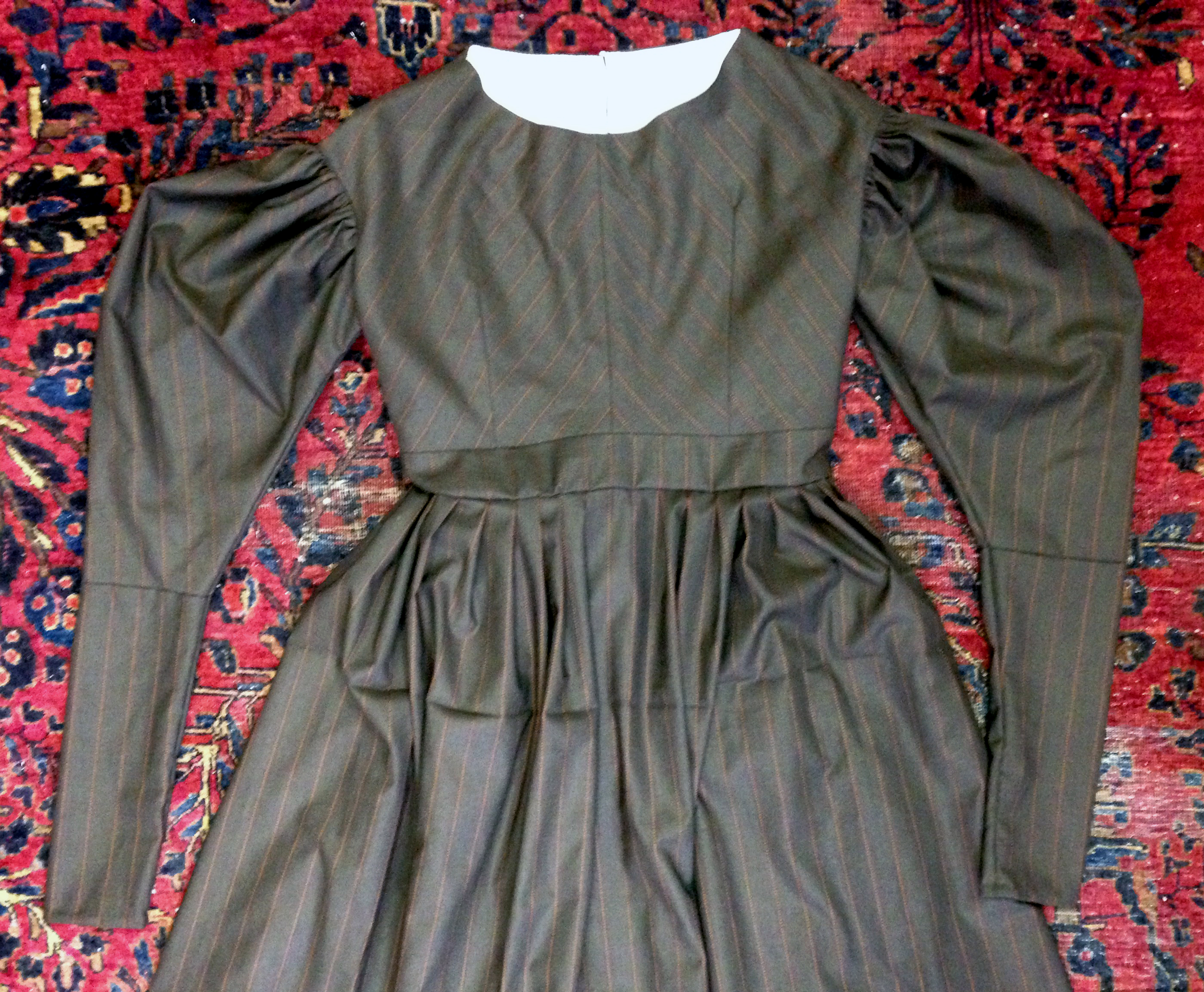
I have 1830s patterns, and a muslin was quick to make. Worse yet, once the muslin was made up and tried on over stays, it needed no alteration beyond a slight shoulder seam adjustment. Can you imagine? That hideous decade fits me? Doom or destiny, you be the judge: I had enough striped wool blend to cut a dress and a pelerine… so I did.

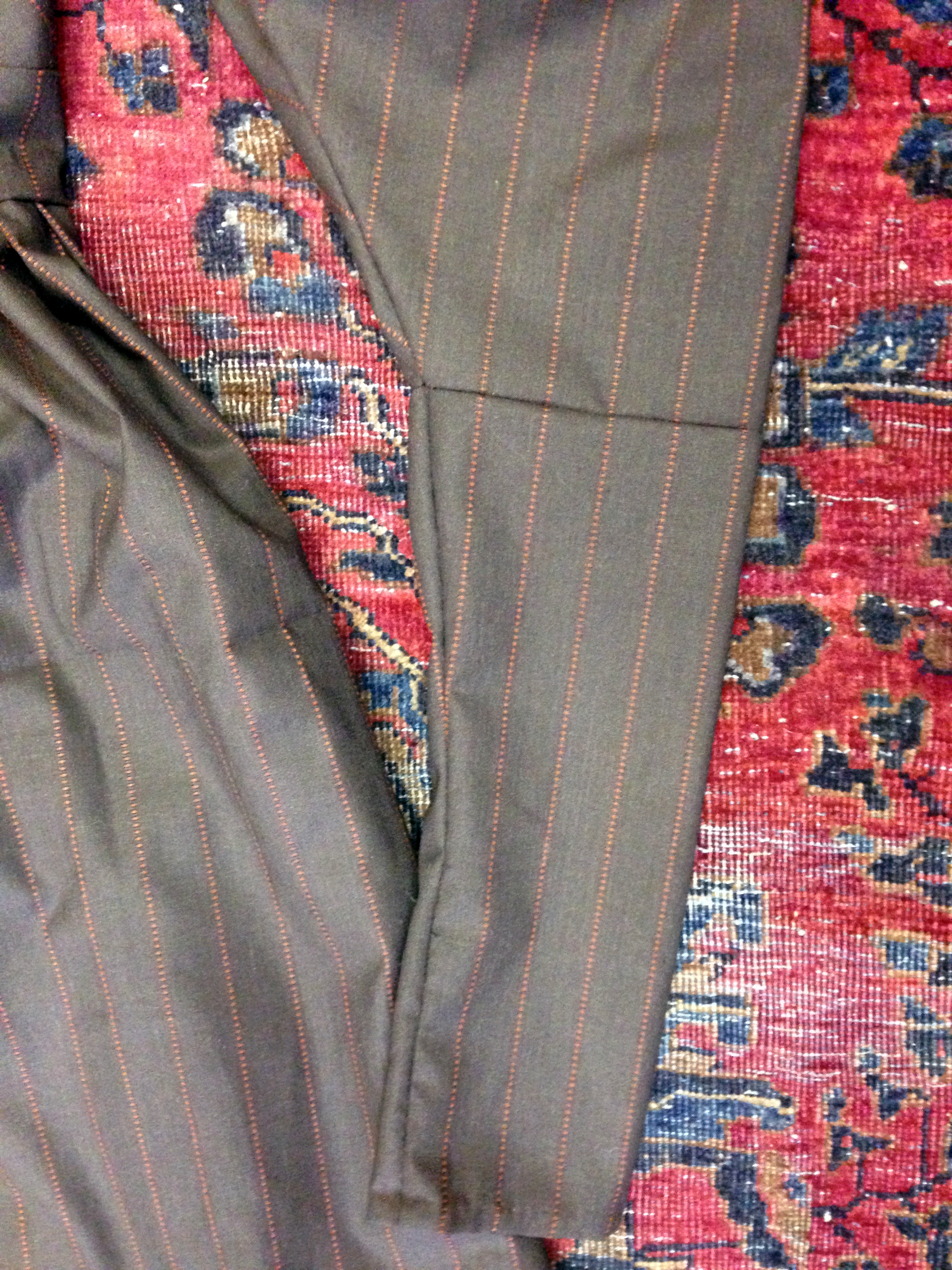
The other sleeve's stripes are just slightly off.

The other sleeve’s stripes are just slightly off.

The bodice went together quickly, and the sleeves were fairly easy at the shoulder and arm scye (I really enjoy setting sleeves). It was the length and width along the forearm that threw me, and I ended up having to piece on the lower sleeve. Twice.

The sleeves are where the meat comes in: you say pork chop, I say leg of lamb, the fashion plate says gigot. I did reduce the arc a bit, which makes this a more late-1820s style than firmly mid-1830s. Since some of the folks I’m going with will be wearing a mix of late 1820s and 1830s styles, slimmer sleeves seemed reasonable.

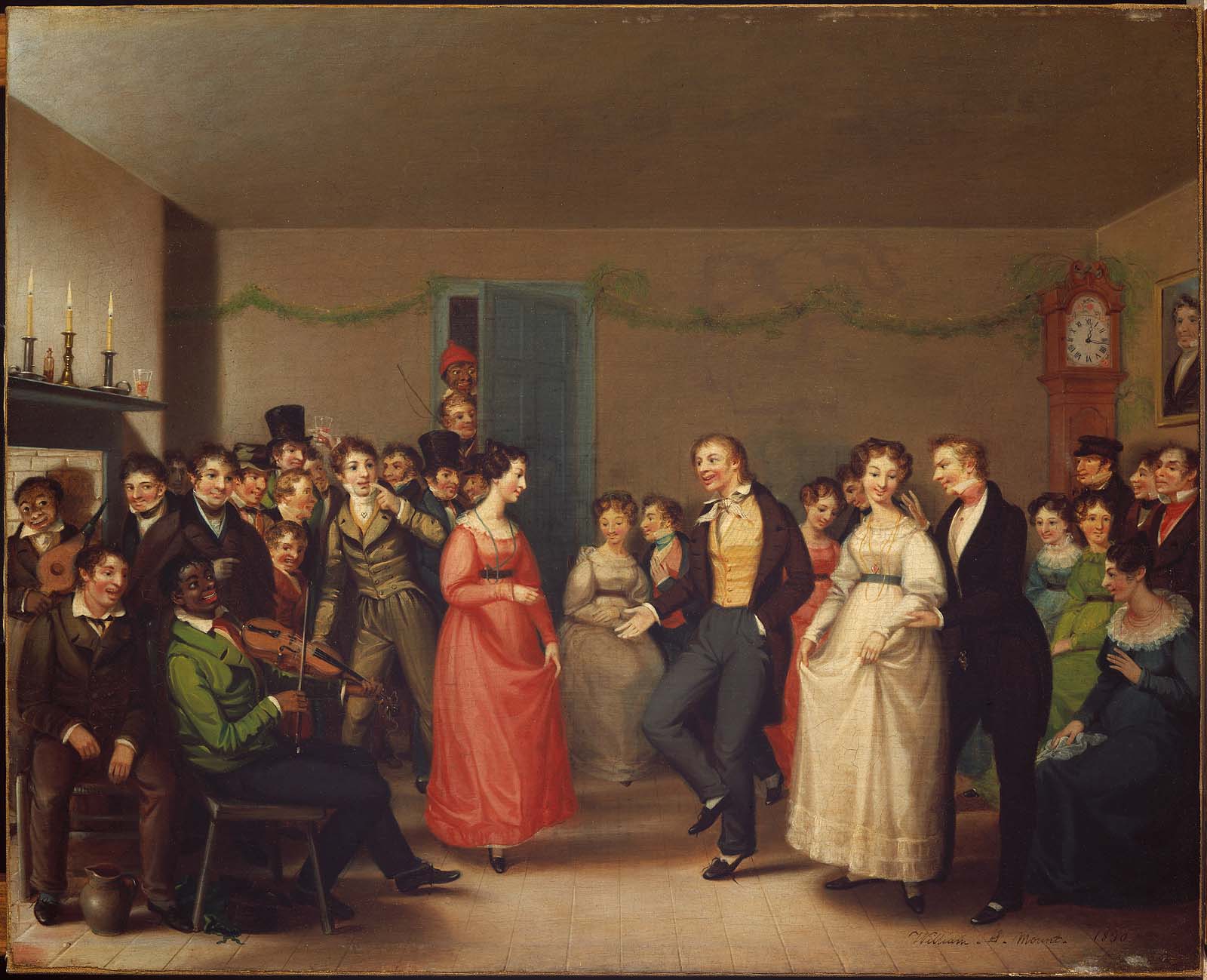
Rustic Dance After a Sleigh Ride, 1830. William Sidney Mount MFA Boston 48.458

Rustic Dance After a Sleigh Ride, 1830.
William Sidney Mount MFA Boston 48.458

More seriously, I’m taking cues from the William Sidney Mount painting I’m so fond of. The women in this 1830 painting have less flamboyant sleeves and possibly achievable hair. Honestly, the things I get into when I lie awake and think. I ought to know better by now…but every decade is a new adventure.

What remains to be done? Backstitching the waistband and waistband lining, hooks and bars at the back closing, the ever-popular hem of enormity, and a final pressing. Achievable, I think, with focus and some lunchtime sewing.

Share this:

  • Share on Facebook (Opens in new window) Facebook
  • Share on Pinterest (Opens in new window) Pinterest
  • Email a link to a friend (Opens in new window) Email
  • Share on X (Opens in new window) X
Like Loading...

Good Grief

25 Sunday Oct 2015

Posted by kittycalash in Events, History, Living History, Museums, Reenacting

≈ 4 Comments

Tags

19th century clothing, authenticity, Federal style, first person interpretation, funeral, historic house museums, interpretation, John Brown, John Brown House Museum, living history, memorials, mourning, Providence, Rhode Island Historical Society, Rhode Island history, What Cheer Day, women's work, work

1803 dress and hair

Pre-sweat melted hair

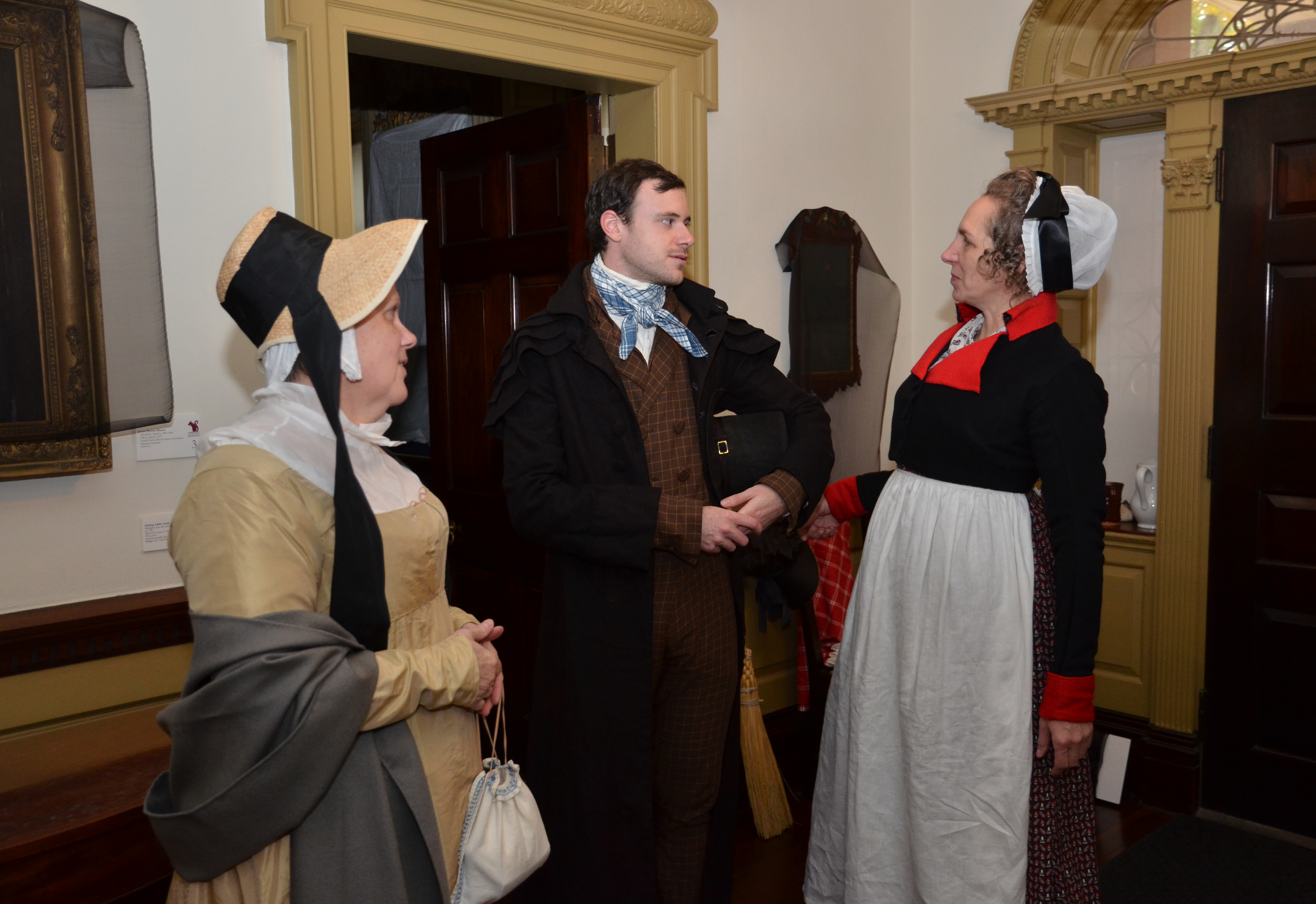
I had my doubts about this event, since we were interpreting the death and mourning of John Brown a full month after it actually happened, and initially resisted somewhat strenuously. But people change, and by the time I was operating a motor vehicle at high speed on I-90 six months later, I could be– and was– convinced. Knowing little, if anything, about early Federal mourning customs mattered not at all. There’s always time to learn, right? Well… if you read fast enough, you can do anything.

Esther and Kitty draping the mirrors

Esther and Kitty draping the mirrors

Despite the bustle, Esther and I found time to cover many of the mirrors with sheets, and the portraits with black crepe; this is a time of reflection, not vanity. It gave our rooms a gloomy mien, and reminded us of our short span on this earth.

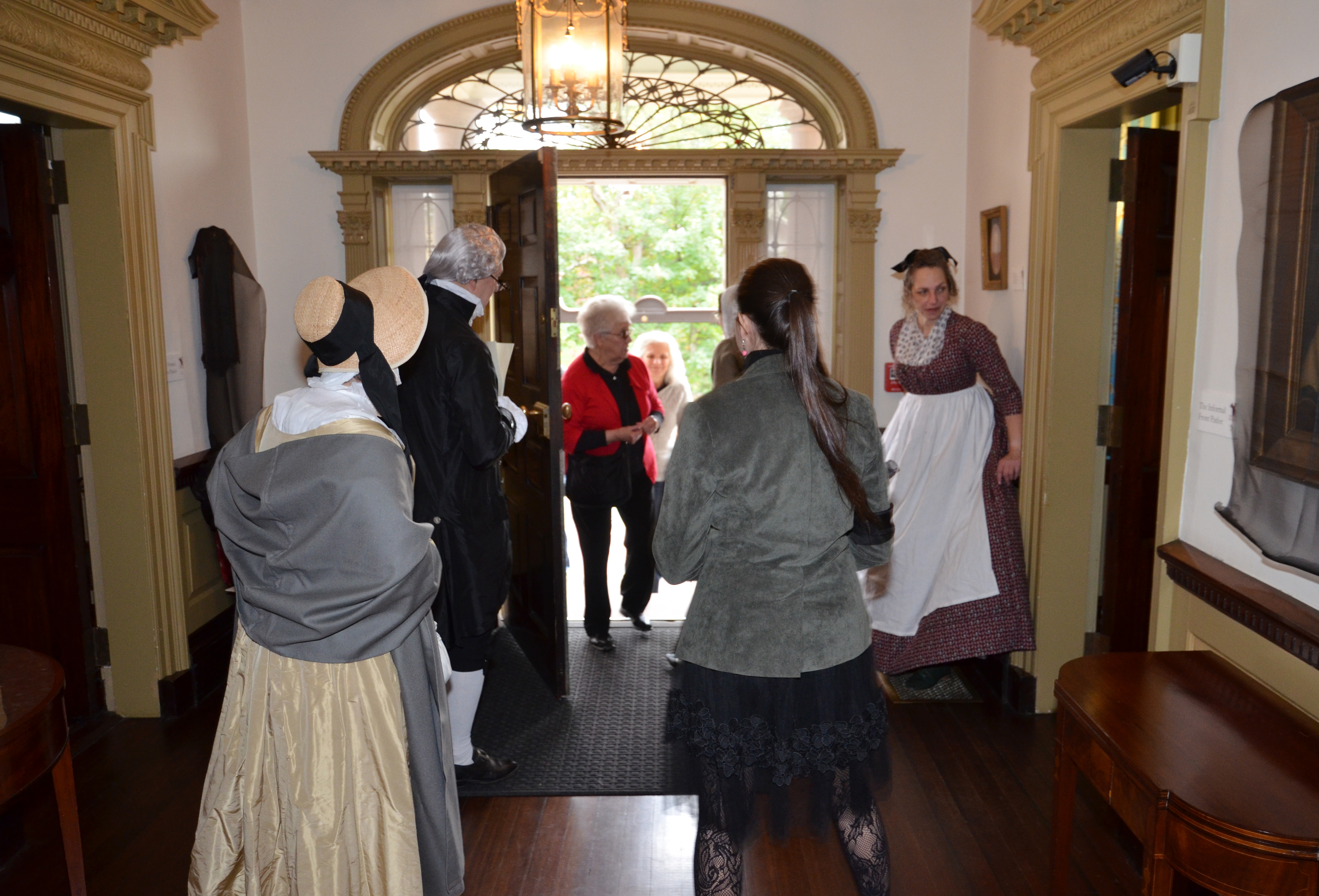
Visitors in the front hall of the John Brown House, Providence RI

We had many callers

We did have many callers Saturday afternoon, as John Brown was such a significant figure in Providence. He accumulated significant wealth, as Mr and Mrs Thurber attested when they came to inquire about the profits from the voyage Mr T had invested in– $30,000!

Callers pay respects to Mr Brown

Mr and Mrs Thurber pay their respects to Mr Brown

Thirty thousand is a fine sum indeed, though one wonders where Mrs Thurber might spend those proceeds. While a generally refined person, she made many inquiries about sherry, so I was relieved I’d had the foresight to lock away the decanters. So many people call during a time of grief that you cannot be too careful.

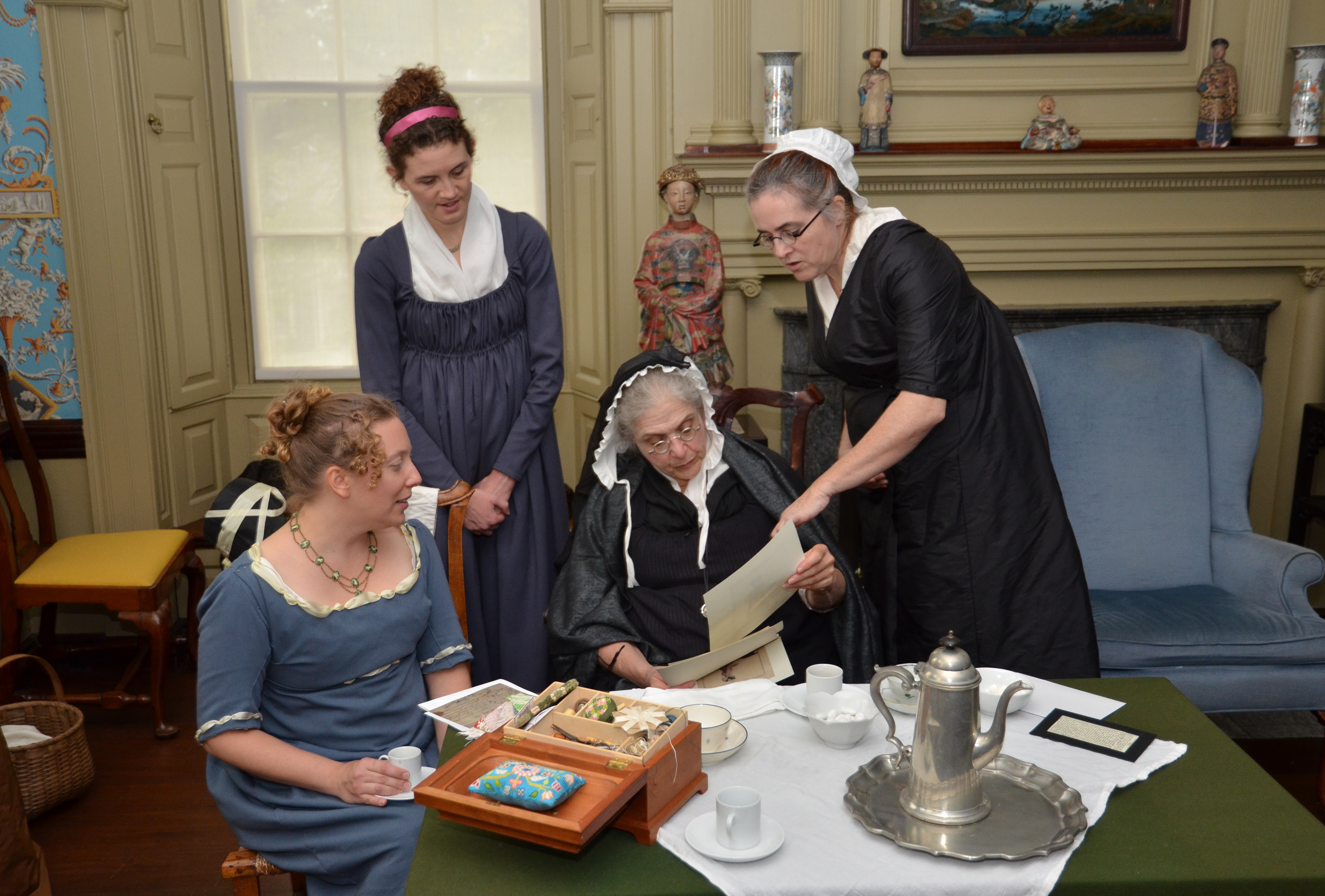
1803 ladies ponder fashion plates

Considering mourning dress options

The mantua maker came to call, bringing black silks and plates for the ladies to choose from. We have had a mix of joy and sorrow in this house, and it is only of late that Mrs Francis (on the left, in blue), has left behind her more matronly garb following the death of her beloved husband John Francis in 1796. It was a crushing blow for her, but she does seem to have recovered now.

1803 woman and baby

Mrs H and her darling daughter, Anna

Mrs Herreshoff was with us, visiting from Point Pleasant in Bristol, and her mother found baby Anna, now just more than five months old, a great consolation indeed. Anna was dressed in mourning for her grand-papa, though she will not remember him. Despite the many callers, baby Anna was truly an angel.

Historical minister and coffin

The Congregational minister called.

The ladies upstairs were a respite for us servants, though we were comforted by the visiting minister from the Congregational church. They cannot make up their minds to a new minister, now that their beloved Dr Hitchcock has left them for heaven. They try on new ones for size nearly every week, and while that is not my congregation, I do think the Reverend Cooke is an excellent choice, combining devotion with humor.

costumed interpreters

The sexton’s son came to inquire if Mrs B wished rent the hearse

A more troublesome caller was Mr Richard Hoppin, son of the sexton at First Baptist church. They do possess the sole hearse in our town, and kindly (for a fee) provide it in times of need. I’m not certain of Mr Hoppin’s stability, for he was inclined to– well, to hop!– in our hallway, a most inappropriate action. The widow did seem to cause him fright (she is a formidable personage, as one would be, after so many years married to Mr Brown), so perhaps he was merely addled by his encounter with her. She wisely inquired after the solidity and soundness of the hearse, for Mr Brown was a substantial figure.

1803 widow and coffin

The widow Mrs Brown reflects upon her late husband

Mr Brown was a great support to us all, and his absence will truly be noted in our household and in our town. I do expect the house will feel empty without his presence, and that Esther, Goody and I will much remark upon the quiet as we go about our tasks.

costumed interpreters on the steps of the John Brown House

The obligatory group photo finale.

From an administrative and managerial stance, this What Cheer Day was different: we cut the interpreted day in half, running the event from 1:00 till 4:00, but still saw about the same number of visitors as we had in a six-hour day. A shorter day meant interpreters were somewhat less exhausted by the close of the day (costumed staff who started their day at 5:00 AM excepted), and the schedule did not have to be as detailed as in previous years. We also reprised a “make your own miniature” activity from the August George Washington 1790 event, and brought in period musicians, who played in the Washington Wallpaper room while people colored miniatures. We also put out an exhibit of memorial art and mourning jewelry, to help contextualize the miniature activity. Since we’ll be leaving the coffin on display and the mirrors and portraits draped through next weekend, a small display (three cases, labels finally finished at 11 AM on the day of the event) seemed like a good idea and opportunity. Upsides: chance to show off the collection, engage people in a hands-on activity, multi-sensory experiences. Downsides: Slightly more to accomplish than hands to do the work, still short a servant, always a little rough the first time you change topics. Unexpected bonus: slightly bumpy transitions in personal life make a suitably sad housekeeper. Score!

Share this:

  • Share on Facebook (Opens in new window) Facebook
  • Share on Pinterest (Opens in new window) Pinterest
  • Email a link to a friend (Opens in new window) Email
  • Share on X (Opens in new window) X
Like Loading...

On & Off the Grid

16 Wednesday Sep 2015

Posted by kittycalash in 1830s, Clothing, Living History, Making Things

≈ 2 Comments

Tags

10th Massachusetts, 19th century, 19th century clothing, checks, Clothing, common dress, common people, fashion, Federal style, linen, stripes

It’s been a very busy time chez Calash, with many changes underway and to come. It’s hard to keep up with all the writing I’m doing everywhere, but eventually I’ll be back on topics of authenticity, standards, and whimsical Wednesdays.

This week, though, is all about checks. (Most weeks are, in some way, aren’t they?) Not paychecks, silly: linen checks.

We are headed out to Eastfield Village Friday afternoon where Mr Hiwell and the Young Mr will join in the 1833 militia muster, and Mr JS and I will occupy a house as a shop/tailoring business/punch-making and cooking establishment of one kind or another.

Mr Hiwell has been warned to expect a diet unlike his norm, and since his roundabout is white, we will quickly know if he is smuggling Oreos and barbeque sauce.
 For the Young Mr, I have been making trousers. Yes, I do like things to line up. I wasn’t even paying that much attention when I cut these, but apparently that was  was enough.

Yes, even the buttons.

IMG_4452
IMG_4459

Sigh. It’s a thing.

He’s also got a roundabout in the works, which I must focus on more closely to finish. This is patterned from an original in Henry Cooke’s collection, but… Mr. Cooke and I, on a very sticky Tuesday afternoon, did not have the Young Mr at hand to measure again. The original was too small: that we knew. What we did not know was that the boy had taken on a man’s shape– or, as a friend says, “he’s dude-shaped now!”–and the additions we made were not enough, except (barely) to the sleeves.

IMG_4335
IMG_4336

Oh, well. There was just enough to make it all work, and after some trials I realized it needed a lining. What kind of lining? A checked lining, of course!

It seems okay, but these collars are strange to  me.

IMG_4450
IMG_4451

Well, at least he will be clad.

Let you think  I’m sewing only for the lad, I am in fact working on a gown for myself. There’s a hopeful yard or so of another check’d  linen from the stickiest fabric store on 39th Street lurking, but I do not think that apron will happen this week. Perhaps John Brown’s housekeeper will finish it someday.

IMG_4329
IMG_4479

At least there are already gowns and aprons ready-made that can travel with me. Someday soon I’d like to finish my new stays… winter will come soon enough, and more sewing then.

Share this:

  • Share on Facebook (Opens in new window) Facebook
  • Share on Pinterest (Opens in new window) Pinterest
  • Email a link to a friend (Opens in new window) Email
  • Share on X (Opens in new window) X
Like Loading...

Frivolous Friday: Festive but Frigid

31 Friday Jul 2015

Posted by kittycalash in 1830s, Clothing, Events, Frivolous Friday

≈ 1 Comment

Tags

1833, 19th century, 19th century clothing, Clothing, common dress, common people, Costume, fashion, Federal style, Reenacting, Sleigh Ride, style, William Sidney Mount

Rustic Dance After a Sleigh Ride, 1830. William Sidney Mount MFA Boston 48.458

Rustic Dance After a Sleigh Ride, 1830.
William Sidney Mount MFA Boston 48.458

I don’t know about your weather, but we’re in full summer in New England, sultry and humid, with the occasional thunderstorm and power outage to enliven the evening. A sleigh ride sounds like fun today– and I know we all just finished complaining about the snow of February– but a brisk ride followed by a dance would certainly round out this week.

1833 approaches faster than expected, so it’s time to pick that back up and get serious. Not just a gown but petticoats and, ideally, a new shift should be made. This may be the project that breaks my resolve and finds the Bernina back on my table for cording a petticoat.

Detail, Rustic Dance After a Sleigh Ride, 1830. William Sidney Mount. MFA Boston 48.458

Detail, Rustic Dance After a Sleigh Ride, 1830. William Sidney Mount. MFA Boston 48.458

This image helps define the look of the early 1830s: not nearly as exaggerated as the fashion plates, these dresses and coats seem to fall into a progression from the 1820s– as you’d expect this early in the decade.

The gentleman at the back, in the drab colored suit, sports an interesting pair of trousers. I don’t think I know anyone ready to bust out the cossacks, but Mr Drab may be sporting a slightly modified pair. The collars and lapels show a shawl-shape that seems new, and modified from the more serpentine form seen in fashion plates– or else not yet as developed. There’s a range of headwear, too: tall hats on the left, a soft cap on the right. The Ladies’ Workbook has a pattern for one of those caps. Wonder how hard they are to make?

Detail, Rustic Dance After a Sleigh Ride, 1830. William Sidney Mount. MFA Boston, 48.458

Detail, Rustic Dance After a Sleigh Ride, 1830. William Sidney Mount. MFA Boston, 48.458

In the detail, we can also see the women’s hairstyles, less exaggerated than the fashion plates with their high top knots, and within the realm of possibility for those of us not practiced in historical hairstyle recreation.

So much has carried into this decade: colored neck wear, ruffles or chemisettes under women’s gowns, men’s hair brushed forward. As always, it’s the details that count. Tall shirt collars, rounded lapels, ladies’ sashes, the shape of sleeves. This should be a fun decade to represent.

Share this:

  • Share on Facebook (Opens in new window) Facebook
  • Share on Pinterest (Opens in new window) Pinterest
  • Email a link to a friend (Opens in new window) Email
  • Share on X (Opens in new window) X
Like Loading...
← Older posts
Newer posts →

Archives

wordpress statistics

Creative Commons License
Kitty Calash blog by Kirsten Hammerstrom is licensed under a Creative Commons Attribution-NonCommercial-ShareAlike 4.0 International License.

Website Built with WordPress.com.

  • Subscribe Subscribed
    • Kitty Calash
    • Join 621 other subscribers
    • Already have a WordPress.com account? Log in now.
    • Kitty Calash
    • Subscribe Subscribed
    • Sign up
    • Log in
    • Report this content
    • View site in Reader
    • Manage subscriptions
    • Collapse this bar
 

Loading Comments...
 

    %d