• Home
  • Completed Costumes/Impressions
  • Emma and Her Dresses
  • Free Patterns and Instructions

Kitty Calash

~ Confessions of a Known Bonnet-Wearer

Kitty Calash

Tag Archives: authenticity

Checked Linen Aprons post-1800

16 Monday Feb 2015

Posted by kittycalash in Clothing, History, Living History, Museums, Reenacting, Research

≈ 6 Comments

Tags

19th century clothing, apron, authenticity, checks, Clothing, common dress, common people, Costume, dress, fashion, Federal New England Fashion, New England, Newport, Rhode Island, Rhode Island history, sewing, style

Not that this is an exhaustive or final chronicle, but Jackie asked about the apron.

Spring Cleaning, 2012

Spring Cleaning, 2012

I first encountered this form of apron at Old Sturbridge Village, on display in the Firearms and Textiles exhibit space, which I think of as “Muskets and Muslins.” The accession number given on the exhibit label was 26.39.4, but the object does not appear in the OSV online collections database (they do warn that it contains just a selection of their total 60K-plus object holdings). The original at OSV, as sketched and described by me in April 2012 has a drawstring at the neck, straps that button, string at the back opening, and is slim, without gathers. That means the bodice is very similar to the gown bodices of the early part of the 19th century.

Smock, Checked cotton, Pocumtuck Valley Memorial Association. #2000.01.869.

Smock, 2000.01.869 PVMA

There is another original checked bodiced apron in the Pocumtuck Valley Memorial Association collection in Deerfield, MA. This original appears in color in The Needle’s Eye by Marla Miller. As you can see in the images of my apron, I mashed the two styles together to suit the amount of material I had on hand, the skills I had three years ago, and the amount of time I had between seeing the apron and the day of the program, which was probably two days during which time I had pleurisy.*

This is also wrong, but funny.

This is also wrong, but funny.

To refocus: I chose to wear this apron at Whitehorse House in 1820 for a really wrong reason: it was what I had.

Prints in the British Museum show a maid in a yellow gown with a black apron, no bib; there is another, with a maid in a green gown, in a wikigallery, that I could not fully track down; a London Market scene; and a French print from 1818 that does show a bibbed black apron on a shop assistant. The visual research I’d done for the 1820 program suggested that black aprons were the height of fashion, and that they did not always have bibs.

Papering the Saloon at Tickford Hall, watercolor by Diana Sperling, 1816.

Papering the Saloon at Tickford Hall, watercolor by Diana Sperling, 1816.

Since we deal in confessions here, I will tell you that I did buy material for a black apron, and I planned to make a strapped or bibbed one, much like the one Sabine made. The appearance of the dark apron in Diana Sperliing’s watercolor of the ladies papering the saloon at Tickford Park put the dark strapped and sometimes bibbed apron the in English-speaking world. And still I did not manage to make one. If I were to do an 1820 program again, or even an 1813 or later millinery shop again, I like to think I would find the time to make a black strapped and possibly bibbed apron. I do think they were the height of fashion, and are likely to have been worn by women in shops, and by maids.

Do I think the checked apron is wrong? Given that I can rationalize anything, of course not! I think a checked apron is probably reasonably appropriate within the context of a kitchen, even in 1820, especially in New England. Since we did not cook on Saturday, the black apron would have been ideal, but I think the checked apron passes. To make it pass with a higher grade, I will freely admit it requires button and tape upgrades. Since the next dates on the horizon are 1775 and 1780, chances are good those upgrades won’t happen anytime soon. * Do not attend an all-day outdoor event in the cold when you are not well. Do not attend said event without your cloak, or in stays you have laced up a little too firmly. Do not deny that the cold you have might actually be the start of something bigger, when it includes a productive cough. Lo, the lessons of living history are many.
Share this:

  • Share on Facebook (Opens in new window) Facebook
  • Share on Pinterest (Opens in new window) Pinterest
  • Email a link to a friend (Opens in new window) Email
  • Share on X (Opens in new window) X
Like Loading...

Rude Boys and Reenactors

06 Friday Feb 2015

Posted by cyclokitty in Frivolous Friday, History, Living History, personal

≈ 7 Comments

Tags

authenticity, Frivolous Friday, London Calling, music, personal, philosophy, punk, the Clash

This morning, the Twitterz provided me with a link I’d missed back in November, to a piece about the Clash’s Vanilla Tapes. I listened to the cut of London Calling, and heard the ways in which it was not the final cut, and thought of authenticity. What a fabled state of grace: authenticity.

You think, if I just get this one thing right, I’ll be done.

portrait as a process test

process test poser portrait

But you won’t. And that’s okay. You’re still not a poser. (That’s an old Chicago punk term that got thrown around the way farb gets thrown around now.)

I’m pretty familiar with the album version of London Calling, but the Vanilla Tape version really reminded me: it’s not a destination, it’s a process.

It can mean taking coats apart and making them over till our eyes bleed. It can mean thinking and rethinking a character.

What matters is the process. I know, how tiresome: it’s the journey not the snow leopard.  But it’s true: what makes history in any expression fun are the questions, the new things to learn.

Yes, I have always like to dress up, and to get my friends to join me.

Yes, I have always liked to dress up, and to get my friends to join me.

I realized, too, that the joy I felt seeing the Clash at the Aragon ballroom none-of-your-business years ago was not unlike the pleasure I get from living history– and that’s not just because of the funny clothes and loud noises, though both sub-cultures share a taste for natty dressing and unusual music.

I find joy in the physicality of living history*, for although a milliners’ shop is no mosh pit, when your  clothes, shoes, and accessories are as right as they can be, you will move and feel differently than you do in your office or workout clothes.

There’s joy for me in the difficulties, too: from Saratoga to cooking, I like a problem to solve, a process to learn.

I’ll never get everything just right: I’ll get closer to right, and the fun is in figuring out how.


Share this:

  • Share on Facebook (Opens in new window) Facebook
  • Share on Pinterest (Opens in new window) Pinterest
  • Email a link to a friend (Opens in new window) Email
  • Share on X (Opens in new window) X
Like Loading...

Does Accuracy Make Cromwell a Dull Boy?

26 Monday Jan 2015

Posted by kittycalash in Art Rant, Clothing, Philosophy

≈ 6 Comments

Tags

accuracy, authenticity, costume design, Costumes, interpretation, Sons of Liberty, TV Review, Wolf Hall

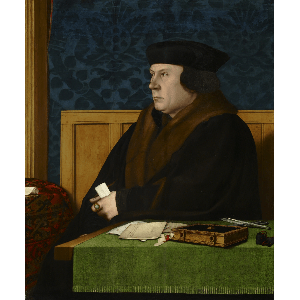
Thomas Cromwell, Hans Holbein the Younger. The Frick Collection,1915.1.76

Thomas Cromwell, Hans Holbein the Younger. The Frick Collection,1915.1.76

My personal interwebs have been hating on Sons of Liberty, but I’ve left it alone, largely because I haven’t found the forty-syllable German word for “enjoying watching someone else enjoy hating something.” My FB feed exploded with meta-schadenfreude, but really: hating on that show is so easy it’s cruel.

Still, all that chatter did get me wondering: what about Wolf Hall? No, I haven’t yet gone proxy server and watched it on the BBC iPlayer, but I have been following along on the Twitterz and this turned up in my TL: Wolf Hall May be Historically Accurate, but it’s also A Bit Dull.

Except I think the author destroys the accuracy bit. First there’s this:

Peter Ackroyd audaciously asks us to imagine pre-Reformation London as the street markets of Marrakesh. Cheapside would have been a bustling surge of traders and customers, alive with noise and smells, packed with barrels and panniers of fish, fruit and spices, more like a bazaar than the modern city. Equally, to imagine the interiors of English churches in the 1520s, think Andalusian gaudy rather than Hawksmoor’s classicist austerity, the walls covered in brightly painted scenes, the chapels filled with statuary and icons.

Fete at Bermondsey, 1569. Joris Hoefnagel. Private Collection, UK. Colorful, right?

And this:

Early Tudor London was a bright, brash and bustling place, unlike its whitewashed Protestant successor, and its inhabitants behaved in similarly extravagant fashion. Foreign ambassadors were surprised by Englishmen’s capacity to weep openly and publicly at the slightest provocation. Satirists condemned the aristocracy and burghers for wearing too much bling: flaunting their status in chains of gold so heavy you were amazed they could walk at all.

Then this:

the costumes, beautifully designed and no doubt scrupulously researched, make Tudor society less, rather than more, intelligible. Only Cardinal Wolsey (a melancholic Jonathan Pryce) and Henry VIII (Damian Lewis on imperious form) are allowed bright colours. Everyone else, aristocrat and commoner alike, wear gowns in muted blacks, browns and greens, and so all look much the same – especially as so many scenes take place in near-darkness.

The past sure was a drab place, at least as seen on TV. That’s how you know it’s history! And if the show was so well-researched, why are the costumes so wrong? Because they’re costumes.

Cassidy has gone into good detail about how costume design for a movie or TV programs isn’t about accuracy: it’s about interpretation. And that’s where Sons of Liberty, Wolf Hall, Pride and (or &) Prejudice or Your Favorite Hobby Horse diverge wildly from interpretation in living history. We’re interpreting the past, they’re interpreting a script. (Yes, a script: Sons of Liberty is no way a documentary.)

So I’d save your ire for historic sites and museums and documentaries: what you see on TV is all drama, and just drama. The costuming (and, often, material culture) will in no way be accurate, because it is always designed to further the dramatic goals, and not the accurate depiction of an moment in time.

And that’s why Wolf Hall can be accurate and dull, correct and incorrect. Costume and production designers and directors want us to get the point of the story, so they’ll create dullness where there should be color to make sure we can “read” an otherwise unreadable scene. Now, between you and me, I think good writing can explicate all those class and origin relationships, and that actions large and subtle will show me the emotional relationships, but that’s asking a lot of people who wrecked Mantel’s amazing writing.

In the novel, Mantel has master and servant embrace each other in fleeting triumph. When the dukes go, Wolsey turns and hugs him, his face gleeful. Though it is the last of their victories and they know it, it is important to show ingenuity; 24 hours is worth buying when the king is so changeable. Besides, they enjoyed it. “Master of the Rolls”, Wolsey says, “did you know that, or did you make it up?”

In the adaptation, on the other hand, Wolsey stays seated and Cromwell stands, invisible behind him.

– Did you know that, or did you make it up?
– They’ll be back in a day.
– Well, these days 24 hours feels like a victory.

In the end, I may skip the BBC’s Wolf Hall and re-read the novels. It’s a lot less shouty.

Share this:

  • Share on Facebook (Opens in new window) Facebook
  • Share on Pinterest (Opens in new window) Pinterest
  • Email a link to a friend (Opens in new window) Email
  • Share on X (Opens in new window) X
Like Loading...

Frocks Coats in Providence

21 Wednesday Jan 2015

Posted by kittycalash in Clothing, History, History Space, Living History, Making Things, Museums, Reenacting

≈ 1 Comment

Tags

18th century clothes, 18th century clothing, authenticity, common dress, common people, fashion, Henry Cooke, History Space, living history, Making Things, menswear, sewing

Saturday last saw the launch of History Space, the collaborative project of the Rhode Island Historical Society and the Newport Historical Society designed to help living history practitioners and reenactors acquire the clothing and skills needed to bring the past to life.

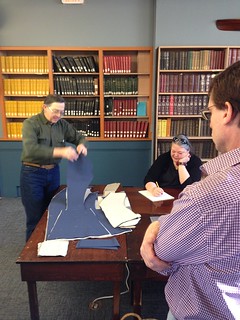
Many parts to a frock coat.

Scheduling being what it is, we plunged right in to hands-on work with Easy Grace and Comfort, a two-day man’s frock coat workshop with Henry Cooke. We saved enormous amounts of time in the workshop by having Mr Cooke cut coat kits for participants, and I know it was well worth every penny.

There is much less on-body fitting when Mr Cooke cuts a coat for the kid than when I do. (I think the Young Mr grows while I am trying to figure it out, but Henry cuts fast enough to head him off.)

Buckram and button stands

Buckram and button stands

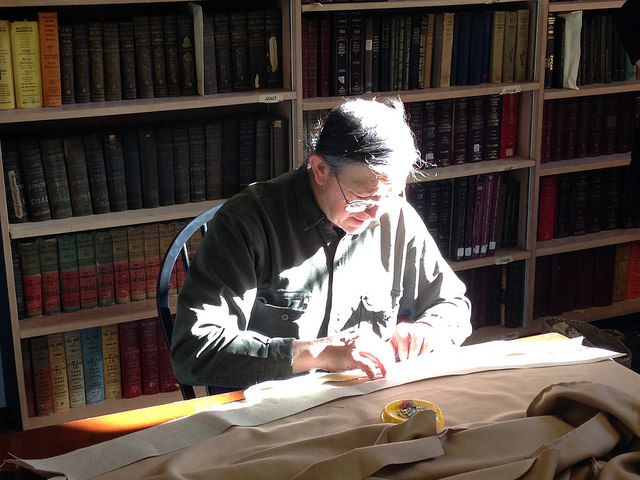
The most painful part of the whole thing (if fitting is largely done) is stitching on the buckram interfacing and the button stand. The zig-zag stitch as demonstrated by Henry was fairly easy to get the hang of when you caught the rhythm, but the tightness of the Red Edge stand tested my needle and even my fingertips.

There were some complaints at one table, largely voiced by the Fifer Formerly Known as Lambchop, who awaits his 10th Mass name.

Sleevils!

We made it all the way to sleeves, which is impressive, considering that some of the gentleman had not made more than a haversack or knapsack before. But if you can backstitch, and have some help with your fitting, you can make a coat.

I happen to like sleeves, myself, stitching them up and setting them in the garment. I think it’s the three-dimensionality of them that appeals to me– and I like a good challenge.

And here we are: sleevil one.

It’s critical to pay attention, though, so you make one left and one right sleeve, and to keep track of them as you set them to the garment body. I sometimes mark mine with chalk, and have even pinned notes to the pieces when feeling especially daft.

I’ve made it to an assembled coat body and sleeves, with one sleeve basted on. Before Saturday, I plan to baste on the second sleeve and test fit sleeve set on the boy. I’ll also try to get pocket flaps made. Since I have a talk to write and a bedgown to finish as well, I’m probably dreamin’ big.

When this suit is done, the Young Mr will have a very nice blue ensemble that includes breeches (join in the fun here) and a waistcoat. I think he’ll look rather nice, and better than he has previously. I still want to make lower-class* clothes for him, but first he does need a nice suit.

*I said urchin, but Mr Cooke said urchins can’t be over 6 feet tall. Basking sharks are big, but in this blue-grey suit, perhaps the Young Mr will finally be a grey reef shark.

Share this:

  • Share on Facebook (Opens in new window) Facebook
  • Share on Pinterest (Opens in new window) Pinterest
  • Email a link to a friend (Opens in new window) Email
  • Share on X (Opens in new window) X
Like Loading...

Same Place, Different Day

17 Saturday Jan 2015

Posted by kittycalash in History, Living History, Museums, Philosophy, Reenacting

≈ 7 Comments

Tags

accuracy, authenticity, history event, history events, interpretation, living history, museum practice, rant, Reenacting

We were doing some preliminary planning for an event this fall, and we were considering recreating the 1803 funeral of Important White Guy. Our event is in October; the funeral was in September. Somebody asked me, “What does it matter when we do it?” and I didn’t respond nearly as gracefully or eloquently as I could have.

Why does it matter? Does it matter to anyone but me and my cohort?

It does, and here’s one reason why: When interpreting the funeral in late October, perhaps a member of the public will ask, “When did he die?” Can an interpreter really say “September 20” and not expect a slew of questions about how long the body was kept and why the funeral was delayed and wasn’t that a health hazard? Can the event orientation start out with “We’re doing it in October because that’s when we want to do it,” without fundamentally changing the event?

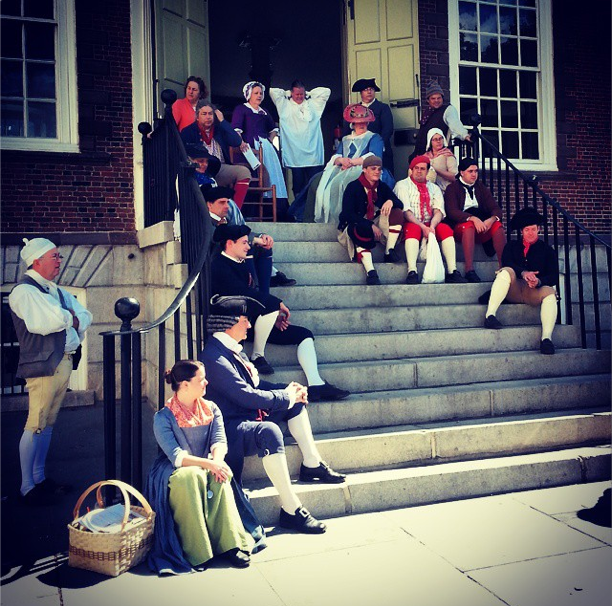
On the Colony House steps

August is hot. Can we riot in September? No!

Moving the recreation of a specific event by more than it takes to get to a weekend* seems dishonest to me: do you really want to celebrate your birthday 5 weeks after the actual date for someone else’s convenience? July 4th: Gosh, it’s not working for me this year. Let’s do that in August.

For a historical organization to suspend caring about accuracy for living history events but not for published articles, catalog records, or finding aids just contributes to the greater problem in and of living history.

When asked about the goal of a living history event, I have been told, “Well, we want families, right? So we should have some hands-on activities, you know, immersive, like candle dipping.”+

It took a bit, but at last I grasped the core of the angry-making: Kids like living history, therefore it is less sophisticated than other forms of history.

The right place for immersive string activities.

The right place for immersive string activities.

Living history is not as sophisticated, nor need it be as accurate, as traditional (written, orated, curated) historical presentations: I think that is the background assumption a lot of people make, both in the adminstration of traditional historical organizations and in the presentation on the field. It is a complete fallacy.

Living history done well and done right is as well-researched as a paper, exhibition, or article. It draws from primary sources both written and visual, it requires the absorption of countless secondary sources to help analyze the primary sources. It is as collaborative and negotiated a process as any museum exhibition, and like exhibitions, it uses material culture interpretation to deliver its messages, i.e. meet its educational and interpretive goals.

15316751814_946818c254_z

A good living history event is beautiful, but like a ballet, that beauty does not come easily. There are no shortcuts, and beauty does not equal superficial or stupid. It indicates sophistication. Part of that appeal is accuracy: the better, the more accurate and immersive the historical setting and action you create, the more visitors can learn without asking.

Lawn games

Lawn games

When I organize an event in our house at work (or even on a guided tour) one of my interpretive points is always “people saw the world differently– literally– and this event/house tour helps you see the world of 1800 the way people living then saw it.” Aesthetics were different, and were underpinned by ideas and opinions. But understanding those aesthetics and the opinions people held about race, gender, beauty, work and class takes actual research and analysis. It’s not all putting on a pretty dress and cavorting on the lawn. Facts matter. Accuracy matters.

Museums are some of the most trusted organizations. If we started juicing facts like every History channel show, we’d lose that trust, and rightly so. Our trustworthiness is grounded in our honesty and integrity.

Living history events are mobile museums, and every reenactor curates his or her own impression. To retain the trust and interest of the public, we have to be accurate.

*Events are moved to weekends because that’s when interpreters and audiences can come.

+This at a house that not only lacks a working kitchen earlier than 1960 in the staff area and was owned by a partner in a candle factory. I’m thinking “bought ’em in bulk,” here, not dipping.

Share this:

  • Share on Facebook (Opens in new window) Facebook
  • Share on Pinterest (Opens in new window) Pinterest
  • Email a link to a friend (Opens in new window) Email
  • Share on X (Opens in new window) X
Like Loading...
← Older posts
Newer posts →

Archives

wordpress statistics

Creative Commons License
Kitty Calash blog by Kirsten Hammerstrom is licensed under a Creative Commons Attribution-NonCommercial-ShareAlike 4.0 International License.

Website Built with WordPress.com.

  • Subscribe Subscribed
    • Kitty Calash
    • Join 621 other subscribers
    • Already have a WordPress.com account? Log in now.
    • Kitty Calash
    • Subscribe Subscribed
    • Sign up
    • Log in
    • Report this content
    • View site in Reader
    • Manage subscriptions
    • Collapse this bar
 

Loading Comments...
 

    %d