• Home
  • Completed Costumes/Impressions
  • Emma and Her Dresses
  • Free Patterns and Instructions

Kitty Calash

~ Confessions of a Known Bonnet-Wearer

Kitty Calash

Tag Archives: Clothing

Frivolous Friday: A-Spalling Behaviour

08 Friday May 2015

Posted by kittycalash in Fail, Frivolous Friday, personal, Snark

≈ 6 Comments

Tags

19th century clothing, art, Clothing, common dress, Costume, fashion, movies, Mr. Turner, Museums, snark, some snark, style

Mr. Turner, out now on iTunes and elsewhere, won’t be for everyone: M’damsel isn’t treated very well– artists are, you know, often narcissistic, driven users– but the landscapes thrill.

We talk sometimes about going to the antique store in historical clothing and asking why our chattel is for sale. I toy with similar naughty thoughts about visiting historic house and other museums, but Mr Turner inspires a dream of a simpler pleasure: dressing in period clothes to visit a period gallery.

Classic Mr Turner in the salon

Possibly my companion would grunt as Turner does, but we might also unnerve guards by pointing walking sticks at salon-hung still lifes or reacting with disgust at the sight of an Impressionist work. (Might as well take it all the way.)

Everybody’s a critic

No takers yet for this diversion, which is just as well. I expect it would be a quick way to meet security and police staff if you didn’t coordinate with the museum/gallery in advance. Still: what a stunt. Someday I’ll pull it off.

Share this:

  • Click to share on Facebook (Opens in new window) Facebook
  • Click to share on Pinterest (Opens in new window) Pinterest
  • Click to email a link to a friend (Opens in new window) Email
  • Click to share on X (Opens in new window) X
Like Loading...

Smock it to Me

18 Wednesday Feb 2015

Posted by kittycalash in Clothing, History, Making Things, Museums, Reenacting, Research

≈ 2 Comments

Tags

19th century clothing, anna maria von Phul, authenticity, Clothing, Colonial Williamsburg, common dress, common people, Costume, fashion, Federal New England Fashion, Federal style, Missouri History Museum, New England, style, watercolors

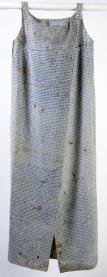
Smock, Checked cotton, Pocumtuck Valley Memorial Association. #2000.01.869.

Smock, Checked cotton, PVMA. #2000.01.869.

Edited to correct numerous typos and to add a bad sketch of the OSV apron. Don’t try to do research while conducting a small but energetic boy through a musket exhibit.

Two aprons, many questions, all of them excellent.

It’s really tough when an extant garment lacks provenance or even faux-venance, as in the “Revolutionary War” garments that turn out to be later. So, where do we look to figure things out when we a) like a garment a lot and don’t know if it’s right or b) are embarking on something a little new? And yes, in this case, we are talking bibbed aprons in the first quarter of the nineteenth century, in Rhode Island and in the Missouri Territory.

We start with questions:

1. What documentary sources can I find?
2. Is the form plausible for time period/area?
3. What is the typical fabric for the time period/area?
4. Is the item appropriate for my character/persona/impression?

Apron, checked with high waist, 1800-1820. Plain weave linen, probably Southeastern US. Colonial Williamsburg 1995-53

Apron, checked with high waist, 1800-1820. Plain weave linen, probably Southeastern US. Colonial Williamsburg 1995-53

What documentary sources do we have?
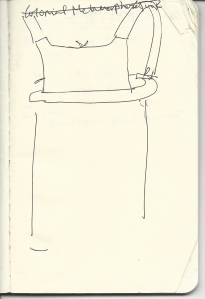
OSV's apron: I do my best work on the fly.

OSV’s apron: I do my best work on the fly.

We have some extant garments, two with images.

1. Extant apron 26.39.4, Old Sturbridge Village
2. Extant smock ca. 1800, Pocumtuck Valley Memorial Association 2000.01.869
3. Extant apron 18100-1820, 1995-33, Colonial Williamsburg (unstable links, search for accession number)
4. Apron 2005.24.4 at Historic New England has an intriguing description: A reddish brown linen apron with blue and white plaid. The apron is smock-like, with two holes for the arms and ties that extend from under the arms to the back. The bottom has a double hem. The neckline can be tightened or loosened with a blue and white string. What does that look like? Could it look like the Stonington plaid? It’s certainly a plausible New England weave 1810-1820.
5. Apron 1989.3, also at Historic New England, with a description similar to the CW high waisted apron:Cream & blue plaid linen; tucked at waist; no waistband; long cotton tape ties. (The tucked waist is similar to CW’s)

We have some imagery from the United States.

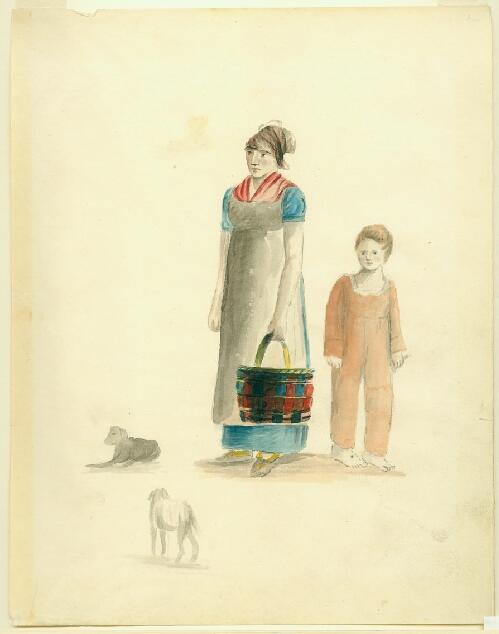
1. “Creole woman and child,” watercolor by Anna Maria von Phul, 1953.158.37, Missouri Historical Society

What else is out there? MHS’s database has an Apache error today, so not sure what aprons  they have, though they’re exactly where we need to look for one instance. I’ve looked and failed to find aprons of this description in the following catalogs: Historic New Orleans, Chicago Historical Society, State Historical Society of Wisconsin, Connecticut Historical Society, the Met, MFA Boston, Maine Historical Society, New Hampshire Historical Society, Ohio Historical Society, Newport Historical Society and Little Compton (RI) Historical Society. I’m now really tired of interacting with Past Perfect software.

Is this form plausible?

We have 5 objects and one image, all found in a cursory afternoon. Me, I’m still liking this form for the first quarter of the nineteenth century in the United States. I think the form varies somewhat, as can be seen in the descriptions; the OSV apron is the outlier, with the other 4 extant garments seeming more smock-like.

From RIHS MSS 72, Preserved Pearce papers,  Tailor's and Tavern account books, 1778-1781.

From RIHS MSS 72, Preserved Pearce papers, Tailor’s and Tavern account books, 1778-1781.

Fabric type?

Neither the OSV apron nor the PVMA smock have much (any) provenance, but the fabric is very typical of New England from the Connecticut River to the coast; it appears in inventories from 1777, on home- bound volumes, extant aprons in Deerfield and and in sample books from 1815.

Blue and white check: I am comfortable saying that those two aprons are 1800-1820 New England based on form and fabric. I am delighted to have found it in the apron at Colonial Williamsburg, which is thought to be from the Southeastern United States. I think that expand the range down the eastern seaboard. With the evidence of the extant garments and fabrics typical in New England, I am still OK with this form of apron, even if my rendition of the OSV apron is rather poor, thank you for noticing.

But what about Missouri? What should you wear out there, on the banks of the Mississippi?

Creole woman and boy. Acc. # 1953.158.37. Watercolor and pencil on paper by Anna Maria von Phul, 1818. Missouri History Museum Collections. Von Phul 37

Creole woman and boy. Acc. # 1953.158.37. Watercolor and pencil on paper by Anna Maria von Phul, 1818. Missouri History Museum Collections. Von Phul 37

Enter Anna Maria Von Phul. She is a little sketchy on some details– these are watercolors, after all–but I think she would have made the apron blue if it was made of blue and white check. She has rendered some stripes (?) in the head scarf, so she does hint at some detail.

Because I know AMVP, I believe that she is documenting fashions pretty typical of the time and place. The ladies she portrays in St. Louis in 1818 are fashionably dressed and not behind the times for the year, even if we cannot see every detail of dress.

If I were to make the cognitive leap that women across what is now the eastern half-or-so of the United States wore bibbed-style smocks or aprons between 1810-1820, and made them up in the most common fabric of their area (cue blue and white checks for New England), I might step back from that link in Wm Booth’s catalog. If I were to copy this image’s apron, I think I would make it in plain, unbleached linen, based on how I read this color and shading.

Ideally, you would find bracketing aprons– that is, some a little earlier and some a little later– in a “typical” fabric. I didn’t find those animals in the Western Reserve or Louisiana Purchase Territory collections available online, but that only means I didn’t dig in hard enough.

I don’t think these utilitarian garments will turn up in shop records, and I don’t think we are likely to find detailed probate inventory descriptions– mostly it says “apron,” which is too general for our purposes. We won’t find runaway ads: it’s too late for those, and a little early for newspapers in the Territories, though it wouldn’t hurt to search online.

I think our best alternate documentary sources in this case will be in diaries (again, we may not get the specificity we want; Sylvia Lewis only makes Spencers differentiated by color, so we are ignorant of collar shape, trims, number of buttons, closures, etc.) and in watercolors and drawings, often amateur, of everyday life.  After all, you can never have too many sources.

Is it appropriate?

Well…the evidence on the PVMA smock is of some use, though stains can be acquired in storage, too. The CW smock-apron is less used. I think this form in a checked or plain linen fabric would be best suited for everyday and working wear, cleaning, cooking, gardening, but not for serving at table (in a house that supported that), and not for dress or best, when white would have been what was wanted.

Share this:

  • Click to share on Facebook (Opens in new window) Facebook
  • Click to share on Pinterest (Opens in new window) Pinterest
  • Click to email a link to a friend (Opens in new window) Email
  • Click to share on X (Opens in new window) X
Like Loading...

Checked Linen Aprons post-1800

16 Monday Feb 2015

Posted by kittycalash in Clothing, History, Living History, Museums, Reenacting, Research

≈ 6 Comments

Tags

19th century clothing, apron, authenticity, checks, Clothing, common dress, common people, Costume, dress, fashion, Federal New England Fashion, New England, Newport, Rhode Island, Rhode Island history, sewing, style

Not that this is an exhaustive or final chronicle, but Jackie asked about the apron.

Spring Cleaning, 2012

Spring Cleaning, 2012

I first encountered this form of apron at Old Sturbridge Village, on display in the Firearms and Textiles exhibit space, which I think of as “Muskets and Muslins.” The accession number given on the exhibit label was 26.39.4, but the object does not appear in the OSV online collections database (they do warn that it contains just a selection of their total 60K-plus object holdings). The original at OSV, as sketched and described by me in April 2012 has a drawstring at the neck, straps that button, string at the back opening, and is slim, without gathers. That means the bodice is very similar to the gown bodices of the early part of the 19th century.

Smock, Checked cotton, Pocumtuck Valley Memorial Association. #2000.01.869.

Smock, 2000.01.869 PVMA

There is another original checked bodiced apron in the Pocumtuck Valley Memorial Association collection in Deerfield, MA. This original appears in color in The Needle’s Eye by Marla Miller. As you can see in the images of my apron, I mashed the two styles together to suit the amount of material I had on hand, the skills I had three years ago, and the amount of time I had between seeing the apron and the day of the program, which was probably two days during which time I had pleurisy.*

This is also wrong, but funny.

This is also wrong, but funny.

To refocus: I chose to wear this apron at Whitehorse House in 1820 for a really wrong reason: it was what I had.

Prints in the British Museum show a maid in a yellow gown with a black apron, no bib; there is another, with a maid in a green gown, in a wikigallery, that I could not fully track down; a London Market scene; and a French print from 1818 that does show a bibbed black apron on a shop assistant. The visual research I’d done for the 1820 program suggested that black aprons were the height of fashion, and that they did not always have bibs.

Papering the Saloon at Tickford Hall, watercolor by Diana Sperling, 1816.

Papering the Saloon at Tickford Hall, watercolor by Diana Sperling, 1816.

Since we deal in confessions here, I will tell you that I did buy material for a black apron, and I planned to make a strapped or bibbed one, much like the one Sabine made. The appearance of the dark apron in Diana Sperliing’s watercolor of the ladies papering the saloon at Tickford Park put the dark strapped and sometimes bibbed apron the in English-speaking world. And still I did not manage to make one. If I were to do an 1820 program again, or even an 1813 or later millinery shop again, I like to think I would find the time to make a black strapped and possibly bibbed apron. I do think they were the height of fashion, and are likely to have been worn by women in shops, and by maids.

Do I think the checked apron is wrong? Given that I can rationalize anything, of course not! I think a checked apron is probably reasonably appropriate within the context of a kitchen, even in 1820, especially in New England. Since we did not cook on Saturday, the black apron would have been ideal, but I think the checked apron passes. To make it pass with a higher grade, I will freely admit it requires button and tape upgrades. Since the next dates on the horizon are 1775 and 1780, chances are good those upgrades won’t happen anytime soon. * Do not attend an all-day outdoor event in the cold when you are not well. Do not attend said event without your cloak, or in stays you have laced up a little too firmly. Do not deny that the cold you have might actually be the start of something bigger, when it includes a productive cough. Lo, the lessons of living history are many.

Share this:

  • Click to share on Facebook (Opens in new window) Facebook
  • Click to share on Pinterest (Opens in new window) Pinterest
  • Click to email a link to a friend (Opens in new window) Email
  • Click to share on X (Opens in new window) X
Like Loading...

Winter Amusement

11 Wednesday Feb 2015

Posted by kittycalash in Clothing, History, Making Things

≈ 2 Comments

Tags

18th century, 18th century clothes, 18th century clothing, Amusement, Clothing, common dress, Costume, fashion, James Tookey, New England, snow, style, weather, winter, winter coat, Yale Center for British Art

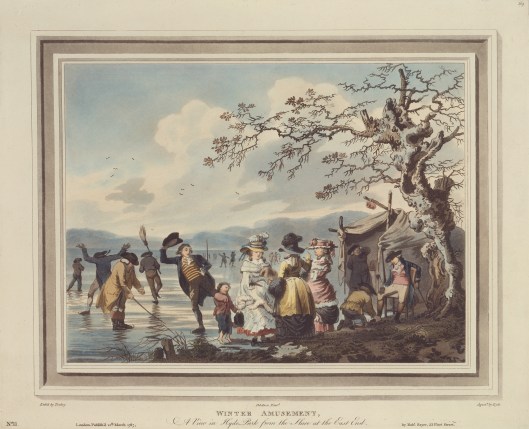
Winter Amusement: A View in Hyde Park from the Sluice at the East End.Aquatint, printed in color and colored by hand, 1787.Print made by James Tookey. YCBA  B1985.36.609

Winter Amusement: A View in Hyde Park from the Sluice at the East End.Aquatint, printed in color and colored by hand, 1787.Print made by James Tookey. YCBA B1985.36.609

I count myself among the people sick of winter in New England, but the piles of snow and wretched driving have prompted some comments from the Young Mr, including “Well, it would be worse in the 18th century, right?”

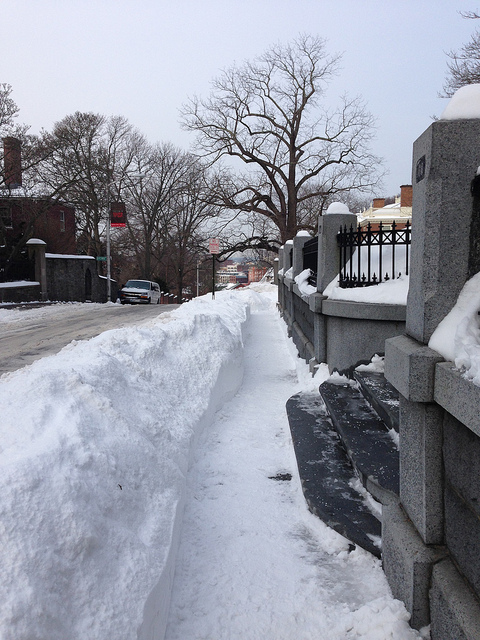
16314413949_fca9e1de44_zHaving recently walked on a combination of cleared, partially cleared, and uncleared walks, I’m not so sure…but I was in modern boots, and not my leather-soled repro shoes, which I prefer not to expose to the variety of modern snow-melting chemicals, though they can be cleaned.

Still: the partially cleared and unsalted walk was easier to walk on than you might imagine, and I suspect that the 18th century tasks of clearing steps and paths to make room to walk or drive carts, wagons and carriages was probably reasonably effective– though the melting must have been more annoying and messy when mud season arrived.

In all this cold and snow, how did people keep warm and stay fashionable? For gents, of course, greatcoats were an option, and cloaks or mantles for women, both in the last quarter of the 18th century and into the 19th. I found documentation for women’s Spencers and greatcoats in the first decade of the 19th century, but what about earlier?

detail,  Winter Amusement, 1787

detail, Winter Amusement, 1787

While I cannot (yet) place the coat at right in New England, you know I covet one.

Tail pleats with back buttons, a possible shoulder cape? I love the menswear styling of this coat, and the drab-and-black color combination of coat, gown and accessories. I don’t have much call for 1787 clothing in my life (actually none whatsoever) but by the time I’ve patterned and made this coat (after many other things to finish), perhaps I will also have created a reason.

Winter frolics, New Year’s Eve party, 1788? Anything is possible, and time is better spent imagining fun than complaining about snow.

Share this:

  • Click to share on Facebook (Opens in new window) Facebook
  • Click to share on Pinterest (Opens in new window) Pinterest
  • Click to email a link to a friend (Opens in new window) Email
  • Click to share on X (Opens in new window) X
Like Loading...

Drapers, Sutlers and Other Sources

10 Saturday Jan 2015

Posted by kittycalash in Clothing, Living History, Making Things, Reenacting, Research

≈ 11 Comments

Tags

Clothing, fashion, Research, resources, sewing, shopping, style

Shopping with swatches: it’s what I do.

The biggest difference between sewers is location: I have access to resources here that people in the Midwest don’t, but friends in New York have the garment district, which is just a little too far for me.  For a lot of my projects, I’m buying from the reputable sources we all know about: Burnley & Trowbridge and Wm Booth Draper. They’re supplying people who want accurate fabrics, they do their research, and the goods are well described. But how to choose among the offerings? And where else can you go?

Wools
The creme de la creme are Kochan and Philips wools. I have some bottle green I haven’t cut yet, which I got from Roy Najecki because he’s local, he’s got the stuff, and he has other stuff my household uses (like cartridge box clasps and quarter-inch mohair braid).

Wm Booth and B&T’s wools are also good, and you can get samples. What you buy will be dictated by what you are making. Broadcloth for suits and cloaks, stuff (worsteds) for gowns and waistcoats. Buy the best you can afford: this is an investment. Divide the cost of the fabric by the number of times you’ll wear a garment, and look at the per-wear cost, the way you might look at a suit for work. (I have no regrets about that Saratoga coat, which has now been worn on at least 5 separate occasions, making the per-wear cost $25 after 18 months, and I know it will be worn again.)

Once you’ve felt and seen good-quality, period-correct wools, shopping locally is easier. Take a swatch with you and compare to what’s in the stores and you’re likely to find yourself shopping online. You’ll want 100% wool, and that’s expensive pretty much everywhere. Here in Rhode Island, I do have access to mill stores and remnant tables that make a difference in my costs and allow me to be a little more frivolous in my sewing. Sewfisticated in Framingham and Somerville and Lorraine Fabrics in Pawtucket both have remnant tables with reasonably priced goods with pretty accurate fibre labels. They’ve been the source for many a garment, but have no online sales. I don’t recommend JoAnn’s wools: they’re not as tightly woven and they’re over-priced. Wm Booth and Burnley and Trowbridge are a better value.

Silks
Here again, it’s unfortunate, but my local sources come into play. Artee, Sewfisticated and Lorraine all have both discounted taffetas and tantalizing remnant tables, but Wm Booth and Burnley & Trowbridge have fabrics the local shops do not carry. I don’t have a local source for what Booth calls “persian,” but taffeta can be found– though color choices can be limited.

The trick with silks is slub. Much of what is sold today is silk dupioni. It is not universally bad for all historical applications, as by the 19th century, silks were being sold in several grades. If it’s right for your impression (i.e. not upper class), and you can find a pretty fine dupioni, you can use it. But the really slubby (bumpy) stuff should remain in this century.

Crisp taffetas from the bridal department can be your friend, though home decorating can also yield good results. Some higher-end home dec departments do stock wool, linen and silk fabrics, as the best designers and manufacturers use them. You’ll pay for it, but again: it’s an investment you’ll enjoy over time. Online, there’s Hyena Silks, too, which has supplied some friends. But my silks are pretty much locally bought, at $9/yard.

Cottons
Here’s the biggest trouble spot for a lot of people. The mantra is that today’s quilting cottons are nothing like the cottons of the past, and while that is true in part, it is not the whole, or nuanced, truth. Quilting cottons are stiff and crisp, and generally do not drape as well as apparel fabrics. But what’s more correct is to say that the range and hand of cottons available today in historically correct or acceptable prints do not come close enough to the cottons of the past. Still, you can find good analogues for late 18th and early 19th century cottons (1750-1825) if you’re careful.

Aside from Wm Booth and Burnley & Trowbridge, I buy from Reproductionfabrics.com. She has been a good source for Indian print cottons. Time Travel Textiles no longer has a functioning web store, but the articles are still there, and useful.
Regency Revisited sells via phone and Facebook now, and has an interesting range of prints, though I have not bought from them…yet…as I am trying hard to sew down the strategic fabric reserve.

But again, I buy locally from the bargain loft at the mill store where I can feel the goods. It’s worth ordering some swatches from Burnley & Trowbridge just to get a sense of the hand of different goods. That, along with printed resources, can serve you well in an actual store (presuming they still exist near you).

Linens
Again, much of my trade is with the main two sutlers, but I buy linen in quantity from Fabrics-store.com. It’s not the best of the best (see the main two) but it gets the basic job done.

For really nice and perfectly correct linen, in every sense, Justin Squizzero’s hand-woven linens are the way to go. I’ll get a hand-woven neckerchief one of these days– actually, I want one for February– but have yet to make the leap to buying hand woven linen shirts and shifts.

Share this:

  • Click to share on Facebook (Opens in new window) Facebook
  • Click to share on Pinterest (Opens in new window) Pinterest
  • Click to email a link to a friend (Opens in new window) Email
  • Click to share on X (Opens in new window) X
Like Loading...
← Older posts
Newer posts →

Archives

wordpress statistics

Creative Commons License
Kitty Calash blog by Kirsten Hammerstrom is licensed under a Creative Commons Attribution-NonCommercial-ShareAlike 4.0 International License.

Website Built with WordPress.com.

  • Subscribe Subscribed
    • Kitty Calash
    • Join 621 other subscribers
    • Already have a WordPress.com account? Log in now.
    • Kitty Calash
    • Subscribe Subscribed
    • Sign up
    • Log in
    • Report this content
    • View site in Reader
    • Manage subscriptions
    • Collapse this bar
 

Loading Comments...
 

    %d