• Home
  • Completed Costumes/Impressions
  • Emma and Her Dresses
  • Free Patterns and Instructions

Kitty Calash

~ Confessions of a Known Bonnet-Wearer

Kitty Calash

Tag Archives: common people

Maid to Order

07 Wednesday Jan 2015

Posted by kittycalash in Uncategorized

≈ 5 Comments

Tags

1820s, 19th century, 19th century clothing, common dress, common people, Federal style, living history, maids, servants, sewing, sewing project

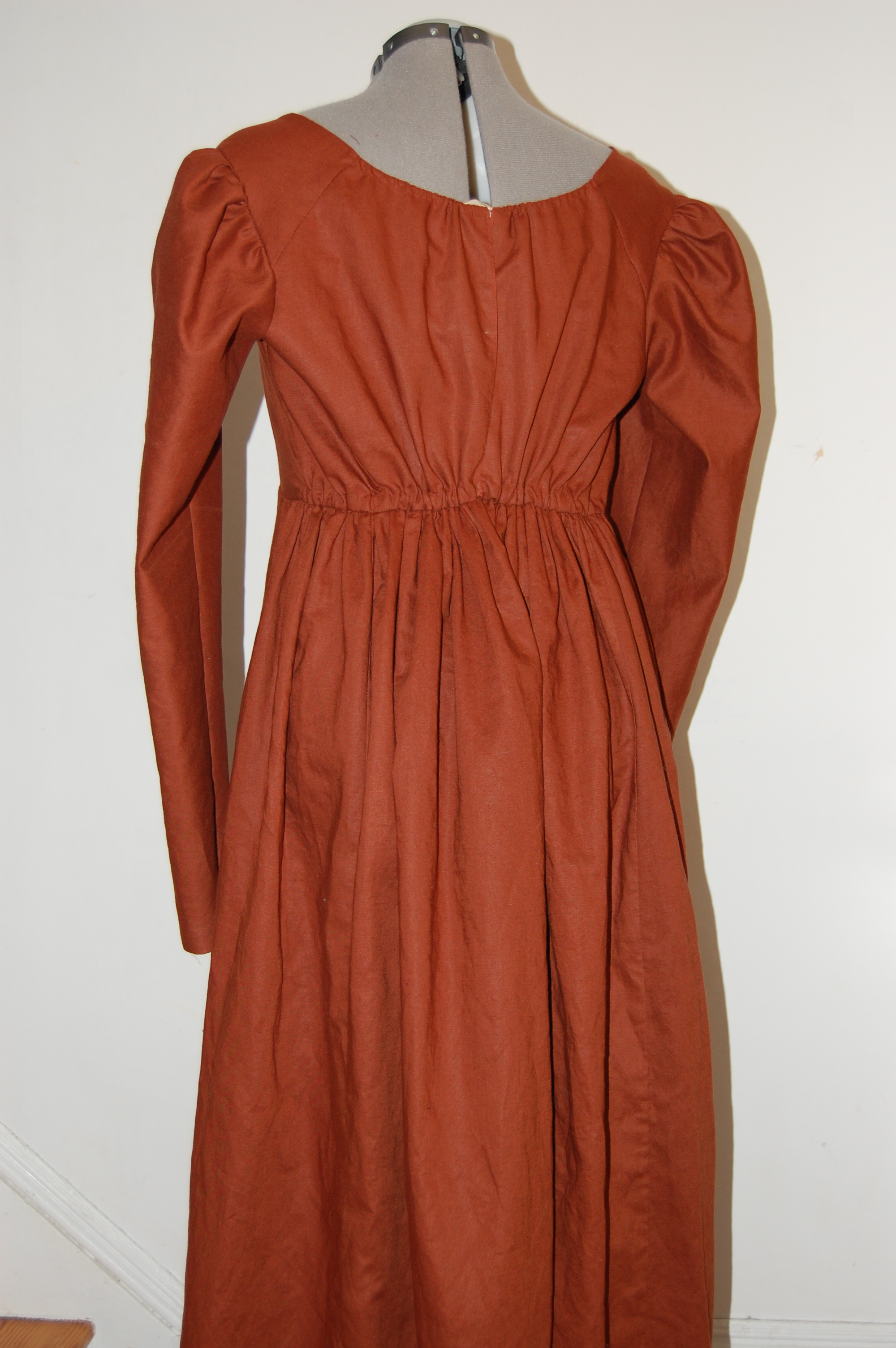
DSC_0572 I play the maid a lot, or one the lower sort, both at home and abroad.

I’ll be a maid in Newport again this February, and for that event, I’ve made the skritchy rust brown gown.

Not quite finished, it still requires hemming and something to finish the sleeves, but in three days, I got pretty far, considering.

This back-closing bodice with bust darts was pretty awful to fit– strange relationships developed between the bodice neckline and a waistband now discarded and on its way to Johnston.

DSC_0573

The back closes with a drawstring at neck and waist, as simple as possible. Mr S and I discovered that fitting a bodice back was deleterious to our relationship, so drawstrings won over buttons. I can tie the lower string, but not the upper– annoying, as I was trying to make a gown that was easy enough to put on solo at 4:30 AM. Vanity won over a pinned apron front gown, though I know they exist in Rhode Island collections. The skritchy rust-brown cotton pays homage to that extant garment, which is a rough homespun brown wool. I may not be stylin’ extant, but I’ll be itching correctly.

Share this:

  • Share on Facebook (Opens in new window) Facebook
  • Share on Pinterest (Opens in new window) Pinterest
  • Email a link to a friend (Opens in new window) Email
  • Share on X (Opens in new window) X
Like Loading...

The Unbearable Sameness of Dressing

04 Sunday Jan 2015

Posted by kittycalash in Clothing, Living History, Making Things, Reenacting, Research

≈ 9 Comments

Tags

18th century clothing, authenticity, common dress, common people, dress, John Copley, living history, sewing

One of the arguments I hear against changing the way people dress as civilians at reenactments, particularly the women but sometimes the men, is that “if we all use the same pattern, we’ll all look alike, and that’s not how people dress now or then.”

I have news for you: that is how we dress[ed].

I know, we can’t apply modern thinking to the past– that’s crap historiography. But why do we resist using the same correct patterns for historic garments when we are clearly dressing alike today?

Mrs Samuel Browne by Smibert, RIHS 1891.2.2
Mrs Joseph Mann by Copley, MFA Boston, 43.1353

I’ve not yet read a paper on the similarity of women’s dress in Robert Feke or John Copley’s portraits that really convinced me, but if you look at enough of them, you might think there’s only one woman and one dress in all of British North America, because Badger and Greenwood are painting her, too.

Even if those clothes are studio props, what does it say that the sitters wanted to be portrayed in the same clothes? Look, if that’s the only means of getting myself into a Charles James, you bet I’d take it. Or, for a more contemporary analogue, Alexander McQueen.

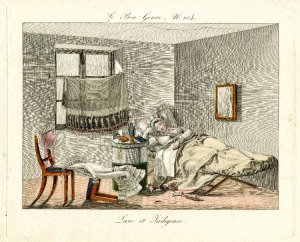
Luxe et Indigence. Le Bon Genre, 1817

Luxe et Indigence. Le Bon Genre, 1817

Dressing is about status as much as it is about self-expression, and in the 18th century, dressing signaled refinement, sensibility, and status through the quality of fabric as much as through the cut of clothes. Air Jordans do the same thing today, or North Face jackets, or Kate Spade purses. They show what you can afford, even if you’re eating oatmeal for dinner behind closed doors.

We dress the same now, and we dressed the same then, with variations according to pocketbook. We can’t all afford K&P superfine wool today any more than we could have bought the best wools or prints in the 18th century. But using accurate patterns and fabrics appropriate to our station will create the best impressions possible– even if my gown is cut to the same pattern as my wealthier acquaintance’s.

Share this:

  • Share on Facebook (Opens in new window) Facebook
  • Share on Pinterest (Opens in new window) Pinterest
  • Email a link to a friend (Opens in new window) Email
  • Share on X (Opens in new window) X
Like Loading...

Pushing Interpretation Forward

18 Tuesday Nov 2014

Posted by kittycalash in Events, History, Living History, Museums, Philosophy, Reenacting

≈ 7 Comments

Tags

18th century clothes, anarchist guide to historic house museums, authenticity, common people, common soldier, exhibits, first person interpretation, historic interiors, history, interpretation, living history, Reenacting, Revolutionary War

Dare I say progressing?
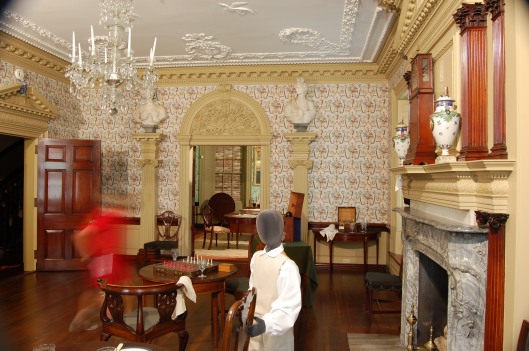
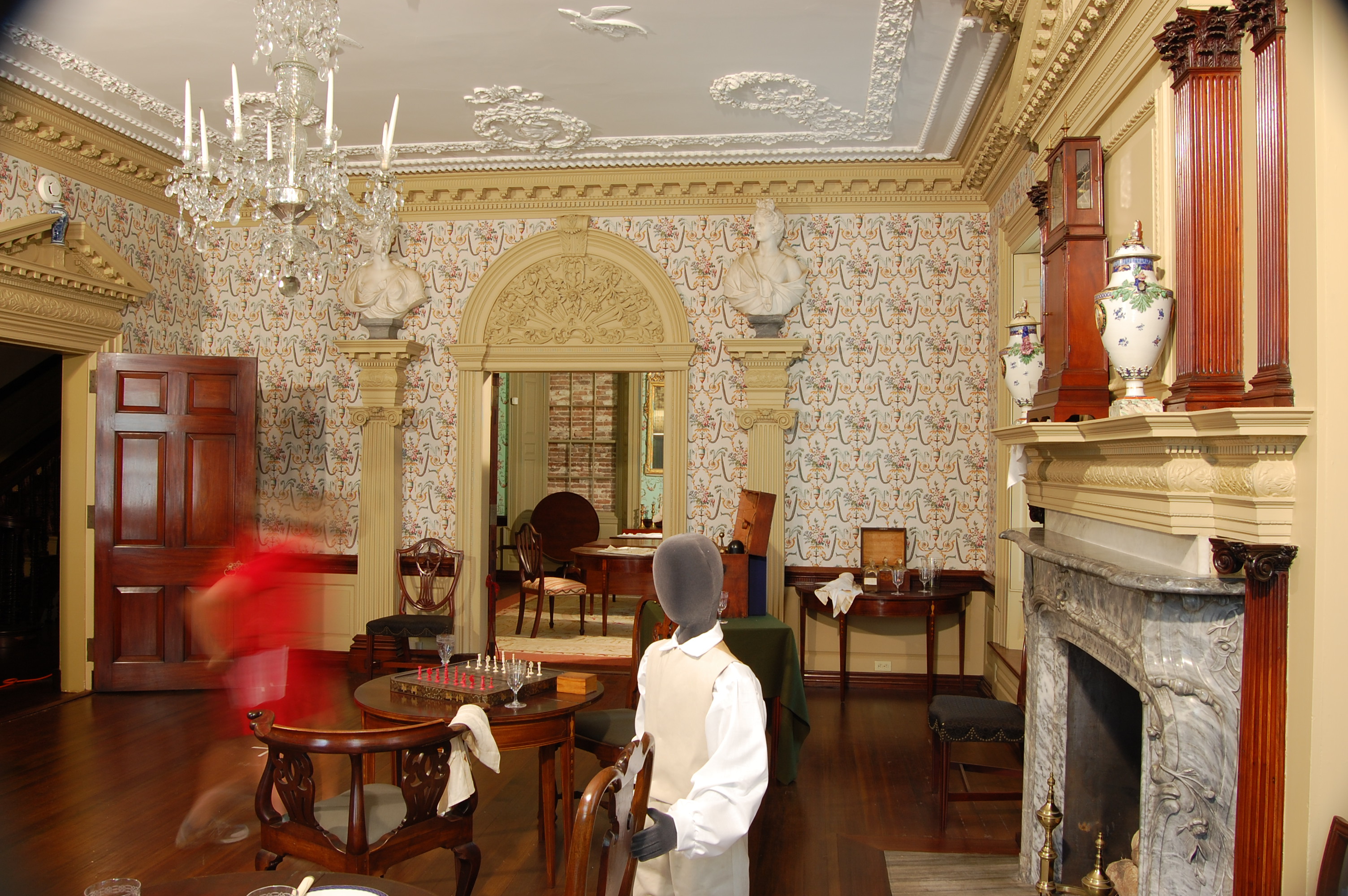
servant mannequin in 18th century room

That’s no ghost, that’s my kid

In the past decade, museums, particularly historic house museums, have been challenged to refresh and reinvent their interpretations and presentations. The most notable challenge has come from the Anarchist Guide to Historic House Museums (AGHHM), and the Historic House Trust of New York’s executive director, Franklin Vagnone.

I re-read a number of Vagnone and Deborah Ryan’s papers recently (including this one), thinking not just about What Cheer Day in a historic house, but about reenacting, living history, and costumed interpretation.

To make a historic house museum (HHM) seem more inhabited and real takes a lot of stuff: clothes, dishes, shoes, stockings, toys— all the stuff that surrounds us now, but correct for the time of the HHM, and arranged in a plausible manner, not like a sitcom set, where chairs before a fireplace face the visitor and not the hearth.
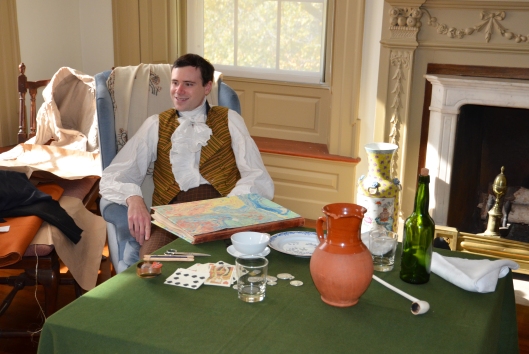
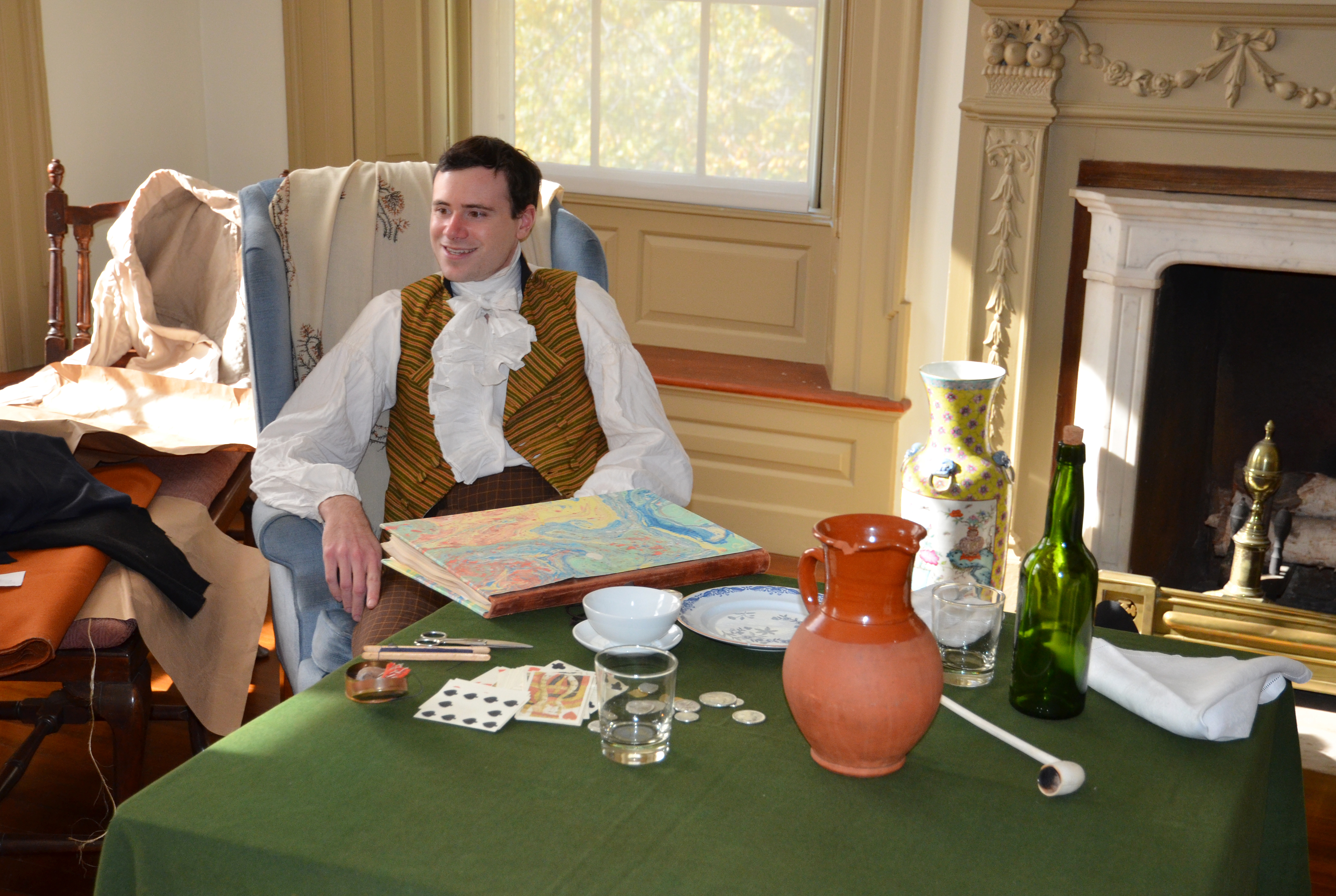
Man with cards, glasses and pipe in 18th century room

Stuff makes a house

To a degree, this is set-dressing, but set-dressing for a still-life, or real life, if the habitation will be by costumed interpreters. It has to be accurate to be authentic, whether it’s a HHM or a living history event that is striving to create a moment, or series of moments, in time– immersive moments.

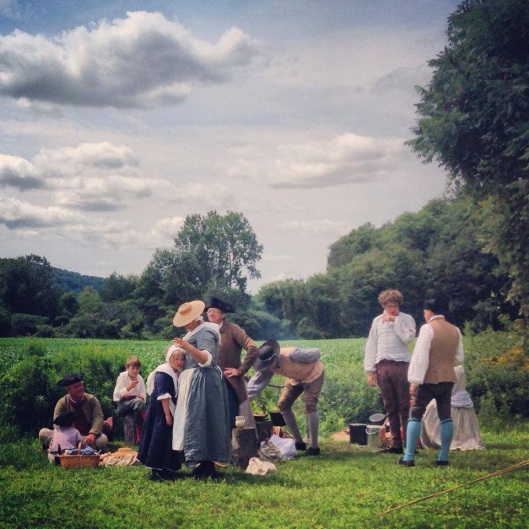
We cannot step into the past unless we believe the representation we’re seeing, and that’s true no matter where we are: that’s why fabric matters, sewing techniques matter, tent pins and kettles and canteens matter. The world is made up of tiny details that we do actually notice without even knowing it: we see more than we realize, faster than we think. We’ll trip on the different, and stop.
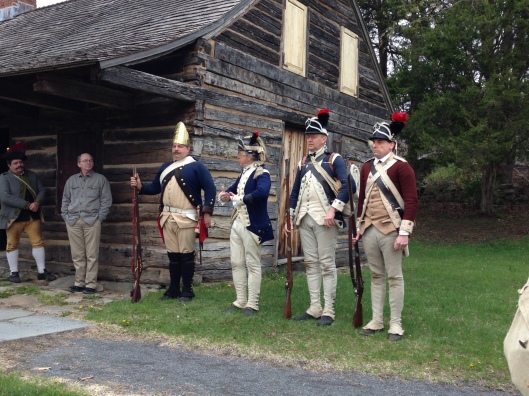
A variety of coats can tell a variety of stories

A variety of coats can tell a variety of stories

But what we want to do, as interpreters, is to have the visitor catch the right difference: not the one about which canteen and why, but the larger interpretive point. In one hypothetical example, wooden canteens are a way to talk about defense contracting and supplying the American army, just as over-dyed captured coats are a way to talk about the American Revolution as an international, and not just a civil, war.

An encampment is, in a way, a neighborhood of HHMs turned inside out, with each regiment a separate family within the larger neighborhood. Each regiment tells a story about itself and its history, and is a lens through which visitors see the larger story.
14999323655_5d9dcf2259_o

That’s why accuracy matters: you don’t want to debunk Ye Olde Colonial craft in camp, or cotton-poly polonaises (poly-naises?) worn by purported women on the ration: you want to focus on the larger interpretive point. When not everyone plays by the same rules, it is better to focus on your own accuracy and authenticity and to ignore Ye Olde Annoyances.

Tell the larger story, the story of your own regiment’s people: that’s your interpretive goal.

Share this:

  • Share on Facebook (Opens in new window) Facebook
  • Share on Pinterest (Opens in new window) Pinterest
  • Email a link to a friend (Opens in new window) Email
  • Share on X (Opens in new window) X
Like Loading...

Cold Scoops

30 Tuesday Sep 2014

Posted by kittycalash in Clothing, History, Living History, Reenacting, Research

≈ 8 Comments

Tags

18th century clothing, 19th century clothing, authenticity, Clothing, common dress, common people, John Brown House Museum, Julia Bowen, Julia Bowen Martin, living history, Providence, Research, Rhode Island, What Cheer Day

What Cheer Day preparations must begin in earnest now, no matter how distracting I might find orderly books or silk shoes (not in my size, alas: no last can be found). I already have clothes enough for a housekeeper, though I still crave a broadcloth Spencer and am working on a petticoat. I’ll hardly go outside that day, so why am I thinking bonnets– especially when I have a known bonnet problem?

One of my favorite resources for Federal era Providence is Julia Bowen’s diary. Born December 1, 1779, Julia’s diary records her life in Providence in 1799, when she was 19. She records the daily activities of the second set of Providence women– daughters not of the most elite merchants, like John Brown and John Innes Clark, but the Bowens, Powers, Howells, and Whipples. Distinguished, but not super-elite. Many of the entries are as prosaic and superficial as you’d expect from a young woman in late adolescence, and thank goodness they are, or we’d never be able to imagine life in such fine detail.

Julia got me thinking about bonnets with her entry of April 12:

found the Major & Citizen Sarah & C. Angell altering their cold scoops into Rosina hats, so busily were they employed that the Major could not go a visiting, which deprived me at once of the greatest pleasure I anticipated in my visit.

(She used code names for her friends; some we can decode, and some we cannot.)

I haven’t been able to decipher what “Rosina hats” were, but cold scoops I could handle: coal scoops.
That colloquialism fits not just fashion plates but extant coal scoops and buckets.

Denham's Auctioneers: Lot 418 A copper coal shovel and a brass coal shovel
Denham’s Auctioneers: Lot 418 A copper coal shovel and a brass coal shovel
Denham's Auctioneers: Lot 153 A copper helmet shaped coal scuttle with brass shovel and turned wooden handle £20-40
Denham’s Auctioneers: Lot 153 A copper helmet shaped coal scuttle with brass shovel and turned wooden handle £20-40

You just have to imagine them turned over.

The Gallery of Fashion, 1797, Bathing Place, Morning Dresses.

The Gallery of Fashion, 1797, Bathing Place, Morning Dresses.

15400635112_e9997f750f_z
15397772861_3ff46f286d_z

I went for cold scoop, with a pasteboard brim and olive green taffeta brim and caul. The mannequin is a 3-D sketch, if you will, of what the housekeeper plans to wear this autumn. At least until she can figure out what a Rosina hat is.

Share this:

  • Share on Facebook (Opens in new window) Facebook
  • Share on Pinterest (Opens in new window) Pinterest
  • Email a link to a friend (Opens in new window) Email
  • Share on X (Opens in new window) X
Like Loading...

Not by Half (robes)

12 Friday Sep 2014

Posted by kittycalash in Clothing, Research

≈ Comments Off on Not by Half (robes)

Tags

1790s, 18th century clothing, common dress, common people, Costumes, costuming, engravings, half robes

two ladies looking out a window in 1790s garments

The Frail Sisters, 12 May 1794. British Museum, 2010,7081.1077

Here’s the British Museum’s description of this print: “Two young women dressed in fine clothes in a room with decorated wallpaper, one sitting in front of the window looking onto the street, with a pet squirrel on her lap, turning to smile towards the viewer and pointing at herself, while the other stands behind her chair on the right. 12 May 1794.” It’s good to get the pet squirrel question out of the way.

This is another print that’s hard for us to read completely: you might wonder why they’re called the Frail sisters. Is Frail a proper noun, an adjective, or something else? It’s probably code: frail here may well refer to the strength of their morals rather than their biceps.

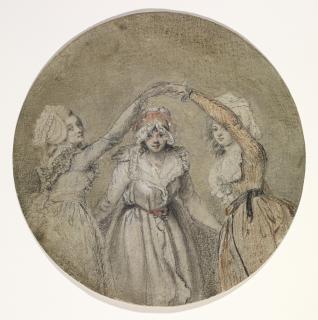
he frail sisters John Raphael Smith (1752-1812) Chalk (black and coloured) on paper (given a light grey ground) Height: 19.4 cm (circular); Acquisition Witt, Robert Clermont (Sir); bequest; 1952 D.1952.RW.4037, Copyright: © The Samuel Courtauld Trust, The Courtauld Gallery, London

The frail sisters
John Raphael Smith (1752-1812)
Chalk (black and coloured) on paper (given a light grey ground) Height: 19.4 cm (circular);
Witt, Robert Clermont (Sir); bequest; 1952
D.1952.RW.4037, Copyright: © The Samuel Courtauld Trust, The Courtauld Gallery, London

There’s another Frail Sisters drawing, also 18th century, probably late 1780s-early 1790s. This is appears to be a ‘straight’ drawing, but I don’t know: it could be an artist’s portrait of three prostitutes at play. Or it could be actresses (they weren’t so very far from prostitutes and courtesans).

Mrs Frail appears in William Congreve’s Love for Love; do these images also reference characters first seen in Restoration comedies? This is stuff I haven’t thought about in a long time, so I can’t yet unpack how the title and meaning of the print relate to what the women are wearing. And I might be over-thinking things a bit, so let’s step back and just look.

What is the standing sister wearing?

A half-robe, indoors. Time of day, indeterminate, but perhaps morning.

The Farmer's Door. George Morland, London: Published by J. R. Smith, King Street, Covent Garden, Aug. 4, 1790

The Farmer’s Door. George Morland, London: Published by J. R. Smith, King Street, Covent Garden, Aug. 4, 1790

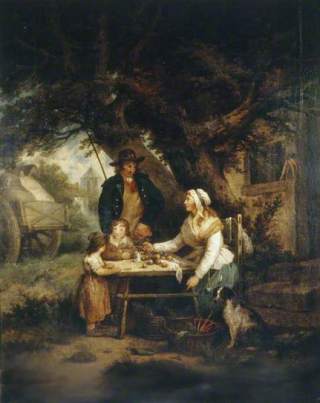
A somewhat easier image to read is the print after George Morland’s The Farmer’s Door, from 1790. This genre painting presents the romanticized vision of humble life, with the farmer’s wife and her children (note the blue stays on the seated child).

Is the farmer’s wife wearing a half-robe over a quilted petticoat and apron? The quality of the images I can find is poor, and the coloring questionable.

In another version here, the kerchief is clearer and seems to go over a long-sleeved garment with a short skirt.

Selling Carrots by George Morland Date painted: 1795 Oil on canvas, 76 x 63.5 cm Collection: Brighton and Hove Museums and Art Galleries

Selling Carrots
by George Morland
Date painted: 1795
Oil on canvas, 76 x 63.5 cm
Collection: Brighton and Hove Museums and Art Galleries

In Selling Carrots, there is another short-skirted garment with long sleeves worn over a petticoat and with a kerchief.

Without getting overly distracted by titles and meaning, I think there are clues to how these half-robes or jackets are worn by women of different classes, aspirations, and locations. For rural women who are not gentry, these appear to be comfortable working clothes worn all day. For urban women, they seem to be worn early in the day, and sometimes out of doors, perhaps even to the lending library.

Share this:

  • Share on Facebook (Opens in new window) Facebook
  • Share on Pinterest (Opens in new window) Pinterest
  • Email a link to a friend (Opens in new window) Email
  • Share on X (Opens in new window) X
Like Loading...
← Older posts
Newer posts →

Archives

wordpress statistics

Creative Commons License
Kitty Calash blog by Kirsten Hammerstrom is licensed under a Creative Commons Attribution-NonCommercial-ShareAlike 4.0 International License.

Website Built with WordPress.com.

  • Subscribe Subscribed
    • Kitty Calash
    • Join 621 other subscribers
    • Already have a WordPress.com account? Log in now.
    • Kitty Calash
    • Subscribe Subscribed
    • Sign up
    • Log in
    • Report this content
    • View site in Reader
    • Manage subscriptions
    • Collapse this bar
 

Loading Comments...
 

    %d