• Home
  • Completed Costumes/Impressions
  • Emma and Her Dresses
  • Free Patterns and Instructions

Kitty Calash

~ Confessions of a Known Bonnet-Wearer

Kitty Calash

Tag Archives: common people

The Stamp Act Protest of 2014

25 Monday Aug 2014

Posted by kittycalash in Events, Living History, Museums, Uncategorized

≈ 11 Comments

Tags

18th century, Colony House, common people, living history, Newport, Newport Historical Society, Rhode Island, Rhode Island history, Stamp Act Protest, Washington Square

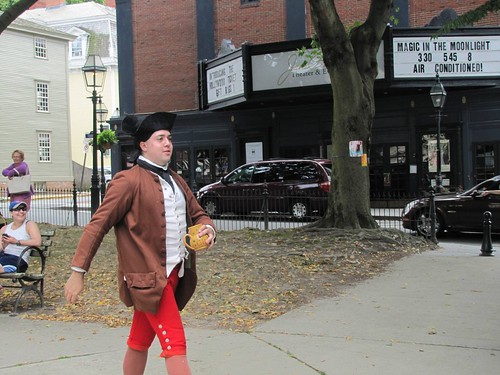
Last Saturday, we stepped back in time to 1765 in Newport. I know: Newport always seems to be in a different time than gritty Providence, but this trip was truly different.
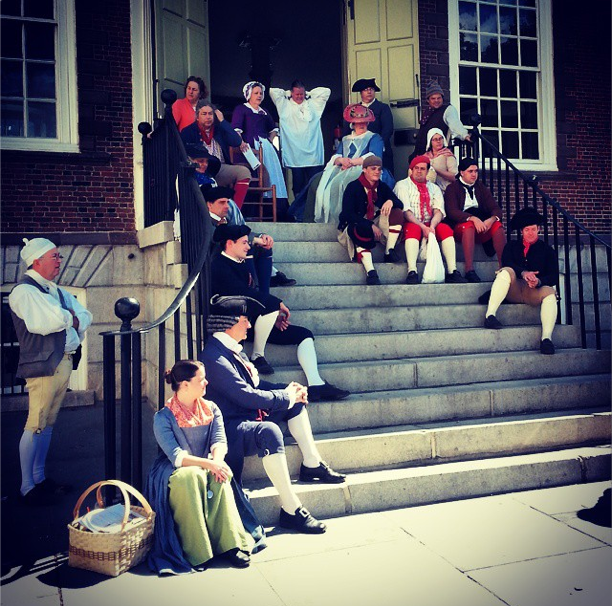
On the Colony House steps

On the Colony House steps

We were headed across the Bay for a Stamp Act Protest (no rioting, per police request). In this effort, we joined a large group of recruits from New England and even beyond, to fill Washington Square and other sites in the city.

18th century sailors prepare to sew a sail

Preparing the ‘sails’ for stitching. I never really noticed the cars till I saw the photos!

Stationed around the square were sailors mending or making a sail*, an apprentice-less printer, a sleepy apprentice boy, a tailor and his journeyman, a milliner, and leading citizens, one of whom was kind enough to read the newspaper to the apple seller, who wonders what has become of her son.
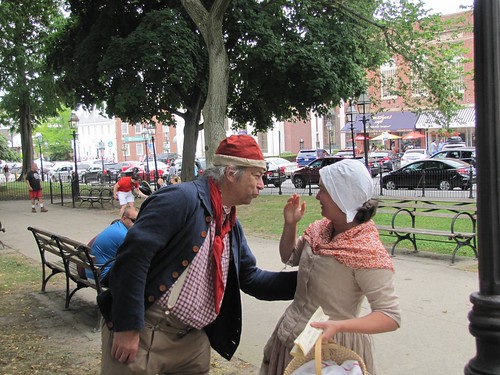
You must be very careful indeed around the sailors!

Up the street, some very fine ladies were having tea. Their refinement was evident in their appearance and dress, as well as in the elegant setting of their tables. They wanted none of my apples, as they had imported citrus fruits, far better than the apples the island’s trees produce. (Wasted on tea, truly: what one wants to do with a lemon is to find some rum and make a punch.)

18th century tea party in Newport

The Ladies’ Tea

Ladies at a tea table

Seated for tea

Mr Robinson marches forth

The news was very bad, and tempers flared in the square. Mistress Ellery told me that dinner parties had become impossible to hold: parties nearly come to blows over discussions of taxes, customs, stamps, and the oppressive policies of Mr Robinson, who insists on enforcing the very letter and penny of the law. (He was quite insulting on the quality of my apples, indeed, spitting one upon me even as he continued to eat it!)
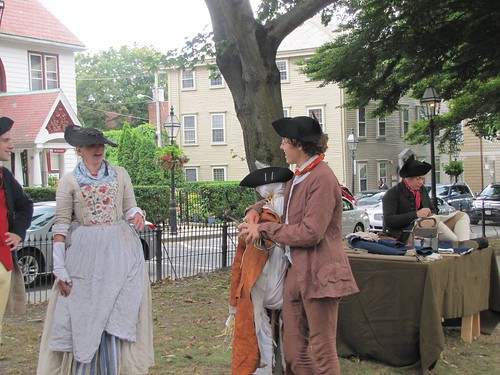
The apprentice boy had charge of the effigy; the tailor sewed on.

As the afternoon wore on, the debate grew more intense and the crowd more heated. And effigy of Mr Howard was made, paraded, and hung, and then the crowd of protesters dispersed to the White Horse Tavern.
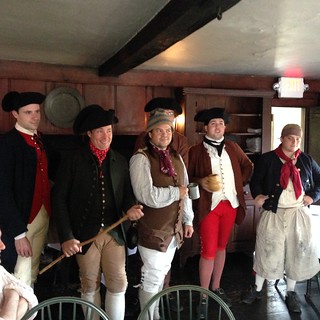
18th century men at the White Horse Tavern in Newport

Fortified!

Tensions seemed to dissipate, though when the runner came, the protesters– now fortified with ale, porter and cider–ran down the street to “plunder” Mr Howard’s house, played here by the Wanton-Lyman-Hazard House.

18th century people at Want-Lyman-Hazard House

Ignoring the mistress of the house, protesters dashed to the back.

Although the mistress of the house tried to reason with them, the crowd would not be dissuaded, convinced of their mission (and perhaps more fortified than you would expect after just one glass). They carried their loot to the front of the Colony House, and heaped it up, glorying in their success.

The goods!
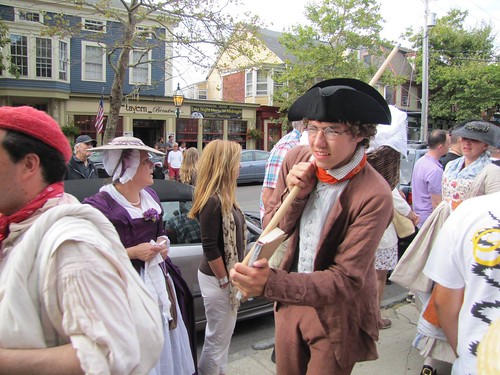
More goods!

In the end, the house was not looted, tensions were dissipated, and the protesters dispersed into the afternoon. We were well-rewarded with cheese and ale at the Colony House, and enjoyed discussing the events of 1765 and 2014 with the public and Newport Historical Society staff members.

*Yes, Virginia, they do look like tents. That’s because they are tents. Someday, Light Infantry soldiers will sleep beneath that canvas. But for now, keep stitching!

Share this:

  • Share on Facebook (Opens in new window) Facebook
  • Share on Pinterest (Opens in new window) Pinterest
  • Email a link to a friend (Opens in new window) Email
  • Share on X (Opens in new window) X
Like Loading...

Camp Life

22 Friday Aug 2014

Posted by kittycalash in Events, Living History

≈ 6 Comments

Tags

10th Massachusetts, 18th century, Brigade of the American Revolution, common dress, common people, common soldier, cooking, Events, living history, Revolutionary War

The Ks, Mr C, Mr McC, and the Ss in camp

The Ks, Mr C, Mr McC, and the Ss in camp

When I don’t manage to write up the weekend quickly, I risk forgetting what happened, which is sad when you think how intense the time can be. This past weekend was a little different from others as there were more of us in camp than usual. I locked the camera in the car along with my car keys, and never remembered to ask Mr S for his key when he was present…so the images are all from other sources.

Last week I was party to the Great Oatmeal Debate by Text Message as I tried to determine whether or not oatmeal was correct in period, and if so, what kind.  Let’s call it Hannah Glasse’s “oatmeal flummery” and move on.

To make Oatmeal-Flummery. GET fome oatmeal, put it into a broad deep pan, then co ver it with water, stir it together, and let itftand twelve hours, then pour off that water clear, and put on a good deal of fresh water, shift it again in twelve hours, and fo orrin twelve more ; then pour off the water clear, and ftrain the oatmeal through a coarfe hair-fieve, and pour it into a fauce-pan, keeping it stir ring all the time with a stick till it boils and is very thick ; then pour it into difhes ; when cold turn it into plates, and eat it with what you pleafe, either wine and fugar, or beer and sugar, or milk. It eats very pretty with cyder and fugar.

We were very lucky to have hard wood for fires, and I was very lucky indeed to have Mr McC on hand to tend to the fire, especially on Sunday morning, when I did not get up and start dressing until 6:00 AM. He joined us early Saturday morning with a kettle of hot coffee in hand, proving long experience with the un-caffeinated reenactor in the wild.

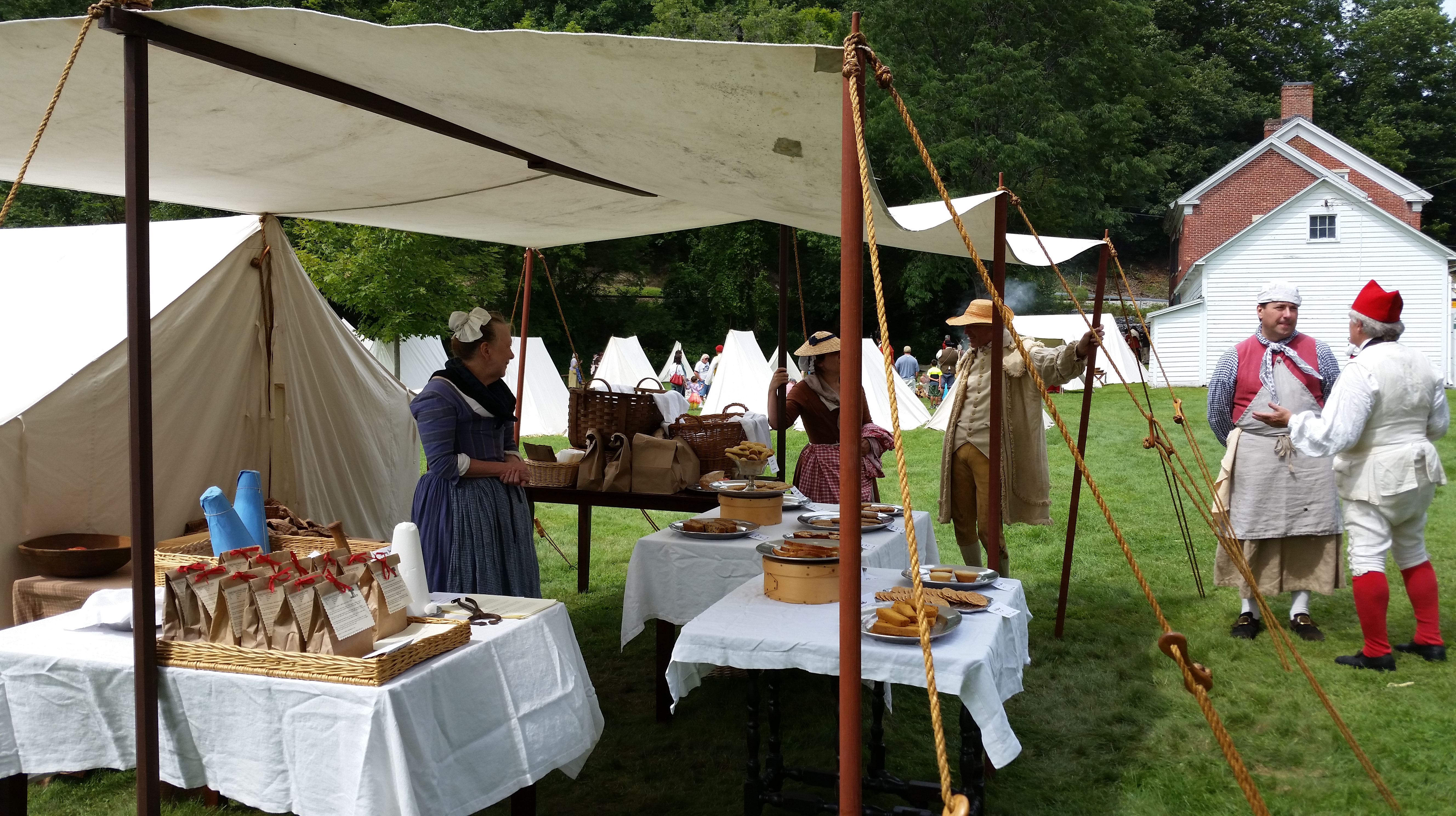
We ate very well this past weekend, with contributions from Mr McC, Mr L, the family C, and purchases from the Georgian Kitchen and Sugar Loafe Baking Company.

The Georgian Kitchen and Sugar Loafe Baking Co at Walloomsac

The Georgian Kitchen and Sugar Loafe Baking Co at Walloomsac

The Young Mr eventually bought his own loaf of bread, stuffed it in his haversack, and ate from it fairly continually on Sunday. If there had been a ginger cookie as large as a loaf of bread, I expect he would have bought that instead, but bread was a reasonable choice (though I think it proven tricky to hold a musket and a loaf of bread simultaneously….)

18th century militia in small clothes

Militia in Small Clothes

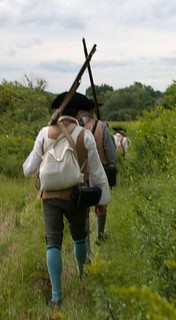
18th century militia marching in New York countryside

Mr S (left handed, as you can see) following MrMcC

The 10th Massachusetts, fielding as militia, are in the second and third rows above; I was shocked–shocked!– to see them fielding in their small clothes, but it is documented, and as they said when they lay down and even left ranks before fielding, “We’re militia. We’re not listening.” (Left to right, that’s Mr FC, Mr S, Mr McC and, in the rear, Mr L.)

For me, the best part of the weekend was, as it always is, being outside of time. (I even had a nap on Saturday, when the gents were up at the battle: more delicious than stew or cookies or even quince cake.)

At Sunday’s divine service, I was reminded again of why I enjoy this, and why we keep doing this, even when it all seems ridiculous in the face of the larger world.

The old service from the Book of Common Prayer is not that different from what we used in church. The formal rhythm and familiar words always remind me of how different the 18th century was from our own time, and how small people could feel in the face of a world without electricity, internal combustion engines, and modern weapons of war. As we lined a psalm and recited the liturgy that hoped for peace, I thought of Ferguson again, and of the ways that people bind together in beliefs without regard to class or color, and had some hope (even as I recited om mani padme hum internally). A moment of grace is often more easily found stepping outside yourself, and stepping out of time and out of doors can help.

Speaking of stepping out…

woman undressing in stays and petticoats

Almost steppin’ out of the 18th century…

We had to pack up and flee back to the 21st century on Sunday afternoon, and I was caught getting partially undressed outside our tent (between my height and Natural Gace, I find outdoor dressing easier). No matter what you do, or when you do it, a healthy sense of humor about oneself is always useful.

Share this:

  • Share on Facebook (Opens in new window) Facebook
  • Share on Pinterest (Opens in new window) Pinterest
  • Email a link to a friend (Opens in new window) Email
  • Share on X (Opens in new window) X
Like Loading...

Boil and Not Too Much Trouble

19 Tuesday Aug 2014

Posted by kittycalash in Events, Food, Living History, Reenacting, Research

≈ 3 Comments

Tags

10th Massachusetts, authenticity, Bennington, Brigade of the American Revolution, common people, common soldier, cooking, Enos Hitchcock, food, hearth cooking, history, living history, Research

Camp cooking can get old. Stew, sigh. Bread, sigh. Cheese, sigh. Apples, sigh.

Don’t get me wrong: all of the above are delicious today. Historically, New England troops are all about cheese and cider, and have much to say about the quality of beef, but menu can be repetitive and lacking in challenge.

Ever since I had boiled flour pudding at Coggeshall Farm, I’ve wanted to make it since I so much enjoyed the texture.

When I found it mentioned by Enos Hitchcock, I was particularly excited.

1777 May 24
Dined upon flowr puding & Venison Steak.

Flowr puding? I love that guy! But there it is, documented, even if eaten by the officers and not the private soldiers. It’s common enough that I think it likely almost everyone knew how to make it. The trick would have been getting hold of eggs and milk, which is easy enough for me, if not for the soldiers of 1777. Fortunately, as we drove down Cottrell Road headed for home, a flock of Plymouth Rock chickens crossed the road in front of us: there were the eggs, at least in our time.

postcard of kittens eating christmas pudding

Not your chaplain’s pudding.

The method I had tried at home worked: I beat three eggs and four spoons of milk in my tall redware mug, and added the liquid slowly to the flour and salt mixture. The whole mixture went into a cloth bag, which I tied with a string and boiled in the smallest kettle, not want to risk any damage to the beef stew. I’ll test the works at home on my nearest kin and willing victims before I loose it upon a regiment and hungry guests.

Although the pudding was a strange shape, it cooked up quickly in about 45 minutes, had a firm texture and a satisfactory enough flavor. I would have liked it to rise a bit more, which is an argument either for beating the eggs with a fork in the confined cylinder of the cup, or risking the splash of the whisk in a bowl, or, finally, for a smaller whisk.

Still, not too bad for expanding the camp cooking repertoire of Things That Can be Boiled and Eaten.

Share this:

  • Share on Facebook (Opens in new window) Facebook
  • Share on Pinterest (Opens in new window) Pinterest
  • Email a link to a friend (Opens in new window) Email
  • Share on X (Opens in new window) X
Like Loading...

Measure for Measure

12 Tuesday Aug 2014

Posted by kittycalash in Fail, Food, History, Living History, Reenacting, Research

≈ 5 Comments

Tags

10th Massachusetts, 18th century, authenticity, common people, cooking, experimental archaeology, food, living history, Research, resources, Revolutionary War

or, a boiled Flour Pudding in two tries.

14699830917_63d67ffee0_b
Tablespoons and Cups

Alone in my Ossining ca. 1962 kitchen, I decided to tackle Amelia Simmons. The first task seemed to be to establish measurements, and then proportions, so I took stock of the tools and containers I would have in a typical camp. Spoon, mug, half-pint: these are plausible items, though we have tin cups that hold exactly 8 ounces, so the measure is unnecessary. The spoon was cast from a 1780 mold, so it seemed like a reasonable place to start for “how much is a spoon?” It will hold exactly one tablespoon if you scrape it flat across or are measuring liquid. Handy to know.

Next, I checked the recipe again.

A boiled Flour Pudding.
One quart milk, 9 eggs, 7 spoons flour, a little salt, put into a strong cloth and boiled three quarters of an hour.

This is not a popular receipt, so you won’t find it on History is Served, nor will you find this version on other popular sites; you can find a boiled pudding with suet, but that’s not what I’m after: I’m after a receipt that starts with a portion of the ration of flour soldiers received, and adds only eggs, milk, and available seasonings.

You have to remember that Simmons corrected the 7 spoons to 9 spoons of flour and increased the boiling time; you also have to remember that eggs were smaller then.

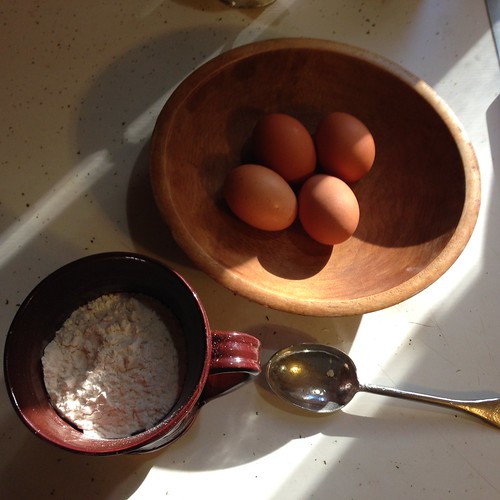
redware mug and wooden bowl with egggs

Halfsies.

I thought I’d try a half receipt first. There are no directions as we think of them– American Cookery sometimes has that “put your lips together and blow” feeling–but this is not too complex. The eggs and milk must be beaten together, and then combined with the flour. For this first attempt, I got it a bit backwards, adding the spices to the eggs, which I beat in the large wooden bowl.

That left me scooping the egg-and-milk with the measure into the flour, which I had in a smaller wooden bowl, remembering too late the method for scones.

egg and flour mixing in wooden bowls

Fuzzy photo, fuzzy logic.

And then it was really too late: I added just too much egg-and-milk, and it became more like batter than dough. This was not correct, and I knew it, but I didn’t dump it and I didn’t add more flour. Now it’s clear that 7:00 AM is not my best time for baking experiments (it was also quite early the day I made gingerbread without any eggs).

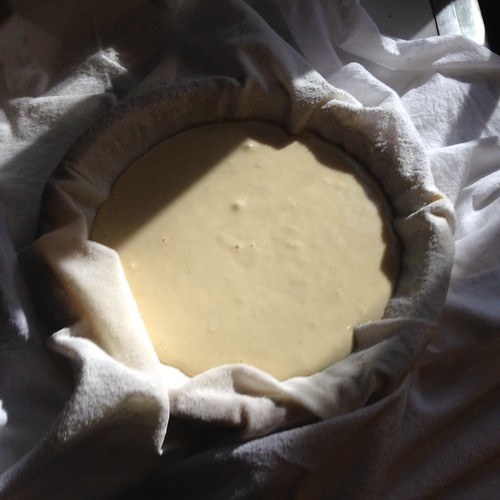
pudding mixture in cloth

Well, it took a decent photo.

I buttered and floured a cloth anyway, and poured the mixture into it. After tying the gathered neck of the cloth with string, I boiled the whole business for 45 minutes.

I did not take a photo of the mess I found when I unwrapped the bag. It wasn’t pretty, and it was clear that while some portions of the pudding were ‘done,’ they constituted about 5% of the whole, which otherwise resembled steaming cottage cheese. Really, truly, awful.

But from time to time I am undeterred by my failures, and instead of consigning the mess to the trash and sticking with store-bought bread*, I rinsed the cloth and regrouped.

This time, I went smaller: 1 cup of flour (about five spoons), two eggs, and a scant two spoons of milk. I also managed to put the flour, salt, and allspice in the regular sized wooden bowl, crack the eggs into the mug and beat them there with the milk. When I mixed the egg-and-milk into the flour, the mixture was far too stiff, so I added more milk, but kept the mixture stiff.

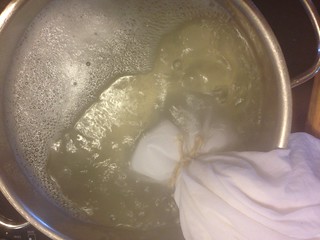
pudding bag in boiling water

Patience is required for pudding

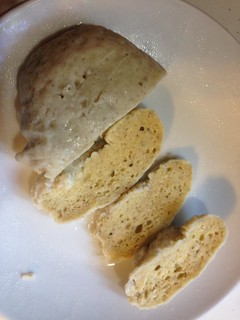
Once more into the buttered cloth, once more into the water, once more boiling for three-quarters of an hour. This time was better, though. The results actually looked and tasted much more like what I’ve had before.

sliced boiled flour pudding

A boiled Flour Pudding

So, where does this leave me? Knowing that I’m the only documented fan of this in the regiment, I’ll stick with the smaller receipt: five spoons flour; two eggs, beaten; and three or four spoons of milk.

My plan is to boil this in whatever stew or stew-like device we have for supper on Saturday, and then eat it sliced with the stew. The plain flour-egg-milk mixture will pick up some of the flavors of the stew (think dumplings), but these could also have been served with a sauce, if made at home.

I’m also going to go back to the Experienced English Housekeeper, and see what she has to say.

* Years in ceramics classes taught me to knead all the air out of plastic material, so my bread tends to be better for building than eating. Even the dog wouldn’t eat the biscuits I made while in grad school…

Share this:

  • Share on Facebook (Opens in new window) Facebook
  • Share on Pinterest (Opens in new window) Pinterest
  • Email a link to a friend (Opens in new window) Email
  • Share on X (Opens in new window) X
Like Loading...

The Coats of August

07 Thursday Aug 2014

Posted by kittycalash in Clothing, Living History, Making Things, Reenacting

≈ Comments Off on The Coats of August

Tags

common dress, common people, common soldier, fashion, frock coats, Making Things, sewing, sewing project, style

Coat, Nantucket Historical Association, 1985.0068.001

I could have a coat problem so very easily. Look at that coat!

I was looking for something else when I came across this coat. Pity my friend who got the excited, “Who do you know on Nantucket?” text message, because after I saw this coat and couple others, I was checking out the high speed ferry schedules. (They’re not too great; I’d need to stay overnight at least one night– poor me, right?–which means this must be a winter visit.)

Once you’re hooked on 1812, it’s hard to travel back in time, but travel back I must, for Bennington is just a little over a week away.

What am I thinking? Well, in my madness and in the face of the enormous growth of the Young Mr, here I am thinking Coats in August.

Paul Sandby, 1731–1809, British, London Cries: A Fishmonger, ca. 1759, Watercolor and graphite on medium, cream, slightly textured laid paper, Yale Center for British Art, Paul Mellon Collection

Paul Sandby, 1731-1809, British, London Cries: A Fishmonger, ca. 1759, Watercolor and graphite on medium, cream, slightly textured laid paper, Yale Center for British Art, Paul Mellon Collection, B1975.3.210

I know, Bennington/Walloomsac is 1777, so why am I looking at 1759 coats? Because I’m thinking a short-skirted workman’s jacket for the kid, of striped linen, rather than another frock coat. My plan–such as it is– is to alter the  pattern I know fits him to make these shorter skirts…we’ll see how this experiment goes, and hope for fewer than six toiles!

By next Friday night, I need to complete:

  • One new coat, from a newly drafted pattern
  • One new waistcoat
  • New buttons for a waistcoat
  • Alterations to breeches including new buttons and new knee bands

That doesn’t seem so bad, does it?

Share this:

  • Share on Facebook (Opens in new window) Facebook
  • Share on Pinterest (Opens in new window) Pinterest
  • Email a link to a friend (Opens in new window) Email
  • Share on X (Opens in new window) X
Like Loading...
← Older posts
Newer posts →

Archives

wordpress statistics

Creative Commons License
Kitty Calash blog by Kirsten Hammerstrom is licensed under a Creative Commons Attribution-NonCommercial-ShareAlike 4.0 International License.

Website Built with WordPress.com.

  • Subscribe Subscribed
    • Kitty Calash
    • Join 621 other subscribers
    • Already have a WordPress.com account? Log in now.
    • Kitty Calash
    • Subscribe Subscribed
    • Sign up
    • Log in
    • Report this content
    • View site in Reader
    • Manage subscriptions
    • Collapse this bar
 

Loading Comments...
 

    %d