• Home
  • Completed Costumes/Impressions
  • Emma and Her Dresses
  • Free Patterns and Instructions

Kitty Calash

~ Confessions of a Known Bonnet-Wearer

Kitty Calash

Tag Archives: Events

Men, Women, and Work

07 Wednesday Oct 2015

Posted by kittycalash in Uncategorized

≈ 8 Comments

Tags

authenticity, common people, Events, history, interpretation, Reenacting, women's history, women's work

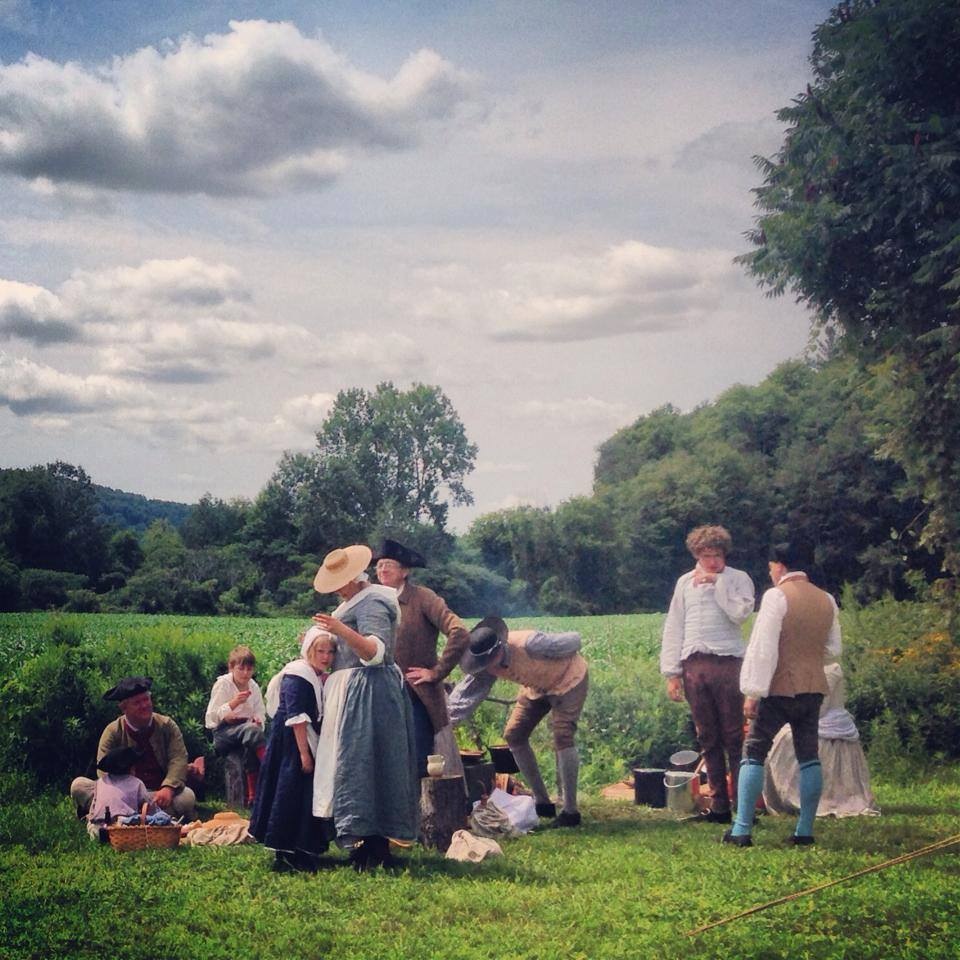
After a late afternoon meeting that left me raw from the way men speak over, interrupt, and dismiss women, I began to think again about a conversation I’d had with a friend at lunch about women’s roles at living history events, primarily military, but also militia, so let’s call them Gun Shows.

14999323655_5d9dcf2259_o

What do women do at the Gun Shows? They cook, for one thing, tied to camp fires. That’s at least a little better than the spinning that can happen, but it’s still not always right. I think a lot about how we’re not truly representing the ways that armies moved, slept, provisioned themselves, and how that affects the roles that women, children, and the (forgive me ) Invalid Corps might play. Yes, there are options: laundry, petty sutlering. There are women doing those things and doing them well, which is fantastic. When I think about how I might complement that, I end up thinking about women even naughtier than Bridget– and I think Bridget must have been very naughty indeed.

Even when you move away from military events, let us say to militia events, similar segregation occurs: women cook and wash dishes, men fire weapons. It just makes me tired, this notion of women forever being pendant to a gun, dependent on housework. It leaves me wondering what else I can do.

Perhaps more Gaskell than Austen, here

Perhaps more Gaskell than Austen, here

That’s easier in a civilian context. Women ran boarding houses, had small shops, ran needlework and boarding schools, worked as seamstresses, soap makers, tailoresses, milliners, mantua makers, painters and silhouette cutters. None of those things belong in a camp, and I begin to think that unless I can figure out a feminist interpretation of women’s lives of drudgery, I will have to give up the Gun Shows completely. And yes, for those of you who know me, that will be a natural transition, won’t it?

Share this:

  • Click to share on Facebook (Opens in new window) Facebook
  • Click to share on Pinterest (Opens in new window) Pinterest
  • Click to email a link to a friend (Opens in new window) Email
  • Click to share on X (Opens in new window) X
Like Loading...

Afternoon in Cambridge

27 Monday Jul 2015

Posted by kittycalash in Events, History, Living History

≈ 1 Comment

Tags

10th Massachusetts, Cambridge, common people, common soldier, Events, living history, Massachusetts, Revolutionary War

Cambridge. We’ve been there before to cause some mild lawn-based havoc and this year was much the same. We were on our own on the lower level, with just the six-plus-me of some abbreviated form of Soper’s company. Longfellow House is a very lovely site, and the lawn is large enough for a wall tent, drilling, eating, and general mischief.

Longfellow House, Cambridge. Photo from @longnps on Instagram

Longfellow House, Cambridge. Photo from @longnps on Instagram


I packed our lunch in a series of linen bags in the wallet, and stuffed a gown skirt and sewing box in the other end, with a bowl and a mug. I brought the small pitcher and a glass, with the intent of selling ‘gin’ to the militia, but had only one taker. They got into enough trouble themselves with filthy faces, pilfering, and stealing the captain’s books.

unknown artist, 18th century, The Encampment in the Museum Garden, 1783, Aquatint, hand-colored, Yale Center for British Art, Paul Mellon Collection

unknown artist, 18th century, The Encampment in the Museum Garden, 1783, Aquatint, hand-colored, Yale Center for British Art, Paul Mellon Collection

It’s no immersion event, what with traffic on the street and tourists dressing in Mr Townsend’s best* but there are moments at any gathering when you become so engrossed in what you are doing that you forget where you are. This time was no different: I don’t recall how it started, but we took off down Brattle Street with Sergeant Cooke crossing the yard in hot pursuit– only to be stopped by the wall. He turned the stone barricade into a large and angry goose, neaatly solving solving the problem of not being able to scale the wall.

James Sowerby, 1756–1822, A Goose, undated, Watercolor and graphite on moderately thick, slightly textured, cream wove paper, Yale Center for British Art, Paul Mellon Collection

James Sowerby, 1756–1822, A Goose, undated, Watercolor and graphite on moderately thick, slightly textured, cream wove paper, Yale Center for British Art, Paul Mellon Collection

I don’t think I’ve ever bolted that fast in stays before, and it wasn’t the best idea I’ve ever had, but who cares? It can be done, running in stays, at least for short bursts.

There was much discussion of the filth of the troops, and their need to bathe; despite our best efforts, we could not quite get a satisfactory rise out of the officers, though some soldiers had clearly rolled in dirt. (It’s of a much better quality in Cambridge, you know, where you can wear the Harvard Yard.) There was an attempt at bathing at the Great Bridge, but in the end, one private’s face was washed with an apron corner dipped in ‘gin.’

Benjamin West, 1738–1820, American, active in Britain (from 1763), The Bathing Place at Ramsgate, ca. 1788, Oil on canvas, Yale Center for British Art, Paul Mellon Collection

Benjamin West, 1738–1820, American, active in Britain (from 1763), The Bathing Place at Ramsgate, ca. 1788, Oil on canvas, Yale Center for British Art, Paul Mellon Collection

Satisfying all around, really, from the recitation of Mr Pickering’s manual with its endless repetition of ‘butt,’ meaning musket, entertaining the simpler, uncivil soldiers, to the meal of bread, cheese and cherries, to the chasing. The audience was small, but well entertained if they were paying any attention.

*Oh, NPS, what were you thinking?

Share this:

  • Click to share on Facebook (Opens in new window) Facebook
  • Click to share on Pinterest (Opens in new window) Pinterest
  • Click to email a link to a friend (Opens in new window) Email
  • Click to share on X (Opens in new window) X
Like Loading...

Context is Critical

15 Wednesday Jul 2015

Posted by kittycalash in Clothing, Events, Fail, Living History, Research

≈ 10 Comments

Tags

18th century, 18th century clothes, authenticity, common dress, common people, Events, fashion, living history, Research, Revolutionary War

Context: it’s everything, right? We so dislike our statements taken out of context. But what about our clothes? They make statements, too, and so do our accessories.

A friend noticed that market baskets were fairly prominent carriers used by reenactors portraying the Boston gentry greeting L’Hermione this past weekend, and asked, “What gives? Is there something I missed?”

There are two images that people often turn to in documenting these baskets:

The Farmer’s Return, by Zoffany

Johan Joseph Zoffany RA, 1733–1810, German, active in Britain (from 1760), David Garrick and Mary Bradshaw in David Garrick’s “The Farmer’s Return”, ca. 1762, Oil on canvas, Yale Center for British Art, Paul Mellon Collection

and

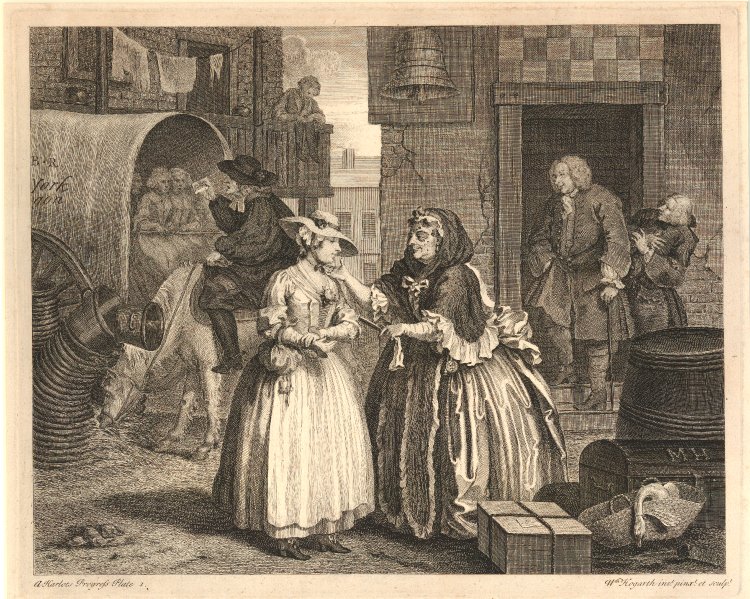
The Harlot’s Progress, Plate 1

The Harlot's Progress, Plate 1. William Hogarth.

The Harlot’s Progress, Plate 1. William Hogarth.

In both of these, the context is working class and food-oriented. As my friend asked, “Are these floppy baskets for floppy birds?”

Two images from 1740 to 1760 aren’t a lot of documentation to go on for 1775-1783, so I checked the Rhode Island newspapers for 1770-1790, searching for “basket.” No mention in ads, but “baskets of grapes” appeared in stories, and a mention of Chinese dogs in cotton-lined baskets (apparently the “basket dog” is the 18th century equivalent of today’s purse dog).

As satisfying as basket-dogs might be, they’re not helpful in this instance.

The Yale Center for British Art helpfully adds keywords or tags to their catalog records, which allows one to look for “basket.” Aside from The Farmer’s Return, this ovoid, market-basket form isn’t really seen. What is seen?

For one thing, not many upper-class women carrying baskets, or any kind of burden or bundle. A woman carrying a kind of ovoid basket over her arm is shopping for food, not perambulating.

The upper class girl with her father has an open basket full of flowers (hint: probably symbolic) which appears to be made of what we lump into “wicker,” in an open design. (BTW, that’s not a pinner apron; zoom in and you will see shoulder straps. Fight at your leisure.)

Arthur Devis, 1712–1787, British, An Unknown Man with His Daughter, between 1746 and 1748, Oil on canvas, Yale Center for British Art, Paul Mellon Collection

In the most class-appropriate image, The Virtuous Comforted by Sympathy, the workbasket at the woman’s feet is a tidy, round form with a lid, more similar to Nantucket baskets* than to market baskets. It really doesn’t look like the kind of thing you’d leave home with. It’s a sewing basket.

Edward Penny RA, 1714–1791, British, The Virtuous Comforted by Sympathy, 1774, Oil on canvas, Yale Center for British Art, Paul Mellon Collection

Edward Penny RA, 1714–1791, British, The Virtuous Comforted by Sympathy, 1774, Oil on canvas, Yale Center for British Art, Paul Mellon Collection

On balance, I think it appears that public basket carrying is more suited to carrying foodstuffs than personal items, and that the most common use of baskets in this period is to collect and carry food, whether from a greengrocer, fish stall, or gathering apples— at least if you are trying to be quite precise in the use of documented accessories. If you’re using a market basket to carry food, you do so knowing that it’s only (thus far) documented to England, and that the handles must be woven and not leather riveted to the side.

The material from which the baskets are made is another question altogether, along with the proper woven form. As I noted to my friend, I don’t care that much. And why?

Balthazar Nebot, active 1730–1762, Spanish, active in Britain (from 1729), Fishmonger's stall, 1737, Oil on copper, Yale Center for British Art, Paul Mellon Collection

Balthazar Nebot, active 1730–1762, Spanish, active in Britain (from 1729), Fishmonger’s stall, 1737, Oil on copper, Yale Center for British Art, Paul Mellon Collection

Pockets, of course. My enormous pockets contain multitudes, sometimes even camera and water bottle along with wallet and phone, even if that much stuff distorts the line of my skirts somewhat. I can also fit my knitting in a pocket, and a slim, if dangerous novel (perhaps Moll Flanders). For carrying more than that, a wallet is probably best, or a cloth bag, or a portmanteau. But for a day in town, even if you’re a lady, you can carry quite as much in your pockets as I can as Bridget, though of course of a better quality.

* I am not advocating carrying Nantucket baskets, to be quite clear.

Share this:

  • Click to share on Facebook (Opens in new window) Facebook
  • Click to share on Pinterest (Opens in new window) Pinterest
  • Click to email a link to a friend (Opens in new window) Email
  • Click to share on X (Opens in new window) X
Like Loading...

The Boarding Party, or, Trip to the Wrong Ship

12 Sunday Jul 2015

Posted by kittycalash in Events, Fail, Living History, Reenacting, Snark

≈ 7 Comments

Tags

10th Massachusetts, 18th century, 18th century clothes, Boston, Events, failure, L'Hermione, living history, Massachusetts, ship, weekend

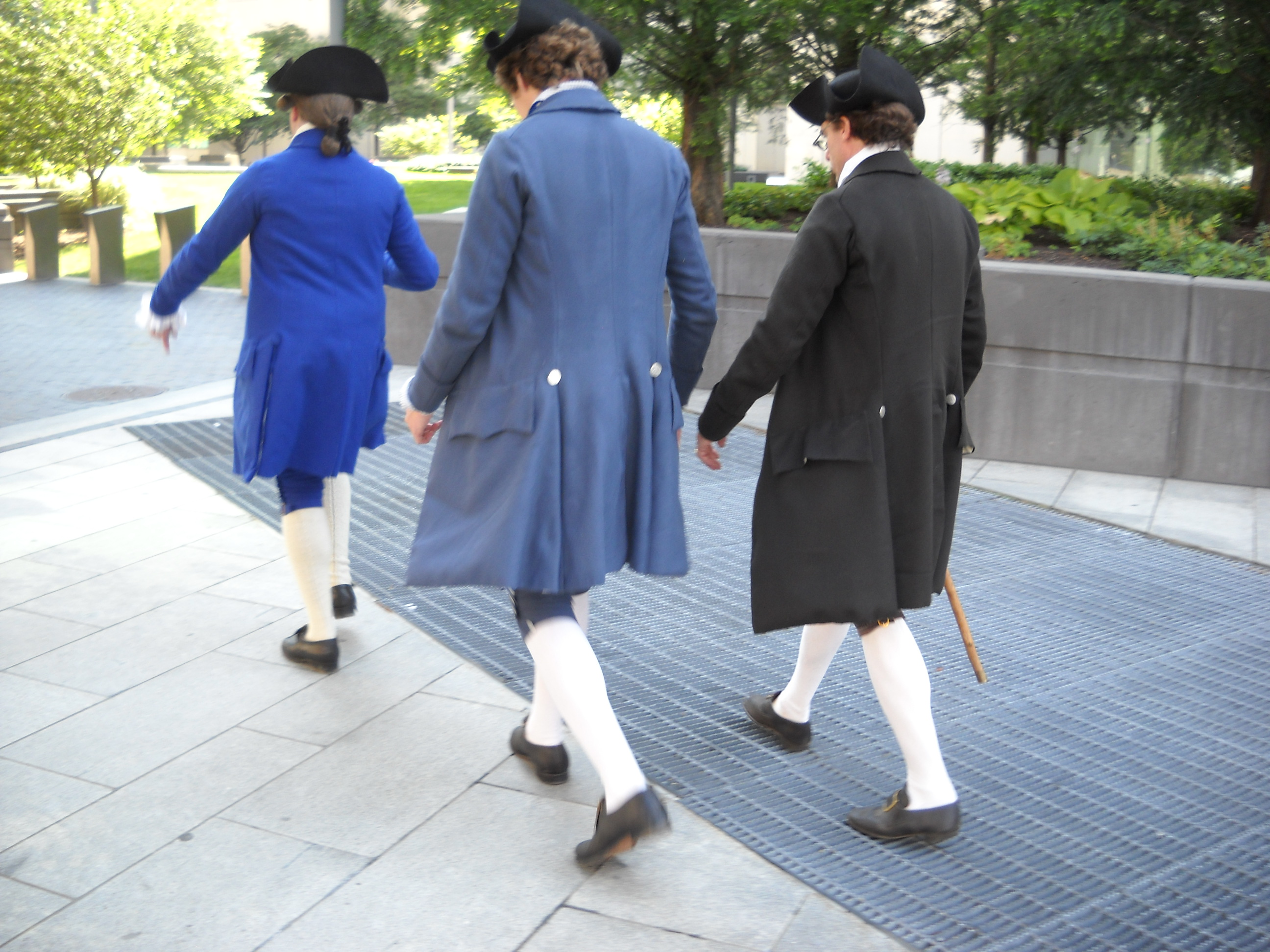
Three gentlemen at the Providence Station

Three gentlemen at the Providence Station

L’Hermione, remember her? That French ship? We were asked back in January if we wanted to be part of a group of Citizens of Boston in 1780 who came out to greet L’Hermione when she arrived in port. Yesterday (July 11) was the day she finally came to town, and most of the Rhode Island contingent of our Massachusetts group went up on the MBTA to see her. The train was totally the way to go, though Mr Hiwell did consume three Diet Cokes before we even got to the ship. Turns out the Henry Cooke frock coat pattern pockets can each hold three cans– a full six pack per coat, should you care for such a thing.

Walk fast, it's the city!

Walk fast, it’s the city!

We got to Rowe’s Wharf in time for the national anthem– or, as we like to call it, The Anacreontic Song. There was much speechifying, and though we were not talking too much, water was required. Those pockets came in handy again, as did my own capacious pockets. Good thing, too: the line was long and the sun was hot. One woman offered to let us go ahead of her in line, but that seemed wrong: if you have to wait in line, you have to wait, and the rule we have absorbed is that the public comes before reenactors. But, since we’d been asked to come, we decided to check the situation, and went to inquire. The “bouncer” at the head of the line told us to come back later, so we decided it was time for some lunch.

Lead, follow, get out of the way, or take another photo of backs.

Lead, follow, get out of the way, or take another photo of backs.

By lunch, things were a little surreal as we sat at a table with people I never imagined sitting down with. No worries: it was all good, just a little weird that you have to leave Rhode Island to meet Rhode Islanders. The Young Mr inhaled his lunch, and probably made a lasting, if Hooverish, impression on our new acquaintances. The fact that the entire new contingent of the 10th Massachusetts sat on one side of the table, and that 80% of us were from RI, also made an impression. We are why you can’t have nice things.

Refreshed, we journeyed back to the ship, meeting more friends along the way. To be fair, Mr S and I had agreed beforehand that going up to Boston was as much about seeing our very dear and far-away friends as it was about the ship, and we were delighted to see every one of them. But at last, we thought, we can get on board.

Totally justified.

Totally justified.

No soap, as they say. The line was closing at 1:00 and we were too late to make it into the last crowd that would get on– it was the longest line I’d ever seen– and, even worse, many members of the public waited in the hot sun and failed to board. For us, five and a half months of anticipation were dashed in a moment.

But wait! Well found again, Mr and Mrs B and Baby B. Mr S was delighted to meet Georgiana (he has a thing for babies, and an uncanny ability to guess their ages, and to tease and delight them), whom he had very much wanted to see. L’Hermione was not the only tall ship in the sea: we considered the dry-docked USS Constitution, but chose the Sagres instead, as she is only in port for a few days. Off we went on another trek, waylaid often for photos. The Young Mr in particular kept getting stopped.

Gulliveresque, relly.

Gulliveresque, relly.

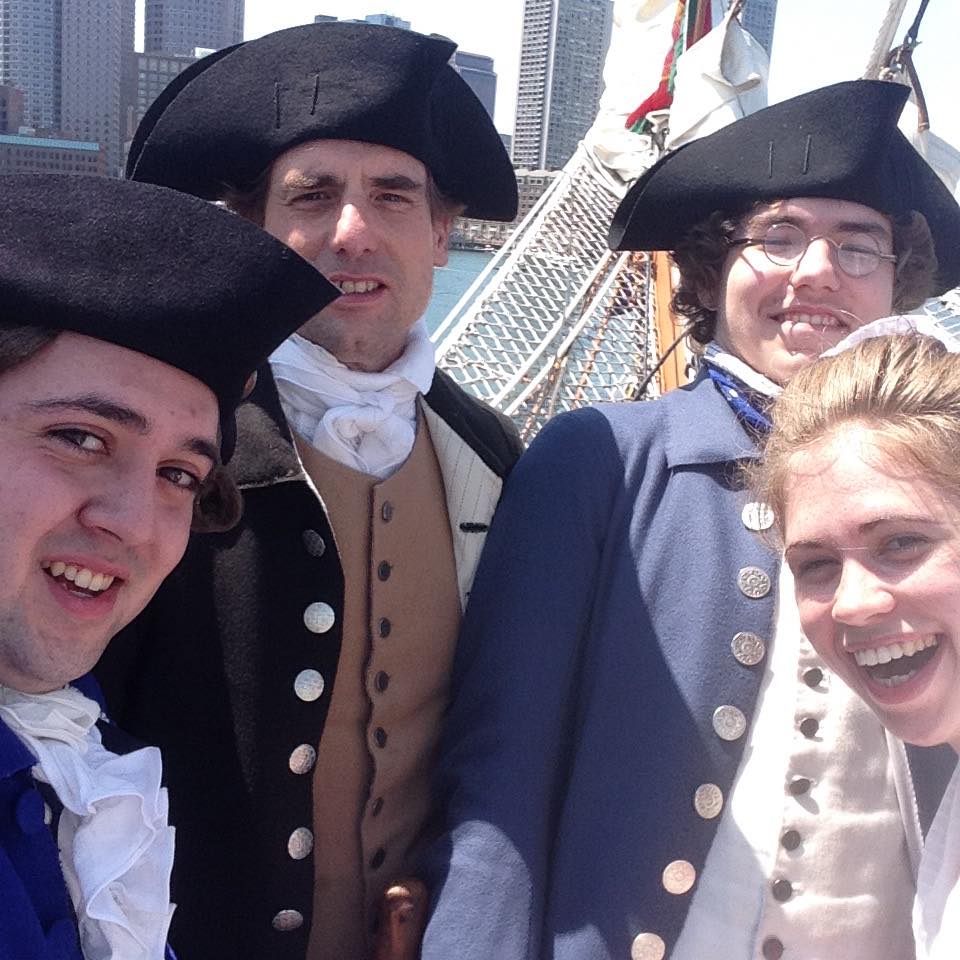
At least there was some shade here, and a bench. We took it in turns to go on the Sagres. Mr and Mrs B and I watched from the shore, and could see this happening. I don’t know how they trapped Mr S in this, but they did.

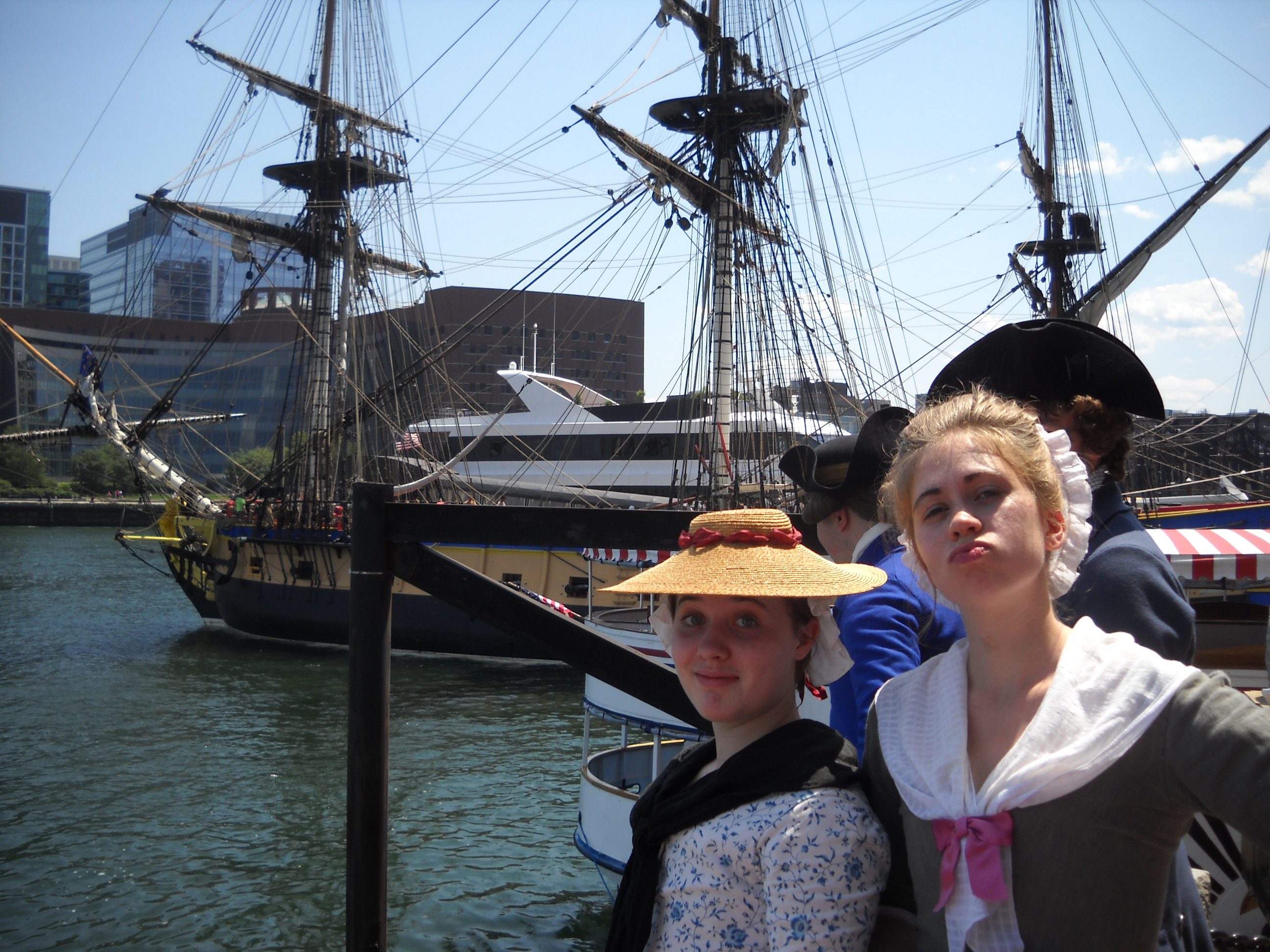
SagresSelfie

After an excursion to the ICA (which we are, as temporal performance art) for water, bathrooms, and some AC, the second shift got to visit the boat. We must have been cursed, because there was another line! At least this one moved, and however slowly and carefully in leather-soled shoes, we managed to go aboard.

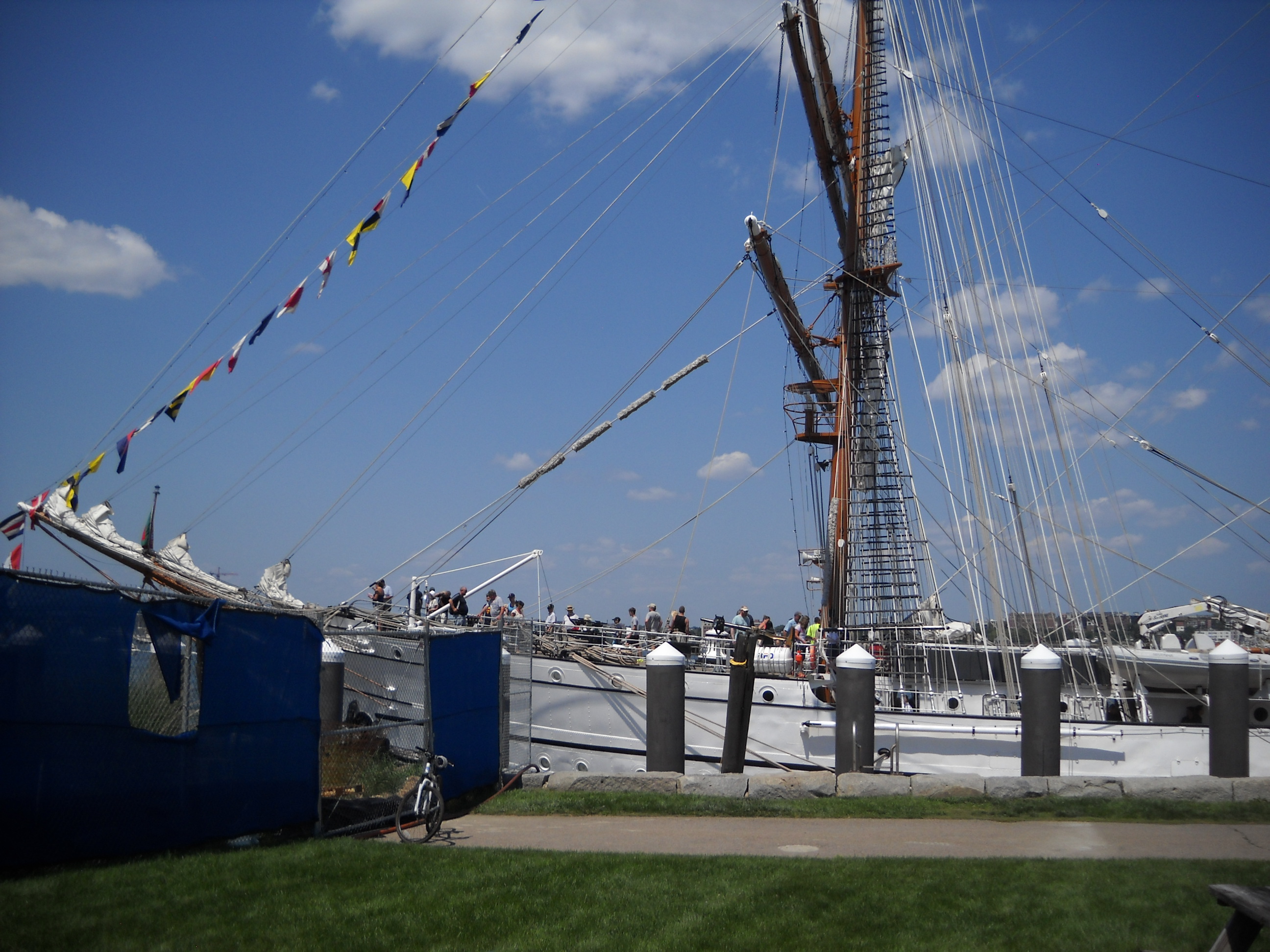
Hey, it's got masts.

Hey, it’s got masts.

Mr B was right: oversized yacht. Still very happy to have gone on a ship and to have seen many interesting things, including a very specific kind of display.

Portugal. The Best Fish in the World.

Portugal. The Best Fish in the World.

Mmmm, fish. All the packages were, in fact, empty. At this point we decided it was time for ice cream, and headed back. The Rhode Island Party ended up back at South Station for frozen yogurt and a bit of a rest. I don’t normally wear heels– ever– so a day in 18th century women’s shoes was a pedal workout. (We considered renting bikes, because if you have to be anachronistic, you might as well go all the way.)

Mr Hiwell and I considered the day: it wasn’t bad. We didn’t even get close to achieving what we thought was our goal. But we made our own fun with wonderful friends, had an adventure, and went at least three places we did not expect to go and had not been  to before. All in all, success, even in failure to board.

If they sleep on the way home, it wasn't a bad day.

If they sleep on the way home, it wasn’t a bad day.

Share this:

  • Click to share on Facebook (Opens in new window) Facebook
  • Click to share on Pinterest (Opens in new window) Pinterest
  • Click to email a link to a friend (Opens in new window) Email
  • Click to share on X (Opens in new window) X
Like Loading...

Man at His Desk

07 Tuesday Jul 2015

Posted by kittycalash in Events, Fail, Living History, Making Things, personal

≈ 1 Comment

Tags

Clothing, Events, Georg Friedrich Kersting, Making Things

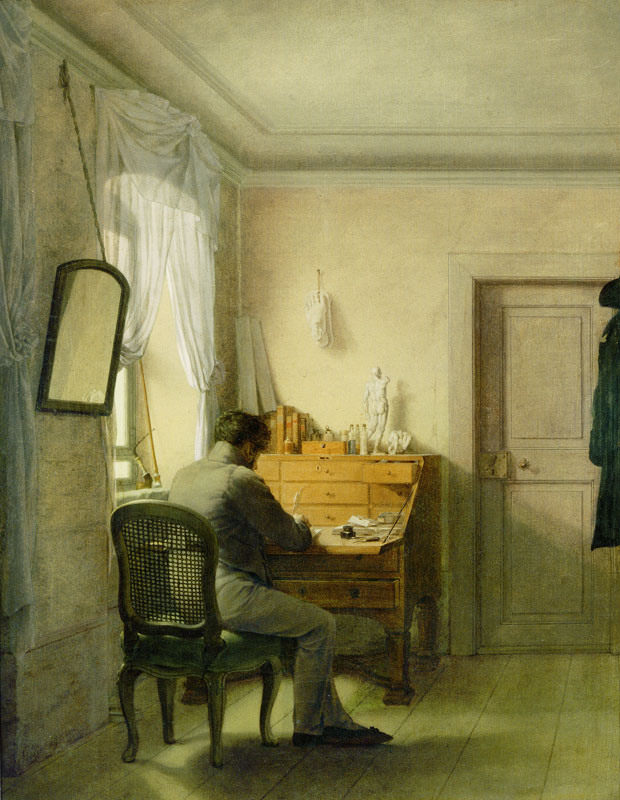
Georg Friedrich Kersting, A Man (artist) at His Desk.  1811. Klassik Stiftung Weimar, Goethe Nationalmuseum

Georg Friedrich Kersting, A Man (artist) at His Desk. 1811. Klassik Stiftung Weimar, Goethe Nationalmuseum

1811 caught my eye and stopped my Twitter scrolling. Kersting never fails to please, luminous watercolors and delicate details. Summer is here, along with events in so many years I feel quite distracted.

1780 this weekend (L’Hermione in Boston). 1775 a few weeks later. 1814 in August. 1833 in September. You could get whiplash looking at waistlines and sleeve silhouettes.

What I need is to take the time to sit, like Kersting’s man, to reflect and to write and to make a plan. I’ve fallen behind on the garment-a-week program, and need to catch up quickly. The faster I sew, the less like the Young Mr can outgrow the garment before it’s finished.

Share this:

  • Click to share on Facebook (Opens in new window) Facebook
  • Click to share on Pinterest (Opens in new window) Pinterest
  • Click to email a link to a friend (Opens in new window) Email
  • Click to share on X (Opens in new window) X
Like Loading...
← Older posts
Newer posts →

Archives

wordpress statistics

Creative Commons License
Kitty Calash blog by Kirsten Hammerstrom is licensed under a Creative Commons Attribution-NonCommercial-ShareAlike 4.0 International License.

Website Built with WordPress.com.

  • Subscribe Subscribed
    • Kitty Calash
    • Join 621 other subscribers
    • Already have a WordPress.com account? Log in now.
    • Kitty Calash
    • Subscribe Subscribed
    • Sign up
    • Log in
    • Report this content
    • View site in Reader
    • Manage subscriptions
    • Collapse this bar
 

Loading Comments...
 

    %d