• Home
  • Completed Costumes/Impressions
  • Emma and Her Dresses
  • Free Patterns and Instructions

Kitty Calash

~ Confessions of a Known Bonnet-Wearer

Kitty Calash

Tag Archives: museum practice

Two Shells, One Man, Dozens of Stories

04 Wednesday Feb 2015

Posted by kittycalash in Museums

≈ Comments Off on Two Shells, One Man, Dozens of Stories

Tags

American soldiers, collections management, Exhibitions, exhibits, interpretation, militaria, museum collections, museum practice, Rhode Island history, Woonsocket, World

Yesterday I felt like an anthropologist on Mars, or perhaps more precisely, like Ariel and her collection of human objects, as my friend suggested.

TALY. Anzio. January, 1943. American soldiers rejoicing upon reaching Italian soil, after their beachhead landings. © Robert Capa © International Center of Photography

TALY. Anzio. January, 1943. American soldiers rejoicing upon reaching Italian soil, after their beachhead landings. © Robert Capa © International Center of Photography

We are inventorying a collection of militaria currently on display at a museum in the northern part of our tiny state, and while I recognize most of the things, I don’t have the intensive knowledge that some of my friends and acquaintances have to recognize the subtle changes in accouterments over time. Fortunately, plenty of things are marked: the military tends to do that. And fortunately, there are books and the Google and I remember enough of what I learned to ask the right questions.

American soldiers inside hospital tent riddled w. holes caused by German schrapnel from long range gun attacks which killed 5 & wounded 8 patients in the tent. Photograph by George Silk. Life Magazine

American soldiers inside hospital tent riddled w. holes caused by German schrapnel from long range gun attacks which killed 5 & wounded 8 patients in the tent. Photograph by George Silk. Life Magazine

The most meaningful items are the ones that have been personalized in some way, or that were never issued at all. There were, for a long time, two small shells picked up at Anzio and Nettuno, each white interior curve labeled in ink, one Anzio and one Nettuno. I could only guess at their significance, as you probably can too: what I did not know was that the soldier who picked them up was only 18 in January 1944—and how appropriate it is to have returned them to his daughter this month.
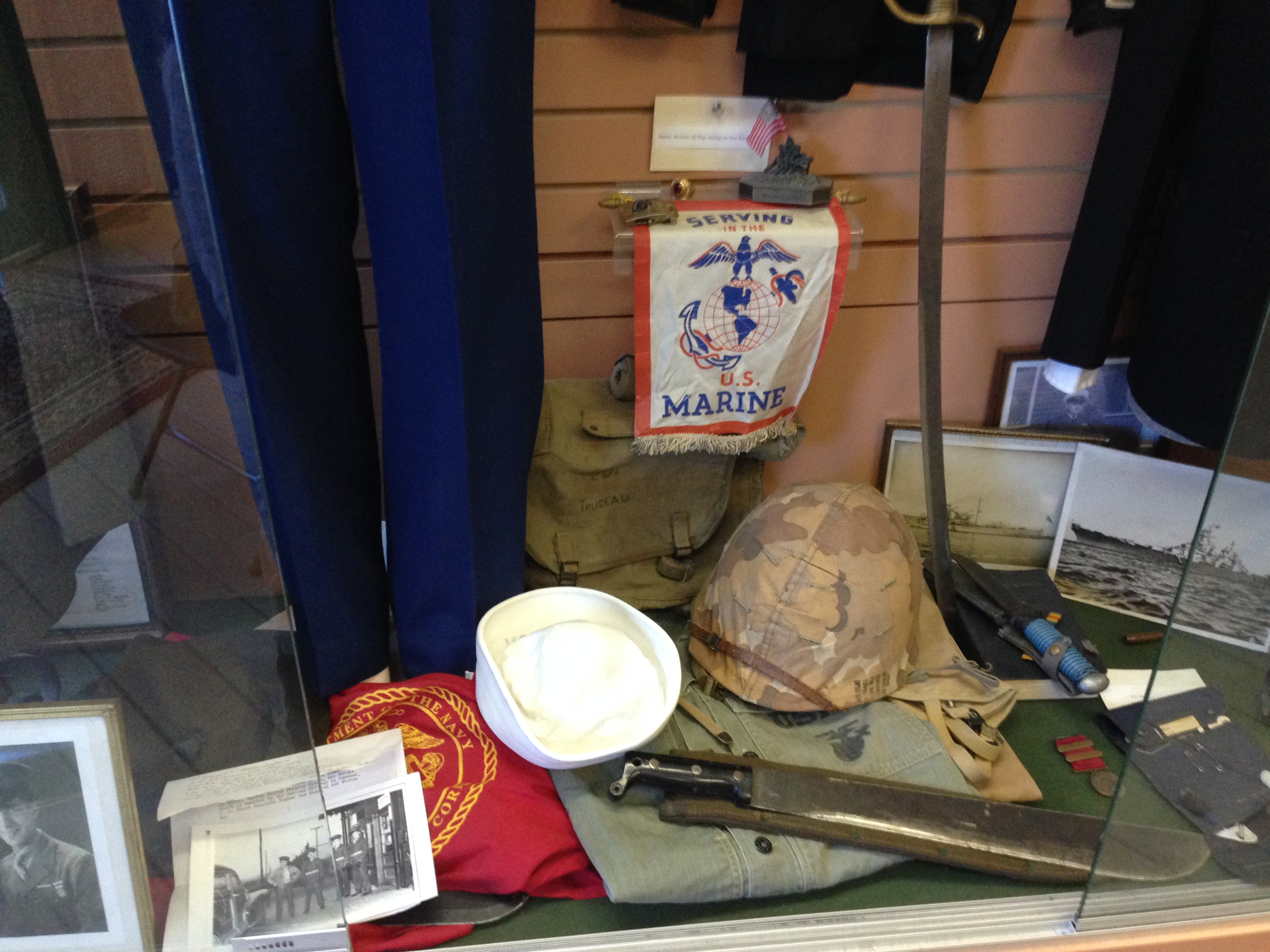
Not about Anzio, but this is a typical case.

Not about Anzio, but this is a typical case.

The cases are packed with things he and his friend collected, all of which had some meaning to them: that guy, this place, that story, these memories. The soldier who picked up the shells could never tell his daughter or granddaughters any of what he had seen, though later on, he began to tell his nephews. But he assembled this collection and in that, I think, he was telling us all. Our job at the museum is to translate mute, general issue objects into meaningful individual narratives.
Share this:

  • Click to share on Facebook (Opens in new window) Facebook
  • Click to share on Pinterest (Opens in new window) Pinterest
  • Click to email a link to a friend (Opens in new window) Email
  • Click to share on X (Opens in new window) X
Like Loading...

Same Place, Different Day

17 Saturday Jan 2015

Posted by kittycalash in History, Living History, Museums, Philosophy, Reenacting

≈ 7 Comments

Tags

accuracy, authenticity, history event, history events, interpretation, living history, museum practice, rant, Reenacting

We were doing some preliminary planning for an event this fall, and we were considering recreating the 1803 funeral of Important White Guy. Our event is in October; the funeral was in September. Somebody asked me, “What does it matter when we do it?” and I didn’t respond nearly as gracefully or eloquently as I could have.

Why does it matter? Does it matter to anyone but me and my cohort?

It does, and here’s one reason why: When interpreting the funeral in late October, perhaps a member of the public will ask, “When did he die?” Can an interpreter really say “September 20” and not expect a slew of questions about how long the body was kept and why the funeral was delayed and wasn’t that a health hazard? Can the event orientation start out with “We’re doing it in October because that’s when we want to do it,” without fundamentally changing the event?

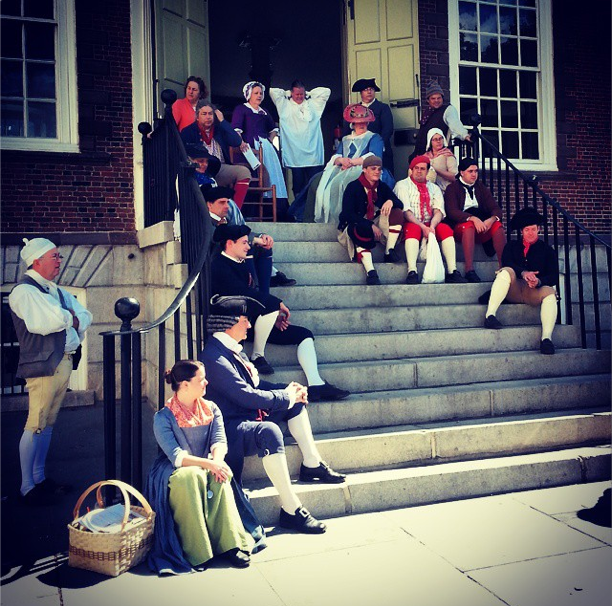
On the Colony House steps

August is hot. Can we riot in September? No!

Moving the recreation of a specific event by more than it takes to get to a weekend* seems dishonest to me: do you really want to celebrate your birthday 5 weeks after the actual date for someone else’s convenience? July 4th: Gosh, it’s not working for me this year. Let’s do that in August.

For a historical organization to suspend caring about accuracy for living history events but not for published articles, catalog records, or finding aids just contributes to the greater problem in and of living history.

When asked about the goal of a living history event, I have been told, “Well, we want families, right? So we should have some hands-on activities, you know, immersive, like candle dipping.”+

It took a bit, but at last I grasped the core of the angry-making: Kids like living history, therefore it is less sophisticated than other forms of history.

The right place for immersive string activities.

The right place for immersive string activities.

Living history is not as sophisticated, nor need it be as accurate, as traditional (written, orated, curated) historical presentations: I think that is the background assumption a lot of people make, both in the adminstration of traditional historical organizations and in the presentation on the field. It is a complete fallacy.

Living history done well and done right is as well-researched as a paper, exhibition, or article. It draws from primary sources both written and visual, it requires the absorption of countless secondary sources to help analyze the primary sources. It is as collaborative and negotiated a process as any museum exhibition, and like exhibitions, it uses material culture interpretation to deliver its messages, i.e. meet its educational and interpretive goals.

15316751814_946818c254_z

A good living history event is beautiful, but like a ballet, that beauty does not come easily. There are no shortcuts, and beauty does not equal superficial or stupid. It indicates sophistication. Part of that appeal is accuracy: the better, the more accurate and immersive the historical setting and action you create, the more visitors can learn without asking.

Lawn games

Lawn games

When I organize an event in our house at work (or even on a guided tour) one of my interpretive points is always “people saw the world differently– literally– and this event/house tour helps you see the world of 1800 the way people living then saw it.” Aesthetics were different, and were underpinned by ideas and opinions. But understanding those aesthetics and the opinions people held about race, gender, beauty, work and class takes actual research and analysis. It’s not all putting on a pretty dress and cavorting on the lawn. Facts matter. Accuracy matters.

Museums are some of the most trusted organizations. If we started juicing facts like every History channel show, we’d lose that trust, and rightly so. Our trustworthiness is grounded in our honesty and integrity.

Living history events are mobile museums, and every reenactor curates his or her own impression. To retain the trust and interest of the public, we have to be accurate.

*Events are moved to weekends because that’s when interpreters and audiences can come.

+This at a house that not only lacks a working kitchen earlier than 1960 in the staff area and was owned by a partner in a candle factory. I’m thinking “bought ’em in bulk,” here, not dipping.

Share this:

  • Click to share on Facebook (Opens in new window) Facebook
  • Click to share on Pinterest (Opens in new window) Pinterest
  • Click to email a link to a friend (Opens in new window) Email
  • Click to share on X (Opens in new window) X
Like Loading...

Preservation or Petrification?

22 Saturday Nov 2014

Posted by kittycalash in History, Living History, Museums, Philosophy

≈ 5 Comments

Tags

anarchist guide to historic house museums, historic house museums, Historic House Trust of New York, historic houses, historic interiors, interpretation, living history, museum practice, Museums

For almost ten years, I’ve been working on the re-interpretation and re-presentation of the HHM that is part of my employer’s stable of properties. We’ve had mixed results: guides who refuse to look me in the face, guides who quit because a piano got moved, guides who hissed “hedonism!” at the site of a lounging mannequin, and guides who were made incredibly sad by the representation of a sick (dying) child.

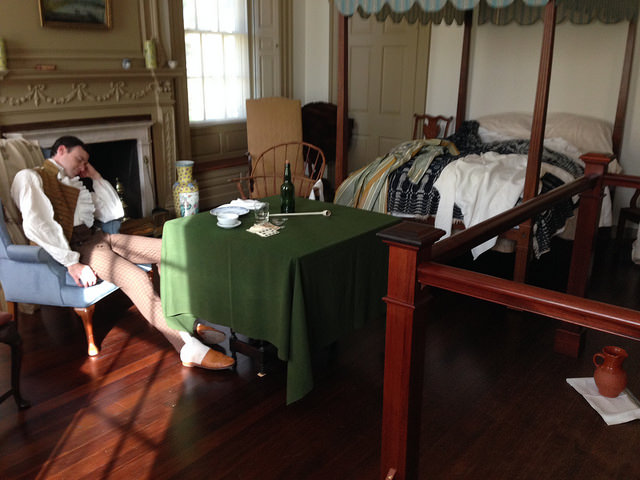
James, recovering from a party the night before

James, recovering from a party the night before, angered some guides (2007)

Me, I consider all those things successes.
The people who had to deal directly with that fall out, maybe not so much.

Change is hard and scary, and every one has a different tolerance for risk. As you have probably guessed, mine’s fairly high. I blog, I go out into the world in some pretty funny clothes, and inhabit characters I am not. I expect to fail regularly: it’s a reliable way of learning.

Change is hard to maintain, it’s hard to continually evolve and push an interpretation forward. It takes time, focus, and money; it takes cross-disciplinary collaboration and communication between curators, educators, and docents or guides.

Taking risks in spaces full of very expensive furniture is particularly daunting, but especially rewarding when you see how a house looks, inhabited and, to a degree, used.

Alice receives the mantua maker's letter

They’re sitting in real, accessioned chairs. (2014)

The job of museums is to preserve, but we sometimes seem determined to petrify, to freeze a perfect moment in amber, to freeze our visitors with fear of touching, photographing, asking, and to freeze and understanding, all in a fluid world.

If we reject the beautiful and untouchable past to embrace the messy human past, we can juxtapose the fine mahogany-furnished rooms of the merchant elite with the work to create those rooms and make the picture more whole by including slaves, servants, workmen and tradesmen.

More of us would have been working than lounging

More of us would have been working than lounging (2006)

Most of us would not have lived the way the merchants did: to a degree, our historic house visits are backwardly aspirational, as we wish for nostalgia that is more false than most nostalgia.

I am not advocating favoring the smelly past, or descriptions of unpleasantness, over exultations about carvings and upholstery—except that I am—because I see these pendulum swings as a part of the process of creating more complete and honest representations and recreations of the past, in museums, at historic sites, and in living history presentations.

It’s past time for me to work again on re-imagining the house under my care: I acknowledge that. Synthesizing what I learn in living history with the work I do in museums, and vice-versa, will improve and enhance the public experience of history inside and out.

Share this:

  • Click to share on Facebook (Opens in new window) Facebook
  • Click to share on Pinterest (Opens in new window) Pinterest
  • Click to email a link to a friend (Opens in new window) Email
  • Click to share on X (Opens in new window) X
Like Loading...

Interpretation 101

28 Monday Apr 2014

Posted by kittycalash in Events, History, Living History, Reenacting, Research

≈ 4 Comments

Tags

10th Massachusetts, 18th century, Bridget Connor, Brigade of the American Revolution, common dress, common people, common soldier, first person interpretation, interpretation, living history, museum practice, Museums, Reenacting, Research, resources, Revolutionary War

This slideshow requires JavaScript.

On Saturday morning, I gave a presentation at the BAR School of Instruction on Interpretation. The slides are above, and the presentation (with my notes) is here.

The handouts and bibliography I used in thinking about Bridget Connor an be found on the Interpretation 101 page.

Share this:

  • Click to share on Facebook (Opens in new window) Facebook
  • Click to share on Pinterest (Opens in new window) Pinterest
  • Click to email a link to a friend (Opens in new window) Email
  • Click to share on X (Opens in new window) X
Like Loading...

Breaking into Museums (for research, silly)

14 Saturday Dec 2013

Posted by kittycalash in Art Rant, Museums, Research

≈ Comments Off on Breaking into Museums (for research, silly)

Tags

libraries, museum collections, museum practice, Museums, Research, special collections

Curator’s storeroom, World Rugby Museum

So, how do you get into museums?

Most of us come into through the front door, pay a fee or show a membership card, and enjoy whatever spectacle we’re after. Some of us like jelly fish, some of us like taxidermy, some of us like clothes.

A universal constant for going behind the scenes is a specific, and not a general, request. You can say, “Show me all your spoons,” but not even please is going to help when there are thousands of spoons.

I like researchers: they’re always interesting, they see the collections in ways I don’t, and they have insights that are valuable and useful. But someone who wants to see all the spoons, or all the chairs, or shoes, or fire buckets is really hard to help: There are too many of each of those things. Specific shoes, chairs, fire buckets or coats are manageable and realistic. “May I make an appointment to see spoon 1492.1.12, please?” is a question a curator, registrar, or collections manager can work with. One spoon, two spoons, five spoons, a few pairs of shoes: Studying these few things can take a great deal longer than you might expect.

STEAM Museum of the Great Western Railway storeroom

Think about it this way: in a Special Collections Library, you generally don’t begin with, “I’d like to see all your material on the Civil War.” For one thing, that will be a lot of stuff. Chances are good you won’t be interested in all (or even much) of it. What you’re really after is usually more specific. “All your home front diaries written by women over the age of 44,” or perhaps it’s “Battle accounts written by chaplains in the field.” Those requests archivists and librarians can and will gladly handle, and through a reference interview, can help you identify not just specific items on your topic, but help you think about your topic. But asking to see all the diaries (or anythings!) at once, is usually a non-starter. They’re all in separate collections, in separate boxes, on separate floors. Heck, I work in a place with hundreds of diaries, and I am pretty sure they’d call my therapist and the cops if I asked to see all the diaries at once. (Tempting thought that it is.)

Once in my life have I seen “all the somethings” pulled out from storage in a museum.  The Curator of  Photographs and Prints and a visiting (contracted) scholar were selecting daguerreotypes for an exhibition, and in my very junior role as the Curatorial Assistant, I got to pull out all the daguerreotypes by Thomas M. Easterly and help spread them out on an enormous mahogany table. I’ll never forget how beautiful that was, and how special, to see so same silvered plates and brass mats spread out on a dark surface. If this link is stable, you can get a sense of what it was like. Once, in a quarter century of working in museums. Sad, isn’t it? more people should get this chance, but it’s rare. However, this rule is in place for the preservation and security of the objects.

Yes, I want this wall of chairs. The Röhsska Museum, GÖTEBORG, Sweden

These kinds of restrictions are part of why museums have open storage, and it’s why I wish we could have open storage. But most museums don’t, so the key to getting into the storerooms (or the research rooms) is to ask the right way. I did a presentation on the process, and there’s more good advice over at the Still Room Blog.

Always, in museums or in libraries, if there’s a catalog, start there! You can narrow down your choices with database searches and questions in advance so that you can make the absolute most of the time you have. Your time is precious. Focusing in on what you really want to see will help the museum’s staff help you better. And if you really enjoy a collection, please consider supporting it financially, with a donation to a collections care fund, annual fund, or a membership. Your dollars count, they’re noticed, and they’re truly appreciated.

Share this:

  • Click to share on Facebook (Opens in new window) Facebook
  • Click to share on Pinterest (Opens in new window) Pinterest
  • Click to email a link to a friend (Opens in new window) Email
  • Click to share on X (Opens in new window) X
Like Loading...
Newer posts →

Archives

wordpress statistics

Creative Commons License
Kitty Calash blog by Kirsten Hammerstrom is licensed under a Creative Commons Attribution-NonCommercial-ShareAlike 4.0 International License.

Website Built with WordPress.com.

  • Subscribe Subscribed
    • Kitty Calash
    • Join 621 other subscribers
    • Already have a WordPress.com account? Log in now.
    • Kitty Calash
    • Subscribe Subscribed
    • Sign up
    • Log in
    • Report this content
    • View site in Reader
    • Manage subscriptions
    • Collapse this bar
 

Loading Comments...
 

    %d