• Home
  • Completed Costumes/Impressions
  • Emma and Her Dresses
  • Free Patterns and Instructions

Kitty Calash

~ Confessions of a Known Bonnet-Wearer

Kitty Calash

Tag Archives: Research

A Trip to Stonington

17 Wednesday Sep 2014

Posted by kittycalash in Clothing, History, Living History, Museums, Reenacting, Research

≈ 1 Comment

Tags

1812, 19th century clothing, Clothing, Connecticut, Federal style, Research, Stonington, Stonington Historical Society

The view from Stonington Point

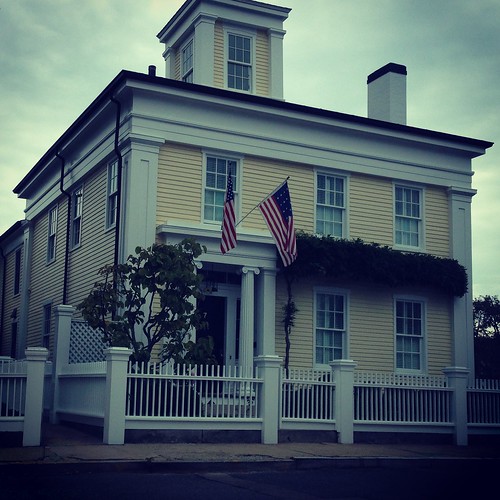
On Tuesday, I drove down to Stonington, CT to visit the Stonington Historical Society’s Lighthouse Museum and look at a coat. Stonington was beautiful as ever, smelling of the ocean and money, and the little Lighthouse Museum was nicely done.

The coat did not disappoint.

It is a truly amazing artifact, having survived despite pretty incredible events. The donor wrote a letter about the coat when he gave it to the SHS in 1914:
“I have heard my father say due to the haste and excitement of the volunteers they failed to properly cool their gun before pouring into its muzzle the powder, which due to the excessive heat of the gun caused the powder to explode prematurely, as you may see by reference to the coat—burned and torn upon the neck and shoulder.” (Coat and letter, Stonington Historical Society, 2009.120.001).

Stonington, CT

As beautiful as the town of Stonington may be, and as much money as there may be on the Connecticut coast, the SHS has a small budget and must use its funds wisely. We had an interesting conversation about the reenactors and museum collections, and what responsibility historical costumers have to the collections that hold clothes they replicate.

Share this:

  • Share on Facebook (Opens in new window) Facebook
  • Share on Pinterest (Opens in new window) Pinterest
  • Email a link to a friend (Opens in new window) Email
  • Share on X (Opens in new window) X
Like Loading...

Half Robe or Jacket: How Do You Wear One?

10 Wednesday Sep 2014

Posted by kittycalash in Clothing, Events, History, Making Things, Reenacting, Research

≈ 3 Comments

Tags

18th century clothing, 19th century clothing, bonnets, Costume in Detail, Costumes, costuming, Federal style, frock coats, half robes, Isaac Cruikshank, living history, National Trust Collections UK, Regency, Research, resources, tailcoat, What Cheer Day, Yale Center for British Art

Half robe, 1790-1800. National Trust Inventory Number 1348749,

Half robe, 1790-1800.
National Trust Inventory Number 1348749,

What Cheer Day is coming, and I hate to miss an opportunity to make a new gown (despite having just made one, and despite needing to make some waistcoats and trousers for the event). While I lay awake last night, I pondered my options, and whether a half gown would be suitable.

Although I have concluded it probably is not, I was curious about how these should be worn. Where can you wear such a garment? Is it only suitable for at-home use?

This is the robe from Nancy Bradfield’s Costume in Detail, replicated by Koshka the Cat here, and approximately by me, here.

CostumeinDetail_p84
CostumeinDetail_page83

Since I will be a housekeeper again, I think a gown is more correct for me, but that doesn’t stop me thinking about half robes, and whilst scrolling images by year at the Yale Center for British Art, I found this by Cruikshank:

ladies in a lending library

Isaac Cruikshank, 1756–1810, British, The Lending Library, between 1800 and 1811, Watercolor, black ink and brown ink on medium, lightly textured, beige wove paper, Yale Center for British Art, Paul Mellon Collection

There’s a lot to love in this image, even with its fuzzy “between 1800 and 1811” date. Not only do we get an array of reading material (Novels, Romance, Sermons, Tales, Voyages & Travels, Plays), we get costume tips and– special bonus– a dog gnawing its leg.

(If you are curious about some of the books in the Library at the John Brown House, check out this tumblr bibliography. I’ve been using it of late, and the representative genres are quite similar to what we see in the Cruikshank.)

We also get a chemisette on the lady at the counter, along with a very dashing hat, a fancy tiered necklace on the lady in pink, who also carries a green…umbrella? Parasol? With just a veil, that seems likelier than the longest reticule ever.

I like our Lady in a Half-Robe and her deep-brimmed bonnet showing curls at her brow. She and her companions show the range of white and not-white clothing seen in early 19th century fashion plates, and the range of head wear, too.

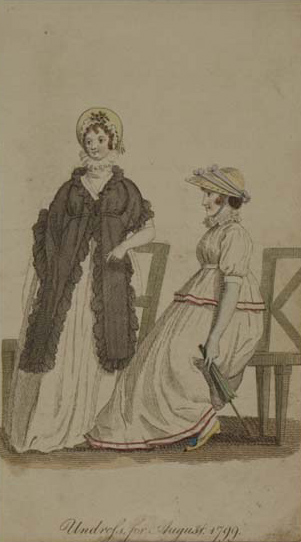
Undress for August, 1799. Museum of London

Undress for August, 1799. Museum of London

The last question I’m asking myself, though, is whether the yellow garment is a half-robe or a short pelisse or a jacket. And can you wear a half robe out of doors? And what did the ladies of the period call that garment?

In this fashion plate (featured by Bradfield on page 84, found by me at the Museum of London), the lady on the right is certainly wearing a short upper body garment, and I’d wager that she’s out of doors or headed that way, since she’s carrying a (green) parasol. Bradfield calls her garment a “jacket,” and until I can find the text of the Ladies’ Monthly Museum for August 1799, perhaps that is the term we should use instead.

While two images aren’t a lot of evidence, it does appear possible to wear a half-robe or jacket out of doors for informal visits in clement weather, and finding two is as good a reason as any to look for more.

Share this:

  • Share on Facebook (Opens in new window) Facebook
  • Share on Pinterest (Opens in new window) Pinterest
  • Email a link to a friend (Opens in new window) Email
  • Share on X (Opens in new window) X
Like Loading...

Boil and Not Too Much Trouble

19 Tuesday Aug 2014

Posted by kittycalash in Events, Food, Living History, Reenacting, Research

≈ 3 Comments

Tags

10th Massachusetts, authenticity, Bennington, Brigade of the American Revolution, common people, common soldier, cooking, Enos Hitchcock, food, hearth cooking, history, living history, Research

Camp cooking can get old. Stew, sigh. Bread, sigh. Cheese, sigh. Apples, sigh.

Don’t get me wrong: all of the above are delicious today. Historically, New England troops are all about cheese and cider, and have much to say about the quality of beef, but menu can be repetitive and lacking in challenge.

Ever since I had boiled flour pudding at Coggeshall Farm, I’ve wanted to make it since I so much enjoyed the texture.

When I found it mentioned by Enos Hitchcock, I was particularly excited.

1777 May 24
Dined upon flowr puding & Venison Steak.

Flowr puding? I love that guy! But there it is, documented, even if eaten by the officers and not the private soldiers. It’s common enough that I think it likely almost everyone knew how to make it. The trick would have been getting hold of eggs and milk, which is easy enough for me, if not for the soldiers of 1777. Fortunately, as we drove down Cottrell Road headed for home, a flock of Plymouth Rock chickens crossed the road in front of us: there were the eggs, at least in our time.

postcard of kittens eating christmas pudding

Not your chaplain’s pudding.

The method I had tried at home worked: I beat three eggs and four spoons of milk in my tall redware mug, and added the liquid slowly to the flour and salt mixture. The whole mixture went into a cloth bag, which I tied with a string and boiled in the smallest kettle, not want to risk any damage to the beef stew. I’ll test the works at home on my nearest kin and willing victims before I loose it upon a regiment and hungry guests.

Although the pudding was a strange shape, it cooked up quickly in about 45 minutes, had a firm texture and a satisfactory enough flavor. I would have liked it to rise a bit more, which is an argument either for beating the eggs with a fork in the confined cylinder of the cup, or risking the splash of the whisk in a bowl, or, finally, for a smaller whisk.

Still, not too bad for expanding the camp cooking repertoire of Things That Can be Boiled and Eaten.

Share this:

  • Share on Facebook (Opens in new window) Facebook
  • Share on Pinterest (Opens in new window) Pinterest
  • Email a link to a friend (Opens in new window) Email
  • Share on X (Opens in new window) X
Like Loading...

When in Doubt, Bake

14 Thursday Aug 2014

Posted by kittycalash in Food, History, Living History, Reenacting

≈ 3 Comments

Tags

10th Massachusetts, Amelia Simmons, authenticity, Diet Bread, food, history, living history, Making Things, Reenacting, Research, resources

There was a Very Bad Summer when much was awry at work, the flat we were living in was for sale, my father was moving far away, and the Howling Assistant was sick. In response, I baked.

Things are roiling in the world of late, both at work and in the wider world (I am from St. Louis, and cannot ignore the news from Ferguson), and so again, I turned to baking. Eggs, flour, sugar: what could be sweeter?

A friend tried Amelia Simmons‘ Diet bread a few years ago, with limited success, but the simplicity of the receipt has always appealed to me.

recipe for diet bread

Diet Bread

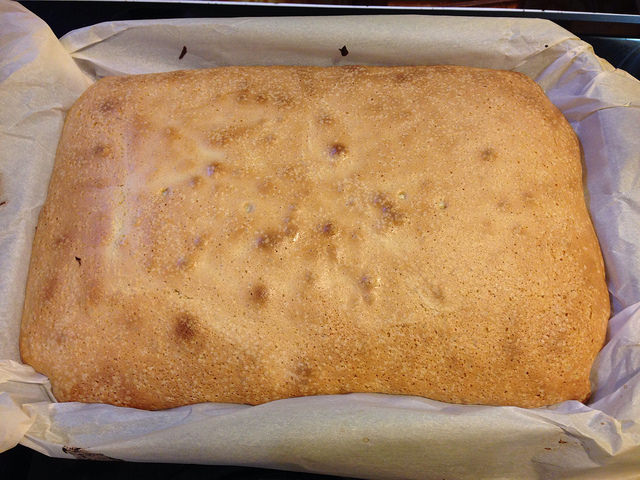
Once again, I risked early morning baking, but I think this has turned out OK. I had to leave for work before it was cool enough to really eat, but a corner was delicious! The intense amount of sugar– a full pound!– was intimidating, the rose water curious when tested, but combined with the cinnamon, seems to have a pleasant and slightly exotic flavour.*

The simplicity of the ingredients was encouraging, but I probably would not have jumped into this had I not found someone else had leaped before me.

Kathleen Gudmundsson on the Historical Cooking Project blog tackled diet bread in May. From her work, I took the tip to use only six eggs.

Following Gudmundsson thoughts at the end of her entry, I beat the egg yolks separately, intending to add the stiff-peaked whites at the end. Half way through adding the flour, the batter became extremely stiff and sticky, and nearly unmanageable, so I beat a whole seventh egg and added that, followed by a little flour and 1/4 of the beaten whites. I alternated flour and egg whites, finishing with egg whites, and found the mixture retained pliability and texture.

Like Gudmundsson, I also lined a glass pan with parchment paper, but my (electric, rental-quality) oven runs a little slow, so baked for 30 minutes at 400F.

diet cake made of sugar, flour and eggs

Diet Cake, from American Cookery by Amelia Simmons.

The results look like hers, and since she thought the cake was as good or better three days after she’d made it, my hopes for an interesting dessert remain intact.

The other, less distracting, project I’ve taken on this week is a set of bags for coffee and food stuffs.

handsewn linen bags in white and check

Linen bags for foodstuffs

After all, there are no ziplock bags or plastic tubs in 1777, and full complement of graduated tin canisters seems unlikely to plummet into my lap anytime soon. The two slender bags are for coffee: tied at the neck, they’ll hold enough for cold coffee and fit the slender tin coffee pot we have, sparing the larger cloths, wrangling grounds, and giving us clear, cold, caffeine. Another is for flour, one could be for oatmeal, another for sugar. In any case, things to eat are getting wrangled in a way that can remain visible in camp.

I know: a trifle mad, but the time I spend now makes living in public so much easier when there’s less to hide. And yes, before you ask: that will be a real fire.

*Fellow eaters, you’ve been warned.

Share this:

  • Share on Facebook (Opens in new window) Facebook
  • Share on Pinterest (Opens in new window) Pinterest
  • Email a link to a friend (Opens in new window) Email
  • Share on X (Opens in new window) X
Like Loading...

Measure for Measure

12 Tuesday Aug 2014

Posted by kittycalash in Fail, Food, History, Living History, Reenacting, Research

≈ 5 Comments

Tags

10th Massachusetts, 18th century, authenticity, common people, cooking, experimental archaeology, food, living history, Research, resources, Revolutionary War

or, a boiled Flour Pudding in two tries.

14699830917_63d67ffee0_b
Tablespoons and Cups

Alone in my Ossining ca. 1962 kitchen, I decided to tackle Amelia Simmons. The first task seemed to be to establish measurements, and then proportions, so I took stock of the tools and containers I would have in a typical camp. Spoon, mug, half-pint: these are plausible items, though we have tin cups that hold exactly 8 ounces, so the measure is unnecessary. The spoon was cast from a 1780 mold, so it seemed like a reasonable place to start for “how much is a spoon?” It will hold exactly one tablespoon if you scrape it flat across or are measuring liquid. Handy to know.

Next, I checked the recipe again.

A boiled Flour Pudding.
One quart milk, 9 eggs, 7 spoons flour, a little salt, put into a strong cloth and boiled three quarters of an hour.

This is not a popular receipt, so you won’t find it on History is Served, nor will you find this version on other popular sites; you can find a boiled pudding with suet, but that’s not what I’m after: I’m after a receipt that starts with a portion of the ration of flour soldiers received, and adds only eggs, milk, and available seasonings.

You have to remember that Simmons corrected the 7 spoons to 9 spoons of flour and increased the boiling time; you also have to remember that eggs were smaller then.
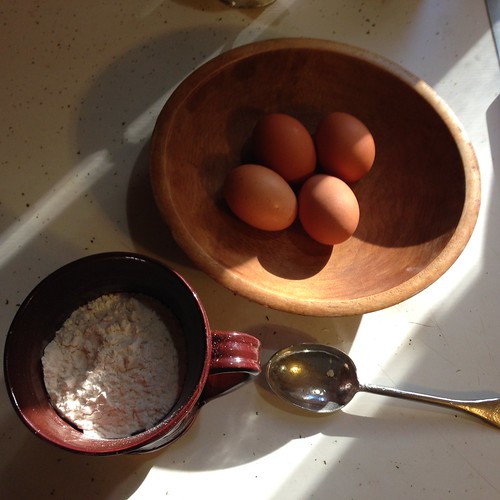
redware mug and wooden bowl with egggs

Halfsies.

I thought I’d try a half receipt first. There are no directions as we think of them– American Cookery sometimes has that “put your lips together and blow” feeling–but this is not too complex. The eggs and milk must be beaten together, and then combined with the flour. For this first attempt, I got it a bit backwards, adding the spices to the eggs, which I beat in the large wooden bowl.

That left me scooping the egg-and-milk with the measure into the flour, which I had in a smaller wooden bowl, remembering too late the method for scones.

egg and flour mixing in wooden bowls

Fuzzy photo, fuzzy logic.

And then it was really too late: I added just too much egg-and-milk, and it became more like batter than dough. This was not correct, and I knew it, but I didn’t dump it and I didn’t add more flour. Now it’s clear that 7:00 AM is not my best time for baking experiments (it was also quite early the day I made gingerbread without any eggs).
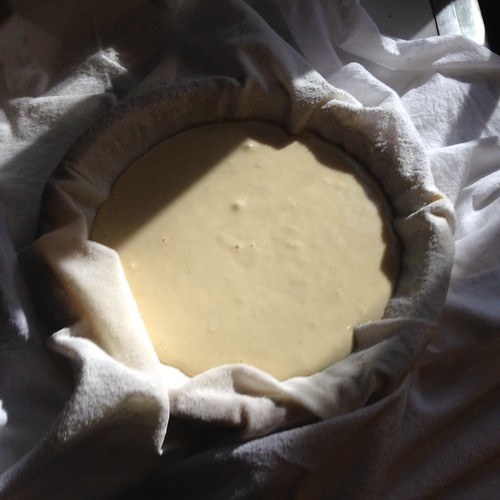
pudding mixture in cloth

Well, it took a decent photo.

I buttered and floured a cloth anyway, and poured the mixture into it. After tying the gathered neck of the cloth with string, I boiled the whole business for 45 minutes.

I did not take a photo of the mess I found when I unwrapped the bag. It wasn’t pretty, and it was clear that while some portions of the pudding were ‘done,’ they constituted about 5% of the whole, which otherwise resembled steaming cottage cheese. Really, truly, awful.

But from time to time I am undeterred by my failures, and instead of consigning the mess to the trash and sticking with store-bought bread*, I rinsed the cloth and regrouped.

This time, I went smaller: 1 cup of flour (about five spoons), two eggs, and a scant two spoons of milk. I also managed to put the flour, salt, and allspice in the regular sized wooden bowl, crack the eggs into the mug and beat them there with the milk. When I mixed the egg-and-milk into the flour, the mixture was far too stiff, so I added more milk, but kept the mixture stiff.
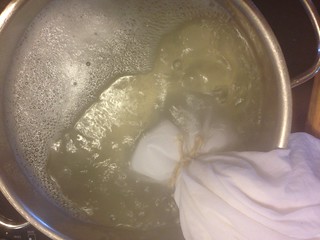
pudding bag in boiling water

Patience is required for pudding

Once more into the buttered cloth, once more into the water, once more boiling for three-quarters of an hour. This time was better, though. The results actually looked and tasted much more like what I’ve had before.
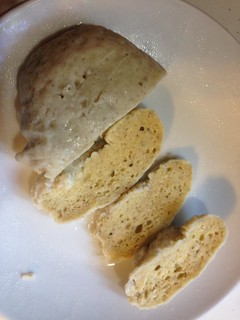
sliced boiled flour pudding

A boiled Flour Pudding

So, where does this leave me? Knowing that I’m the only documented fan of this in the regiment, I’ll stick with the smaller receipt: five spoons flour; two eggs, beaten; and three or four spoons of milk.

My plan is to boil this in whatever stew or stew-like device we have for supper on Saturday, and then eat it sliced with the stew. The plain flour-egg-milk mixture will pick up some of the flavors of the stew (think dumplings), but these could also have been served with a sauce, if made at home.

I’m also going to go back to the Experienced English Housekeeper, and see what she has to say.

* Years in ceramics classes taught me to knead all the air out of plastic material, so my bread tends to be better for building than eating. Even the dog wouldn’t eat the biscuits I made while in grad school…


Share this:

  • Share on Facebook (Opens in new window) Facebook
  • Share on Pinterest (Opens in new window) Pinterest
  • Email a link to a friend (Opens in new window) Email
  • Share on X (Opens in new window) X
Like Loading...
← Older posts
Newer posts →

Archives

wordpress statistics

Creative Commons License
Kitty Calash blog by Kirsten Hammerstrom is licensed under a Creative Commons Attribution-NonCommercial-ShareAlike 4.0 International License.

Website Built with WordPress.com.

  • Subscribe Subscribed
    • Kitty Calash
    • Join 621 other subscribers
    • Already have a WordPress.com account? Log in now.
    • Kitty Calash
    • Subscribe Subscribed
    • Sign up
    • Log in
    • Report this content
    • View site in Reader
    • Manage subscriptions
    • Collapse this bar
 

Loading Comments...
 

    %d