• Home
  • Completed Costumes/Impressions
  • Emma and Her Dresses
  • Free Patterns and Instructions

Kitty Calash

~ Confessions of a Known Bonnet-Wearer

Kitty Calash

Tag Archives: resources

Fabric Selection Resources: Printed & Online

09 Friday Jan 2015

Posted by kittycalash in Book Review, Clothing, Living History, Making Things, Reenacting, Research

≈ 1 Comment

Tags

fabric, Research, resources, sewing, shopping, style

Jackie asked about fabrics: how do you choose?

I’m going to start with prints, cottons, linens and silks; the second part will cover wools and sutlers.

There’s no substitute for feeling up the real thing, or samples, and while I do not have the book, I’m told by a very reliable source that it is worth buying Swatches from Wm Booth or from Hallie. I also order Burnley & Trowbridges swatch sets, which are often  more extensive than what’s on their website. Those samples help me gauge fabrics online– comparing the actual square with a thumbnail online is helpful.

Barbara Johnson: a typical page

Barbara Johnson: a typical page, this from 1803

Where else can you look for guidance? One of the best books that spans a wide range of living history time periods is the Barbara Johnson book of swatches. Owned and published by the Victoria and Albert Museum, A Lady of Fashion is out of print, but the pages have been scanned and are available online. The print version is better– it’s big!– but you can download the images and get a better sense of the scale of the samples.

What is particularly useful is that Barbara Johnson dated the samples, and wrote down how they were used. You can’t get better than that!

Susan Greene’s Wearable Prints is neither small nor cheap, but it is extensive, covering 1760 to 1860. This is a very hand book to have to help sort out typical looks for different time periods, and the likely range of colors.

Textile Sample Book, 1771. Metropolitan Museum of Art. 156.4 T31

Textile Sample Book, 1771. Metropolitan Museum of Art. 156.4 T31

Other museums have digitized sample books: the Met, for example, has multiple images of woven fabrics from a 1771 sample book online.

What you need to remember here is fibre: those homespuns at JoAnn will not behave the way linens behave, even if they look the same. Hand and drape are everything, and cotton, or cotton-poly will not do want linen does. Buy the linen, it’ll look, feel, and wear better.

There are many more sample books, but you have to be careful: some are dated only “19th century.” Great. That’s where Susan Greene and Barbara Johnson can help you sort out which *part* of the 19th century you’re looking at.
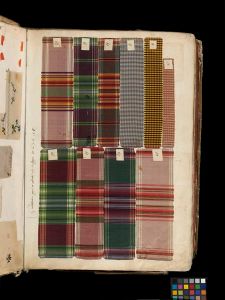
Swatch book, 1763-1764. Victoria and Albert Museum, T.373-1972

Swatch book, 1763-1764. Victoria and Albert Museum, T.373-1972

For silks, you can see a very specific and detailed range of silks in Selling Silks, which reproduces another sample book at the Victoria and Albert. Not all samples are 1763-1764; you will need to read the descriptions, but this can be helpful in figuring out how to use fabrics. I have come into some red silk damask that I can make into a gown; it’s vintage silk from France, probably pre-World War II. The pattern is large, replicating a 1740s fabric, but when I make up my gown, I think it can be 1760s, but not a lot later.

Part of looking and buying is understanding how textiles might be bought, saved, made up, reused and repurposed over time.


Share this:

  • Share on Facebook (Opens in new window) Facebook
  • Share on Pinterest (Opens in new window) Pinterest
  • Email a link to a friend (Opens in new window) Email
  • Share on X (Opens in new window) X
Like Loading...

Scabbers Paints

10 Wednesday Dec 2014

Posted by kittycalash in Living History, Museums, Philosophy, Reenacting

≈ Comments Off on Scabbers Paints

Tags

authenticity, interpretation, living history, movies, Museums, Research, resources, theory

Perhaps you know him as Timothy Spall, but the actor playing Mr Turner is best known in my house for his role as Scabbers, AKA Peter Pettigrew, in the Harry Potter films.

I am anxiously awaiting the release of Mr Turner, and have watched the trailer multiple times in anticipation of material for the authenticity and accuracy fires.I’ve also watched The Power of Art again, because I love Simon Schama as the David Attenborough of fine art, and I’ve enjoyed the way that Mr Turner’s titles appear to use a similar color-into-liquid trope as TPOA’s bleeding titles. Just go watch it.

Why am I so excited to see Scabbers paint? Because the trailer looks so damn good.

The color, the set dressing, the intensity of the colors, all suggest that the film team paid close attention to the material culture of the past, and to those tiny details that create a satisfactory, accurate closed world that helps us achieve experiential and even transcendent authenticity.

Of course I enjoy costume drama: you’d expect that, right? And messed up costume and material culture details can wreck a film or TV program for me, but what you might not expect is that there are some films I enjoy despite their apparent inaccuracy.

Take the Muppet Christmas Carol. That’s one of my favorite adaptations of the Dickens’ work, because it creates a world true to itself filled with believable objects and characters (even the ones I can’t stand), and returns authentic emotions. Scrooge’s headmaster was never an enormous eagle muppet: but the shabby school room works, much the way Beatrix Potter’s anthropomorphic tales work.

In The Pie and the Patty Pan, Duchess can’t bake– what dog can bake? But we can believe that Duchess is a greedy eater, and might well think she swallowed the patty pan. The touch of hypochondria in a greedy dog is intensely satisfying, I think.

Cat and dog at a tea table

Where is the Patty Pan?

What does this mean for historic house and living history interpretation? It means furnishing a believable world with accurate clothing, goods, and accouterments, based on primary sources with characters who convey authentic emotions and ideas to create a transcendent learning experience.

I even have a diagram:

The experience equation

The experience equation

And that’s why I want to see Scabbers Paint. Because anything that creates a believable historical experience is worth learning from.

Share this:

  • Share on Facebook (Opens in new window) Facebook
  • Share on Pinterest (Opens in new window) Pinterest
  • Email a link to a friend (Opens in new window) Email
  • Share on X (Opens in new window) X
Like Loading...

Winter Workshops

05 Friday Dec 2014

Posted by kittycalash in Clothing, Events, Living History, Museums

≈ Comments Off on Winter Workshops

Tags

18th century clothes, 18th century clothing, 19th century clothing, common dress, Costume, Events, Henry Cooke, interpretation, living history, Newport Historical Society, resources, Rhode Island Historical Society, Stamp Act Protest, What Cheer Day

Interior of a Tailor's Shop, Museum of London

Interior of a Tailor’s Shop, Museum of London

Come sew with me! Well, you’ll be sewing with Henry Cooke, but I’ll be there, too.

Check the Newport Historical Society’s website for more information about workshops and conversations this winter designed to for anyone with an interest in early American history who wants to expand their understanding of material culture interpretation.


Share this:

  • Share on Facebook (Opens in new window) Facebook
  • Share on Pinterest (Opens in new window) Pinterest
  • Email a link to a friend (Opens in new window) Email
  • Share on X (Opens in new window) X
Like Loading...

“As much so as we can”

26 Friday Sep 2014

Posted by kittycalash in History, Living History, Research

≈ 5 Comments

Tags

10th Massachusetts, 18th century, Brigade of the American Revolution, common soldier, Library, Orderly Book, Research, resources, Revolutionary War, Society of the Cincinnati

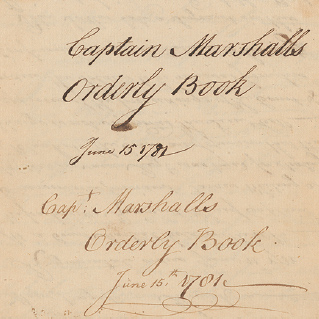
Captain Christopher Marshall Orderly Book, 1781. Society of the Cincinnati Library.

Captain Christopher Marshall Orderly Book, 1781. Society of the Cincinnati Library.

It’s been a tougher week than usual chez Calash, what with the AP Euro History and Honors English homework and struggles of the Young Mr, early mornings at work for window installation (finally, thank you!) and a round (lost) with an Orange Line Special virus brought home by Mr S.  The bright note came in the mail, though, and thank you USPS for your really reliable and right on (this) time delivery!

I have been working to get this book from the Society of the Cincinnati Library on behalf, and at the behest, of the 10th Massachusetts. The SoC have an pretty amazing collection, and they undertook a project to have their entire collection of British and Continental Orderly books conserved. These are incredibly fragile and almost ephemeral books: they’re the daily record of orders, courts martial, movements, complaints and requests for a regiment. It’s like the notes you might keep if you had to meet with your boss and other direct reports every day and keep track of many orders affecting the several hundred unruly, hungry, and possibly irritable guys under your command. But you’re taking notes with quill and ink, in longhand, and no one is going to email minutes out later that afternoon.

Bridget Connor turned up in an orderly book, so they can have a novelistic appeal (handy for those of us who approach military history from the social history world). So far, this book has produced no Bridgets, but it has not disappointed. Reader, I wept.

This book has moved me. Take this:

The disadvantage and difficulties which from inevitable Circumstances we labour under instead of depressing should inspirit us to surmount them. That we are involved in them is only our misfortune; not to make efforts to Conquer them will be our fault: and if we cannot be so well prepared as we ought at least let us be as much so as we can.

There are sketches of the “disposition of the New hampshire Massachusetts Rhode Island and Connecticut lines.” And, as I read to the Young Mr, there is unfinished business in nasty rooms.

Some part of the Camp and about the long Barracks in particular is relaxing into nastiness. Regimental QuarterMasters have been ordered to have them Clean and keep them so. An Officer of each Company has been ordered to visit the Barracks every day and to Confine & Report those who throw bones of meat Pot Liquor or filth of any kind near the Barracks. Yet all this has been done and no report has been made. it is hatefull to General Howe to Reitterate orders as it ought to be shamefull those who make it necessary.

Why, the Young Mr and I just had a similar talk last night…though, thankfully, there were no bones of meat involved.

This going to be a good read.

I know the SoC has a beautiful library and nice website, but folks, if you are into this history, throw them some love. I checked their 990s and they’re struggling just like everyone else. And if not them, please, support your favorite local historical site, organization, museum, whatever. Every place has something magical that will change your day. Your money– even a small donation– helps them do that work.

Share this:

  • Share on Facebook (Opens in new window) Facebook
  • Share on Pinterest (Opens in new window) Pinterest
  • Email a link to a friend (Opens in new window) Email
  • Share on X (Opens in new window) X
Like Loading...

Half Robe or Jacket: How Do You Wear One?

10 Wednesday Sep 2014

Posted by kittycalash in Clothing, Events, History, Making Things, Reenacting, Research

≈ 3 Comments

Tags

18th century clothing, 19th century clothing, bonnets, Costume in Detail, Costumes, costuming, Federal style, frock coats, half robes, Isaac Cruikshank, living history, National Trust Collections UK, Regency, Research, resources, tailcoat, What Cheer Day, Yale Center for British Art

Half robe, 1790-1800. National Trust Inventory Number 1348749,

Half robe, 1790-1800.
National Trust Inventory Number 1348749,

What Cheer Day is coming, and I hate to miss an opportunity to make a new gown (despite having just made one, and despite needing to make some waistcoats and trousers for the event). While I lay awake last night, I pondered my options, and whether a half gown would be suitable.

Although I have concluded it probably is not, I was curious about how these should be worn. Where can you wear such a garment? Is it only suitable for at-home use?

This is the robe from Nancy Bradfield’s Costume in Detail, replicated by Koshka the Cat here, and approximately by me, here.

CostumeinDetail_p84
CostumeinDetail_page83

Since I will be a housekeeper again, I think a gown is more correct for me, but that doesn’t stop me thinking about half robes, and whilst scrolling images by year at the Yale Center for British Art, I found this by Cruikshank:

ladies in a lending library

Isaac Cruikshank, 1756–1810, British, The Lending Library, between 1800 and 1811, Watercolor, black ink and brown ink on medium, lightly textured, beige wove paper, Yale Center for British Art, Paul Mellon Collection

There’s a lot to love in this image, even with its fuzzy “between 1800 and 1811” date. Not only do we get an array of reading material (Novels, Romance, Sermons, Tales, Voyages & Travels, Plays), we get costume tips and– special bonus– a dog gnawing its leg.

(If you are curious about some of the books in the Library at the John Brown House, check out this tumblr bibliography. I’ve been using it of late, and the representative genres are quite similar to what we see in the Cruikshank.)

We also get a chemisette on the lady at the counter, along with a very dashing hat, a fancy tiered necklace on the lady in pink, who also carries a green…umbrella? Parasol? With just a veil, that seems likelier than the longest reticule ever.

I like our Lady in a Half-Robe and her deep-brimmed bonnet showing curls at her brow. She and her companions show the range of white and not-white clothing seen in early 19th century fashion plates, and the range of head wear, too.

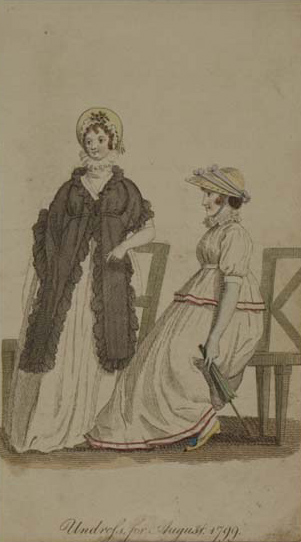
Undress for August, 1799. Museum of London

Undress for August, 1799. Museum of London

The last question I’m asking myself, though, is whether the yellow garment is a half-robe or a short pelisse or a jacket. And can you wear a half robe out of doors? And what did the ladies of the period call that garment?

In this fashion plate (featured by Bradfield on page 84, found by me at the Museum of London), the lady on the right is certainly wearing a short upper body garment, and I’d wager that she’s out of doors or headed that way, since she’s carrying a (green) parasol. Bradfield calls her garment a “jacket,” and until I can find the text of the Ladies’ Monthly Museum for August 1799, perhaps that is the term we should use instead.

While two images aren’t a lot of evidence, it does appear possible to wear a half-robe or jacket out of doors for informal visits in clement weather, and finding two is as good a reason as any to look for more.

Share this:

  • Share on Facebook (Opens in new window) Facebook
  • Share on Pinterest (Opens in new window) Pinterest
  • Email a link to a friend (Opens in new window) Email
  • Share on X (Opens in new window) X
Like Loading...
← Older posts
Newer posts →

Archives

wordpress statistics

Creative Commons License
Kitty Calash blog by Kirsten Hammerstrom is licensed under a Creative Commons Attribution-NonCommercial-ShareAlike 4.0 International License.

Website Built with WordPress.com.

  • Subscribe Subscribed
    • Kitty Calash
    • Join 621 other subscribers
    • Already have a WordPress.com account? Log in now.
    • Kitty Calash
    • Subscribe Subscribed
    • Sign up
    • Log in
    • Report this content
    • View site in Reader
    • Manage subscriptions
    • Collapse this bar
 

Loading Comments...
 

    %d