• Home
  • Completed Costumes/Impressions
  • Emma and Her Dresses
  • Free Patterns and Instructions

Kitty Calash

~ Confessions of a Known Bonnet-Wearer

Kitty Calash

Tag Archives: servants

Writing for the Weekend

25 Thursday Feb 2016

Posted by kittycalash in Events, History, Living History, personal, Reenacting, Research

≈ Comments Off on Writing for the Weekend

Tags

first person interpretation, interpretation, living history, Rhode Island history, servants, What Cheer Day, women's history

Johann Ender, Woman at her writing desk ca 1820

Johann Ender, Woman at her writing desk ca 1820

or, Women’s History at Washington’s Crossing

I haven’t dropped the peddling question, I promise! But I’m busy writing a paper for this coming weekend’s women’s history conference (yes, I know: but I’ve read that procrastination fuels creativity, so those digressions into the Canton voyage of the Ann and Hope were totally worth it).

Georg Friedrich Kersting: Briefschreibende Dame im Biedermeier Interieur, 1817

Georg Friedrich Kersting:
Briefschreibende Dame im Biedermeier Interieur, 1817

If you’re curious about the process I go through developing characters for living history programs, or best practices for women of the Revolutionary War-era armies, among other topics, there are some tickets left, and you can register online here.

But before I can compile what I’ve found about food markets in 18th century Boston, I have to go back to writing for this weekend.

Those Providence servants don’t research and describe themselves, and the housekeeper is particularly unreliable.

Share this:

  • Click to share on Facebook (Opens in new window) Facebook
  • Click to share on Pinterest (Opens in new window) Pinterest
  • Click to email a link to a friend (Opens in new window) Email
  • Click to share on X (Opens in new window) X
Like Loading...

Maid to Order

07 Wednesday Jan 2015

Posted by kittycalash in Uncategorized

≈ 5 Comments

Tags

1820s, 19th century, 19th century clothing, common dress, common people, Federal style, living history, maids, servants, sewing, sewing project

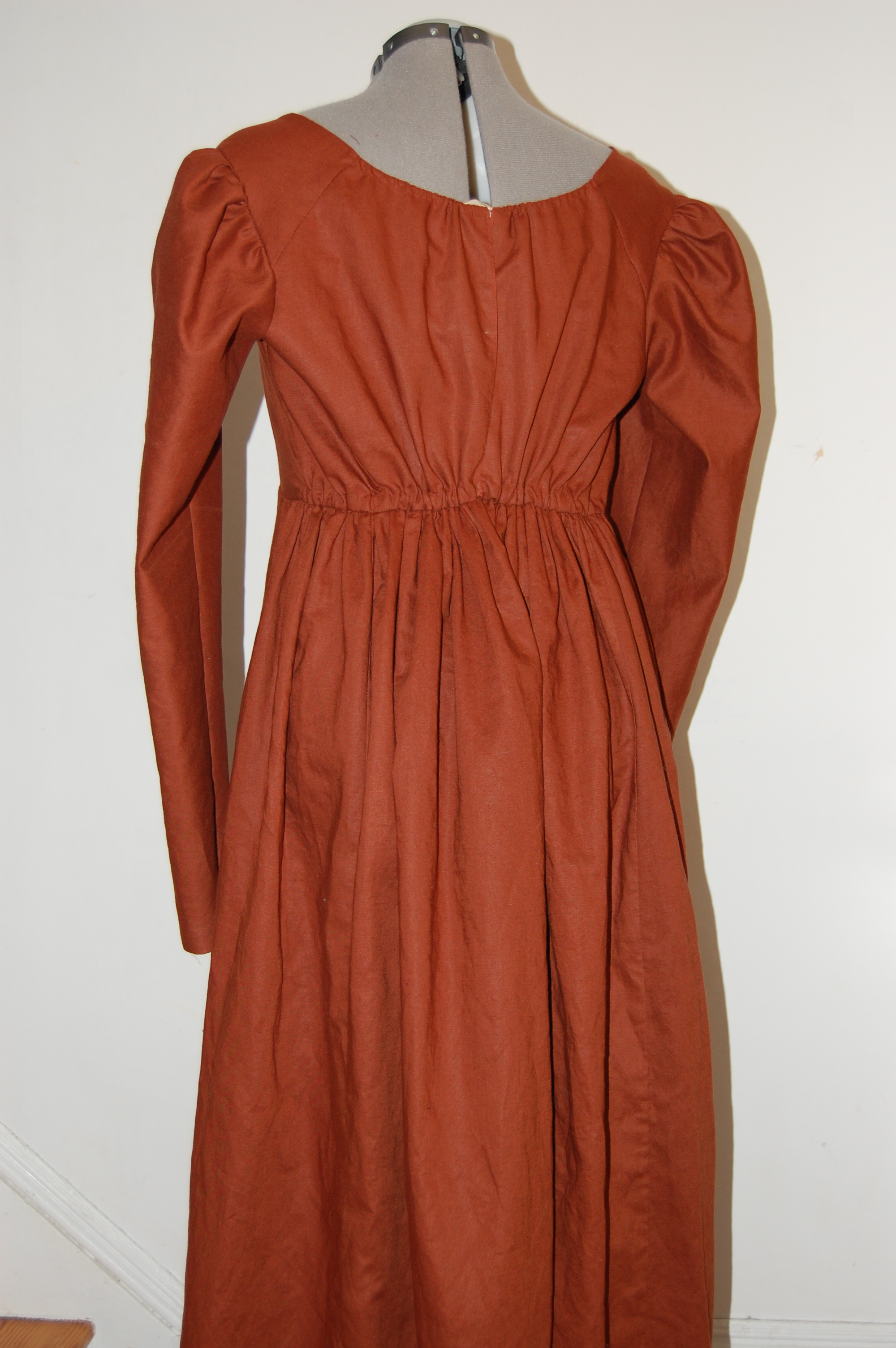
DSC_0572 I play the maid a lot, or one the lower sort, both at home and abroad.

I’ll be a maid in Newport again this February, and for that event, I’ve made the skritchy rust brown gown.

Not quite finished, it still requires hemming and something to finish the sleeves, but in three days, I got pretty far, considering.

This back-closing bodice with bust darts was pretty awful to fit– strange relationships developed between the bodice neckline and a waistband now discarded and on its way to Johnston.

DSC_0573

The back closes with a drawstring at neck and waist, as simple as possible. Mr S and I discovered that fitting a bodice back was deleterious to our relationship, so drawstrings won over buttons. I can tie the lower string, but not the upper– annoying, as I was trying to make a gown that was easy enough to put on solo at 4:30 AM. Vanity won over a pinned apron front gown, though I know they exist in Rhode Island collections. The skritchy rust-brown cotton pays homage to that extant garment, which is a rough homespun brown wool. I may not be stylin’ extant, but I’ll be itching correctly.

Share this:

  • Click to share on Facebook (Opens in new window) Facebook
  • Click to share on Pinterest (Opens in new window) Pinterest
  • Click to email a link to a friend (Opens in new window) Email
  • Click to share on X (Opens in new window) X
Like Loading...

Behind the Scenes, Below Stairs

21 Monday Oct 2013

Posted by kittycalash in History, Museums, Research

≈ Comments Off on Behind the Scenes, Below Stairs

Tags

Adriaan de Lelie, art, art history, Clothing, common dress, common people, family portrait, portraits, Rijksmuseum, servant girls, servants

Jonkheer Gijsbert Carel Rutger Reinier van Brienen van Ramerus (1771-1821), met zijn vrouw en vier van hun kinderen, Adriaan de Lelie, 1804

Jonkheer Gijsbert Carel Rutger Reinier van Brienen van Ramerus (1771-1821), met zijn vrouw en vier van hun kinderen, Adriaan de Lelie, 1804

Perhaps because I just finished Longbourn and have just started Year of Wonders, servants are on my mind.

In the family portrait at left, the servants are visible (just) to the right of the tree.

The man and woman almost literally mirror the main subjects, Carel Rutger Reinier van B can Ramerus and his wife, positioned as they are in opposite relationship to each other. The servants, too, are surrounded with life, carrying a child and dogs and game.

servants

The woman is holding the infant of the van Ramerus couple, and even without Google Translate (that’s “four of their children”) we can figure this out. How? Because the child is held away from her body, and faces forward. It is a slightly odd arrangement, with the infant so peripheral to the main image, but we’re fortunate, because this composition allows us to see the servants.

Class distinctions are clear in the dress: the female servant wears a cap, kerchief and short gown, the male servant-gamekeeper, perhaps–wears breeches and a jacket from the pervious century, as well as a cocked, and not a tall, hat.

It does remind me strongly of the imperative to continue a family line, and the lot of women to breed and produce male heirs. For all that I love the past, I know I could not live there easily.

Share this:

  • Click to share on Facebook (Opens in new window) Facebook
  • Click to share on Pinterest (Opens in new window) Pinterest
  • Click to email a link to a friend (Opens in new window) Email
  • Click to share on X (Opens in new window) X
Like Loading...

Longbourn: Book Review

19 Saturday Oct 2013

Posted by kittycalash in Book Review, Literature

≈ 6 Comments

Tags

18th century, book review, common dress, common people, common soldier, literature, servant girls, servants

The Chocolate Girl is adapted for the cover of Jo Baker’s new book

 On Sunday, I read the NYT review of Jo Baker’s new book, Longbourn. As soon as I finished the review, I ordered the book, which arrived Wednesday evening. By 2:00 AM Thursday, I had finished it.

I like Austen, but my favorite Austen novel is Mansfield Park, not Pride & Prejudice. The BBC and other adaptations sometimes make the world of her novels seem too cloistered, too precious, and too refined to me. (Mrs Hurst Dancing can be a helpful corrective.) So of course I was captivated by the premise of Longbourn: “The world of the people who laid the fires, cooked the meals and fetched the horses for Jane Austen’s Bennet family.”

The story was engaging–heck, I stayed up until 2:00AM  to find out how it ended–and while I found it slightly romantic for my taste, on the whole, the world was believable.

For one thing, there is plenty of mud. And Sarah the housemaid must clean the mud off the Bennett girls’ petticoats. The hauling of water, laying of fires, and the chill and exhaustion the maids feel is pretty well rendered. Baker addresses the question I’ve always had, How did servants tolerate servitude? by portraying Sarah’s struggle with resentment and resignation to her lot.

I thought, too, that the way Baker described women as “breeding” was also good; she referred as well to Elizabeth Bennett’s “dark, musky” armpits, and that seemed a nice way to slip in historical hygiene information. But women in English gentry were valued for their breeding capabilities: the need for a male heir didn’t die with Henry VIII, and it is much of what drives, or drove, the plot of Downton Abbey. For women, the past was a smaller world, and Sarah’s life is particularly small. Her carriage rides help define the very real confinement of her world.

There are a few slips: backpack instead of knapsack once or twice, but not many. It feels well-researched, well imagined, and believable. I don’t want to wreck it for you, so I won’t go into too much…there are some classic plot twists and devices that I put up with because they’re so typical of the literature of the period. I particularly enjoyed that Sarah reads from Mr Bennett’s library, including Pamela. It was a nice way to reinforce Wickham’s creepiness, and the echoes between the novel derived from a novel, in which  fictional characters read real novels, delighted me. (Being a fictional character myself.)

Jo Baker’s not Hilary Mantel-– this isn’t the kind of writing where the language stops you cold and sentences leave you breathless with awe, but for historical fiction derived from Jane Austen, Baker’s book is excellent and well-written.

Share this:

  • Click to share on Facebook (Opens in new window) Facebook
  • Click to share on Pinterest (Opens in new window) Pinterest
  • Click to email a link to a friend (Opens in new window) Email
  • Click to share on X (Opens in new window) X
Like Loading...

Always the Lady’s Maid, Never the Lady…

26 Thursday Sep 2013

Posted by kittycalash in Clothing, Events, Living History, Museums, Research

≈ Comments Off on Always the Lady’s Maid, Never the Lady…

Tags

18th century clothes, common dress, dress, fashion, John Brown House Museum, maids, servants, What Cheer Day, widows

Testing the bodice and sleeve

but that’s fine, actually. I like to get dirty. The red Virginia cloth dress is now clay-splashed, and while it was made especially for the “People of 1763” event, it may no longer work. Fine for cherry-sellers, fine for hand-bill hawkers, it will not do for a lady’s maid, and I don’t especially want to clean it. Hope I can get my stays wrangled back into shape and that my cross-barred gown fits…but if not, I’ll be a recently promoted lady’s maid.

From the back.

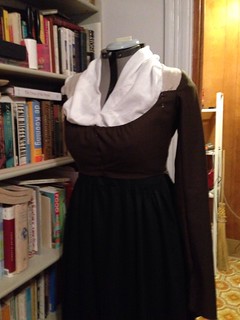
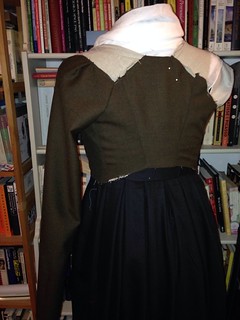
My other upcoming role as a maid will be at the John Brown House Museum, on October 5. This has required quite a bit of thinking and stewing about appropriate clothing and realistic background. I finally settled on a black-and-brown combination of petticoat and open robe, with the style of the open robe based on Paul Sandby drawings and extant garments, but determined by the scant three and a quarter yards of brown worsted that I was able to find.

Winter, 1795. The British Museum, 2010,7081.509

Winter, 1795. The British Museum, 2010,7081.509

The bodice back is based on the 1795-97 cross-front gown from Museum of Costume in Bath shown in The Cut of Women’s Clothes. The front is meant to be transitional: a little bit of gathering at the neck, but not a great deal, with the edges still pinning closed. The sleeves are long and slim, and will button at the wrist once I’ve gotten the length worked out.

The skirt will pleat, with fullness centered on the back triangle and decreasing to the front. For the black petticoat, I used the double inverted box pleat of the 1790s open robe in Costume in Detail. As you might imagine or just plain hope, they work! I’ve also made a small pad to help lift the skirt in the back and create the right profile; I’m thinking of adding buttons and loops so that it can migrate from gown to gown.

Share this:

  • Click to share on Facebook (Opens in new window) Facebook
  • Click to share on Pinterest (Opens in new window) Pinterest
  • Click to email a link to a friend (Opens in new window) Email
  • Click to share on X (Opens in new window) X
Like Loading...
← Older posts
Newer posts →

Archives

wordpress statistics

Creative Commons License
Kitty Calash blog by Kirsten Hammerstrom is licensed under a Creative Commons Attribution-NonCommercial-ShareAlike 4.0 International License.

Website Built with WordPress.com.

  • Subscribe Subscribed
    • Kitty Calash
    • Join 621 other subscribers
    • Already have a WordPress.com account? Log in now.
    • Kitty Calash
    • Subscribe Subscribed
    • Sign up
    • Log in
    • Report this content
    • View site in Reader
    • Manage subscriptions
    • Collapse this bar
 

Loading Comments...
 

    %d