• Home
  • Completed Costumes/Impressions
  • Emma and Her Dresses
  • Free Patterns and Instructions

Kitty Calash

~ Confessions of a Known Bonnet-Wearer

Kitty Calash

Category Archives: Reenacting

Milliner’s Shop Redux: A big, visual project

10 Thursday Aug 2017

Posted by kittycalash in Clothing, History, Living History, Museums, Reenacting

≈ 1 Comment

Tags

bonnets, canezou, CoBloWriMo, Federal New England Fashion, Federal style, living history, millinery, millinery shop, Salem Maritime Festival

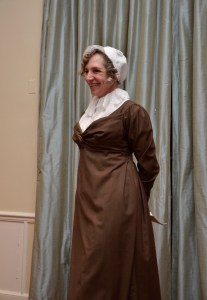
The complete ensemble, under supervision.

When I first moved to Providence, I lived in Fox Point, a slightly fringy-dingy neighborhood of Portuguese and Cape Verdean immigrants and their descendants that was cheap enough for students (and even today remains imperfectly gentrified: Providence, I love you dearly). As my then-boyfriend and I walked my dog, we passed a man whom I later came to know as the Block Captain, who remarked to my boyfriend, “Beeg wooman.” Any project I take on is, therefore, big, since I am nearly six feet tall.

Although I have schemes for a Big New Century Project (a complete 1585 ensemble), I’ll take a shortcut instead to my current enthusiasm and write about last weekend and the 1811 fashion plate reconstruction, which happily includes one of my favorite visual sources, early 19th century fashion plates — thanks to Scene in the Past’s albums and Ackemann’s Repository on the Internet Archive.

Display window
Display window
and counter
and counter

I’ve written about the canezou plate before, but not since I (mostly) completed it on the trip up to Salem. This 1811 plate appealed to me first because of the bonnet (checks!) and the necklace (lapis!), but then realized that the canezou and its petticoat were within my ability to complete.

The ensemble also seemed suitable for a summer day in Salem, which, while usually more humid than hot, calls for cool, lightweight, clothing that can withstand a potentially sweat-drenched day without melting.

Gentlemen lounging on the street
20727717_10154869339193527_2136485927_o

From start to finish was three weeks: canezou, bodiced petticoat, necklace, bonnet, and shoe trims, all a vernacular rendition of a high-fashion image, adapted to the materials at hand– though I did have to order bonnet taffeta from India, which arrived just in time– much faster than I could have expected in 1811 Salem!

Setting up the shop for the fourth time was as much fun as the first time, and a little easier, given the practice I’ve had. I shared the shop with a tailor, Mr. B, of hat-making renown which made for a nice contrast interpreting men’s and women’s fashions and purchasing habits.

Packing up hat stands, bonnets, accessories, and furniture and driving them 470 miles is a kind of madness, but interpreting women in business and early shopping is one of my favorite historical enterprises.

Share this:

  • Click to share on Facebook (Opens in new window) Facebook
  • Click to share on Pinterest (Opens in new window) Pinterest
  • Click to email a link to a friend (Opens in new window) Email
  • Click to share on X (Opens in new window) X
Like Loading...

Rethinking Reenacting Redux

22 Saturday Apr 2017

Posted by kittycalash in Art Rant, Living History, personal, Philosophy, Reenacting

≈ 2 Comments

Tags

art, authenticity, interpretation, living history, Reenacting, transcendence

Some of you may recall my friend from the antediluvian age, Dread Scott. He was in town briefly and while I wasn’t able to attend his talk, I got my own special artist’s talk over breakfast.

Scott’s working on a Slave Rebellion Reenactment, (additional info here) so we had a lot to talk about.

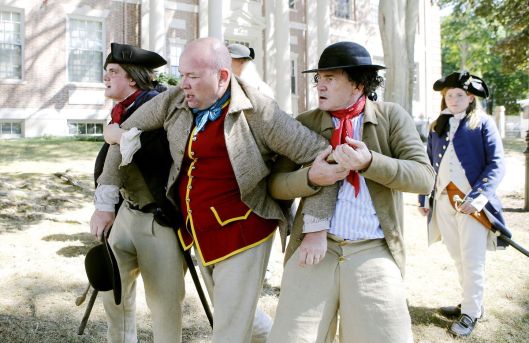
Scuffle in the Square, Princeton, 2017. Photo by Wilson Freeman at Drifting Focus Photography

He had some great questions about what we do, and why we do it, especially around Princeton, and in talking about my end goal (getting the public to understand how the past informs the present), I said something about how in Newport in 2014, the cars disappeared and we forgot we were in the present.

Scott’s great reply was about keeping the present present, occupying two time periods simultaneously, to recognize that the past made the present. I know that seems obvious, but it isn’t always when we’re out in our funny clothes. It’s another layer of interpretation that we can build onto our reenactments and recreations, particularly when we are trying to talk about slavery. Slavery built the institutions we have today– like Aetna Insurance and Georgetown University– so if we acknowledge our surroundings in a place like downtown Princeton or Newport, we can talk about more than just the moment we are recreating.

Some of us seek historical transcendence. Some of us enjoy a social experience. And some of us seek ways to connect the present to the past in ways that help us understand how we got here, and how to make a better future.

The more I contemplate what matters to me, the more I think I’m seeking that last more than I am even transcendence.

Share this:

  • Click to share on Facebook (Opens in new window) Facebook
  • Click to share on Pinterest (Opens in new window) Pinterest
  • Click to email a link to a friend (Opens in new window) Email
  • Click to share on X (Opens in new window) X
Like Loading...

Workshop Wednesday: Accessory to the Past in June!

22 Wednesday Feb 2017

Posted by kittycalash in Clothing, Living History, Making Things, Reenacting

≈ Comments Off on Workshop Wednesday: Accessory to the Past in June!

Tags

authenticity, Clothing, dress, fashion, sewing, workshops

Neck stocks: just so.

Neck stocks: just so.

Drunk Tailor and I will be up to more mischief this summer, and you can join us! We’re teaching a class this June at Historic Eastfield Village. Among the things you can learn to make are chemisettes, reticules, gaiters and neck stocks.

We plan to start with the basic question: who are you? And what does that mean for what you wear? What visual and extant sources can inform your choices? From John Lewis Krimmel to Sophie Du Pont, images help paint a picture of a distinctive early American style.

Mrs Pabodie attempts to remember when she was born (1771). Photo by J. D. Kay

Mrs Pabodie attempts to remember when she was born (1771). Photo by J. D. Kay

Collections from Rhode Island to New York contain examples of early garments that help us understand how people dressed in the early 19th century, as well as diaries that tell us how they lived. Fortune telling? Sewing for money? Bored with quilting? Church as a social experience? There’s much more to the early nineteenth century than Jane Austen. Come find out more this June.

Share this:

  • Click to share on Facebook (Opens in new window) Facebook
  • Click to share on Pinterest (Opens in new window) Pinterest
  • Click to email a link to a friend (Opens in new window) Email
  • Click to share on X (Opens in new window) X
Like Loading...

Serving Delaplace

21 Tuesday Feb 2017

Posted by kittycalash in Events, History, Living History, material culture, Museums, Reenacting

≈ 2 Comments

Tags

18th century, authenticity, cleaning, common soldier, cooking, Drunk Tailor, Fort Ticonderoga, interpretation, living history, Revolutionary War, servants

dscn4628

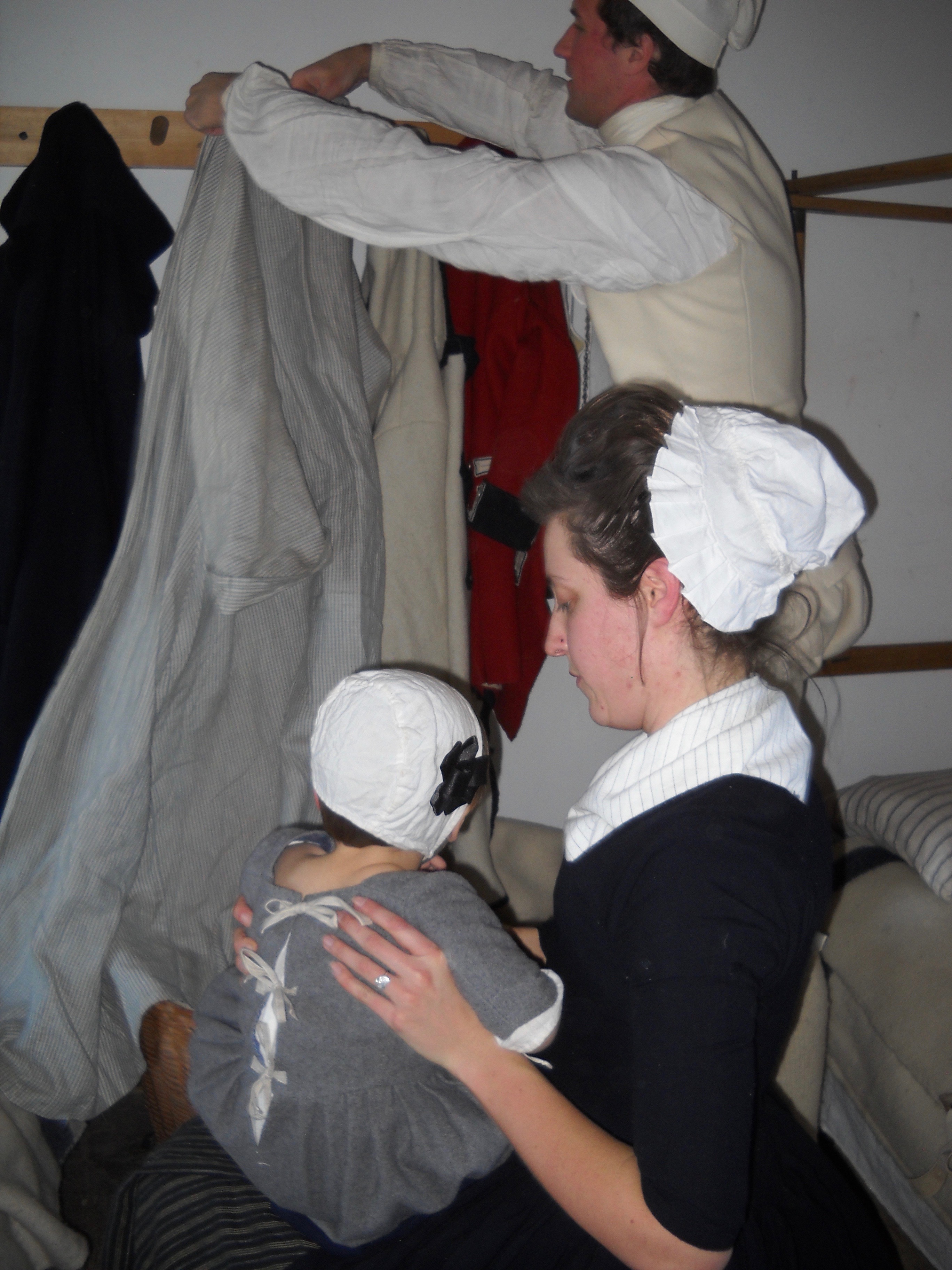
With 400 miles between us, Drunk Tailor and I have few chances to explore the past together, so I was both delighted and nervous when he agreed to join the British Garrison 1775 event at Fort Ticonderoga as one of Captain Delaplace’s servants.  Even better, we were also joined by the itinerant Deep North Yankee who wandered around the Fort (possibly seeking roofing shingles, of which he is much in need).

dscn4631

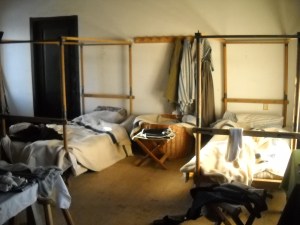
Friday nights are always magical, candle and firelight (and only the warmth of the fire) as we drink cider and talk about history. But morning always comes: Saturday, cold and clear, Mr S and I woke and blinked across the room at each other, and I wondered to what degree I really wanted to ever crawl out of bed…only hunger and an eventual need to pee (and fear of a Sergeant) propelled me.

Yup, you cook 'em on a board.

Yup, you cook ’em on a board.

First order of business: breakfast. Mr S, supplied with his corn meal of choice, made us johnnycakes, which provided perhaps more interpretive than nutritive value. Still, they were warm and tasty and he is the only person I know who can make them; my efforts end up as FEMA disaster sites.

cooking
img_20170218_110626

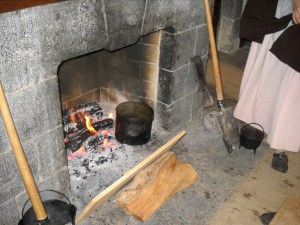
Captain Delaplace’s servants were tasked with cooking for his mess, so Mr S and I got a start. We had a chicken, an onion (I traded onion # 2 for some bacon), butter, carrots, potatoes, a butternut squash, salt, and some port. I don’t know where this English serving woman of 1775 encountered mis en place, but she accidentally introduced coq au vin to the Captain’s table with the dinner meal.

Captain and Mrs Delaplace dining, manservant in attendance

Captain and Mrs Delaplace dining, manservant in attendance

The Captain and his Lady dined on chicken braised in butter and bacon with root vegetables in a port sauce; we servants waited until they were done before we could eat. (Confession: I need to eat a lot, and have a sensory overload problem, so when visitors fully crowded the room, I had to dash across the parade ground for a Clif Bar and an Ativan before I could continue to wait for my dinner.) In the afternoon, dishes were washed at the table, as was common (at least in early New England), dried, and set away, while the Captain’s lady and child played in the cabbage patch between the beds.

dscn4657

When the room was empty, servants were able to eat (huzzay!) and found the meal very tasty indeed. I would certainly make this again, and learned more about cooking– a typically female task I generally try to avoid– than I had expected to. Then we had yet another round of dishes before it was time to tidy the room and make ready for tea or supper.

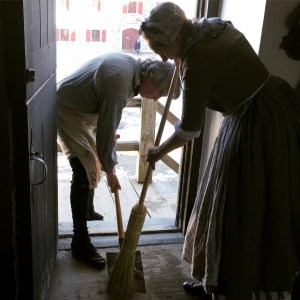
To that end, we cleared the table and broke it apart to reveal the floor and hearth, which needed to be swept of bread crumbs, squash peels, dead leaves, and other detritus. The best way to sweep an unfinished floor in the 18th century (per Hannah Glasse et al) is to strew the floor with wet sand and then sweep. I mixed sand with lavender-infused vinegar and threw it on the floor; this keeps the dust down as you sweep months of dust and dirt out of the corners and from behind tables and chests.

img_20170218_144218
img_9513

The trick is to sweep in one direction (more or less) from the back of the room to the front, and then to gather up the sand (here in a shovel) and pitch it off the landing. Much was thrown out the door and over the stair rail, just as servants would have done in 1775. (And I am told it is soothing to nearly hit the sergeant, but perhaps that’s merely hearsay, if not heresy.)

img_9478

When we were done, we restored the table (Drunk Tailor noticed the height of the ceiling, and wondered about hanging birds in cages whist awaiting the return of the tabletop), fully reset with cloth, candlesticks, plates, and knives, ready for the supper we didn’t cook, as we skipped away at the close of the day to find our own meal in Glens Falls, where live music is inescapable on a Saturday night.

Share this:

  • Click to share on Facebook (Opens in new window) Facebook
  • Click to share on Pinterest (Opens in new window) Pinterest
  • Click to email a link to a friend (Opens in new window) Email
  • Click to share on X (Opens in new window) X
Like Loading...

“Exteriorizing,” or, Showing the Past: Part II

16 Thursday Feb 2017

Posted by kittycalash in History, Living History, Reenacting

≈ 2 Comments

Tags

authenticity, first person interpretation, living history, Reenacting, Research

Part II of the two-part guest posts by Sharon Burnston. Part I is here. ( Just below, if you are scrolling)

In the previous blog post, I explained the concept of “Yes, and”. But in the case of the naval press gang reenactment last summer in Newport, the “Yes, and” dialogue that I expected didn’t happen. When the press gang invaded the tavern I was mistress of, and started grabbing sailors, I attempted to intervene. This would have allowed me to put into words, for the benefit of the public watching, what this intrusion into our community would do to the town, in terms of the loss of the local men both collectively and individually.

Melee in the Square, Newport RI, August 2016

Melee in the Square, Newport RI, August 2016

In attempting to defend my customers, I as tavern mistress could have functioned as a token representative of all the other women of Newport, all of whom had economic, social, and maybe personal ties to the impressed men. The public would have had a better chance to grasp what the impressment actually meant to the people of Newport. But this failed to happen. Nobody in the press gang picked up on my gambit, they went about their business with a very convincing and no doubt authentic silent ruthlessness. One brandished his club and snarled, “Silence, woman!” which effectively shut down my efforts entirely. However one of my “customers” picked up on my gambit and began pleading to be released on account of his wife and children, but he got essentially the same response that I did, and he was also shut down.

Alex Cain impressed in Newport, August 2016. Photo by Philip Sherman, Newport Daily News

Alex Cain impressed in Newport, August 2016. Photo by Philip Sherman, Newport Daily News

I didn’t put all that effort into my tavern and tavern mistress impression just to be a scenic backdrop for the press gang. It was my expectation that there would be interaction between the tavern owner and the naval crew, which would serve to better educate the public by exteriorizing what we roleplayers were thinking and feeling about what was happening. My mistake was in taking for granted that this would be obvious to the other role players, and that the naval crew would give me a “Yes, and” response for the benefit of the audience.

In short, I think we could have done a better job of *interpreting* what was happening if we hadn’t all been quite so focused on doing it as *authentically* as possible. I do not in any way fault the guys who were portraying the naval crew. To their credit, they played their roles with superb accuracy. If anything the fault was mine for assuming we’d be all on the same page, and ready to interact with one another. It is my opinion that as an interpretive exercise, this living history scenario would have benefited from being just a teensy bit less “authentic” and a little bit more theatrical.

A Cribbage Party in St. Giles. Thomas Rowlandson, 1787. Royal Collection Trust.

A Cribbage Party in St. Giles Disturbed by a Press Gang. Thomas Rowlandson, 1787. Royal Collection Trust.

In talking afterward with members of the public, I found too many of them confused, they saw the action but didn’t really understand what was going on, nor what was at stake for the various individual characters involved. It would have been so easy to get the essential points across while the scene was unfolding, and it doesn’t take long, a few sentences exchange is enough. But all participants have to understand in advance the merits of this, and be prepared for it when it happens.

DSCN4459

In my opinion it’s great, but not enough, to know the best possible historical information on the event we are presenting, and to replicate the clothing and equipment so meticulously. We also should be prepared to join together to learn how to portray it in the most informative and articulate way possible. This can only make our first-person historical reenactments even better than they already are.

Share this:

  • Click to share on Facebook (Opens in new window) Facebook
  • Click to share on Pinterest (Opens in new window) Pinterest
  • Click to email a link to a friend (Opens in new window) Email
  • Click to share on X (Opens in new window) X
Like Loading...
← Older posts
Newer posts →

Archives

wordpress statistics

Creative Commons License
Kitty Calash blog by Kirsten Hammerstrom is licensed under a Creative Commons Attribution-NonCommercial-ShareAlike 4.0 International License.

Website Built with WordPress.com.

  • Subscribe Subscribed
    • Kitty Calash
    • Join 621 other subscribers
    • Already have a WordPress.com account? Log in now.
    • Kitty Calash
    • Subscribe Subscribed
    • Sign up
    • Log in
    • Report this content
    • View site in Reader
    • Manage subscriptions
    • Collapse this bar
 

Loading Comments...
 

    %d