• Home
  • Completed Costumes/Impressions
  • Emma and Her Dresses
  • Free Patterns and Instructions

Kitty Calash

~ Confessions of a Known Bonnet-Wearer

Kitty Calash

Tag Archives: 18th century clothes

Mrs Pabodie, I presume?

16 Wednesday Nov 2016

Posted by kittycalash in Clothing, History, Living History, Museums, Pabodie Project

≈ 1 Comment

Tags

18th century clothes, 18th century clothing, 19th century clothing, dress, fashion, Federal style, interpretation, Research, Rhode Island Historical Society
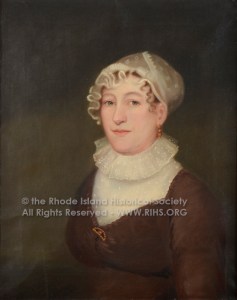
Mrs William (Jane) Pabodie. oil on canvas, 1813. RIHS 1970.60.2

Mrs William (Jane) Pabodie. oil on canvas, 1813. RIHS 1970.60.2

Remember Mrs Pabodie? She appeared a week ago today in Providence after an intense sewing effort left your author with numb fingers. The process was as straightforward as these things ever are, manipulating fabrics to do your bidding once you think you have the right materials.

It took more rounds of white muslins from Burnley and Trowbridge than I care to count, and a variety of book muslins from Wm Booth Draper, just for the chemisette and cap. The laces came from Farmhouse Fabrics in the most expensive small package I’ve yet ordered that did not contain antique jewelry.

Mrs Pabodie attempts to remember when she was born (1771). Photo by J. D. Kay

Mrs Pabodie attempts to remember when she was born (1771). Photo by J. D. Kay

The gown is a wool and silk blend remnant from Wm Booth Draper, just enough to make a gown (even at my height) though I admit the front hem will need some piecing or a ruffle to give it the proper length. Still, the thing more or less works, though as I compare the details to the original painting, I admit we’re still in beta.

Impressed from Newport-- or nearly so-- Low Spark makes his Providence debut. Photo by J.D. Kay
Impressed from Newport– or nearly so– Low Spark makes his Providence debut. Photo by J.D. Kay
Reverend Hitchcock, hoping against hope that the tailor will one day finish his fine silk waistcoat. Photo by J. D. Kay
Sissieretta Jones extols the beauties of Paris-- and pearls. Photo by J. D. Kay
Sissieretta Jones extols the beauties of Paris– and pearls. Photo by J. D. Kay

I was joined by three friends from different eras (because you know me: if it’s not didactic, we’re not doing it): a sailor who on the run from a Newport press gang in 1765; Reverend Enos Hitchcock of the Beneficient Congregational Church in 1785; and Sissieretta Jones, soprano of Providence, around 1880. Each of the characters described their lives and their clothing, and I will admit that the Annual Meeting audience may not have been fully prepared for some of what they heard– I’m not certain they had ever considered how apt “balancing a sheep on my head” might be in describing Reverend Hitchcock’s wig.

Mrs Pabodie points out East Side landmarks to a visitor examining the theatre curtain backdrop painted around 1810. Photo by J. D. Kay

Mrs Pabodie points out East Side landmarks to a visitor examining the theatre curtain backdrop painted around 1810. Photo by J. D. Kay

In the end, they were entertained, and may even have learned something, as we celebrated 2016’s interpretive theme, Fashioning Rhode Island.
Share this:

  • Share on Facebook (Opens in new window) Facebook
  • Share on Pinterest (Opens in new window) Pinterest
  • Email a link to a friend (Opens in new window) Email
  • Share on X (Opens in new window) X
Like Loading...

The Art of Deviance

01 Tuesday Nov 2016

Posted by kittycalash in History, Living History, personal, Philosophy, Reenacting, Research

≈ Comments Off on The Art of Deviance

Tags

18th century clothes, authenticity, common people, difficult interpretations, interpretation, living history, Research

portrait as a process test

portrait as a process test

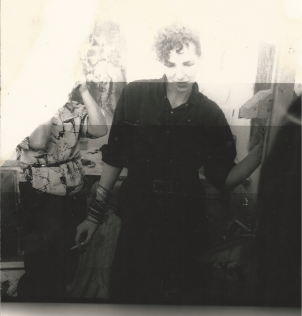
Some regular readers know I was part of Chicago’s punk rock scene in the early 1980s: my first foray into unusual music and natty dressing.* I think that’s me and my keffiyeh at a Naked Raygun show in the Chicago episode of Sonic Highways. But more to the point, I was on the fringes of an underground, taking style tips from obscure English zines, and being told I looked like a whore by a variety of men using Chicago’s public transit system. Judge not lest ye be judged aside, I’m accustomed to occupying uncomfortable spaces by design and by accident. (I wasn’t looking to be called a whore on the Fullerton El platform when I dressed in a below-the-knee vintage skirt and lot of Bakelite jewelry combined with bullet belts and studded leather, but everybody’s a critic when it comes to women’s appearance.)

The Frail Sisters, 1794

The Frail Sisters, 1794

Now that I live in Providence, where indoor prostitution was legal for decades, if not centuries, my interest in gender role non-conformity extends to finding ways to document and represent sex workers in Rhode Island history. The adult section of the now-defunct Providence Phoenix, ‘zines, and diaries help record at least some aspects of this facet of our culture, but how do we represent it, and do it well? Jamie Lee Curtis in Trading Places is not a realistic model.

In discussing this lately, I’ve found consistent themes in representing sex workers in the 18th century: white face powder, rouge, bright clothing, visible stays, friendliness rather than reserve. There are lithographs to guide the portrayal through clothing, and visual tropes that signified a lack of virtue in the 18th century. In considering the local variations on this theme, my thought had been to expand upon the visual imagery by reading the Providence and Newport town papers, and the records of the Colony of Rhode Island, along with the contemporary newspapers.

The Tar's Triumph, or Bawdy-House Battery, print by Charles Mosley, 1749. British Museum 1868,0808.3896

The Tar’s Triumph, or Bawdy-House Battery, print by Charles Mosley, 1749. British Museum 1868,0808.3896

Nothing is likely to be quite as good as the Nort’ Providence chief of police who, in the midst of Tropical Storm Irene, pursued a stripper who took clients on the side when she ran a red light in her SUV. She crashed into a parked car in Pawtucket and abandoned the car, at which point the chief of police searched the vehicle, found her open purse, and stole the cash she’d earned that morning. When questioned later, he was at pains to explain why the money was wet…** in any case, the Providence brothel riot of 1782 aside, I do not expect to find anything quite as lurid.

The Bargain Struck, or Virtue conquer'd by Temptation. Mezzotint, 1773. British Museum 1935,0522.1.130

The Bargain Struck, or Virtue conquer’d by Temptation. Mezzotint, 1773. British Museum 1935,0522.1.130

My sartorial choices for a prostitute would include a rather over-fancy cap with a worn silk ribbon, rouge and a velvet patch, a silk gown stained on the back, silk petticoat stained at the knees, laddered stockings, and heeled shoes tied with silk ribbons, or fastened with paste buckles. If my character worked from a brothel, the dress could be brighter and cleaner, but in either case, neck handkerchiefs would be optional or silk and askew, showing my stays and cleavage.

This is not an easy impression. It’s not just that I do not want to parody an 18th century prostitute, but that I want to honor the memory of these largely forgotten women. They had families– in all likelihood they had children, as we know from the story of Mary Bowen and Eliza Jumel– they had feelings, desires, dreams, felt love and pain. They were likely desperate.

They were human.

We owe them the respect of representing them well– of representing them at all– if we strive to recreate a more complete picture of the past.


*What else is this crazy thing we do?

**You cannot make this stuff up.

Share this:

  • Share on Facebook (Opens in new window) Facebook
  • Share on Pinterest (Opens in new window) Pinterest
  • Email a link to a friend (Opens in new window) Email
  • Share on X (Opens in new window) X
Like Loading...

Hell is a Hand Basket

15 Thursday Sep 2016

Posted by kittycalash in Art Rant, Clothing, Fail, History, material culture, Research

≈ 5 Comments

Tags

18th century, 18th century clothes, art history, authenticity, baskets, Costume, dress, fashion, interpretation, John Copley, john smibert, Joseph Blackburn, portraits, Research

Gentle Reader: Remember the post on semiotics? We need to go back to that once more.

Just what are we looking at here?
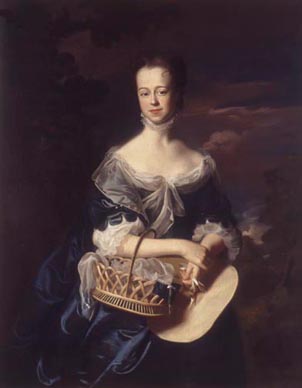
copley_john-singleton-mrs-daniel-rogers-middleton-collection

John Singleton Copley.
Portrait of Mrs. Daniel Rogers (Elizabeth Gorham Rogers), 1762
50 X 40, oil on canvas.
Middleton Collection, Wake Forest University
HC1991.1.1

Hmm…. 1762. Does that dress look like 1762 to you? Or does it resemble a 17th century garment? Check out those sleeves: scallops. The shift sleeves: super full. The line of the gown at the neck: a shallow scoop. The front of the bodice: closed.

Are those the hallmarks of a typical 1762 gown in New England, England, or France? You are correct, sir: They are not.

What’s happening here? What is Copley doing, and why?

He’s making his subject look good, reflecting her wealth and status. He’s flattering her by painting her in a faux-17th century gown, a “Vandyke costume, a popular artistic convention in England related to the vogue for fancy dress and masquerade.”* 1762 seems a trifle late for this convention, but in 1757, James McArdell produces a mezzotint of Thomas Hudson’s portrait of the Duchess of Ancaster. Henry Pelham wrote to Copley in 1776 that he had purchased one of those mezzotints, suggesting their use as references for Colonial American painters. Reynolda House has a nice explication of this style of dress in the Thëus portrait they own of Mrs. Thomas Lynch, shown below.

Mrs. Thomas Lynch, oil on canvas by Jeremiah Thëus, 1755. Reynolda House, 1972.2.1

Mrs. Thomas Lynch, oil on canvas by Jeremiah Thëus, 1755. Reynolda House, 1972.2.1

There was also a convention of portraying women in “timeless draperies,” following the school of Peter Lely and Godfrey Kneller, both late 17th-century English painters who produced portraits with generalized costumes.

Lady Mary Berkely, wife of Thomas Chambers. oil on canvas by Sir Godfrey Kneller, ca. 1700. Metropolitan Museum of Art, 96.30.6

Lady Mary Berkely, wife of Thomas Chambers. oil on canvas by Sir Godfrey Kneller, ca. 1700. Metropolitan Museum of Art, 96.30.6

This portrait by Kneller (born in Germany, he worked in England) explains a lot, doesn’t it? And this timeless convention persists for some time, and the stylization of the facial features and hair is copied by English and colonial American painters. John Smibert, long familiar to many of you, was a leading practitioner of this style of portrait, and his work would have been well known to Copley and his sitters.

Mrs Samuel Browne by Smibert, RIHS 1891.2.2

Mrs Samuel Browne by Smibert, RIHS 1891.2.2

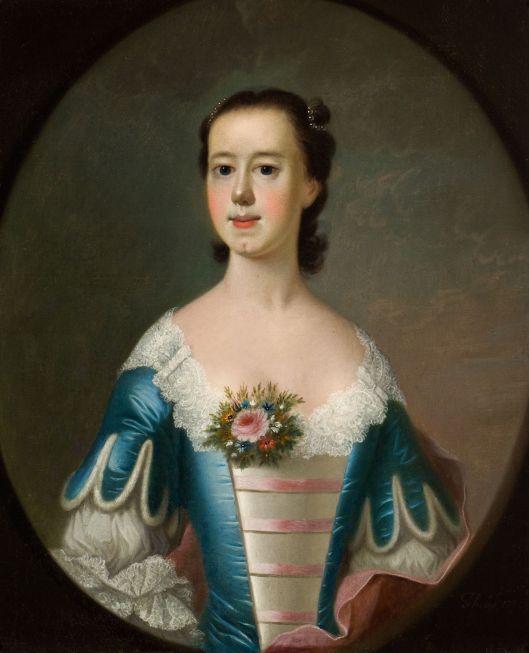
Blackburn’s portrait of Mary Sylvester adopts two conventions at once, in a way: she’s in timeless-style drapery and fancy dress as a shepherdess. Let’s remember, too, that there’s symbolism in the shepherdess imagery, referencing pastoral innocence and Mary Sylvester’s unmarried, presumably virginal, status. Don’t believe me? Read the catalog entry, written (at the very least) under the supervision of actual, degree-toting art historians.

Mary Sylvester, oil on canvas by Joseph Blackburn, 1754. Metropolitan Museum of Art, 16.68.2

Mary Sylvester, oil on canvas by Joseph Blackburn, 1754. Metropolitan Museum of Art, 16.68.2

Where does that leave us with Mrs. Rogers? She’s portrayed in what is essentially fancy dress, holding her straw hat in her left hand (much as Mary Sylvester is) with a basket over her right forearm. You will note the open work of the basket, the delicate arches and the fineness of the base. What’s in it? Something gauzy, as light as the drape around her shoulders, with a square of dark blue silk and a fine white silk ribbon. Honestly I am not entirely certain — the resolution of the image is dreadful.

But what’s NOT in the basket? A redware or pewter mug, sewing, keys, bottle, food, candy, toys, or, really, anything of a very concrete or practical nature.

Is this image a justification for carrying a [nearly empty ] basket on the streets of Boston? Of course it is–as long as you justify walking the streets of Boston in imaginary or fancy dress.

*p.106, Ribeiro, Aileen. “‘The Whole Art of Dress’: Costume in the Work of John Singleton Copley.” John Singleton Copley in America, Metropolitan Museum of Art, 1995.

Share this:

  • Share on Facebook (Opens in new window) Facebook
  • Share on Pinterest (Opens in new window) Pinterest
  • Email a link to a friend (Opens in new window) Email
  • Share on X (Opens in new window) X
Like Loading...

Filthy Friday: Rolling with a Purpose

09 Friday Sep 2016

Posted by kittycalash in Clothing, Laundry, Living History, Reenacting

≈ Comments Off on Filthy Friday: Rolling with a Purpose

Tags

18th century clothes, 18th century clothing, authenticity, common dress, common people, common soldier, interpretation, laundry, living history

“It looks like you rolled in dirt,” I said to the Young Giant when he dumped a gritty mess on my lap.
“I did,” he said, “but it was rolling with a purpose. We dug a fire pit, and then I had to keep the fire going. So I was on my belly in the dirt.”

file_000

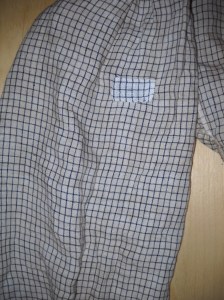
This was followed by, “Mom, you need to mend my shirt.” But first, I needed to wash that shirt.

file_004

I’d like to wash that shirt right out of my hair, but there it is: it’s got to be attended to.

I did what mending I could before I washed it, since some areas seemed more likely to disintegrate further in the wash.

file_003
file_001

That’s clean linen verus dirty linen, the 18th century wrestling match. Patch secured, I very nearly packed this into a priority mailing container for delivery to the esteeméd Red Shoes Laundry, but I took a deep breath, and put the lobster pot back in the cupboard. (Yes, I considered boiling this on my stove top on a 95° day. Wouldn’t you?)

Instead, I trekked down to the cool of the basement and ran the water as hot as it gets and added Oxiclean (used by some of the finest weavers I know when they encounter dyes less fast than anticipated.)

file_005
file_006

The first tub achieved a kind of colloidal slurry of mud and sweat and soap. Delicious. Five rinses and an overnight soak later, dirty shirt became just a shirt again.

file_008

I took advantage of the clear weather to dry this outside on the grass, hoping the later sunlight would aid in whitening.

Wondering about that patch? Wonder no more, compare:

file_004
file_009

It’s another one of those “is it done? it’s perfect” situations. I’d love to wash my clothes with historically correct methods, but for now, the shirt’s clean enough for final mends and wearing in October. The winter should give me time to figure out stove top washing.

Share this:

  • Share on Facebook (Opens in new window) Facebook
  • Share on Pinterest (Opens in new window) Pinterest
  • Email a link to a friend (Opens in new window) Email
  • Share on X (Opens in new window) X
Like Loading...

Stay Thy Hand

02 Monday May 2016

Posted by kittycalash in Clothing, Fail, Making Things

≈ 7 Comments

Tags

18th century, 18th century clothes, 19th century, 19th century clothing, Costume, dress, fail, sewing, stays

IMG_6784

Stays. They’re infrastructure: absolutely necessary, a major time commitment, and decidedly unsexy. I am in dire need to two new pairs, one for late 18th century use and one for early 19th century, and each with deadlines looming.

I can manage 19th century attire and Genesee with the chopped-and-dropped corded stays I already have, but New Jersey will not happen at all unless new stays are made. It was like a weekend of penance chez Calash, two straight days of stay mocking up and making.

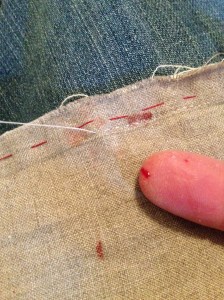
Of course I bled on them. That’s how I know they’re mine.

IMG_6786

And let’s get this out of the way: I thought backstitching the back seam was a little more difficult on this side, but ascribed it to sore fingers. Wrong! I failed to notice that I was stitching through all the layers, and not leaving one free to fold over and finish.

IMG_0806

A glass of cider and an hour later, I’d rectified the error. These are now fully bound along the bottom edge, and ready for the top edge binding. Somewhere there’s coutil for the straps, and then numerous hand-sewn eyelets later, I will have a finished pair of hand-sewn stays.

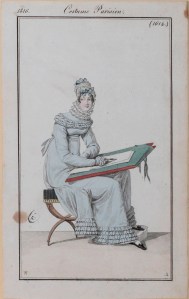
New stays deserve a new gown, and since I found this lovely image, I know what that new gown should look like (as well as a portfolio).  Happily, there’s a dress in Cassidy’s book that will serve as a reasonable basis for recreating this image. I’m still pondering the portfolio, and what it might be made of: paper or leather covered pasteboard? As the clock ticks down to June, I suspect I will be using a portfolio I already have on hand.

And then there are the the 18th century stays, with their history of woe.

File_000

I’ve gotten this far with the new 18th century pair, and an interesting business it is. I altered the front side pieces and the stomacher, but cannot see the back well enough (even with a camera and a mirror) to adjust it by myself, so further changes will have to wait until I have some assistance.

The tabs aren’t right in the back, and while the advice is to shorten the stays when the tabs flare this way, I found the fronts were still too low, once again riding at nipple-cutting height. Finally it occurred to me that the problem– slippage–might actually be one of waist. I lengthened the fronts half an inch and nipped the waist in, and found the fit more pleasing.  I suspect the back pieces need to be trimmed a bit before they’ll fit (they’re stitched closed in this version, so you know they’re too big).

Another weekend of work awaits– with focus, those early 19th century stays may be done by then, if there are no more finger injuries.

Share this:

  • Share on Facebook (Opens in new window) Facebook
  • Share on Pinterest (Opens in new window) Pinterest
  • Email a link to a friend (Opens in new window) Email
  • Share on X (Opens in new window) X
Like Loading...
← Older posts
Newer posts →

Archives

wordpress statistics

Creative Commons License
Kitty Calash blog by Kirsten Hammerstrom is licensed under a Creative Commons Attribution-NonCommercial-ShareAlike 4.0 International License.

Website Built with WordPress.com.

  • Subscribe Subscribed
    • Kitty Calash
    • Join 621 other subscribers
    • Already have a WordPress.com account? Log in now.
    • Kitty Calash
    • Subscribe Subscribed
    • Sign up
    • Log in
    • Report this content
    • View site in Reader
    • Manage subscriptions
    • Collapse this bar
 

Loading Comments...
 

    %d