• Home
  • Completed Costumes/Impressions
  • Emma and Her Dresses
  • Free Patterns and Instructions

Kitty Calash

~ Confessions of a Known Bonnet-Wearer

Kitty Calash

Tag Archives: 18th century

Undocumented but Not Alien

07 Sunday Feb 2016

Posted by kittycalash in Events, Living History, personal, Philosophy, Reenacting, Research

≈ 1 Comment

Tags

18th century, authenticity, common people, Events, interpretation, living history, Reenacting, Research

Cherries. The Itinerant Traders of London in their Ordinary Costume, from Modern London; being the history and present state of the British Metropolis. Illustrated with numerous copper plates - British Library

Cherries. The Itinerant Traders of London in their Ordinary Costume, from Modern London; being the history and present state of the British Metropolis. Illustrated with numerous copper plates – British Library

Sometimes it’s hard to know how a riot gets started; other times, the cause is pretty clear. I’ve started one or two myself. The latest stems from Our Girl History’s musings on the Massacre.

There’s a lot to unpack, and it’s been happening online and in private conversations. Yes, children, Aunt Kitty pays attention, even if she’s silent. This is a tough topic: how can modern feminists represent historical women in a patriarchal culture without losing their minds? How can events better reflect the actual past? The population has, historically, always been about 50-50 male-female. We understand why there aren’t women on battlefields. We get that traditional events (by which I mean the ritualized commemorations of battles) have ridiculously gender-segregated and inauthentic roles. We get that it’s hard to adapt to new ideas, even free, documented ones.

The irritation and anxiety I feel as I expand the kinds of events I attend is actually reassuring: that’s how I know I’m learning. The frustration we feel means we’re banging up against a wall that we can break down with research.

Paul Sandby, London Cries: Black Heart cherries... ca. 1759. YCBA, B1975.3.206

Paul Sandby, London Cries: Black Heart cherries… ca. 1759. YCBA, B1975.3.206

It’s not easy research: women not married to or otherwise affiliated with prominent men are poorly documented. We may never know their names– or we may have a name from a census, newspaper ad, or city directory, and nothing more. But we can fill in the gaps with interpretation. (As it happens, I’ll be talking about this very idea in just a few weeks. Come taunt me in person.)

There’s a lot to think about in recreating the past, in particular at this event. The organizers have done a phenomenal amount of research, gathered the details, sorted them out, assigned roles, scripted and timed an event, and recruited a chorus of characters that reflects the texture of a tense city in 1770.

Building an event, even one that recreates an actual moment in the past, is as much as work of theatre or fiction as it is of fact: character development, motivations, costuming, setting, all of those combine with the documented words to create a scene that conveys an interpretive point for the public. It’s similar to a museum exhibition– it’s interpreted.

Traditionally, living history has interpreted the past with a bias to men’s roles (that’s the nature of our society, folks) and with a tendency to assign roles and activities by gender (again, the nature of our society for centuries). Our task in breaking that pattern is not to right the injustices of the past, for we cannot, but to interpret them.

Playing the game at quadrille : from an original painting in Vauxhall Gardens. London : Robert Sayer, ca. 1750. Lewis Walpole Library, 750.00.00.14

What about the people in the background? Playing the game at quadrille : from an original painting in Vauxhall Gardens. London : Robert Sayer, ca. 1750. Lewis Walpole Library, 750.00.00.14

One way to do that is to bring the undocumented, or poorly documented, people of the past to light. I tried to do that in exploring Bridget Connor. I’ve tried to do that by interpreting a late 18th/early 19th century servant. It’s a long and frustrating process, reading letters and diaries for scraps of information, usually casual references to servants and cooks.  But in the frustration lies the promise: we will find the people on the margins, and bring them in to clearer focus.
Share this:

  • Share on Facebook (Opens in new window) Facebook
  • Share on Pinterest (Opens in new window) Pinterest
  • Email a link to a friend (Opens in new window) Email
  • Share on X (Opens in new window) X
Like Loading...

Frivolous Friday: Flip your Lid

05 Friday Feb 2016

Posted by kittycalash in Clothing, Frivolous Friday, History, Research

≈ 4 Comments

Tags

18th century, 18th century clothing, authenticity, bonnets, Events, fashion, hats, Research, style, women

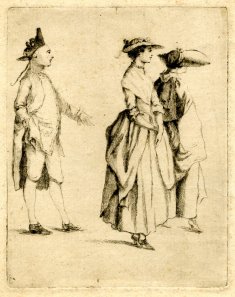
Print. Drypoint by John Theodore Heins, Jr. 1747-1771. British Museum 1858,0417.362

Drypoint by John Theodore Heins, Jr. British Museum 1858,0417.362

Bonnets. Who doesn’t like them? They’re the cupcake of costuming, just enough sugar to be delicious, not enough trouble to count. I know I have far too many, they fall from the hall shelf nearly every time I get my coat.

But I started asking myself questions about bonnets when a friend asked me questions about bonnets: shape, color, and how they’re worn (rakish angle? pulled down low?).

We’re planning on going to an event in March, and I’ve been thinking about head wear, especially bonnets. Now that the question’s been asked, I don’t want to randomly cram black silk taffeta on my head and call it a day: I’m back to “don’t know mind.” Time to start looking. So far, I’ve searched the Tate, the British Museum, the National Portrait Gallery UK, the Lewis Walpole Library, the Yale Center for British Art, the Met,  the V&A, and the BBC’s Your Paintings site.

I started at the British Museum. Here are the results for a collections search using the term bonnet and the production dates 1765-1772.  Hmm. No classic black bonnet. Dammit, actually, because I really like mine.

Print made by James Caldwall, A Ladies Maid Purchasing a Leek, 1772, Line engraving and etching Yale Center for British Art, Paul Mellon Collection. B1977.14.11105

James Caldwall, A Ladies Maid Purchasing a Leek, 1772, YCBA, B1977.14.11105

Yale Center for British Art, same search parameters. I know you know this print.

Man, this is a pain, right? Where are the bonnets? 1772 is actually too late for my purposes in this instance.

The Lewis Walpole Library Digital Collections lack a feature for limiting or sorting by date, but they tag bonnets in their prints. Still: no big black bonnets in early prints.

I’m starting to think it’s lampshade or saucer for the 1765-1770 period. You remember lampshade, don’t you? One of my post-operative slightly narcotized creations based in part on the Marquis of Granby (Relieving a Sick Soldier).

The Marquis of Granby (Relieving A Sick Soldier) Oil on canvas by Edward Penny after 1765 (c) Royal Academy of Arts

The Marquis of Granby (Relieving A Sick Soldier) Oil on canvas by Edward Penny after 1765 (c) Royal Academy of Arts

Lampshade seems pretty fashionable in 1760. There are more portraits at the National Portrait Gallery (UK), but bonnets are scarce in them, primarily, I suppose, because they are not indoor wear.

Anne (née Day), Lady Fenoulhet by Richard Purcell (Charles or Philip Corbutt), after Sir Joshua Reynolds, mezzotint, (1760) National Portrait Gallery UK D1939
Nelly O'Brien by Samuel Okey, after Sir Joshua Reynolds, mezzotint, circa 1765-1780 (circa 1762-1764) National Portrait Gallery UK D19911
Nelly O’Brien by Samuel Okey, after Sir Joshua Reynolds, mezzotint, circa 1765-1780 (circa 1762-1764) National Portrait Gallery UK D19911

Lady Fenoulhet is wearing a lampshade. Nelly O’Brien is wearing an interesting, more hat-like device. Her imprint is ca. 1765-1780, but other impressions are dated ca. 1760. The 1762-1764 seems plausible. But that’s still early for my purposes. The lampshade really is, too; Mrs Mary Smith of Portsmouth may be wearing one, but considering that the artist who drew this plate died in 1766, I think we can place this form in the 1750s to early 1760s. Lampshade is too early. The”Lady’s Maid buying a Leek” is too late.

Next, please.

Share this:

  • Share on Facebook (Opens in new window) Facebook
  • Share on Pinterest (Opens in new window) Pinterest
  • Email a link to a friend (Opens in new window) Email
  • Share on X (Opens in new window) X
Like Loading...

Hot Topic

03 Wednesday Feb 2016

Posted by kittycalash in Art Rant, Clothing, History, Living History, Research

≈ 6 Comments

Tags

18th century, 18th century clothes, 18th century clothing, dress, engravings, fashion, gowns, Research, style, women

I’m of an age (none of your beeswax, thanks for asking) where most of the clothes in the shops are simply not for me. Not only am I picky about labor standards, fabric and construction quality, the styles aren’t for me. I’m too old. I create enough havoc walking (falling) down the street as it is that I do not need to look like the mid-life crisis I’m having involves a desperate search to recapture my youth through H & M or Hot Topic or whatever-the-kids-are-wearing clothing. I’ve achieved “a certain age,” and as with my everyday closet, my living history wardrobe has to reflect my age as well. Pity, really.

Following the Fashion. Hand colored etching by James Gillray, published by Hannah Humphrey, 1794. British Museum 1851,0901.706

Following the Fashion. Hand colored etching by James Gillray, published by Hannah Humphrey, 1794. British Museum 1851,0901.706

But more’s the pity here: I don’t have a clear idea, really, how age was perceived in the various decades I interpret. I have a clearer idea of how different body shapes and class levels were perceived and taunted, though sometimes body shape is an analogue for age.

Is this my daughter Ann? Pen and ink print study by Samuel Hieronymus Grimm, 1774. British Museum 2011,7084.56

Is this my daughter Ann? Pen and ink print study by Samuel Hieronymus Grimm, 1774. British Museum 2011,7084.56

There’s a classic image that juxtaposes age and youth.  Here’s how the British Museum describes this image:

‘Is this my Daughter Ann?’; satire on fashion. A street where, before a house [on the right], over the door of which the name ‘Love Joy’ is written, a sedan chair has been brought, in order to carry away a young lady, who, in a towering toupée, and other articles of fashionable attire of this period, is leaving the house in company with a young soldier, who caresses her as they go; she looks fondly at him. An old woman, in what was then an ‘old-fashioned’ costume is interposing to prevent the departure of the damsel. 1774

Okay… “An old woman, in what was then an ‘old-fashioned’ costume.” You will note that the old woman is wearing what we typically wear here in New England to represent everyday clothing for middling and lower sort American colonists for most of the 1770s. I don’t want to put too much stock in the cataloger’s description, because I’m not sure that print curators or curatorial assistants always know as much about material culture as they think they do. And we know that six weeks is not six years when it comes to transmitting fashion changes and updates across an ocean. I think “old fashioned” might not be exactly or entirely right as a descriptive phrase.

What does the old woman’s clothing really signify? That she’s rural and not urban? That’s she’s poor? That she’s old? How ‘old fashioned’ is that costume by 1774… in a context other than London courtesan couture? And how do we translate the clues we have trouble deciphering into a dress code for living history?

Is this my Daughter Ann, mezzotint by James Watson after S. H. Grimm, published by Sarah Sledge, 1774. British Museum J,5.104

Is this my Daughter Ann, mezzotint by James Watson after S. H. Grimm, published by Sarah Sledge, 1774. British Museum J,5.104

Well, happily, there’s a verse under the image in this print.

Is this my Daughter Ann

The Matron thus Surprised exclaims,
And the deluded Fair One Blames
But had the Mother been as Charming

She had Thought the Mutual sport no harm.
This Moral’s an undoubted Truth
Age envies Still the Joys of Youth

So this print is not about fashion. It’s about sex. (Well, duh. You were wondering when I’d bring that up.) It’s also, in a way, about hypocrisy, isn’t it? But the verse gives us the clue that the mother’s clothes are meant to be matronly.  “Conservative because of her age” might be a better descriptive phrase than “old fashioned” in that catalog record.

But does that mean that those of us who have achieved “a certain age” might also consider whether we, too, should be dressing in a more “conservative because of her age” style? I don’t really know.

But look here: Zoffany, ca. 1762.

David Garrick and Mary Bradshaw in David Garrick's "The Farmer's Return". Johann Zoffany, ca.1762. YCBA B1981.25.731

David Garrick and Mary Bradshaw in David Garrick’s “The Farmer’s Return”. Johann Zoffany, ca.1762. YCBA B1981.25.731

Here we’re looking at a rural woman ten to twelve years before “My daughter Ann.” The costumes are very similar; maybe the mother in Ann really is just old fashioned.

Here’s another version of “My daughter Ann,” this time more clearly fashion focused, without the sexual overtones.

Print made by Francis E. Adams, active ca.1760–1775, British, Heyday! Is This My Daughter Anne!, 1773, Mezzotint and etching on medium, moderately textured, cream laid paper, YCBA, B1970.3.820

Print made by Francis E. Adams, active ca.1760–1775, British, Heyday! Is This My Daughter Anne!, 1773, Mezzotint and etching on medium, moderately textured, cream laid paper, YCBA, B1970.3.820

Yale helpfully provides a transcription of the verse at the bottom:

HEYDAY! Is this my DAUGHTER ANNE! | Heyday! the country Matron in surprize, | Is this my Daughter thus bedizell’d? cries. | To Town she lately went a Damsel plain: | But scarcely now is to be known again. | That City to its Vanities has brought her, | And banish’d the good Housewifery I taught her. | Why, Child you’ll frighten here our honest People: | They’ll say you’ve on your Head a London Steeple.

My best guess is that this print is skewering both Anne and her mother: Anne, for being so outlandishly fashion-forward, and her mother, for being so far behind. But again, that’s only a guess.

Share this:

  • Share on Facebook (Opens in new window) Facebook
  • Share on Pinterest (Opens in new window) Pinterest
  • Email a link to a friend (Opens in new window) Email
  • Share on X (Opens in new window) X
Like Loading...

Small Obsessions

09 Saturday Jan 2016

Posted by kittycalash in Uncategorized

≈ 6 Comments

Tags

18th century, 19th century clothing, art, art history, interpretation, living history, miniatures, paint boxes, paintings, Rhode Island, Rhode Island history, women's work

IMG_5625Some of you may recall that I am a recovering artist with a fairly constant need to keep my hands busy. To encourage industry and the domestic arts, and to keep me out of trouble generally, a thoughtful friend provided me with a start to furnishing an early nineteenth century-style paint box. They’re hard to come by, these paint boxes, and extant examples fetch far more than we can afford chez Calash, being in somewhat reduced circumstances of late.

Thomas Reeves & Son Artists watercolor paint box c. 1784 to 1794. Whimsie Virtual Museum of Watercolor Materials

Thomas Reeves & Son
Artists watercolor paint box c. 1784 to 1794. Whimsie Virtual Museum of Watercolor Materials

Researching paint boxes and miniature painting in the early Federal era has been a happy fall down a deep rabbit hole. It’s clear that Reeves watercolors were being sold in Providence in the early 19th century; Peter Grinnell & Sons include “Reeves watercolor boxes” among the extensive list of items for sale in an 1809 newspaper ad. Frames and cases were also to be had; John Jenckes, gold and silver-smith and jeweler, advertised gold miniature cases in 1800.

Distraction is always easy to come by, tunnels leading from main entrance to the warren. Painting manuals, scholarly articles, and extant examples, which prove most distracting of all. SO shiny.

George Catlin Artist: John Wood Dodge (1807–1893) Date: 1835 Medium: Watercolor on ivory Dimensions: 2 3/16 x 1 13/16 in. (5.6 x 4.6 cm) Classification: Paintings Credit Line: Rogers Fund, 1926 Accession Number: 26.47

George Catlin byJohn Wood Dodge, 1835, MMA 26.47

Searching the Met’s collection, I found a portrait of George Catlin, remarkably similar in pose to an image of a friend I considered copying, but had thought too modern. My assumption has been proved wrong, and I am delighted. And then I found the HIDEOUS checked neck wear, always distracting. Historic New England provided super-tiny-bowtie man, and then I really had to focus, since I’m only enabling, not making, neck wear.

My real focus, of course, is on female miniaturists, especially in Rhode Island (gallery of RI miniatures can be found here.) From the scant number of women I’ve found advertising in the local papers, (okay, two: Miss Mary R. Smith, in 1820, and Mrs Partridge in 1829) I’ll have to expand my search geographically. Nantucket Historical Association had an image attributed to Anna Swain, and ten attributed to Sally Gardner.

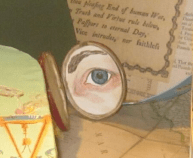
Eye

The Met, repository of so many wonders, has works by six women miniaturists, including Sarah “Wowza” Goodridge and Anna Claypoole Peale. For all we know, some of the works by unidentified makers might be the work of female painters. The extant miniatures in all collections, range in quality from excellent to amateur, giving hope to those of us unpracticed in portraiture, and regaining our hand.

Share this:

  • Share on Facebook (Opens in new window) Facebook
  • Share on Pinterest (Opens in new window) Pinterest
  • Email a link to a friend (Opens in new window) Email
  • Share on X (Opens in new window) X
Like Loading...

High Style/Low Brow

08 Friday Jan 2016

Posted by kittycalash in Collecting, History, Research

≈ 3 Comments

Tags

18th century, american art history, art history, auctions, Clothing, Costume, history, interpretation, paintings, Robert Feke, Sotheby's

It’s auction season again, the best one of all: the major Americana sales and the Winter Antiques Show in New York. I won’t be at any of the exhibitions or sales, which is just as well for me; my friends know the twitchy “must-touch” finger motion that means I need to leave my wallet and checkbook in wiser, saner hands.

Still, even if we can’t buy, we can learn. This time around, I was delighted by the juxtaposition of two pre-1750 paintings in the Sotheby’s sales.

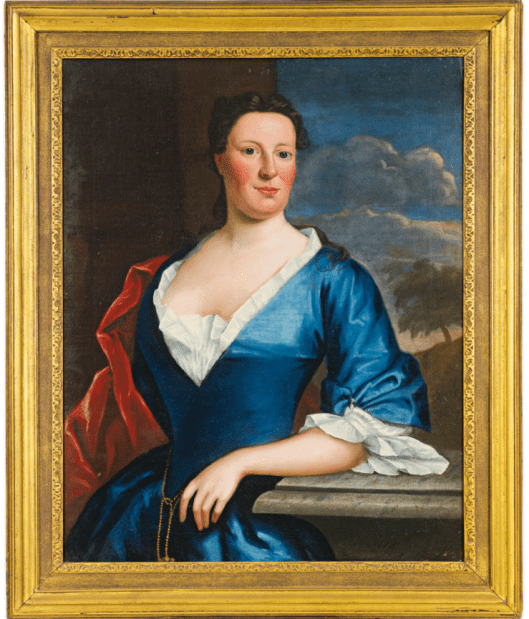
First, the ever-delightful Robert Feke’s portrait of Mrs Tench Francis.

Robert Feke (1707 - 1752) PORTRAIT OF MRS. TENCH FRANCIS In what appears to be the original frame; Bears a label on the back of the frame: Mr. Willing, Bryn Mawr. Painted circa 1746. Label on the back of the stretcher: Philadelphia Museum of Art, Robert Feke, Portrait of Mrs. Tench Francis, 11-1969-2. Lender: Mr. E. Shippen Willing, Jr. Oil on canvas 36 by 28 1/2 in. Sotheby's Sale N09456 Lot 1595

Robert Feke (1707 – 1752)
PORTRAIT OF MRS. TENCH FRANCIS
In what appears to be the original frame; Bears a label on the back of the frame: Mr. Willing, Bryn Mawr.
Painted circa 1746.
Label on the back of the stretcher: Philadelphia Museum of Art, Robert Feke, Portrait of Mrs. Tench Francis, 11-1969-2. Lender: Mr. E. Shippen Willing, Jr.
Oil on canvas
36 by 28 1/2 in.
Sotheby’s Sale N09456 Lot 1595

Francis. Shippen. Willing. This thing is DEEP in the history of Philadelphia, and by my fave 18th century RI painter.

But does she Remind you of anyone? Like a Smibert, maybe? Or perhaps it’s a Copley?

Mrs Samuel Browne by Smibert, RIHS 1891.2.2
Mrs Joseph Mann by Copley, MFA Boston, 43.1353

It was a THING, that blue silk gown business with a red silk wrapper. Better yet? This one:

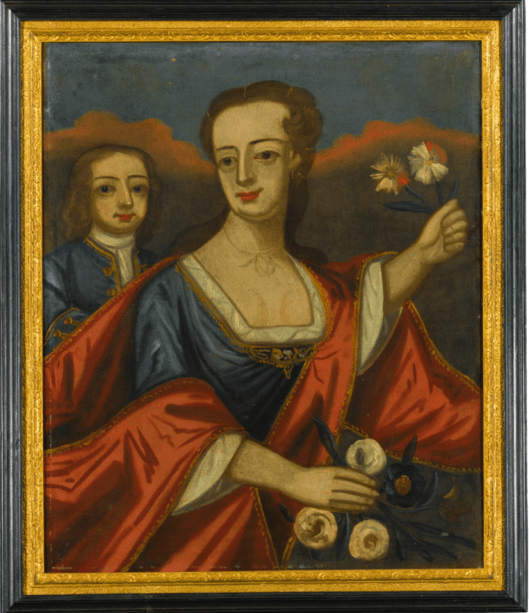
Attributed to J. Cooper 1685 - 1754 WOMAN WITH YOUNG BOY Appears to retains its original frame attributed to J. Cooper. oil on canvas 30 in. by 25 in. CIRCA 1715. Sotheby's Sale N09466, Lot 398

Attributed to J. Cooper 1685 – 1754
WOMAN WITH YOUNG BOY
Appears to retains its original frame attributed to J. Cooper.
oil on canvas
30 in. by 25 in.
CIRCA 1715. Sotheby’s Sale N09466, Lot 398

What I love about the J. Cooper is how crude it is: that painting looks more like a woolwork picture than a painting. But that vernacular adaptation tells us how prevalent this portrait style was, and how desirable.

Share this:

  • Share on Facebook (Opens in new window) Facebook
  • Share on Pinterest (Opens in new window) Pinterest
  • Email a link to a friend (Opens in new window) Email
  • Share on X (Opens in new window) X
Like Loading...
← Older posts
Newer posts →

Archives

wordpress statistics

Creative Commons License
Kitty Calash blog by Kirsten Hammerstrom is licensed under a Creative Commons Attribution-NonCommercial-ShareAlike 4.0 International License.

Website Built with WordPress.com.

  • Subscribe Subscribed
    • Kitty Calash
    • Join 621 other subscribers
    • Already have a WordPress.com account? Log in now.
    • Kitty Calash
    • Subscribe Subscribed
    • Sign up
    • Log in
    • Report this content
    • View site in Reader
    • Manage subscriptions
    • Collapse this bar
 

Loading Comments...
 

    %d