• Home
  • Completed Costumes/Impressions
  • Emma and Her Dresses
  • Free Patterns and Instructions

Kitty Calash

~ Confessions of a Known Bonnet-Wearer

Kitty Calash

Tag Archives: authenticity

Weekend Update

24 Monday Jun 2013

Posted by kittycalash in 1763 Project

≈ 1 Comment

Tags

10th Massachusetts, 18th century, 18th century clothes, authenticity, common dress, Events, living history, Reenacting, Thomas Marshall's Boston Militia

Not the best weekend, but not the worst. Let’s start with the best parts, and perhaps the worst will be forgotten.

Drilling, 1758 style, at MMNHP

We went up to Minute Man on Saturday for the first of two rounds of early-period drilling for the 1763 event which will feature Marshall’s company of militia. One highway closing and a lack of period clothing later, we arrived. There was crossness, mostly occasioned by the closing of 95 northbound at Pawtucket, as we do not like to be late.

This early drill is pretty interesting, especially compared to von Steuben’s manual, developed nearly 20 years later. The early manual is almost baroque, and seems full of superfluous movements, described with superfluous words. In some ways, it reminds me of Morris Lapidus: Too much is never enough.

I sat under a tree and watched while re-pinning and re-basting Mr S’s bloody overalls, which must be done one week from Thursday, ready to be put on for a 7:30 AM departure for a parade on the North Shore, with a step off at 9:30. DC appeared, watched me sew, watched the drilling, got anxious as he always does, but was favored with the present of a rope work dice cup from one of the older members of the regiment. It’s a small kind of acceptance ceremony he performs.

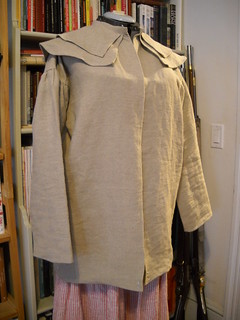
Mariner’s cuff, adapted from a Costume Close Up coat.

After struggling with the utilitarian overalls, I felt the need for a more artistic pursuit. The horrid green frock coat seemed less horrid after staring at what was on display, so I brought it ought and made Mr S try it on all over again. It will still need altering to fit properly, but I think I can manage that better than I can making it into a waistcoat and making a new, proper frock coat. (Though I have some lovely wool, and a plan to have him turn out in that for next year’s Battle Road.)

With stripey-lined flap.

I found more green linen scraps in my stash, and then it dawned on me: If you haven’t got width, go vertical. With Koshka’s tutorial onscreen and Costume Close Up, I fiddled around with the scraps on Sunday morning, and came up with a mariner’s cuff adaptation. At this point, I figure this is a test garment, and whatever mistakes I make will turn out better on a broadcloth coat, and all buttons are recyclable. It’s a bit of a lie, this coat, since it’s got to be 1775 in July and 1763 in August. For a one-off event, it’s madness to make a totally correct outfit when I haven’t got exactly what is wanted for July. That short wool coat will be murder in August– so wonky cuffs and alterations it is.

The Young Mr might get a blue linen unlined short jacket: I have proven I can make those, there’s one in a Sandby drawing from 1759, and though I dearly want to make him a short, laborer’s coat in brown camblet with a red lining, I haven’t got a suitable pattern yet. With a 34 inch chest, he’s a tough one to fit.

Share this:

  • Share on Facebook (Opens in new window) Facebook
  • Share on Pinterest (Opens in new window) Pinterest
  • Email a link to a friend (Opens in new window) Email
  • Share on X (Opens in new window) X
Like Loading...

HSF # 11: Squares, Rectangles and Triangles

05 Wednesday Jun 2013

Posted by kittycalash in Clothing, Historical Sew Fortnightly, Reenacting

≈ 1 Comment

Tags

10th Massachusetts, authenticity, Brigade of the American Revolution, fringe, Historical Sew Fortnightly, hunting frock, hunting shirt, Research, Revolutionary War

Hunting frock from the side. Just two sizes of one curve

I drifted away from the HSF. While, at some point, I had plans for HSF #11: Squares, Rectangles and Triangles, and they were even written down somewhere, something like table clearing and recycling happened…but, hey wait a minute, if you will allow me one curve done twice, I give you the Hunting Frock! (also, the checked bag).

Since there was a search for “best rifle frock for rev war reenacting,” I think this probably bears going into.

Presented, for your consideration, The Facts.

The Challenge:  HSF #11: Squares, Rectangles and Triangles

Without fringes or hem

Fabric: 100% “Osnaburg” linen, acquired from Henry M. Cooke IV of Historical Costume Services. I think he orders from the Ulster Linen Co. We are talking bolts here, people.

Pattern: Cut by Mr. Cooke, who used a yardstick, chalk, and an extant shirt (for the cape curve). I have watched him cut two now, and it’s pretty cool.

Year: 1778-1781 <choke> I forgot to ask.

Notions: Does thread count? That’s all this takes.

resolver

How historically accurate is it? Based on Mr. Cooke’s research into the hunting shirts worn by Massachusetts troops, and revised to reflect recent research by Neal Hurst, this frock pattern reflects the most current, accurate representation of the hunting frocks (sometimes called shirts) worn by Continental troops during the American Revolutionary War. The garment is entirely hand-sewn using, as much as possible, the correct (thankfully basic) stitches. Flat-felled seams, all that good stuff. Any place it is incorrect is purely my own genius.

Triangles and trapezoids!

Hours to complete: Remember those soul-crushing hours? Yes, these were among them. Actually, no, it’s not too bad. Perhaps twenty-four? You can power down on one of these, but even once you have the initial fringing done and the fringes attached, you will have more thread-pulling ahead of you.

First worn: Monday, May 27, 2013, for the Memorial Day Parade in Warren, Rhode Island.

Total cost: $45, for the linen and the cutting. Your mileage may vary, as the Young Mr and Mr S are in the regiment for which Mr. Cooke is the adjutant.

Hunting Shirt/Frock Schematic

Hunting Shirt/Frock Schematic, no scale whatsoever

To the person looking for the “best rifle frock for rev war reenacting,” I have to say, it depends. If you are with a Rhode Island regiment, for example, the linen you choose could be brighter, to reflect the fact that the state called for “whitened towcloth” for hunting frocks for Rhode Island troops. I have found some I think might be likely at Burnley and Trowbridge, but I have not checked it with the RI captain. You need to know if your regiment or group favors hunting shirts (pull over) or hunting frocks (open down the front), and then you need to figure out what kind of linen they were wearing in the period.

But, like a shirt of the period, these garments are very simple: triangles for the gussets (or squares), rectangles, and just the curved cape. The pattern (schematic) at right is adapted from what I have seen Mr. Cooke cut, which is quite similar to the Brigade of the American Revolution pattern I had for the Rhode Island frock I made (also entirely by hand). Since these were so close to shirts, they would have been very easy to construct, and since they’re large, measurements could be generalized. The BAR pattern does not use the under-arm gussets, and the sleeves are not tapered; there is more fringe on the standard Rhode Island frock than on the Massachusetts frock, but there seem to have been variations at the time.

You may also wish to consider whether or not there is a difference between hunting frocks and rifle frocks (I do not know, please don’t ask, I wasn’t told this would be on the test).

For more, here is Neal Hurst, on Fringe on the American Hunting Frock. You can read it before or after you pull threads out of those two inch strips until only 6 to 8 remain in the center. Happy fringing! 

Share this:

  • Share on Facebook (Opens in new window) Facebook
  • Share on Pinterest (Opens in new window) Pinterest
  • Email a link to a friend (Opens in new window) Email
  • Share on X (Opens in new window) X
Like Loading...

What’s behind that green suit?

04 Tuesday Jun 2013

Posted by kittycalash in 1763 Project, Clothing, Events, Reenacting, Research

≈ 5 Comments

Tags

1763, 18th century clothes, alterations, authenticity, Battle, Clothing, Events, fashion, frock coat, frock coats, menswear, planning, Reenacting, style

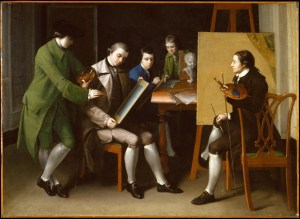
The American School, by Matthew Pratt, 1765. MMA 97.29.3

The American School, by Matthew Pratt, 1765. MMA 97.29.3

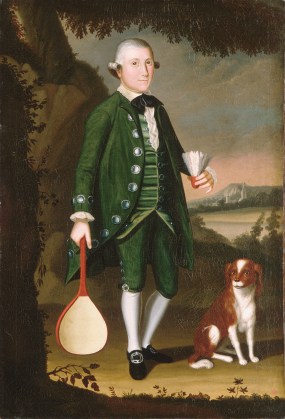
Mr S. has a green linen suit in the making; that is, he has breeches which mostly fit, and a frock coat in need of serious alteration. Since I will need to alter this coat eventually (that is, take it apart, re-cut and re-assemble it) I have started looking for images of green suits.

Portrait of a Boy, probably of the Crossfield family. William Williams, MMA 65.34

Portrait of a Boy, probably of the Crossfield family. William Williams, 1770-75, MMA 65.34

The green linen the suit was made from is no longer available, so there will be no matching waistcoat. If I can get the thing tweaked to an approximation of ca. 1763, we should be set for the August event (if that happens) and for Battle Road next year, though I know he might want wool. The taunts of “bet you wish you had the rest of that coat” from this year linger in my mind, at least.

The jacket is, admittedly, too short. I begin to wonder if I need to cut it down even more, like a workman’s short coat; the Massachusetts line “Bounty Coats” are cut shorter, and similar to a coat at the Connecticut Historical Society (1981.110.0, search by number here, the links are not stable).

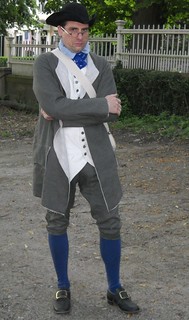
Mr S last June, in the unfinished 36-hour-frock coat

The problem with that plan, at least for 1763, is that the cuffs are clearly larger and coats longer, in 1763, than they are in 1775, at least for gentleman. I realize that this means I am better off starting over completely for the 1763 coat from a muslin up (which against all instinct and principles, I did not do for the 36-hour-frock coat). So I’m waffling here, as Mr S doesn’t always want to portray the day laborer/tenant farmer, but would like some pretensions to artisan and property owner. That means more fabric, and that means starting over completely is in order–breeches, waistcoat, frock coat and all. But wait, there’s more!

The events in the queue before the August 10th event for 1763 include Monmouth on June 15-16 (for which overalls and hunting frock are in production), Washington’s Arrival in Cambridge on July 14, which requires militia clothing, and Old Sturbridge Village the first weekend in August, for which a regimental coat is requested. Somewhere along the line, I’d like to make myself something…but it looks more and more like a summer of menswear. Perhaps cutting down that green coat and altering the breeches for July 14 is the most sensible plan…though where that will leave 1763, or the regimental coat, I do not know.

Share this:

  • Share on Facebook (Opens in new window) Facebook
  • Share on Pinterest (Opens in new window) Pinterest
  • Email a link to a friend (Opens in new window) Email
  • Share on X (Opens in new window) X
Like Loading...

The Business

16 Thursday May 2013

Posted by kittycalash in Art Rant, Literature, Museums

≈ 1 Comment

Tags

arts, auctions, authenticity, endowments, fine art, Museums, sales, Sotheby's

Sotheby's sale June 11 2013

Fine Books & Manuscripts, June 11, 2013

I’m in this business, so I shouldn’t be bothered. I have been a seller and a buyer, and I’m a card-carrying member of Team Hoarder, AKA the Curators. So why does this bother me?

This sale features a strong selection of modern authors highlighted by Property from the Descendants of William Faulkner, including the manuscript of his Nobel Prize speech with the gold Nobel medal and diploma (1950), autograph letters written to his mother from Paris in 1925, the typescript book of his poem sequence “Vision in Spring” in a handmade binding by the author, drawings, corrected typescripts and other items.

You’d think I’d know better by now: Life isn’t an Indiana Jones movie, and no amount of saying “It belongs in a museum!” will help matters along.

More and more I see the cultural economy–and the disposition of cultural goods–following the “winner takes all” pattern of the larger economy. I give you Walmart, and Walmart gives you the Crystal Bridges Museum of Art. The FAQ’s deny any tie to Walmart stores, but Alice Walton founded the museum. For a lot of people, that’s a connection to Walmart. The claim that there is no connection seems even more disingenuous when you visit the homepage and read “General admission to Crystal Bridges is sponsored by Walmart. There is no cost to view the Museum’s permanent collection, which is on view year-round.”

The people of Arkansas deserve a nice museum; everyone does–that’s not my point. My point is that private collectors can buy, and keep from public hands, important pieces of material cultural and cultural heritage. Faulkner’s work post-Nobel may have paled compared to earlier work, but he won the Nobel–score one for Southern Literature and the power of Faulkner’s words, the sway he held over American letters.

Also in what is shaping up to be a very wordy sale: “[O]ne of possibly as few as three intact 1924 recordings of Joyce reading Ulysses.” Joyce reading Ulysses. That’s pretty damn cool. Lucky for you and me, if we’re word fans, you can listen to another recording here, thanks to The Public Domain Review.

Would an online photo, or a magazine photo, of Faulkner’s medal ever be as good as the online version of Joyce’s reading? No,  I don’t think so.  Because there is a power in the authentic, in the real. And the medal is material, three-dimensional: sound waves over an internet speaker wouldn’t be as frisson-inducing as listening to a recording in a darkened library, but they’re still sound waves.

Authenticity will be the subject of an upcoming session at AAM’s Annual Meeting in Baltimore, and though I can’t be there, I’m following as best I can.

Authenticity is something reenactors strive for in their work. Museums present authentic– real– objects and experiences. I sit the gallery and one of the most common questions people ask is, “Is it real?” and when told, “Yes, it is,” they gasp a little.

So when museums and libraries are priced out of the auction or private sale market, what does that mean? It means less public access to authentic items, to the “real,” three-dimensional evidence of the past.

We’re choosy, of course: it could well be that the University of Virginia did not want these items. Perhaps they did not contribute materially to Faulkner scholarship–the medal wouldn’t, really, would it? But the additional papers and letters might, but would be hard to justify at $250,000-$350,000.

Private collectors, people who can afford a $286,000 watch, drive up prices. Museums that can attract major donors attract more major donors.

MET MFA RIHS NHS
2011 Income $470,048,040 $157,082,067 $3,440,281 $615,008

That’s a chart of the 2011 income for the Met, the MFA, the RIHS, and the Newport Historical Society. All four have decorative art, art, and textile collections. All four would be interested in pieces of Newport furniture. Two are art museums, two are historical societies. Only one has the financial power to bid for major pieces.

And then there’s Crystal Bridges: 2011 revenue? $625,995,749. Sorry Met, you were just outdone by $155,947,709. Over one hundred and fifty-five million dollars. Dr. Evil is beyond impressed. The Crystal Bridges Form 990 includes a donor list with $700,000 from Cisco Systems. Nicely done. With endowment return of just a little more than $16 million, and  $37 million for “museum procurement expenses,”  they need those donations to stay healthy financially. But that $37 million buys a lot of art.  And where does that leave smaller museums and collecting organizations?

Pretty much where Walmart left small businesses: highly specialized but small.

And what does that mean for Faulkner’s papers, or a Plunket Fleeson chair?

Chances are they’ll be in private hands, accumulating value.

Share this:

  • Share on Facebook (Opens in new window) Facebook
  • Share on Pinterest (Opens in new window) Pinterest
  • Email a link to a friend (Opens in new window) Email
  • Share on X (Opens in new window) X
Like Loading...

Details. All in the Details.

04 Saturday May 2013

Posted by kittycalash in Clothing, History, Living History, Making Things, Museums

≈ 4 Comments

Tags

18th century, authenticity, embroidery, muse, pockets, Research, Rhode Island, sewing project

Detail, pair of pockets. Gallery of Costume, Platt Hall, Manchester City Galleries. MCAG.1922.2150

This image is from the fantastic VADS site‘s  gallery of pockets. I need new pockets, or a pocket update and overhaul, so I went looking for inspiration.

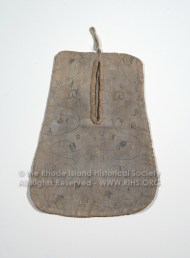
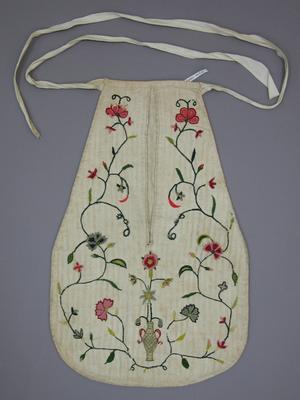
Child's Pocket, 1720-1760. RIHS 1985.1.9.

Child’s Pocket, 1720-1760. RIHS 1985.1.9.

This is a dangerous path to go down if you are as unskilled with a crewel needle as I am.

Sew18thCentury can do it– so, sew, lovely. Me…well, everything I knew about embroidery I learned as a child, and promptly forgot with puberty. So my skills remain appropriate for reproducing this, from a Rhode Island collection. The pocket is child-sized, at 14 inches, and the embroidery has a crabbed, angry look, as if the girl would much rather have been outside, chasing her dog or brother.  I can relate, at least to the dog part.

My copy, on the clearance-bin frame.

My copy, on the clearance-bin frame.

I  made a pattern of the embroidery, traced it onto linen, and started working on dredging up those long-forgotten skills. As a child, I had a sewing or embroidery book, but what I remember most about the projects I made was how far their finished form was from what I had envisioned.

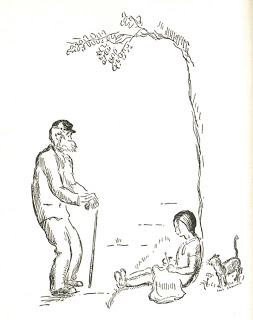
Jane, and the Oldest Inhabitant

Jane, and the Oldest Inhabitant

This is not an uncommon experience for children; my son has certainly experienced this, and even adults are subject to it. I think the best rendition of it, sewing-wise, is Eleanor Estes’ portrayal in The Middle Moffat of Jane Moffat attempting to make a “brocated bag” for Mama’s Christmas present.

The image of Jane sewing or crocheting under a tree while talking to Cranbury’s Oldest Inhabitant, a Civil War veteran, sums up every reenactment I’ve ever been part of… but I digress.

DSC_0283

A detail. Sigh. I know, practice, but…

My embroidery stitches lack a lot, but most of what they lack is practice–and that’s what makes reproducing that RIHS pocket a perfect project for me. Pockets were “sampler” projects, and suitable for girls to learn on. This combines plain sewing with embroidery, and ends up as something useful and authentic, so what more can I ask?

Pocket, single, embroidered. Snowshill Costume Collection, National Trust (UK). mid 1700s. SNO1452

Pocket, single, embroidered. Snowshill Costume Collection, National Trust (UK). mid 1700s. SNO1452

The VADS site has tons of images to inspire me, and with practice, someday I could manage something as beautiful as this. I need only make sure that it fits my time period and station–and for some events it will, but for most, the plain pocket or the crabbed-stitch embroidered pocket, are probably far more appropriate.

Share this:

  • Share on Facebook (Opens in new window) Facebook
  • Share on Pinterest (Opens in new window) Pinterest
  • Email a link to a friend (Opens in new window) Email
  • Share on X (Opens in new window) X
Like Loading...
← Older posts
Newer posts →

Archives

wordpress statistics

Creative Commons License
Kitty Calash blog by Kirsten Hammerstrom is licensed under a Creative Commons Attribution-NonCommercial-ShareAlike 4.0 International License.

Website Built with WordPress.com.

  • Subscribe Subscribed
    • Kitty Calash
    • Join 621 other subscribers
    • Already have a WordPress.com account? Log in now.
    • Kitty Calash
    • Subscribe Subscribed
    • Sign up
    • Log in
    • Report this content
    • View site in Reader
    • Manage subscriptions
    • Collapse this bar
 

Loading Comments...
 

    %d