• Home
  • Completed Costumes/Impressions
  • Emma and Her Dresses
  • Free Patterns and Instructions

Kitty Calash

~ Confessions of a Known Bonnet-Wearer

Kitty Calash

Tag Archives: dress

Criss Cross, or, My Checker’d Past

09 Monday May 2016

Posted by kittycalash in Clothing, Events, Living History, Making Things

≈ 1 Comment

Tags

19th century clothing, Clothing, Costume, dress, fashion, Federal style, Making Things, sewing

Every now and then I look up from what I’m doing (tiny stitches, usually, though sometimes budget math) and realize that Objects in Mirror are Closer Than They Appear. Oops. It was just yesterday I was daydreaming about miniatures, and now I shall want a paintbox and brushes in a mere six weeks– and those six weeks are punctuated by a courier trip, a couple of exhibits, not to mention shepherding The Young Giant through prom and finals.

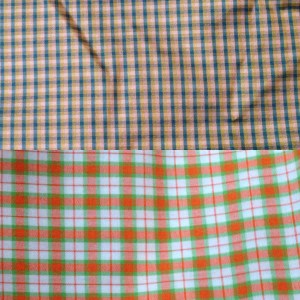
Top: check silk taffeta, Artee Fabrics Bottom: check cotton, Mood Fabrics

Top: check silk taffeta, Artee Fabrics
Bottom: check cotton, Mood Fabrics

This weekend, thanks to the SFR hunt for collar interfacing of an appropriate weight, I realized I’d better get a wiggle on my own sewing, and managed to hunt up the orange check from hell, pop it in the washer, and hunt up the pattern I intend to use.

Mrs Catherine Morey oil on canvas by Michael Keeling, 1817. (c) Walker Art Gallery; Supplied by The Public Catalogue Foundation

Mrs Catherine Morey oil on canvas by Michael Keeling, 1817. (c) Walker Art Gallery

I’m stuck on that 1817-1819 range because of someone’s eventual and particular Mode of Transportation, so I was super pleased to find this portrait while trolling the BBC’s Your Paintings site. Actually, I’m pretty over the moon about this image, since it places that cross-over front firmly in 1817. I’ve made a version of this form already, so I can but hope the next iteration will be even closer to correct for the period, once I tweak the pattern a bit.

The pattern: therein lie so many rubs, often going the wrong way. Still, I remain enamored of the check and of the cross-front gown. Any checkered doubts were dispelled when Alison for reminded me of the sort-of-cross front check gown at the Met, whose catalogers are hiding behind circa 1820 which allows leeway back to 1815. Behold, of course, the ruffled neck of the bodice (I do expect mine will fit a bit better since I am squishier than a mannequin, and possess appropriate infrastructure).

Morning dress ca. 1820. British, cotton.
Metropolitan Museum of Art, Purchase. 1979.385.1
Marcia Sand Bequest, in memory of her daughter, Tiger (Joan) Morse.

Speaking of infrastructure, the appropriate stays are finished, entirely hand-sewn, and ready for deployment in pattern fittings before they debut at Genesee.

File_000 (1)

Six weeks to Genesee: at least one 1817 dress, another sheet, a portfolio and paint box, followed immediately by 18th century stays, a front-closing gown, and a bucket repair. Surely that’s all manageable, right?

Share this:

  • Click to share on Facebook (Opens in new window) Facebook
  • Click to share on Pinterest (Opens in new window) Pinterest
  • Click to email a link to a friend (Opens in new window) Email
  • Click to share on X (Opens in new window) X
Like Loading...

Stay Thy Hand

02 Monday May 2016

Posted by kittycalash in Clothing, Fail, Making Things

≈ 7 Comments

Tags

18th century, 18th century clothes, 19th century, 19th century clothing, Costume, dress, fail, sewing, stays

IMG_6784

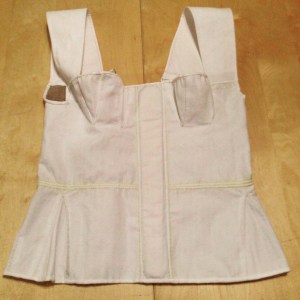
Stays. They’re infrastructure: absolutely necessary, a major time commitment, and decidedly unsexy. I am in dire need to two new pairs, one for late 18th century use and one for early 19th century, and each with deadlines looming.

I can manage 19th century attire and Genesee with the chopped-and-dropped corded stays I already have, but New Jersey will not happen at all unless new stays are made. It was like a weekend of penance chez Calash, two straight days of stay mocking up and making.

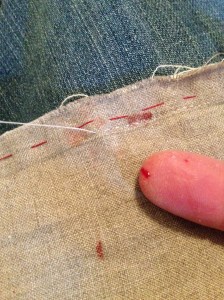
Of course I bled on them. That’s how I know they’re mine.

IMG_6786

And let’s get this out of the way: I thought backstitching the back seam was a little more difficult on this side, but ascribed it to sore fingers. Wrong! I failed to notice that I was stitching through all the layers, and not leaving one free to fold over and finish.

IMG_0806

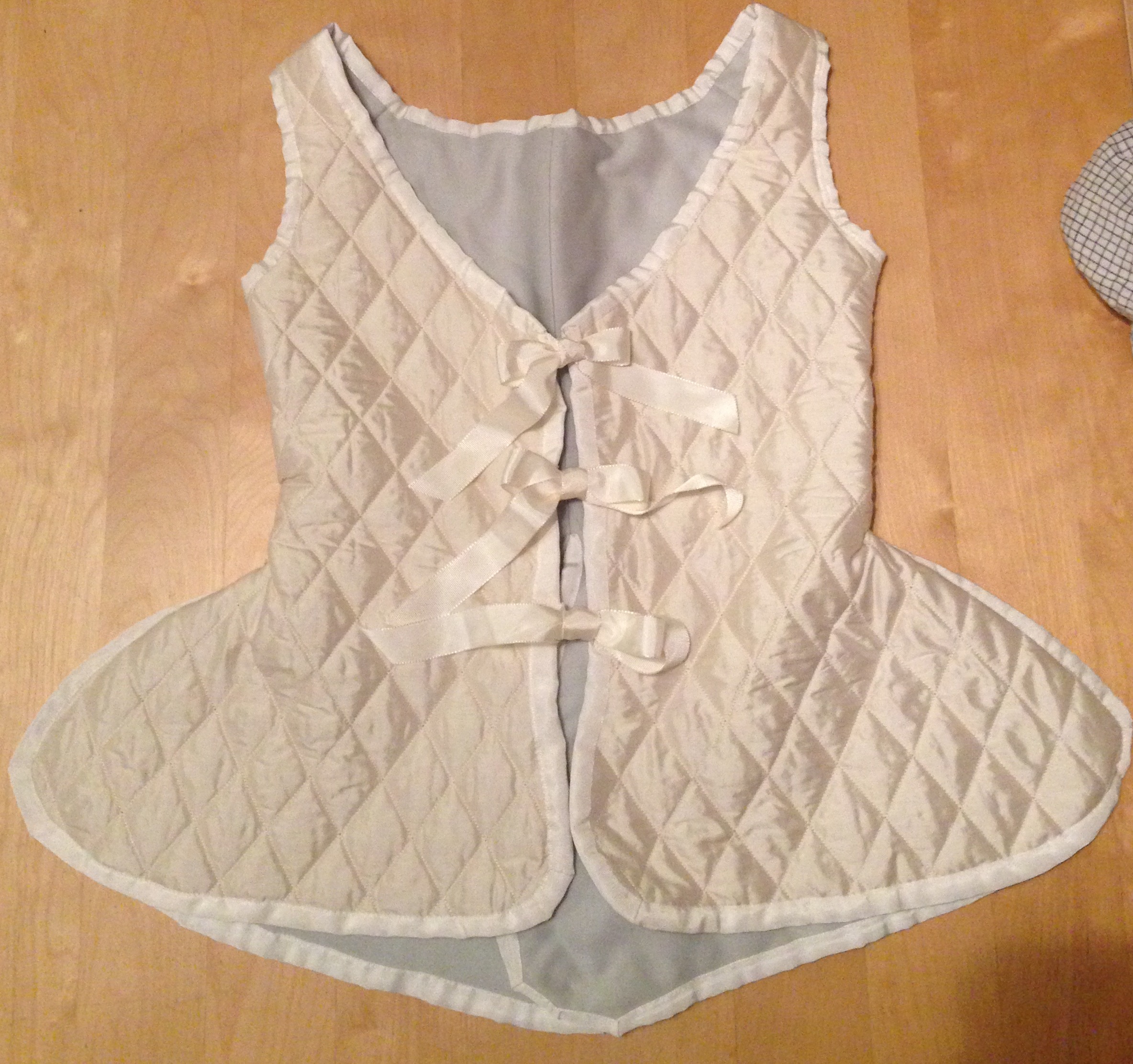
A glass of cider and an hour later, I’d rectified the error. These are now fully bound along the bottom edge, and ready for the top edge binding. Somewhere there’s coutil for the straps, and then numerous hand-sewn eyelets later, I will have a finished pair of hand-sewn stays.

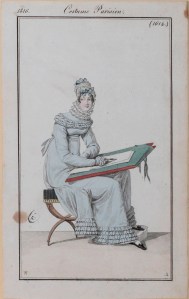
New stays deserve a new gown, and since I found this lovely image, I know what that new gown should look like (as well as a portfolio).  Happily, there’s a dress in Cassidy’s book that will serve as a reasonable basis for recreating this image. I’m still pondering the portfolio, and what it might be made of: paper or leather covered pasteboard? As the clock ticks down to June, I suspect I will be using a portfolio I already have on hand.

And then there are the the 18th century stays, with their history of woe.

File_000

I’ve gotten this far with the new 18th century pair, and an interesting business it is. I altered the front side pieces and the stomacher, but cannot see the back well enough (even with a camera and a mirror) to adjust it by myself, so further changes will have to wait until I have some assistance.

The tabs aren’t right in the back, and while the advice is to shorten the stays when the tabs flare this way, I found the fronts were still too low, once again riding at nipple-cutting height. Finally it occurred to me that the problem– slippage–might actually be one of waist. I lengthened the fronts half an inch and nipped the waist in, and found the fit more pleasing.  I suspect the back pieces need to be trimmed a bit before they’ll fit (they’re stitched closed in this version, so you know they’re too big).

Another weekend of work awaits– with focus, those early 19th century stays may be done by then, if there are no more finger injuries.

Share this:

  • Click to share on Facebook (Opens in new window) Facebook
  • Click to share on Pinterest (Opens in new window) Pinterest
  • Click to email a link to a friend (Opens in new window) Email
  • Click to share on X (Opens in new window) X
Like Loading...

Frugal Friday: Make Do and Mend

11 Friday Mar 2016

Posted by kittycalash in Clothing, Living History, Making Things

≈ Comments Off on Frugal Friday: Make Do and Mend

Tags

18th century clothes, 18th century clothing, Clothing, common dress, common people, Costume, dress, sewing

In a world of fast fashion, mending is quite out of date (unless you’re a hipster, and I am one of the trilobites of hipsterism), so it is all the more appropriate that I have a gown in need of mending.

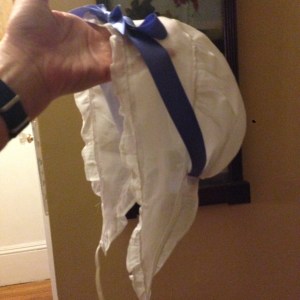
I am still making new things, like the “Bad Squishy” jellyfish cap. It didn’t look so tentacular until I held it up to show it off. As with any cap, the main goal is merely to keep it upon my head–always in doubt.

Tenactularly good. And now I can whip gather.

Tenactularly good. And now I can whip gather.

In just a week I’ll be headed up to Fort Ticonderoga to clean the officers’ quarters and generally represent the women who accompanied the 26th Regiment of Foot— and yes, I know I’m old enough to be the mother of any number of those folks, but there’s no need to point it out all the time. The main thing is the cleaning. And the weather, which looks like it could once again be unseasonably warm. That won’t stop me making another wool gown, which I am making up in a drab wool specifically for dirt and distracting my unsettled mind.

Washing, wearing, and airing

Washing, wearing, and airing

All the same, I pulled out the mother of all wrecked and wreckable gowns, the cotton gingham made for Bridget Connor. This has achieved a pretty nice patina, though I will confess to having washed it last fall after repeated wearings over the course of the summer. I know– not so necessary, but I did. Fear not: the stains remain.

I have no idea how that happened
Pop goes the sleevil

But I wore it vigorously and made it up quickly– to the point of needing to take it off and mend it at Stony Point (was that really two years ago?). Mending is required once again, so that small seam ruptures do not become actual sleeve separations as I dust, sweep, and mop. Yes, of course I’ll be making experimental mops this weekend, why not? There just isn’t enough distraction in the world.

1750-1770 gown, Fashion in Detail
Eyelets help me stay dressed

I worried about those eyelets I installed way back when, but was relieved to discover that I had seen a precedent, and that the date was within tolerances for someone of my age to retain in her clothes. The lacings also make dressing significantly easier for me; some days, putting on an open robe takes me back to the button-up and lace-up toys of pre-school, when tying shoelaces was a major accomplishment.

Share this:

  • Click to share on Facebook (Opens in new window) Facebook
  • Click to share on Pinterest (Opens in new window) Pinterest
  • Click to email a link to a friend (Opens in new window) Email
  • Click to share on X (Opens in new window) X
Like Loading...

Hot Topic

03 Wednesday Feb 2016

Posted by kittycalash in Art Rant, Clothing, History, Living History, Research

≈ 6 Comments

Tags

18th century, 18th century clothes, 18th century clothing, dress, engravings, fashion, gowns, Research, style, women

I’m of an age (none of your beeswax, thanks for asking) where most of the clothes in the shops are simply not for me. Not only am I picky about labor standards, fabric and construction quality, the styles aren’t for me. I’m too old. I create enough havoc walking (falling) down the street as it is that I do not need to look like the mid-life crisis I’m having involves a desperate search to recapture my youth through H & M or Hot Topic or whatever-the-kids-are-wearing clothing. I’ve achieved “a certain age,” and as with my everyday closet, my living history wardrobe has to reflect my age as well. Pity, really.

Following the Fashion. Hand colored etching by James Gillray, published by Hannah Humphrey, 1794. British Museum 1851,0901.706

Following the Fashion. Hand colored etching by James Gillray, published by Hannah Humphrey, 1794. British Museum 1851,0901.706

But more’s the pity here: I don’t have a clear idea, really, how age was perceived in the various decades I interpret. I have a clearer idea of how different body shapes and class levels were perceived and taunted, though sometimes body shape is an analogue for age.

Is this my daughter Ann? Pen and ink print study by Samuel Hieronymus Grimm, 1774. British Museum 2011,7084.56

Is this my daughter Ann? Pen and ink print study by Samuel Hieronymus Grimm, 1774. British Museum 2011,7084.56

There’s a classic image that juxtaposes age and youth.  Here’s how the British Museum describes this image:

‘Is this my Daughter Ann?’; satire on fashion. A street where, before a house [on the right], over the door of which the name ‘Love Joy’ is written, a sedan chair has been brought, in order to carry away a young lady, who, in a towering toupée, and other articles of fashionable attire of this period, is leaving the house in company with a young soldier, who caresses her as they go; she looks fondly at him. An old woman, in what was then an ‘old-fashioned’ costume is interposing to prevent the departure of the damsel. 1774

Okay… “An old woman, in what was then an ‘old-fashioned’ costume.” You will note that the old woman is wearing what we typically wear here in New England to represent everyday clothing for middling and lower sort American colonists for most of the 1770s. I don’t want to put too much stock in the cataloger’s description, because I’m not sure that print curators or curatorial assistants always know as much about material culture as they think they do. And we know that six weeks is not six years when it comes to transmitting fashion changes and updates across an ocean. I think “old fashioned” might not be exactly or entirely right as a descriptive phrase.

What does the old woman’s clothing really signify? That she’s rural and not urban? That’s she’s poor? That she’s old? How ‘old fashioned’ is that costume by 1774… in a context other than London courtesan couture? And how do we translate the clues we have trouble deciphering into a dress code for living history?

Is this my Daughter Ann, mezzotint by James Watson after S. H. Grimm, published by Sarah Sledge, 1774. British Museum J,5.104

Is this my Daughter Ann, mezzotint by James Watson after S. H. Grimm, published by Sarah Sledge, 1774. British Museum J,5.104

Well, happily, there’s a verse under the image in this print.

Is this my Daughter Ann

The Matron thus Surprised exclaims,
And the deluded Fair One Blames
But had the Mother been as Charming

She had Thought the Mutual sport no harm.
This Moral’s an undoubted Truth
Age envies Still the Joys of Youth

So this print is not about fashion. It’s about sex. (Well, duh. You were wondering when I’d bring that up.) It’s also, in a way, about hypocrisy, isn’t it? But the verse gives us the clue that the mother’s clothes are meant to be matronly.  “Conservative because of her age” might be a better descriptive phrase than “old fashioned” in that catalog record.

But does that mean that those of us who have achieved “a certain age” might also consider whether we, too, should be dressing in a more “conservative because of her age” style? I don’t really know.

But look here: Zoffany, ca. 1762.

David Garrick and Mary Bradshaw in David Garrick's "The Farmer's Return". Johann Zoffany, ca.1762. YCBA B1981.25.731

David Garrick and Mary Bradshaw in David Garrick’s “The Farmer’s Return”. Johann Zoffany, ca.1762. YCBA B1981.25.731

Here we’re looking at a rural woman ten to twelve years before “My daughter Ann.” The costumes are very similar; maybe the mother in Ann really is just old fashioned.

Here’s another version of “My daughter Ann,” this time more clearly fashion focused, without the sexual overtones.

Print made by Francis E. Adams, active ca.1760–1775, British, Heyday! Is This My Daughter Anne!, 1773, Mezzotint and etching on medium, moderately textured, cream laid paper, YCBA, B1970.3.820

Print made by Francis E. Adams, active ca.1760–1775, British, Heyday! Is This My Daughter Anne!, 1773, Mezzotint and etching on medium, moderately textured, cream laid paper, YCBA, B1970.3.820

Yale helpfully provides a transcription of the verse at the bottom:

HEYDAY! Is this my DAUGHTER ANNE! | Heyday! the country Matron in surprize, | Is this my Daughter thus bedizell’d? cries. | To Town she lately went a Damsel plain: | But scarcely now is to be known again. | That City to its Vanities has brought her, | And banish’d the good Housewifery I taught her. | Why, Child you’ll frighten here our honest People: | They’ll say you’ve on your Head a London Steeple.

My best guess is that this print is skewering both Anne and her mother: Anne, for being so outlandishly fashion-forward, and her mother, for being so far behind. But again, that’s only a guess.

Share this:

  • Click to share on Facebook (Opens in new window) Facebook
  • Click to share on Pinterest (Opens in new window) Pinterest
  • Click to email a link to a friend (Opens in new window) Email
  • Click to share on X (Opens in new window) X
Like Loading...

Sometimes a Great Notion

03 Thursday Dec 2015

Posted by kittycalash in Clothing, Living History, Making Things, Reenacting

≈ 3 Comments

Tags

18th century clothes, 18th century clothing, Clothing, common dress, dress, fashion, living history, sewing, style

Finished! Cozy, too.

Finished! Cozy, too.

(Think Lead Belly, not Ken Kesey.)

No, I did not take a notion to jump in the river, but I did take a notion to sew slightly more than the quilted waistcoat.

I couldn't resist.

I couldn’t resist.

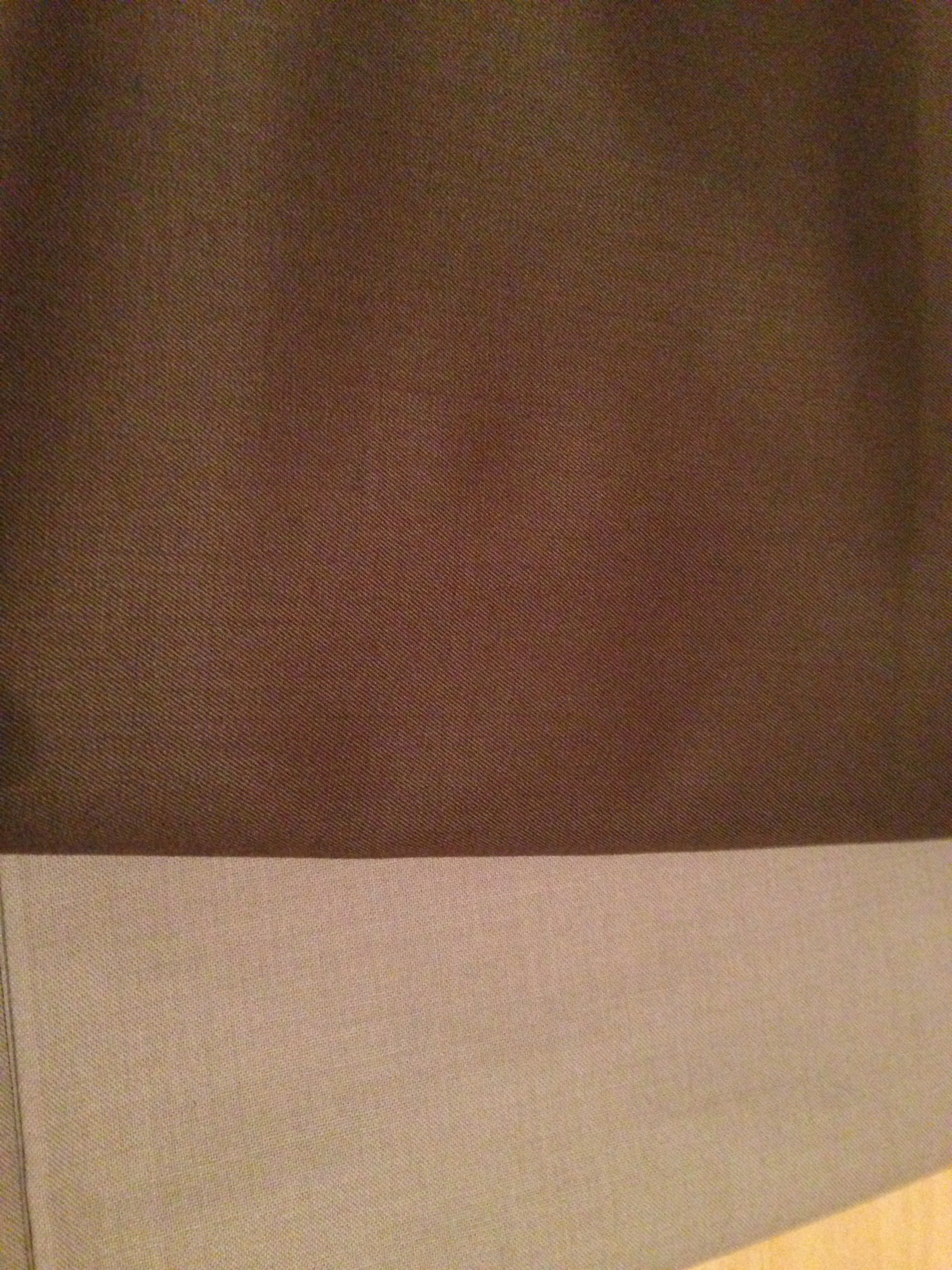
I got this unshakable great notion, you see, about some wool from the remnant table in Framingham. It was a lovely olive color, and paired up with some plain weave I already had, it reminded me strongly of World War II-era Army uniforms from the ETO, which I had been packing recently in Rhode Island’s alpine north. And yes, if I find a pinker tan for a petticoat, I will procure it.

Since I already have an olive wool petticoat that will also work for this notion, I started on the gown last week, cutting it out on Wednesday night so the table would be clear for Thanksgiving dinner.

The wool was a little slippery to pleat, and the twill slightly dazzling with its sheen. Let’s pretend it’s shalloon, shall we?

First the back
First the back
and then the sides.
and then the sides.

A week into the project (after a brief annoying detour attempting to correct my mitt pattern), I have only half the hem and the bottom of the robings to finish. Not too shabby, thanks to a holiday weekend and hours of The Pacific, Band of Brothers, and The Purple Plain. Homage to the color, I suppose.

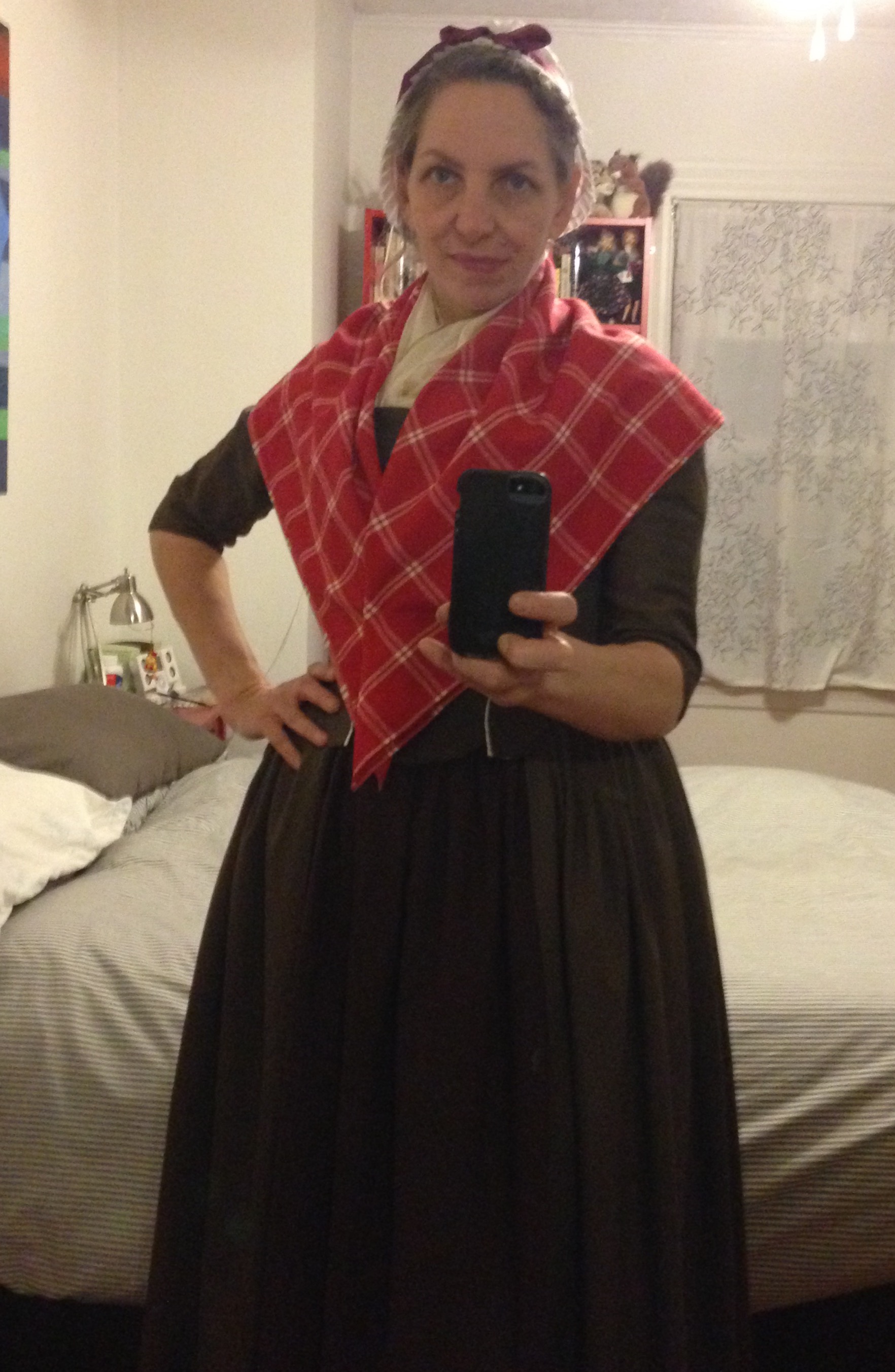
I'm never not smirking, so thanks for not smacking me.

I’m never not smirking, so thanks for not smacking me.

It fits– which always seems like a miracle, even with a tested pattern– and better yet, it fits over that plush waistcoat.

The rustle of the silk and the swish of the wool are unlike anything I’ve ever worn. I think I shall feel quite fancy– let us hope I shall also feel quite warm.

Share this:

  • Click to share on Facebook (Opens in new window) Facebook
  • Click to share on Pinterest (Opens in new window) Pinterest
  • Click to email a link to a friend (Opens in new window) Email
  • Click to share on X (Opens in new window) X
Like Loading...
← Older posts
Newer posts →

Archives

wordpress statistics

Creative Commons License
Kitty Calash blog by Kirsten Hammerstrom is licensed under a Creative Commons Attribution-NonCommercial-ShareAlike 4.0 International License.

Website Built with WordPress.com.

  • Subscribe Subscribed
    • Kitty Calash
    • Join 621 other subscribers
    • Already have a WordPress.com account? Log in now.
    • Kitty Calash
    • Subscribe Subscribed
    • Sign up
    • Log in
    • Report this content
    • View site in Reader
    • Manage subscriptions
    • Collapse this bar
 

Loading Comments...
 

    %d