• Home
  • Completed Costumes/Impressions
  • Emma and Her Dresses
  • Free Patterns and Instructions

Kitty Calash

~ Confessions of a Known Bonnet-Wearer

Kitty Calash

Tag Archives: interpretation

Rethinking Reenacting Redux

22 Saturday Apr 2017

Posted by kittycalash in Art Rant, Living History, personal, Philosophy, Reenacting

≈ 2 Comments

Tags

art, authenticity, interpretation, living history, Reenacting, transcendence

Some of you may recall my friend from the antediluvian age, Dread Scott. He was in town briefly and while I wasn’t able to attend his talk, I got my own special artist’s talk over breakfast.

Scott’s working on a Slave Rebellion Reenactment, (additional info here) so we had a lot to talk about.

Scuffle in the Square, Princeton, 2017. Photo by Wilson Freeman at Drifting Focus Photography

He had some great questions about what we do, and why we do it, especially around Princeton, and in talking about my end goal (getting the public to understand how the past informs the present), I said something about how in Newport in 2014, the cars disappeared and we forgot we were in the present.

Scott’s great reply was about keeping the present present, occupying two time periods simultaneously, to recognize that the past made the present. I know that seems obvious, but it isn’t always when we’re out in our funny clothes. It’s another layer of interpretation that we can build onto our reenactments and recreations, particularly when we are trying to talk about slavery. Slavery built the institutions we have today– like Aetna Insurance and Georgetown University– so if we acknowledge our surroundings in a place like downtown Princeton or Newport, we can talk about more than just the moment we are recreating.

Some of us seek historical transcendence. Some of us enjoy a social experience. And some of us seek ways to connect the present to the past in ways that help us understand how we got here, and how to make a better future.

The more I contemplate what matters to me, the more I think I’m seeking that last more than I am even transcendence.

Share this:

  • Share on Facebook (Opens in new window) Facebook
  • Share on Pinterest (Opens in new window) Pinterest
  • Email a link to a friend (Opens in new window) Email
  • Share on X (Opens in new window) X
Like Loading...

Serving Delaplace

21 Tuesday Feb 2017

Posted by kittycalash in Events, History, Living History, material culture, Museums, Reenacting

≈ 2 Comments

Tags

18th century, authenticity, cleaning, common soldier, cooking, Drunk Tailor, Fort Ticonderoga, interpretation, living history, Revolutionary War, servants

dscn4628

With 400 miles between us, Drunk Tailor and I have few chances to explore the past together, so I was both delighted and nervous when he agreed to join the British Garrison 1775 event at Fort Ticonderoga as one of Captain Delaplace’s servants.  Even better, we were also joined by the itinerant Deep North Yankee who wandered around the Fort (possibly seeking roofing shingles, of which he is much in need).

dscn4631

Friday nights are always magical, candle and firelight (and only the warmth of the fire) as we drink cider and talk about history. But morning always comes: Saturday, cold and clear, Mr S and I woke and blinked across the room at each other, and I wondered to what degree I really wanted to ever crawl out of bed…only hunger and an eventual need to pee (and fear of a Sergeant) propelled me.

Yup, you cook 'em on a board.

Yup, you cook ’em on a board.

First order of business: breakfast. Mr S, supplied with his corn meal of choice, made us johnnycakes, which provided perhaps more interpretive than nutritive value. Still, they were warm and tasty and he is the only person I know who can make them; my efforts end up as FEMA disaster sites.

cooking
img_20170218_110626

Captain Delaplace’s servants were tasked with cooking for his mess, so Mr S and I got a start. We had a chicken, an onion (I traded onion # 2 for some bacon), butter, carrots, potatoes, a butternut squash, salt, and some port. I don’t know where this English serving woman of 1775 encountered mis en place, but she accidentally introduced coq au vin to the Captain’s table with the dinner meal.

Captain and Mrs Delaplace dining, manservant in attendance

Captain and Mrs Delaplace dining, manservant in attendance

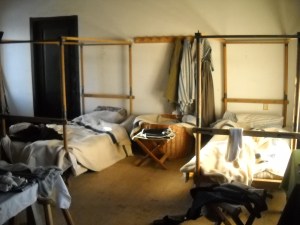
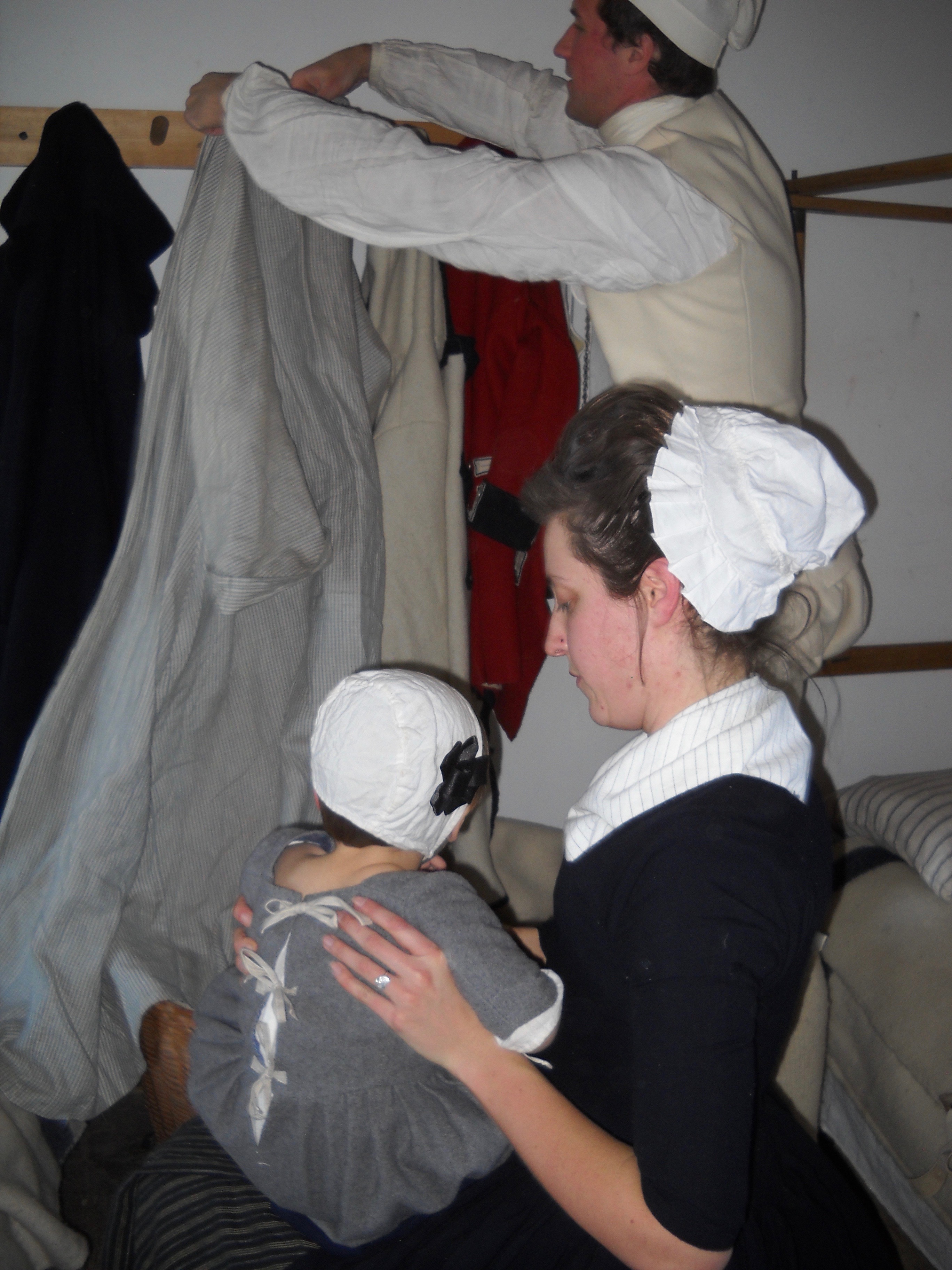
The Captain and his Lady dined on chicken braised in butter and bacon with root vegetables in a port sauce; we servants waited until they were done before we could eat. (Confession: I need to eat a lot, and have a sensory overload problem, so when visitors fully crowded the room, I had to dash across the parade ground for a Clif Bar and an Ativan before I could continue to wait for my dinner.) In the afternoon, dishes were washed at the table, as was common (at least in early New England), dried, and set away, while the Captain’s lady and child played in the cabbage patch between the beds.

dscn4657

When the room was empty, servants were able to eat (huzzay!) and found the meal very tasty indeed. I would certainly make this again, and learned more about cooking– a typically female task I generally try to avoid– than I had expected to. Then we had yet another round of dishes before it was time to tidy the room and make ready for tea or supper.

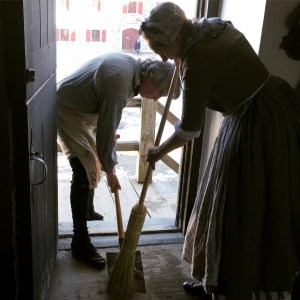
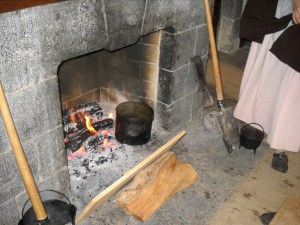
To that end, we cleared the table and broke it apart to reveal the floor and hearth, which needed to be swept of bread crumbs, squash peels, dead leaves, and other detritus. The best way to sweep an unfinished floor in the 18th century (per Hannah Glasse et al) is to strew the floor with wet sand and then sweep. I mixed sand with lavender-infused vinegar and threw it on the floor; this keeps the dust down as you sweep months of dust and dirt out of the corners and from behind tables and chests.

img_20170218_144218
img_9513

The trick is to sweep in one direction (more or less) from the back of the room to the front, and then to gather up the sand (here in a shovel) and pitch it off the landing. Much was thrown out the door and over the stair rail, just as servants would have done in 1775. (And I am told it is soothing to nearly hit the sergeant, but perhaps that’s merely hearsay, if not heresy.)

img_9478

When we were done, we restored the table (Drunk Tailor noticed the height of the ceiling, and wondered about hanging birds in cages whist awaiting the return of the tabletop), fully reset with cloth, candlesticks, plates, and knives, ready for the supper we didn’t cook, as we skipped away at the close of the day to find our own meal in Glens Falls, where live music is inescapable on a Saturday night.

Share this:

  • Share on Facebook (Opens in new window) Facebook
  • Share on Pinterest (Opens in new window) Pinterest
  • Email a link to a friend (Opens in new window) Email
  • Share on X (Opens in new window) X
Like Loading...

“Exteriorizing,” or, Showing the Past: Part I

15 Wednesday Feb 2017

Posted by kittycalash in History, Living History, Reenacting

≈ 2 Comments

Tags

authenticity, first person interpretation, interpretation, living history, Reenacting, Research

This guest post was written by Sharon Burnston. Sharon and I will be co-teaching an interactive workshop on first person impressions this June. “Exteriorizing” is an important part of developing an impression that works not just to represent a character, but to tell a story. Part II will appear tomorrow.
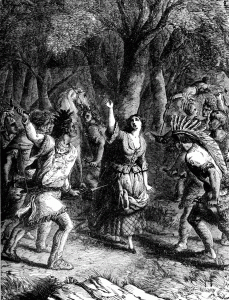
John Gilmary Shea, The Story of a Great Nation (New York: Gay Brothers & Company, 1886)after 444, says "page 475" University of South Florida clip art collection.

John Gilmary Shea, The Story of a Great Nation (New York: Gay Brothers & Company, 1886)after 444, says “page 475” University of South Florida clip art collection.

The first time I was ever “abducted” at a living history event was during an F&I scenario 35 years ago. I was dragged off into the bushes by scary looking strangers, and it was all very well researched and convincing.

But one thing I realized, upon reflection afterward, is that a really accurately portrayed scenario isn’t always in all ways the “best” scenario, for the participants or the public. In real situations that are terrifying, the usual physiological/behavioral responses are those described as Flight, Fight or Freeze. That’s what real people do when that sort of thing really happens. At the time I was abducted by “the French and the Indians”, I put myself into the moment, imagined how I would really feel if it were actually happening, and I froze. I portrayed terror so well, my abductors looked at me oddly, wondering if I was okay. But y’know what? The spectators, standing 30 feet or more away, couldn’t see my face, couldn’t hear my shallow breathing, and they got nothing out of it.

The Abduction of Daniel Boone's Daughter by the Indians. oil on canvas by Carl Wimar, 1853. Washington University Kemper Art Museum. Gift of John T. Davis, Jr., 1954 WU 4335

The Abduction of Daniel Boone’s Daughter by the Indians. oil on canvas by Carl Wimar, 1853. Washington University Kemper Art Museum. Gift of John T. Davis, Jr., 1954
WU 4335

I realized that I had actually failed to do justice to the interpretive moment, I should have done something less lifelike and more communicative. I should have screamed for help, in detail, loudly, and at length. In real life, this would have been a risky thing for a captive to do, but in a reenactment interpretive setting, it would have been useful. I mean, I knew precisely why my character was terrified, but did the public? If I had screamed and carried on, it would have given me an opportunity to put into words what the 18c abducted woman knew about what was going to happen to her. It would have been a better scenario in terms of educating the public if I had, in a word, exteriorized what my character was feeling into words, for everyone present to hear.

The problem with my having learned this sort of thing experientially and so long ago, is that I tend to blithely assume that other folks whom I regard as skilled 18c role players also know it, because to me it is by now so obvious.
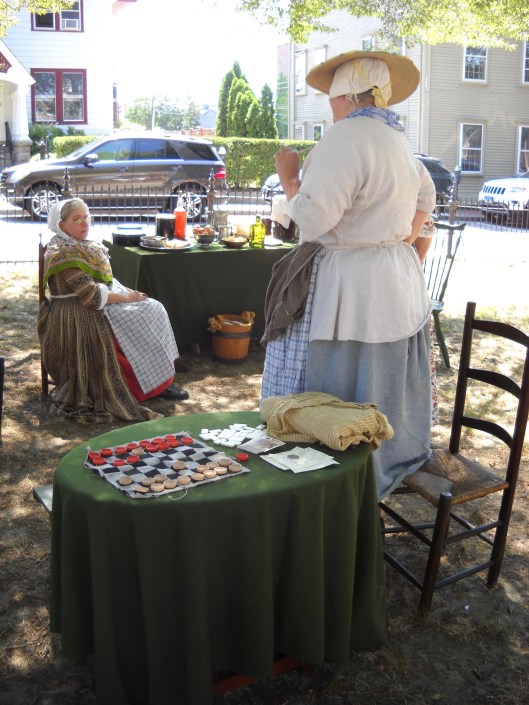
DSCN4448

Last summer I participated in a brilliant re-creation of a different kind of abduction, a reenactment of the British naval press gang that abducted American sailors out of Newport RI harbor in 1765. Over 60 of us from all across New England worked hard for months to research and develop our impressions in order to make this event as convincing and accurate as we could. For the most part, we succeeded magnificently. But I came away dissatisfied and I think some of the public I talked to did also. That was a helluva scenario, meticulously planned and carried out, and we did it so well! But I think we could have done it one or two notches better, and here is why I think so.

First person role playing has far more of theater about it than perhaps we living historians care to admit. Drawing upon theatrical strategies can allow us to better communicate our knowledge to the audience, by exteriorizing our characters’ thoughts or feelings into dialogue the public can hear, even if doing so might slightly violate the strictest historical purity of our role playing. After all, don’t we claim to be doing this in order to educate the public?

The strategy I have in mind is the collaborative trick referred to in improvisational theater as “Yes, and”.

“Yes, and…” refers to a basic concept in improv theater. If a participant throws a gambit at you, don’t shut it down. Accept it, whatever it is (“Yes”) and then add something of your own (“and…”) to expand on the idea and keep it going. “Yes” means being receptive to the contributions of others. “And” means offering something back, to further the collaborative process.

How would this notion apply to a living history role playing scenario? Stay tuned to find out!
Share this:

  • Share on Facebook (Opens in new window) Facebook
  • Share on Pinterest (Opens in new window) Pinterest
  • Email a link to a friend (Opens in new window) Email
  • Share on X (Opens in new window) X
Like Loading...

Sleeping on the Job

03 Friday Feb 2017

Posted by kittycalash in History, Living History, Museums, Research

≈ Comments Off on Sleeping on the Job

Tags

authenticity, common people, interpretation, John Brown House Museum, Museums, Research

img_9092

Last night, as I lay in the tester bed we slept in on What Cheer Eve, I wondered again what it was like to live and work in the house over the course of its life, and how the servants had been treated. In the late 18th and early 19th century, the notion of “service” was still evolving in New England. Help was common, and while northern and urban slavery existed, and we know the Browns traded in and owned enslaved people, we have no evidence of them in the house.

We know there was a white woman between 45 and 60, and four “all other free people,” we have names –Mary, Jonathan, and Gideon– for some of the people associated with the family, but don’t know their details. How did the Browns treat them? What was the relationship like? Were they invisible? Thanked? Chastised?

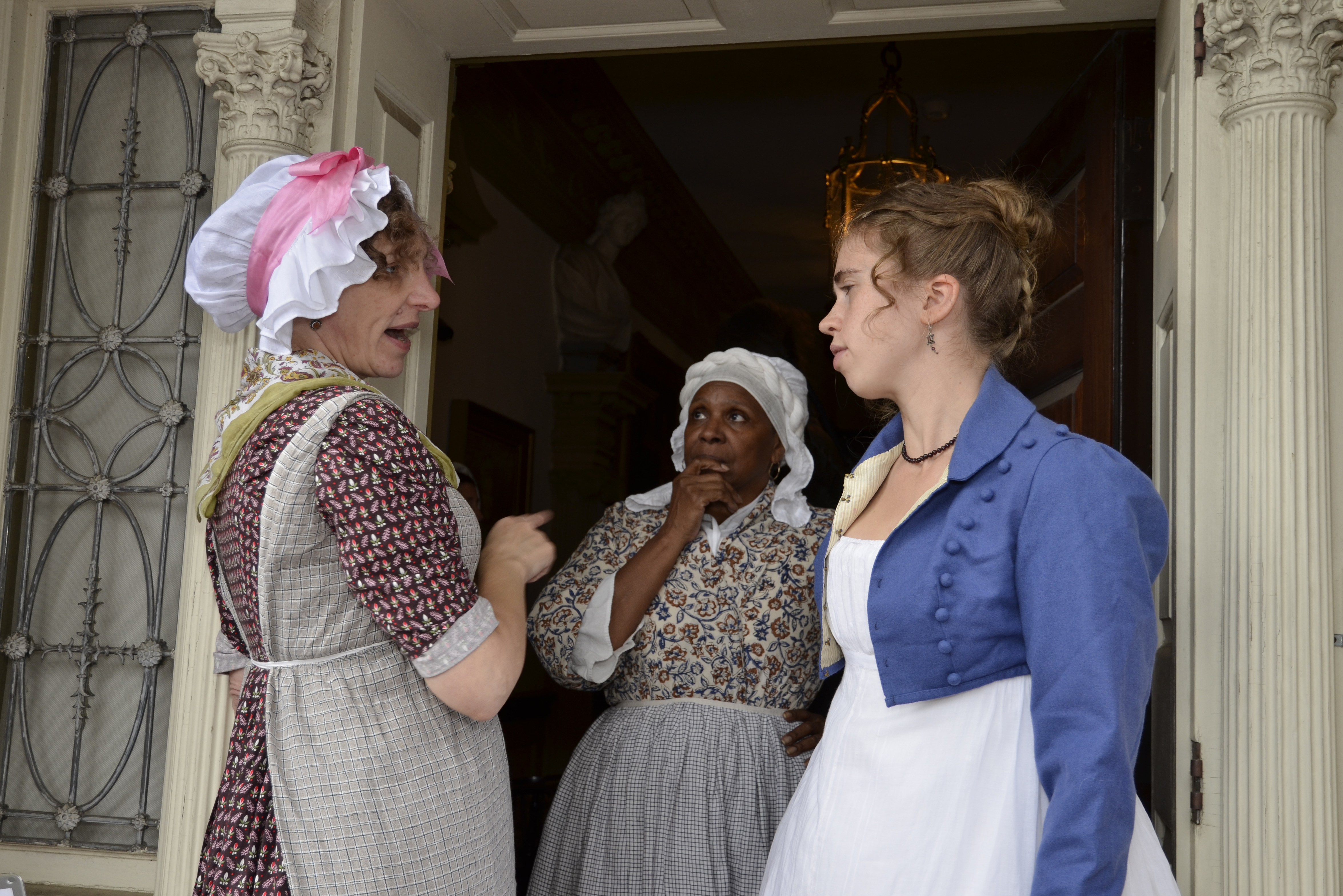
Goody Morris makes up a bed. Photograph by J. D. Kay

Goody Morris makes up a bed. Photograph by J. D. Kay

Diary entries that record “my babe takes tea with Ma’s Mary” suggests that there was some level of familiarity, and hints at the friendly relationship children and servants sometimes had in these houses, when both were seen as less civilized, less refined, and (clearly) less educated than the adult homeowners. Physically, service stairs kept chamber pots, laundry, food, servants, and children out of view, sequestered into smaller, dimmer, less-finished spaces.

Petulant Alice faces her first hurdle, Kitty and Goody Morris. Photograph by J. D. Kay

Petulant Alice faces her first hurdle, Kitty and Goody Morris. Photograph by J. D. Kay

We’ll never really know how the Browns really treated their servants, or felt about them; these are people who matter only enough to be remarked upon in passing. Perhaps even more frustrating is that we’ll never know what the servants thought of the Browns, of their businesses and moods, loves and appetites. These barely-documented people could tell us so much, if only the past could talk.

Share this:

  • Share on Facebook (Opens in new window) Facebook
  • Share on Pinterest (Opens in new window) Pinterest
  • Email a link to a friend (Opens in new window) Email
  • Share on X (Opens in new window) X
Like Loading...

Any Old Epaulet

28 Saturday Jan 2017

Posted by kittycalash in Art Rant, Fail, History, Museums

≈ Comments Off on Any Old Epaulet

Tags

exhibits, interpretation, material culture, Museums, objects

Details: we sweat them in our historical clothing, our impressions, our writing. I try hard to pay attention to them, but in my work, I have a lot of details to manage. Some fall away– I can no longer tell the ranks of men in daguerreotypes immediately, or recognize a Colt revolver at 10 paces, but there was a time when I could. I have managed to retain at least a general understanding of how military units are organized, a general sense of various units from my state in wars before 1939, and the uniforms associated with those units. (And I know which side a man’s coat buttons on.)

What's wrong with this image? Missouri State Guard uniform coat of Col. Austin M. Standish (Confederate). Missouri Historical Society 1916-045-0001

What’s wrong with this image?
Missouri State Guard uniform coat of Col. Austin M. Standish (Confederate). Missouri Historical Society 1916-045-0001

This helps in my work: knowing what HBT is, knowing what various patches signify, knowing how units were structured and the campaigns they were part of helps me be a better cataloger, curator, and exhibit developer. My job is take the details and make them matter by telling stories about the people who wore the HBT or the machinists’ mate patch or carried an ensign or wore an officer’s coat as part of the 14th Rhode Island Heavy Artillery (colored) in the Civil War.

U.S. Flag, regimental. 14th Regiment Rhode Island Heavy Artillery. Belonged to Joseph Carey Whiting, Jr., 1st Lt., Co. B 14th R.I. Heavy Artillery. RIHS 1962.24.1

U.S. Flag, regimental. 14th Regiment Rhode Island Heavy Artillery. Belonged to Joseph Carey Whiting, Jr., 1st Lt., Co. B 14th R.I. Heavy Artillery. RIHS 1962.24.1

People matter more than things, but 154 years later, all we have are things those people owned, used, wore, and carried. The things now represent the people. So when someone working on a exhibit says, “any epaulets will do” while pointing at the shoulder boards on a Lieutenant’s coat, I’m not just taken aback, I’m upset, and reply, “If it’s just for color, you can buy them.” Because “any old epaulet [sic]” being loaned by a museum goes through a laborious process of loan approval, packing, delivery and installation. For that time investment alone, “any old epaulet” should not do: museums are not prop closets.

General's Epaulets of William Clark. Missouri Historical Society. 1924-004-0006

General’s Epaulets of William Clark. Missouri Historical Society. 1924-004-0006

I keep saying the same thing, don’t I? There ain’t nothing like the real thing.

We can’t assume that the public doesn’t know or doesn’t care– they often know more than we do, just think of the wildly detailed knowledge some of us have about very particular things– so we owe it to them, and to the people of the past, to use museum objects as more than visual accents.

Share this:

  • Share on Facebook (Opens in new window) Facebook
  • Share on Pinterest (Opens in new window) Pinterest
  • Email a link to a friend (Opens in new window) Email
  • Share on X (Opens in new window) X
Like Loading...
← Older posts
Newer posts →

Archives

wordpress statistics

Creative Commons License
Kitty Calash blog by Kirsten Hammerstrom is licensed under a Creative Commons Attribution-NonCommercial-ShareAlike 4.0 International License.

Website Built with WordPress.com.

  • Subscribe Subscribed
    • Kitty Calash
    • Join 621 other subscribers
    • Already have a WordPress.com account? Log in now.
    • Kitty Calash
    • Subscribe Subscribed
    • Sign up
    • Log in
    • Report this content
    • View site in Reader
    • Manage subscriptions
    • Collapse this bar
 

Loading Comments...
 

    %d