• Home
  • Completed Costumes/Impressions
  • Emma and Her Dresses
  • Free Patterns and Instructions

Kitty Calash

~ Confessions of a Known Bonnet-Wearer

Kitty Calash

Tag Archives: living history

Compare and Contrast

28 Sunday Jan 2018

Posted by kittycalash in Clothing, Events, Living History, Reenacting

≈ Comments Off on Compare and Contrast

Tags

18th century clothes, 18th century clothing, Boston Massacre, Bostonian Society, Events, living history, women's history, women's work

2016's 1770
2016’s 1770
2018's 1770
2018’s 1770

Boston Massacre planning is underway for everyone involved at every level, including me.

I’ve made changes to what I plan to wear, in part because I have a newer gown that fits better and keeps me warmer, and because I have learned more, and looked at more, in the intervening time. Since 2016, I’ve made/upgraded a quilted petticoat (in a bronze silk, a color documented to Rhode Island quilted ‘coats), settled in to wearing my cap tied under my chin, and made both a new apron and a new bonnet.

2017's 1777
2017’s 1777
2018's 1770
2018’s 1770

Cap and bonnet shape and shoes help make time period distinctions between 1777 and 1770; if I could find the wool I made the gown from, I would add the cuffs it desperately needs. The heeled shoes skew earlier than 1770, but they are the only heeled shoes I have….if the weather is wretched, I will wear the flats for safety and comfort.

2016's Bonnet
2016’s Bonnet
2018's Bonnet
2018’s Bonnet

The bonnet, which I affectionately call “Lampshade,” is meant to have the shape of pre-1770 bonnets as seen in Sandby’s illustrations, and which I have been working on for a while.

Martha Collins, Thomas Sandby’s Cook. watercolor on paper by Paul Sandby, 1770-1780. RCIN 914339

I know from reading the standards that the understanding of mitt material has evolved, and my time this morning looking for an elusive apron shape raises questions for me as well. Here’s Martha Collins, painted by Paul Sandby. What’s that black thing on her arm? A mitt? An arm warmer? Is it knit, or woven? There’s always more to figure out, and more to make.

Cuffs on my gown don’t seem like a big enough deal to warrant buying wool for a whole new gown (with only six weeks to go), so my choices are live with no cuffs, alter the red gown of 2016’s event to fit properly, or initiate an extensive search for the scraps left over from the green gown…which may or may not be buried in storage. Tick tock.
Share this:

  • Share on Facebook (Opens in new window) Facebook
  • Share on Pinterest (Opens in new window) Pinterest
  • Email a link to a friend (Opens in new window) Email
  • Share on X (Opens in new window) X
Like Loading...

Stick-to-it-iveness

14 Thursday Sep 2017

Posted by kittycalash in Events, Living History, Making Things, Reenacting

≈ 3 Comments

Tags

18th century, 18th century clothing, authenticity, common people, Events, living history, peddler, petty sutler, Revolutionary War, sutler

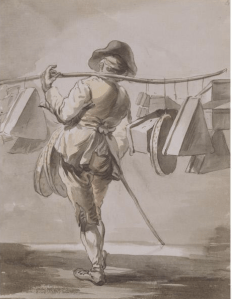
Band Box Seller, pen and watercolor by Paul Sandby, n.d. The Huntington Library, Art Collections, and Botanical Gardens, 67.18

It has been a long time since I participated in a traditional “reenacting” event, the kind with tents and pew and kettles and a TWD but here we go, borne back into the past to where it all began, more or less. I remain as uncomfortable as ever in the camp follower role, constantly questioning the likelihood of my being a follower, and the activities I would participate in. It’s a historical personality disorder, trying to figure out who one was, complicated by all the modern politics of gender roles, relationships, and unit rules.

Now that I’ve switched sides, Bridget Connor is no longer open to me. By nature I’m a townie, happiest in a mercantile endeavor if I’m not able to take on the role of an officer’s servant.

So what to do? Petty sutlery is much on my mind, for I have need of the money and a habit of making things. Lately, i’ve been band-boxing, so I was delighted to find the Huntington had digitized this Sandby drawing of a band-box seller, placing the trade firmly in the middle of the 18th century. Triangular boxes for cocked hats, circular boxes for bergeres, rectangular boxes for gloves and (neck)handkerchiefs, I presume.

Glass coral and garnet necklaces
Red wool pincushions

I’ll have band boxes and a bonnet or two in addition to a custom order delivery, coral, glass, and garnet necklaces for girls and women, pincushions, handkerchiefs, possibly garters, and, if my hands hold up, boxes for hats and bergeres, all on a stick. Look for me between the 17th and the 7th, hindering or helping laundresses.

Share this:

  • Share on Facebook (Opens in new window) Facebook
  • Share on Pinterest (Opens in new window) Pinterest
  • Email a link to a friend (Opens in new window) Email
  • Share on X (Opens in new window) X
Like Loading...

Reap what you Sew

12 Tuesday Sep 2017

Posted by kittycalash in Clothing, History, Living History, Making Things, material culture, Reenacting

≈ 1 Comment

Tags

bonnets, George Stubbs, living history, Making Things, museum collections, Research

Too big!

Lampshade: She’s been the Holy Grail of bonnet making.

There were several failures in the winter of 2016, and some revisiting of the Whale-Safe Bonnet as I tried to figure out the brim and the caul. My first efforts made a caul that was waaaaay too small. That’s not necessarily a bad thing, as I’ve made plenty of too-big bonnets. (Too small did not make the move from RI to VA, but trust me: too small a caul was far too small.)

Reapers 1785 George Stubbs 1724-1806 Purchased with assistance from the Friends of the Tate Gallery, the Art Fund, the Pilgrim Trust and subscribers 1977 http://www.tate.org.uk/art/work/T02257
Haymakers 1785 George Stubbs 1724-1806 Purchased with assistance from the Friends of the Tate Gallery, the Art Fund, the Pilgrim Trust and subscribers 1977 http://www.tate.org.uk/art/work/T02256

This morning, I took another look at George Stubbs’ paintings of working women. I know the lampshade-like bonnet is pre-1770, but where are we at the end of the Revolutionary War period? Well, BIG was in, obviously. (We can have a healthy debate about the likelihood of these gowned women depicting actual working women, but for now, let’s stick to bonnet brim shapes.)  They’re a little cone-like, aren’t they? With generous (yuuuge) cauls, though.

IMG_1921
IMG_1922

Now, I have gone about this all a bit backwards, which is to admit that I picked up the shellacked brim of yesteryear that did make the move down to VA, and decided to make it up as a bonnet yesterday. The brim is easy– trace and cut with a seam allowance– but the caul? I winged it, using a selvage edge for the inside of the back drawstring (I like my headwear to be adjustable and pack flat) and economized on fabric to leave plenty of taffeta left over. So there’s nothing particularly well-researched about this, except for all the years of looking and thinking and drawing and making that came before the moment I threw this all together yesterday afternoon watching North by Northwest and drinking a Manhattan.*

Part I like best?
Part I like best?
The way it hides my face!

Making this up raises more questions: how individually fitted were bonnets to wearers? Did caul and brim size vary depending on wearer? What’s the class line below which a woman doesn’t have a bonnet, but only a hat? How quickly did styles change? The sort-of-conical black bonnet is seen on “older” women in paintings well past the height of the style. But as I’ve asked before, what do we really understand about the portrayal of age in art? Are we really reading the symbols correctly? How well do we grasp the semiotics of the 18th century? All of those questions are present when we try to replicate the past using only visual sources. Yes, there is an extant 18th century black silk bonnet at Colonial Williamsburg, and we can use that in conjunction with images to make the things we wear. But pondering all of these questions makes me think it’s time for another troll through collections in Great Britain, just in case new cataloging has put old bonnets online.

*See my other blog, TipsyMilliner, for more.

Share this:

  • Share on Facebook (Opens in new window) Facebook
  • Share on Pinterest (Opens in new window) Pinterest
  • Email a link to a friend (Opens in new window) Email
  • Share on X (Opens in new window) X
Like Loading...

Milliner’s Shop Redux: A big, visual project

10 Thursday Aug 2017

Posted by kittycalash in Clothing, History, Living History, Museums, Reenacting

≈ 1 Comment

Tags

bonnets, canezou, CoBloWriMo, Federal New England Fashion, Federal style, living history, millinery, millinery shop, Salem Maritime Festival

The complete ensemble, under supervision.

When I first moved to Providence, I lived in Fox Point, a slightly fringy-dingy neighborhood of Portuguese and Cape Verdean immigrants and their descendants that was cheap enough for students (and even today remains imperfectly gentrified: Providence, I love you dearly). As my then-boyfriend and I walked my dog, we passed a man whom I later came to know as the Block Captain, who remarked to my boyfriend, “Beeg wooman.” Any project I take on is, therefore, big, since I am nearly six feet tall.

Although I have schemes for a Big New Century Project (a complete 1585 ensemble), I’ll take a shortcut instead to my current enthusiasm and write about last weekend and the 1811 fashion plate reconstruction, which happily includes one of my favorite visual sources, early 19th century fashion plates — thanks to Scene in the Past’s albums and Ackemann’s Repository on the Internet Archive.

Display window
Display window
and counter
and counter

I’ve written about the canezou plate before, but not since I (mostly) completed it on the trip up to Salem. This 1811 plate appealed to me first because of the bonnet (checks!) and the necklace (lapis!), but then realized that the canezou and its petticoat were within my ability to complete.

The ensemble also seemed suitable for a summer day in Salem, which, while usually more humid than hot, calls for cool, lightweight, clothing that can withstand a potentially sweat-drenched day without melting.

Gentlemen lounging on the street
20727717_10154869339193527_2136485927_o

From start to finish was three weeks: canezou, bodiced petticoat, necklace, bonnet, and shoe trims, all a vernacular rendition of a high-fashion image, adapted to the materials at hand– though I did have to order bonnet taffeta from India, which arrived just in time– much faster than I could have expected in 1811 Salem!

Setting up the shop for the fourth time was as much fun as the first time, and a little easier, given the practice I’ve had. I shared the shop with a tailor, Mr. B, of hat-making renown which made for a nice contrast interpreting men’s and women’s fashions and purchasing habits.

Packing up hat stands, bonnets, accessories, and furniture and driving them 470 miles is a kind of madness, but interpreting women in business and early shopping is one of my favorite historical enterprises.

Share this:

  • Share on Facebook (Opens in new window) Facebook
  • Share on Pinterest (Opens in new window) Pinterest
  • Email a link to a friend (Opens in new window) Email
  • Share on X (Opens in new window) X
Like Loading...

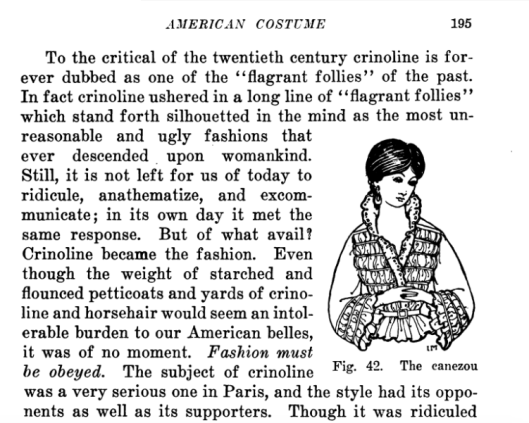
Au courant? Un canezou

02 Wednesday Aug 2017

Posted by kittycalash in Clothing, Living History, Research

≈ 5 Comments

Tags

19th century, 19th century clothing, CoBloWriMo, fashion, fashion plates, Federal style, living history, Salem Maritime Festival

Collier de Lapis. Canezou a Manche[?]

This.

Because, August (or Aôut). The Salem Maritime Festival is nearly upon us, so there’s a flurry of bonnet and accessory and other making happening chez Calash as there usually is in summer. It’s one of my favorite things to do, and this year I was asked if the millinery setup could be more of a demonstration.

That’s a kind of relief, actually, as it allows me to bring bonnets from multiple years in a variety of levels of completion, which allows me the luxury of talking about evolving styles and a variety of construction methods. Whether or not I’ll manage a drawn bonnet is still up in the air; it’s a lot of hand sewing for someone with carpal tunnel.*

Because any trip to Salem affords me the opportunity to join the mercantile class, I like to take the opportunity to make something new and non-working class when I go up there. This year, I was taken with the canezou. What’s a milliner to do, but stay as up-to-date as possible? What the heck is a canezou?

Well….roughly, from the French and English costume history books, the canezou is a short, Spencer-like garment, often in white, lightweight cotton, worn over another garment. The canezou seen here clearly has sleeves, and the plate is dated 1811, giving the lie to the wikipedia’s assertion that it’s circa 1835. (The later evolutions have become more scarf or fichu-like, but are again worn over other gowns- though apparently it enjoys a brief time as the cambric blouse worn with a riding habit. And then there’s another definition, by another fashion historian, in which the canezou is described as being like a man’s shirt.

Well, that’s all cleared up then….

With this information in hand, and the fashion plate before me, I perused the contents of the Strategic Fabric Reserve, and lit upon those popular Ikea curtains which have appeared here before as a gown and as a petticoat and now as a canezou.

I modified a Spencer pattern for the base lining of white cotton, and then draped, stroke gathered, and stitched the curtain fabric to form the floofy bodice. The lace on the cap sleeves is reclaimed from a late 19th century negligee lurking in Drunk Tailor’s collection of usable old fabrics, while the lace at the bottom was reclaimed from an antique petticoat before I picked it up in Sturbridge, MA a few years ago.

To complete this, a bodiced petticoat with an embroidered hem (machine embroidered, of fabric I may have picked up from a remnant table in Pawtucket, RI), a pair of trimmed shoes, a necklace (here of sapphire blue stones, unless I can teach myself hand-knotting by Friday), and a bonnet of blue and white check silk that arrived just in time from India. Five new items in two or three weeks: the price of fashion is slightly mad.

*Hand-sewing everything has, at last, caught up with me. I find soaking my hands in cold water helpful, as well as sleeping in those super attractive hand braces. Imma need some surgery, but for now, braces, Aspercreme, and ice water must do.

Share this:

  • Share on Facebook (Opens in new window) Facebook
  • Share on Pinterest (Opens in new window) Pinterest
  • Email a link to a friend (Opens in new window) Email
  • Share on X (Opens in new window) X
Like Loading...
← Older posts
Newer posts →

Archives

wordpress statistics

Creative Commons License
Kitty Calash blog by Kirsten Hammerstrom is licensed under a Creative Commons Attribution-NonCommercial-ShareAlike 4.0 International License.

Website Built with WordPress.com.

  • Subscribe Subscribed
    • Kitty Calash
    • Join 621 other subscribers
    • Already have a WordPress.com account? Log in now.
    • Kitty Calash
    • Subscribe Subscribed
    • Sign up
    • Log in
    • Report this content
    • View site in Reader
    • Manage subscriptions
    • Collapse this bar
 

Loading Comments...
 

    %d