• Home
  • Completed Costumes/Impressions
  • Emma and Her Dresses
  • Free Patterns and Instructions

Kitty Calash

~ Confessions of a Known Bonnet-Wearer

Kitty Calash

Tag Archives: sewing

Bloody, Bratty, Boning

27 Friday May 2016

Posted by kittycalash in Clothing, Fail, Living History, Making Things

≈ 1 Comment

Tags

18th century clothing, infrastructure, mistakes, sewing, stays, underwear

File_000Sometimes I am a terrible brat, as in this past weekend, when the autocorrect on my phone insisted that the proud four-letter Anglo-Saxon words I was typing were not what I meant to say. Darn tootin’ they were.

This is not my first rodeo with stays, but somehow I’d forgotten about the special stabby hell of boning the beasts. I’m machine sewing the channels for these, mostly because I calculated the time required to completely hand-sew them and realized I would not finish them before I needed them. I’ve rationalized this by acknowledging that I’m not using the hand-woven brown wool sateen I covet, but instead a dark blue wool twill.

A bloody, messy business
all around
all around

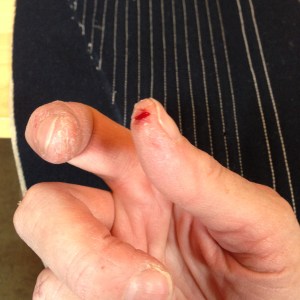
I know, I know: there’s a reason staymaking was a man’s trade. My hands are pretty strong, but it took some doing to figure out how to slide the pieces in neatly without jabbing the ends repeatedly into the freshly re-opened split on my thumb.

d'oh! surgical tape made this *much* better later.

d’oh! surgical tape made this *much* better later.

It takes discipline to keep doing this, the way it takes some discipline not to eat ice cream for breakfast just because you can (though I did, just this week). Spencers and dresses are so tempting, but there’s not point to making a new dress of wonder unless I have the stays to wear it over: infrastructure is required.

The stomacher and the two front pieces are boned… six more pieces plus whipping and eyelets and binding, oh, my! It’ll be a race to have them done by June 24th:  Discipline’s the thing.

Share this:

  • Share on Facebook (Opens in new window) Facebook
  • Share on Pinterest (Opens in new window) Pinterest
  • Email a link to a friend (Opens in new window) Email
  • Share on X (Opens in new window) X
Like Loading...

What’s it Worth Wednesday

25 Wednesday May 2016

Posted by kittycalash in Clothing, Living History, Making Things, personal, Reenacting

≈ 16 Comments

Tags

18th century, 18th century clothing, authenticity, sewing

Or, They’re Clothes, not Costumes.

This past weekend, I had a conversation with a friend about requests to borrow “costumes” we’ve made, sometimes for school children to wear, sometimes for movies, and sometimes for parties. We generally say no: these are hand-sewn clothes, and the replacement cost would be ridiculous– plus, we like them and wear them.

I hand sew because I get better control, but also because there were no sewing machines in the 18th and early 19th centuries. To get a garment right, you have to hand sew it, and that’s expensive. I took the time once to figure out what a set of clothes for the Young Giant cost– much to my dismay, and eventually, to his, as I became even more insistent that the garments be treated with respect.

IMG_3389

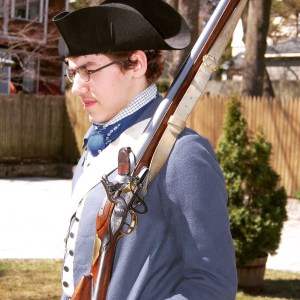
Last year, I sent the Young Mr off to Battle Road in a new suit, and the whole business of what he was wearing was quite expensive. Using $25/hour as a base for labor, here’s how the kid’s Battle Road suit breaks down:

Coat Labor: $1125 (estimated)
Coat fabric: $62.50
Buttons: $10.50
Coat lining & cutting: $90.00
Workshop: $125.00
Total: $1413

Let that one sink in for a while, will you? The 16-year-old boy ran around in a $1400 coat. Oh, and the breeches. Here they are.

Breeches labor: $300 (estimated)
Breeches fabric: $31.25
Buttons: $9.00
Total: $340.25

The blue suit is now up to $1753.25

Let’s add the shirt.

Labor:  $375.00 (estimated)
Fabric: $30.00
Buttons: $3.00
Total: $408

Shoes, hat and stockings:

Shoes: $119
Hat: $125
Stockings: $50
Neckcloth: $18
Glasses: $29.00
Lenses: $30.00
Total Accessories: $371

Grand total, with labor: $2532.25
Grand total without labor: $732.25

This wasn't cheap either.

This wasn’t cheap either.

So think about this the next time you attend an event with a lot of well-made garments: you are standing amid a lot of labor and love.

Sewing is a fairly simple enterprise (you’re pushing thread in and out of fabric, after all), but it takes practice to develop fine skills and speed. A well-made garment will never be cheap. The best investment you can make in your wardrobe is to invest in your skill set, and learn to sew.

Share this:

  • Share on Facebook (Opens in new window) Facebook
  • Share on Pinterest (Opens in new window) Pinterest
  • Email a link to a friend (Opens in new window) Email
  • Share on X (Opens in new window) X
Like Loading...

Fine Art Friday

20 Friday May 2016

Posted by kittycalash in History, Living History, Research

≈ Comments Off on Fine Art Friday

Tags

19th century clothing, art, art history, fine art, history, interpretation, sewing, sketchbook, sketching, women's history

Sketching a Cottage, Sept 29, 1816. Watercolor by Diana Sperling

Sketching a Cottage, Sept 29, 1816. Watercolor by Diana Sperling

In a mere four weeks, I will pack the Subaru and head west into New York State as so many Rhode Islanders have before me. And while I will have clothes suitable for the time of the RI Quaker Migration, I will be leaving not to found a more utopian society nor to seek my fortune on a farm. Instead, I’ll be joining some dear friends for a weekend sketching party (minus the horse and carriage).

This new enterprise has required some additional research, and while I look forward to painting miniatures at some point this summer, I suspect this venture will be a simpler proposition. A new dress and apron are the least of my worries: brushes, watercolor boxes, sketchbooks, pencils and pens all require research just when I should be thinking more seriously about the way the Revolution played out as a civil war in New Jersey.

Anne Rushout, ca. 1768–1849, British, 3 sketchbooks of 82 drawings by Anne Rushout (B1977.14.9506-9587), 1824 to 1832, Watercolor on moderately thick, slightly textured, cream wove paper, Yale Center for British Art, Paul Mellon Collection

Anne Rushout, ca. 1768–1849, British, 3 sketchbooks of 82 drawings by Anne Rushout (B1977.14.9506-9587), 1824 to 1832, Yale Center for British Art, Paul Mellon Collection

Still, the Yale Center for British Art has rarely failed me: a simple search for sketchbook turned up a catalog record for three sketchbooks of 82 drawings by Anne Rushout. These are lovely, well-executed landscapes in a fine British tradition, far more sophisticated than Diana Sperling or Sophie DuPont– I fear I will closer to Sperling and DuPont when I take up sketching again, and can at least console myself that my wonky drawings will be part of a fine tradition of ladies’ accomplishments.

Man and cat, 2004

Man and cat, 2004

The Yale Center for British Art also has a nice Romney sketchbook for Paradise Lost, which demonstrates the cartoon-like nature of preliminary drawings (and I mean cartoon in the old sense, not the Animaniacs sense, though the uses are related). And as I sew my dress of unmatched checks, I have art programming to entertain me: Fake or Fortune, thanks to a tip from Ms B, has provided happy, envious hours of conservation labs, artists’ colourmen, and auction rooms. Vicarious delight, indeed.

Share this:

  • Share on Facebook (Opens in new window) Facebook
  • Share on Pinterest (Opens in new window) Pinterest
  • Email a link to a friend (Opens in new window) Email
  • Share on X (Opens in new window) X
Like Loading...

Making up Monday

16 Monday May 2016

Posted by kittycalash in Clothing, History, Making Things, Research, Thanks

≈ 6 Comments

Tags

18th century, 18th century clothing, 19th century clothing, authenticity, common dress, Costume, dress, fashion, friends, sewing, style, thanks

From Jaipur, darling.

From Jaipur, darling.

Sometimes you’re a jerk without meaning to be, usually because you can’t see past your own limited self. I was that jerk on Friday, when my obsession with a missing package led to unfortunate words with both a supplier and worse, my sweetheart, about an unexpected length of fabric lately arrived from India. Would that my brain would work faster, for by the time I’d figured out what to make of it, the conversation had turned, and an additional 300 miles lay between me and the recipient of my confusion and dismay.

Despite my best intentions and resolve, I am a sentimentalist. This instinct sometimes conflicts with a devotion to honesty, for kindness often lies in elision. Confused? Short story: I don’t wear yellow, but a package arrived Friday with a dress length of printed Indian cotton, red and green flowers on a yellow ground.

“But Kitty,” you say, “Don’t you crave the hideous, the clashing, and the correct? You applaud Our Girl History’s choice of 1770s fashionable pink, though she prefers blue. Yellow is the haute couleur of the 18th century, fashionable everywhere, even in North America. You should leap at the chance to wear it.” (I was not thinking fast at all on Friday evening.) What made me bend my resolve– what will always makes me bend my resolve?

Petticoat fragment. Note yellow, with crudely printed lining. Wintherthur Museum 1959.0118.004

Petticoat fragment. Note the bright yellow, with crudely printed lining. Wintherthur Museum 1959.0118.004

Sentiment, of course, backed by research.

April, that cruel month, brought obsessive searches for Indian cotton print appropriate for the 18th century, as I looked at sample books and extant garments, searching for material to create frankly annoying clothing. Orange and green check with clashing Spencer and bonnet lining isn’t enough: I want to push my representation of the fashion sense of the past closer to truth. People in the past weren’t as matchy-matchy as we are, and their ideas of stylish, attractive, and fashionable were very different from ours. Loud was ladylike, and that’s a style statement I can get behind. Along the way, I ordered fabric in a pink and green (a departure itself) floral print on white ground, yardage now long overdue.
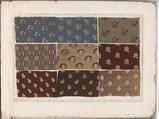
Textile Sample Book, British, 1780. MMA156.41 P34

Textile Sample Book, British, 1780. MMA156.41 P34

A friend has been dabbling in these same waters, and made up a new gown for Mount Vernon, satisfyingly loud and clashing with our modern sensibilities about the past. Our mutual friend, also at Mount Vernon, assisted her in choosing a dress length for me, and reader, I was confused and lacking when it arrived. But like any good curator in a social history museum, it was the story that got me. How can I resist a gift from a fellow enthusiast in a pattern chosen by my sweetheart, on the grounds that I don’t wear the color? Reader, I cannot.

Think of Cranford, of lengths of dress muslin requested and never received, and the sentiment embodied in that fabric. Think of women in Providence craving an India print gown, of lovers, husbands, sons, ordering dress lengths at trading ports thousands of miles and long months from home. Think of the affection and thoughtfulness embodied in textiles brought back months after they were requested. Complex meaning is woven into that cotton, giving this dress length interpretive meaning before it is even a garment.

IMG_6945
IMG_6946

Now what? Now I have to decide which century/event this gets made up for: 1812-1817, 1778, 1804, 1768. There are many choices, but with the meaning embedded in the fabric, I’m most inclined to make something I’d wear often– not that this is particularly housekeeper-appropriate.

And about the research you ask? Yes, small floral print on colored ground is documentable to the 18th century. While early and European, here’s an example of an Indian motif translated by Dutch makers for printing in Sweden. Rhode Island merchants traded in the Baltic, so given the early date of this fabric sample, its arrival in North America could predate 1788 and John Brown’s first ship to China and the far east trade. Possible? Yes. Probable? We can have a lively discussion, in which I will point out the Brown’s love of all things French and French translations of bright, small motif print patterns. The printing factories in Sweden ran until 1771 and produced at least two relevant prints. Would my successful Presbyterian farmer have bought something like this for me in New York or Philadelphia? Would I have worn something so bright and loud? Am I overthinking this? Perhaps, but yellow is a new thought for me.

With especially fond thanks to Miss N and Drunk Tailor, to whom I also owe an apology.

Share this:

  • Share on Facebook (Opens in new window) Facebook
  • Share on Pinterest (Opens in new window) Pinterest
  • Email a link to a friend (Opens in new window) Email
  • Share on X (Opens in new window) X
Like Loading...

Criss Cross, or, My Checker’d Past

09 Monday May 2016

Posted by kittycalash in Clothing, Events, Living History, Making Things

≈ 1 Comment

Tags

19th century clothing, Clothing, Costume, dress, fashion, Federal style, Making Things, sewing

Every now and then I look up from what I’m doing (tiny stitches, usually, though sometimes budget math) and realize that Objects in Mirror are Closer Than They Appear. Oops. It was just yesterday I was daydreaming about miniatures, and now I shall want a paintbox and brushes in a mere six weeks– and those six weeks are punctuated by a courier trip, a couple of exhibits, not to mention shepherding The Young Giant through prom and finals.

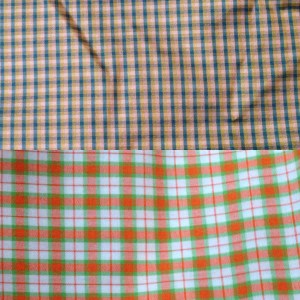
Top: check silk taffeta, Artee Fabrics Bottom: check cotton, Mood Fabrics

Top: check silk taffeta, Artee Fabrics
Bottom: check cotton, Mood Fabrics

This weekend, thanks to the SFR hunt for collar interfacing of an appropriate weight, I realized I’d better get a wiggle on my own sewing, and managed to hunt up the orange check from hell, pop it in the washer, and hunt up the pattern I intend to use.

Mrs Catherine Morey oil on canvas by Michael Keeling, 1817. (c) Walker Art Gallery; Supplied by The Public Catalogue Foundation

Mrs Catherine Morey oil on canvas by Michael Keeling, 1817. (c) Walker Art Gallery

I’m stuck on that 1817-1819 range because of someone’s eventual and particular Mode of Transportation, so I was super pleased to find this portrait while trolling the BBC’s Your Paintings site. Actually, I’m pretty over the moon about this image, since it places that cross-over front firmly in 1817. I’ve made a version of this form already, so I can but hope the next iteration will be even closer to correct for the period, once I tweak the pattern a bit.

The pattern: therein lie so many rubs, often going the wrong way. Still, I remain enamored of the check and of the cross-front gown. Any checkered doubts were dispelled when Alison for reminded me of the sort-of-cross front check gown at the Met, whose catalogers are hiding behind circa 1820 which allows leeway back to 1815. Behold, of course, the ruffled neck of the bodice (I do expect mine will fit a bit better since I am squishier than a mannequin, and possess appropriate infrastructure).

Morning dress ca. 1820. British, cotton.
Metropolitan Museum of Art, Purchase. 1979.385.1
Marcia Sand Bequest, in memory of her daughter, Tiger (Joan) Morse.

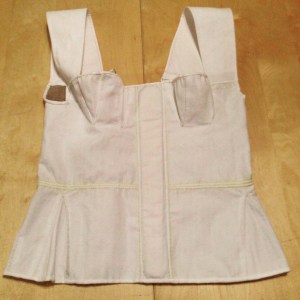
Speaking of infrastructure, the appropriate stays are finished, entirely hand-sewn, and ready for deployment in pattern fittings before they debut at Genesee.

File_000 (1)

Six weeks to Genesee: at least one 1817 dress, another sheet, a portfolio and paint box, followed immediately by 18th century stays, a front-closing gown, and a bucket repair. Surely that’s all manageable, right?

Share this:

  • Share on Facebook (Opens in new window) Facebook
  • Share on Pinterest (Opens in new window) Pinterest
  • Email a link to a friend (Opens in new window) Email
  • Share on X (Opens in new window) X
Like Loading...
← Older posts
Newer posts →

Archives

wordpress statistics

Creative Commons License
Kitty Calash blog by Kirsten Hammerstrom is licensed under a Creative Commons Attribution-NonCommercial-ShareAlike 4.0 International License.

Website Built with WordPress.com.

  • Subscribe Subscribed
    • Kitty Calash
    • Join 621 other subscribers
    • Already have a WordPress.com account? Log in now.
    • Kitty Calash
    • Subscribe Subscribed
    • Sign up
    • Log in
    • Report this content
    • View site in Reader
    • Manage subscriptions
    • Collapse this bar
 

Loading Comments...
 

    %d